
Updated October 2026 · Reviewed by Billy Forte
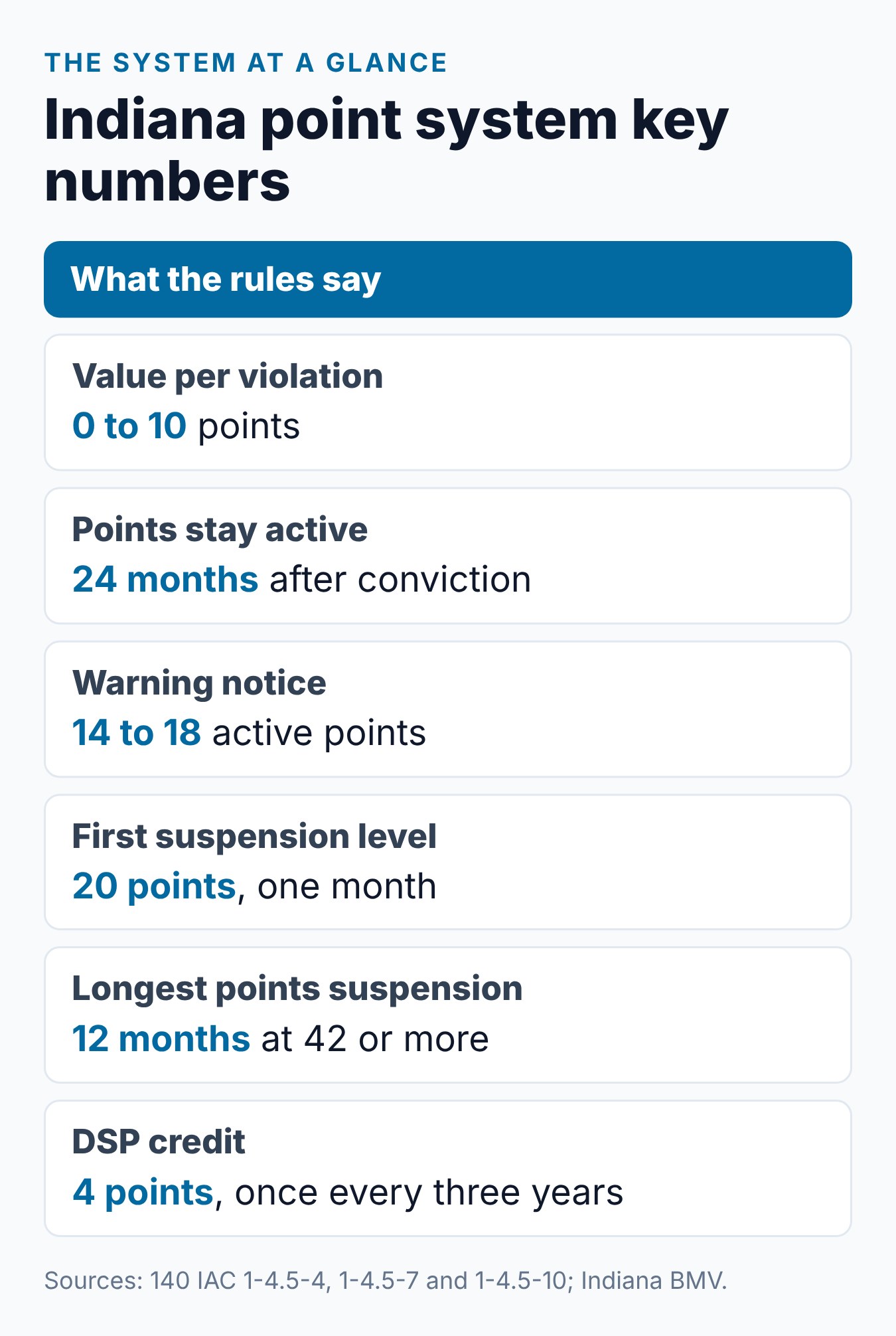
Indiana points on license records work like a running score: the Indiana BMV adds 0 to 10 points for each moving violation you are convicted of, and those points stay active for 24 months. After any Driver Safety Program credit, 14 to 18 active points brings a warning notice, and 20 or more within 24 months brings a suspension. The suspension starts at one month and tops out at 12 months, at 42 or more points.
Key Facts
- Point values: each violation carries a set value in Table 1 of 140 IAC 1-4.5-10; the BMV says values range from zero to ten. See common values.
- Time limit: points go inactive 24 months after the conviction date, but the violation stays on the record. See how long points last.
- Warning: 14 to 18 active points brings a warning notice. See the warning level.
- Suspension: 20 or more active points within 24 months means at least a one-month suspension. See suspension levels.
- DSP credit: a BMV-approved Driver Safety Program adds a 4-point credit, once every three years. See where the DSP fits.
What the Point System Is For
Indiana’s point rules are in 140 IAC 1-4.5, a set of BMV rules. The rule states its purpose plainly. It calls the point system “an objective method of identifying a person in need of improving his or her driving habits.”
The same rule gives the BMV a way to restrict or suspend a license. So points are a tool for spotting risky driving patterns. They are not a fine, and you do not pay them off.
The BMV’s Driver Record Points page says point values range from zero to ten. Higher values go to more serious violations.
How Points Reach Your Record
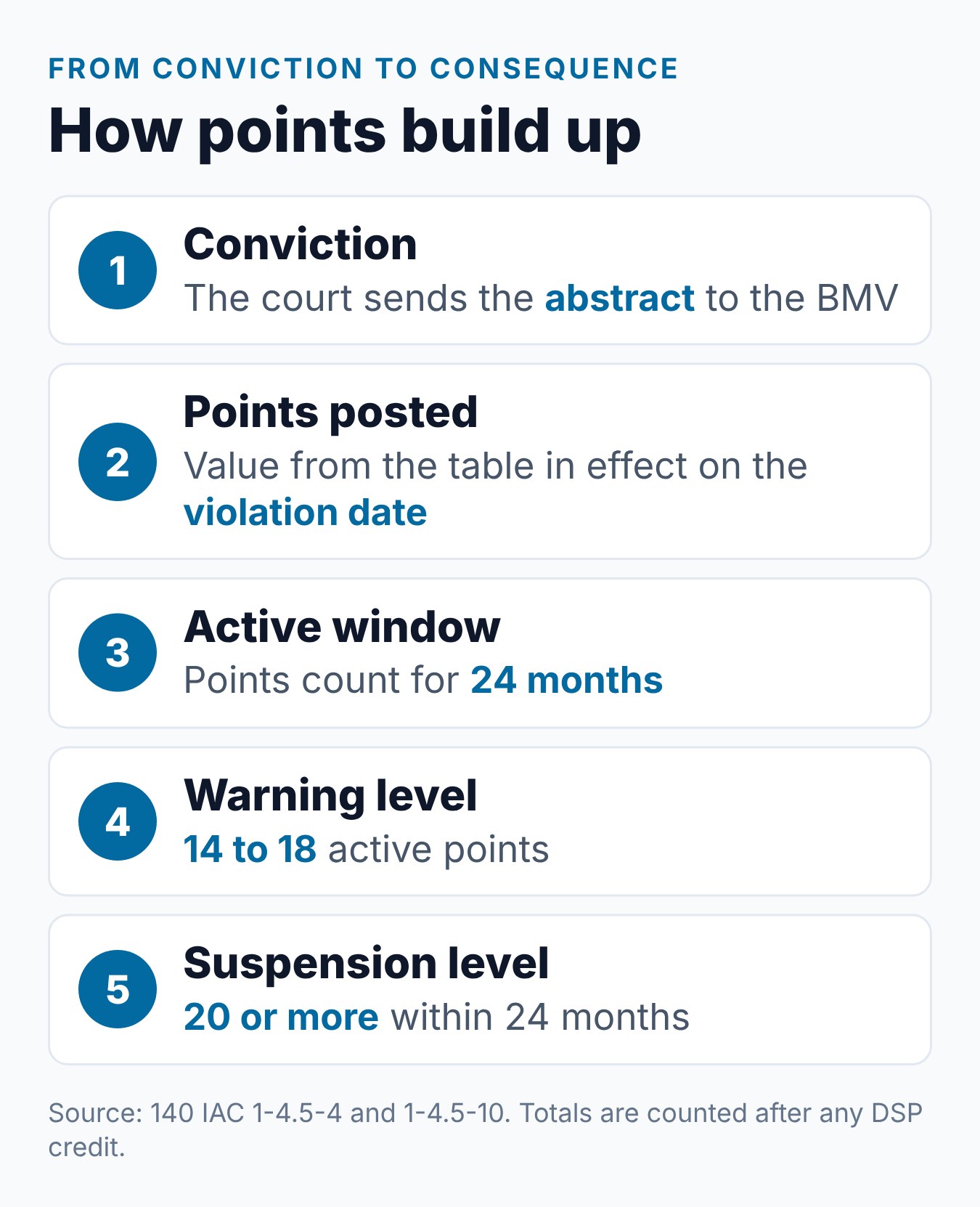
Points do not come from the traffic stop itself. They come after a conviction. The court sends the BMV an abstract of the court record, and the BMV records the violation by its Indiana Code citation or BMV offense code.
A few rules shape what gets counted:
- The date of the violation sets the value. The rule says the point table in effect on the date the violation was committed applies.
- No license, same points. Under 140 IAC 1-4.5-8, a driver without a valid license or permit gets the same points and penalties.
- Out-of-state tickets count. Under 140 IAC 1-4.5-5, the BMV assesses points for a violation in another state when Indiana has a matching pointable violation. The points are set as if it happened in Indiana.
Indiana Points on License for Common Violations
Here are values from Table 1 of 140 IAC 1-4.5-10. Our Indiana BMV points chart lists the main rows, and the rule itself has the complete Table 1.
Speeding on a regular road:
- 1 to 15 mph over the limit: 2 points.
- 16 to 25 mph over: 4 points.
- More than 25 mph over: 6 points.
Speeding in a school zone or work site: 4 points if the speed is not shown, 4 for 1 to 15 over, 6 for 16 to 25 over, and 8 for more than 25 over. See speeding ticket points.
Other moving violations:
- Following too closely: 6 points.
- Disregarding a traffic signal: 4 points.
- Failure to yield, or to obey a stop or yield sign: 4 points.
- Improper U-turn: 4 points.
- Using a phone or other telecommunications device while driving: 4 points.
Serious offenses:
- Reckless driving: 6 points, or 8 with property damage and 10 with bodily injury.
- Driving while suspended: 8 points.
- OWI: 8 points.
How Long Points Stay Active
The BMV says, “Points stay active on an individual’s driving record for two years from the conviction date.” The rule uses the words “24 months after the disposition date.” Both describe the same clock.
When points go inactive, they stop counting toward a warning or suspension. The violation does not disappear, though. The rule says, “The violation shall remain a part of the person’s record.” No official source gives an end date for that entry.
Our guide on how long points stay on your license walks through the dates.
Warning Notice at 14 to 18 Points
Under 140 IAC 1-4.5-4, a driver with 14 to 18 active points gets a warning notice. This is a notice only. The rule does not attach a suspension to it.
The BMV counts points after any Driver Safety Program credit. For example, 16 active points minus a 4-point credit leaves 12. That total is below the warning range.
How Many Points Before a Suspension
The suspension rule starts at 20. A driver with 20 or more active points within 24 months, after any DSP credit, gets a suspension based on the total.
The steps go up every 2 points:
- 20 points brings a one-month suspension.
- Each added 2 points adds one month. So 30 points brings six months.
- 40 or more brings 11 months.
- 42 or more brings the longest point suspension, 12 months.
A driver who gets a points suspension has administrative review rights under IC 4-21.5-3. Our license suspension guide has every step and what happens next.
The Three-Offense Hearing Rule
A separate rule looks at the number of offenses, not points. Under 140 IAC 1-4.5-4(c), if a driver commits three moving traffic offenses in any 12 months, the BMV “may, upon written notice,” require an administrative hearing.
The word “may” matters. The rule lets the BMV call a hearing. It does not say a hearing always happens.
Where the Driver Safety Program Fits
The Driver Safety Program (DSP) is a BMV-approved course of at least 4 hours. It is offered in English and Spanish, online, by DVD or in a classroom. The BMV’s maximum price for any approved course is $55, and the driver pays.
Under 140 IAC 1-4.5-7, finishing an approved course adds a 4-point credit to your record. The credit can be entered only once every three years. The BMV’s Driver Safety Program page is clear about the limit: completion “will not remove a citation from your driver history.”
So the course lowers the total the BMV counts. It does not erase a ticket. See what the DSP can and cannot do and how the 4-point credit works.
Points Do Not Trigger a DSP Order
A point total does not make the BMV order a DSP. Convictions and judgments do. Under IC 9-30-3-12, the BMV must require a DSP in two cases:
- Any driver: two traffic misdemeanor convictions, two traffic judgments, or one of each, for moving violations within 12 months.
- Under 21: being the driver in an incident that can carry points at least twice while under 21. There is no 12-month limit.
The course must be done within 90 days of the BMV notice, or driving privileges are suspended. See BMV-ordered DSP rules.
Drivers Under 21 and the Renewal Test
The warning and suspension levels are the same at every age. The rule has no separate point table for young drivers.
Points do affect license renewal, though. Under IC 9-24-12-5, a written test is required at renewal if:
- You have 6 or more active points, at any age.
- You are under 21 and have any active points.
Licenses issued before age 21 are probationary. The BMV’s probationary license page lists their limits. See points and rules under 21.
How to Check Your Point Total
The BMV offers two records on its Driver Record page. The Viewable Driver Record is free on myBMV. The Official Driver Record is a certified copy that costs $4.
The BMV’s legend for the Official Driver Record says “Current Points” shows your total. An asterisk marks convictions whose points are still active. See how to check your points.
Points Guides in This Series
Each guide covers one part of the system:
- Points chart: the main rows of Table 1 in 140 IAC 1-4.5-10.
- Speeding points: regular, school zone and work site tiers.
- How long points last: the 24-month rule.
- Checking your points: myBMV and the certified record.
- Lowering or fixing points: time, credit, court changes and errors.
- DSP and points: what the course can and cannot do.
- The 4-point credit: timing and the three-year rule.
- Your driving record: record types and how to read one.
- Suspension for points: every level and what happens next.
- Drivers under 21: the probationary license and DSP rule.
- Background checks: what a record shows employers.
- Record errors: the BMV’s Material Error Review.
- Moving away: your record and a new state.
- 8 points: what a mid-range total means.
What We Found on the Official Pages
On the BMV pages we checked on October 26, 2026, the Driver Safety Program page showed a last-modified date of May 14, 2026. It still listed the $55 maximum price and the 4-point credit once every three years.
The Driver Record page showed a last-modified date of March 18, 2026. It listed the free Viewable Driver Record and the $4 Official Driver Record. We found no 2025 or 2026 change to the point table, the suspension levels or the credit rule.
Common Mistakes
Each item below comes from an Indiana rule or BMV page:
- Thinking points erase after two years. The points go inactive, but the violation stays on the record.
- Counting from the ticket date. The BMV counts from the conviction date.
- Expecting a DSP order from points. Only qualifying convictions or judgments trigger it.
- Assuming the course removes the ticket. The BMV says it does not remove the citation.
- Taking a course that is not approved. Only BMV-approved providers earn the credit.
- Ignoring out-of-state tickets. Indiana assesses points when it has a matching violation.
How Requirements Can Vary
Indiana’s point rules, the 4-point credit and the BMV’s Driver Safety Program order come from state law and BMV rules, and they apply statewide. What you must do still depends on whether you take the course by choice, because of a BMV notice, or under a court order. A court order sets its own deadline and proof steps.
Laws, fees and court practice can change. Check your BMV notice, your court order and the Indiana BMV website for current rules before you enroll or file anything.
Frequently Asked Questions
How many points does it take to suspend a license in Indiana?
Twenty active points within 24 months, after any DSP credit, brings a one-month suspension. The length grows one month for every 2 more points. At 42 or more points, it is 12 months.
What happens at 14 points?
The BMV sends a warning notice to drivers with 14 to 18 active points. The rule does not suspend a license at that level.
Do points come off after two years?
The points become inactive 24 months after the conviction date. They stop counting toward a warning or suspension. The violation itself stays on your record.
Does the Driver Safety Program remove points?
No. A BMV-approved course adds a 4-point credit to your record, once every three years. The BMV says it will not remove a citation from your driver history.
Do tickets from other states add Indiana points?
Yes, when Indiana has a matching pointable violation. The BMV assesses the points as if the violation happened in Indiana.
Are the point levels different under 21?
No. The warning and suspension levels are the same at every age. But a driver under 21 with any active points must pass a written test at renewal.
Can points lead to a hearing?
The hearing rule is based on offenses, not points. After three moving traffic offenses in 12 months, the BMV may require an administrative hearing by written notice.
Conclusion
Indiana points on license records come from convictions, last 24 months, and count toward a warning at 14 and a suspension at 20. Check your driving record so you know where you stand.
You can earn the 4-point DSP credit, once every three years, with Driving Logic’s online Indiana Driver Safety Program. If a court ordered your course, check that the order allows an online course.
Related Articles
- Indiana BMV Demerit Points Chart: How Many Points for Each Violation
- How Many Points Is a Speeding Ticket in Indiana?
- How Long Do Points Stay on Your License in Indiana?
- How to Check Points on License Indiana: myBMV Steps
- How Indiana Driver License Points Can Be Reduced or Corrected
- Indiana Driver Safety Program and Points: What It Can and Cannot Do
- Indiana DSP 4 Point Credit: How It Works
- Your Indiana Driving Record: How to Get It and What It Shows
- Indiana License Suspension for Points: Thresholds, What Happens, and How to Reinstate
- Probationary License Indiana: Points and Rules Under 21
- Will an Indiana Traffic Violation Show Up on a Background Check?
- Indiana Driving Record Dispute: How to Fix a BMV Error
- What Happens to Your Indiana Driving Points If You Move Out of State?
- 8 Points on Your Indiana License: What It Means and What to Do
Sources
- Indiana BMV — Driver Record Points
- 140 IAC 1-4.5 — BMV point system rules
- Indiana BMV — Citation Points & Driver Safety Program
- Indiana Code § 9-30-3-12 — Driver safety program
- Indiana BMV — Driver Record
- Indiana BMV — myBMV
- Indiana BMV — Probationary License
Billy Forte is the owner of Driving Logic, a state-approved driver improvement course provider serving Indiana and other U.S. states.
This article is general information, not legal advice. Indiana BMV rules, court orders, fines and penalties depend on your notice, citation, court and case facts, and they can change. Use official Indiana BMV and court sources, and consult a qualified Indiana attorney for advice about your own case.