
Updated October 2026 · Reviewed by Billy Forte
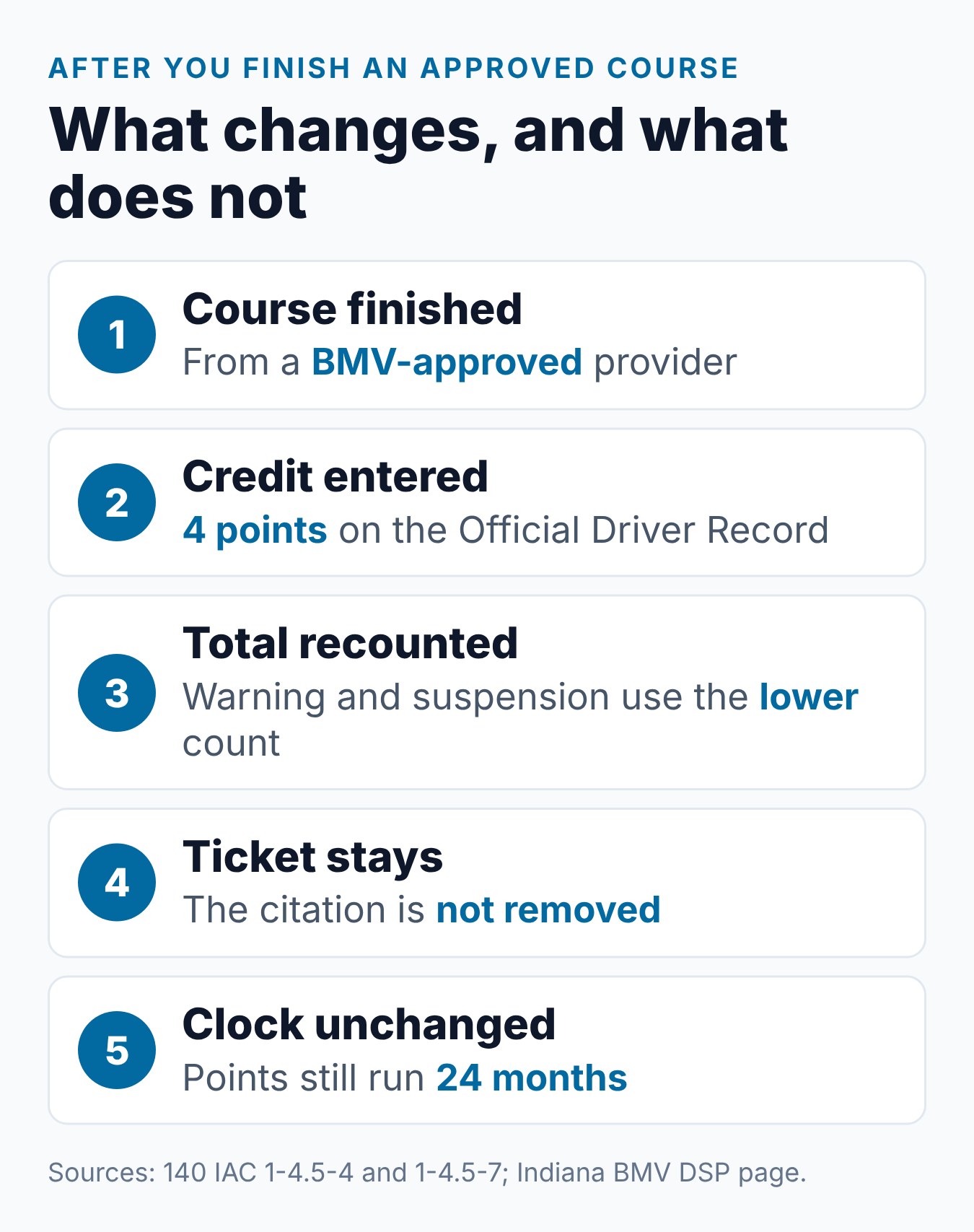
If you are asking does driver safety program reduce points Indiana, the answer is yes in one narrow way: a BMV-approved course adds a 4-point credit to your Indiana Official Driver Record, once every three years. It does not remove the ticket, because the BMV says completion “will not remove a citation from your driver history.” The credit lowers the total the BMV counts for warnings and suspensions, and that is its whole job.
Key Facts
- What it does: adds a 4-point credit on the Indiana Official Driver Record. See what the DSP can do.
- What it does not do: remove a citation, a conviction or the violation entry. See what the DSP cannot do.
- Limit: one credit every three years; another course extends the credit period. See the three-year limit.
- Approved only: only BMV-approved providers earn the credit. See approved courses.
- Still required: the BMV or a court can require a DSP even when no new credit is possible. See required courses.
What the DSP Is
The Driver Safety Program (DSP) is Indiana’s official point-credit course. The BMV’s Driver Safety Program page sets the basics for every approved course:
- At least 4 hours long, with the same curriculum standards for all providers.
- Offered in English and Spanish.
- Available in a classroom, on DVD or online.
- A maximum price of $55, paid by the driver.
People also search for a “defensive driving” course. In Indiana, only a BMV-approved Driver Safety Program earns the point credit. See defensive driving vs the DSP.
What the DSP Can Do
The credit rule is 140 IAC 1-4.5-7. It says a driver who finishes and pays for an approved course “shall receive” a 4-point credit on the record.
That credit does real work:
- Lowers the counted total. The BMV counts active points “after any credit earned” when it applies the warning and suspension levels.
- Stays in effect for three years. The rule says the credit “shall remain in effect for a three (3) year period.”
- Counts however you took it. The rule does not limit the credit to courses taken by choice.
- Meets a BMV order. A BMV-ordered DSP is met by finishing an approved course on time.
- Can cut court costs. Under IC 9-30-3-12(d), a court may cut the court costs for a traffic case in half when the driver finishes a DSP.
The last item is the court’s choice. It is not automatic.
What the DSP Cannot Do
The limits matter as much as the credit:
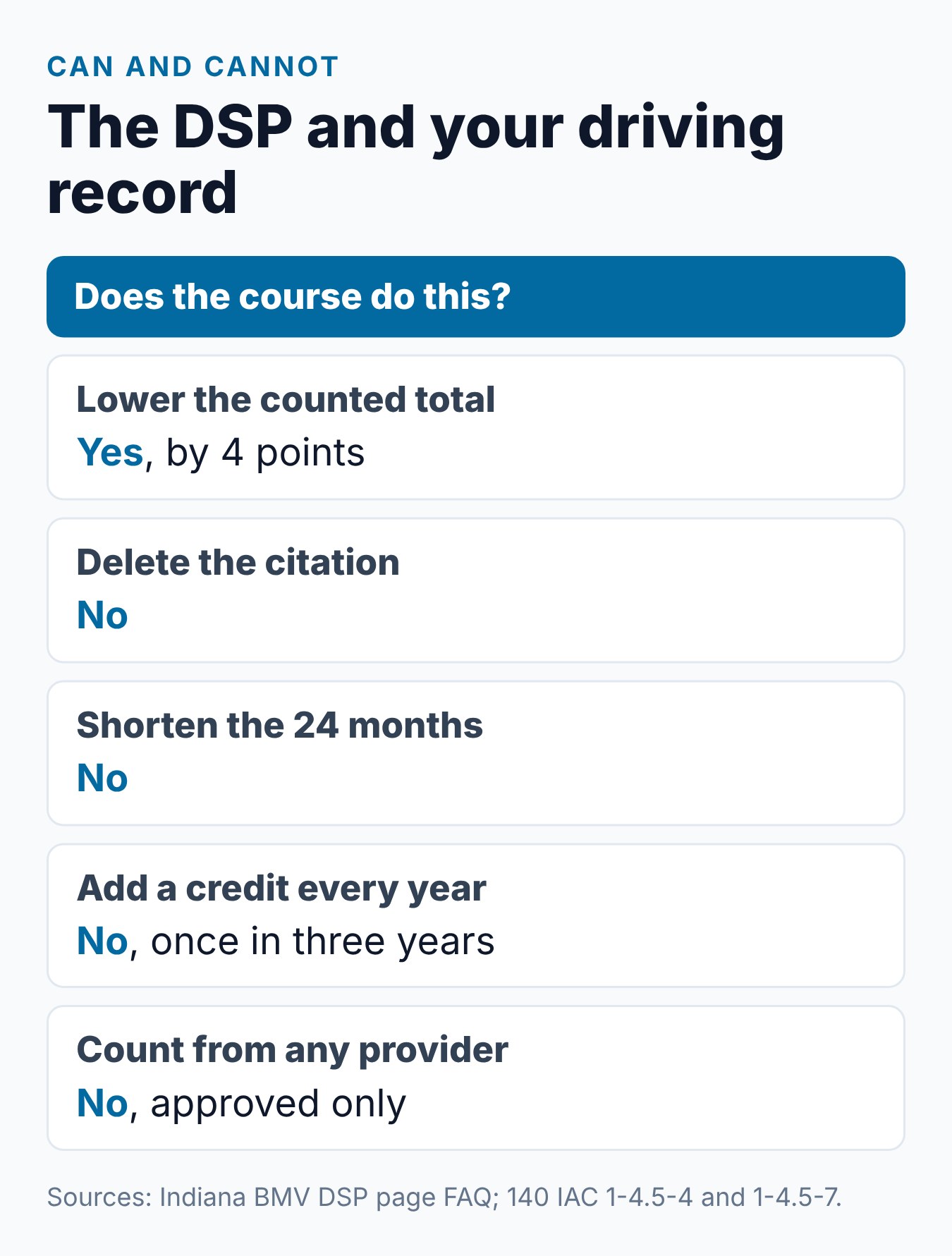
- It cannot remove a citation. The BMV says so directly.
- It cannot erase the violation. Under 140 IAC 1-4.5-4, “The violation shall remain a part of the person’s record.”
- It cannot make points expire sooner. Points still go inactive 24 months after the conviction date.
- It cannot give two credits in three years. A second course extends the credit period instead.
- It cannot work through an unapproved course. Credit applies only for a BMV-approved provider.
- It cannot change a point value. Each violation keeps its value from the point table.
- It cannot replace a court’s terms. A court order sets its own deadline and proof steps.
The BMV’s DSP page and point rules also do not mention insurance. Ask your insurer about that. See the DSP and insurance.
Can and Cannot at a Glance
| Question | Answer | Source |
|---|---|---|
| Lowers the point total the BMV counts? | Yes, by a 4-point credit | 140 IAC 1-4.5-7 |
| Removes the ticket from my history? | No | BMV DSP page |
| Makes old points go inactive early? | No; still 24 months | 140 IAC 1-4.5-4 |
| Earns a credit every time I finish? | No; once every three years | 140 IAC 1-4.5-7 |
| Counts if the course is not approved? | No | BMV DSP page |
| Satisfies a BMV DSP notice? | Yes, if done within 90 days | BMV DSP page |
Does Driver Safety Program Reduce Points Indiana Totals? The Count
The credit changes the number the BMV compares with its levels. Under 140 IAC 1-4.5-4, 14 to 18 active points brings a warning notice. Twenty or more within 24 months brings a suspension.
Here is how the credit shifts that count:
- 16 active points with the credit is counted as 12, below the warning range.
- 21 active points with the credit is counted as 17, a warning instead of a suspension level.
- 30 active points with the credit is counted as 26, still a suspension level.
The ticket stays in each case. Only the counted total moves. See suspension for points.
Points vs the Violation
Two different things sit on your record after a conviction. One is the points. The other is the violation entry itself.
The points stay active for two years from the conviction date, says the BMV’s Driver Record Points page. The violation stays with no end date in the rules.
The DSP touches neither clock. It adds a separate credit.
See how long points stay.
Only BMV-Approved Courses Count
The BMV answers this in its FAQ: “Credit can be applied to your Official Indiana Driver Record only if the course was completed by a BMV-approved Driver Safety (DSP) Program Provider.”
So check the provider list on the BMV’s DSP page before you enroll. The BMV tells drivers to sign up with the provider directly. See how to verify a BMV-approved provider.
The Three-Year Limit
The rule allows one credit entry every three years. The BMV says finishing another course stretches the credit period to three years past the newer completion date.
So a second course inside three years does not add 4 more points. It pushes the next possible credit further out. See how the 4-point credit works for timing and examples.
When a DSP Is Required Anyway
Sometimes the course is not optional, whether or not a new credit is possible. Under IC 9-30-3-12, the BMV must require a DSP after:
- Two traffic misdemeanor convictions, two traffic judgments, or one of each, for moving violations within 12 months.
- For a young driver, two incidents that can carry points, both before age 21, with the driver at the wheel. No 12-month window applies.
Points alone never trigger this order. The course must be done within 90 days of the BMV notice, or driving privileges are suspended. See BMV-ordered DSP rules.
A court may also order a DSP. The BMV says a court order may not specifically require a BMV-approved course.
The order sets the deadline and proof steps. See court-ordered DSP.
How the Credit Reaches Your Record
You do not file the credit yourself. The BMV says the credit “is applied within 7-14 business days of the BMV receiving notification of completion from the vendor.” The vendor is the course provider.
If more time passes with no credit, the BMV says to email your completion certificate to BMVDSP@bmv.IN.gov. On the Official Driver Record, the BMV’s legend says the course shows as a four point credit. See the DSP certificate.
Situations Drivers Ask About
Here is how the rules apply in a few cases:
- A BMV letter after two tickets in a year. Finish an approved course within 90 days of the notice. The credit posts only if none was entered in the past three years.
- A court order to take a DSP. Follow the order’s deadline and proof steps. The court may also suspend half of the court costs.
- A DSP finished two years ago. No new credit yet. A new course extends the credit period three years from the new date.
- A driver under 21 with two pointable incidents. The DSP is required, with no 12-month limit. Any active points also mean a written test at renewal.
For your own case, check your notice, your court order or an Indiana attorney.
DSP and Points Guides in This Series
Each guide covers one part of points and the record:
- Indiana points on license: how the whole system works.
- Points chart: the value for each violation.
- Speeding points: tiers by miles over the limit.
- How long points stay: the 24-month clock.
- Checking points: myBMV and the certified record.
- Reducing or correcting points: every official path.
- The 4-point credit: timing and arithmetic.
- Your driving record: getting and reading it.
- Suspension for points: the full suspension table.
- Drivers under 21: probationary license rules.
- Background checks: what others can see.
- Record disputes: fixing a BMV error.
- Moving away: your record in a new state.
- 8 points: what that total means.
What We Found on the Official Pages
When we read the BMV’s DSP page on October 26, 2026, it carried a May 14, 2026 update date. Its FAQ still said completion “will not remove a citation from your driver history.” It listed 17 approved providers.
The 2026 edition of 140 IAC 1-4.5-7 still set one 4-point credit per three years. Neither source called it a credit for voluntary courses only.
Common Mistakes
Each item ties to a BMV page or rule:
- Expecting a clean record. The citation and the violation stay.
- Taking a second course for 4 more points. One credit every three years.
- Choosing an unapproved course. No credit.
- Waiting for points to trigger a DSP order. Convictions or judgments trigger it.
- Missing a 90-day BMV deadline. Privileges are suspended until the course is completed and processed.
How Requirements Can Vary
Indiana’s point rules, the 4-point credit and the BMV’s Driver Safety Program order come from state law and BMV rules, and they apply statewide. What you must do still depends on whether you take the course by choice, because of a BMV notice, or under a court order. A court order sets its own deadline and proof steps.
Laws, fees and court practice can change. Check your BMV notice, your court order and the Indiana BMV website for current rules before you enroll or file anything.
Frequently Asked Questions
Does the Indiana DSP remove points?
No. It adds a 4-point credit to your Indiana Official Driver Record. The points from your conviction still count down on their own 24-month clock.
Does the DSP take a ticket off my record?
No. The BMV says completion “will not remove a citation from your driver history.”
Can I get the credit if the BMV ordered the course?
Yes, if no credit was entered in the past three years. The rule does not limit the credit to courses taken by choice.
Can a court order a DSP if I took one last year?
Yes. A court may require a DSP, and its order sets the terms. A new credit is still limited to once every three years.
Does any defensive driving course count?
No, only a BMV-approved Driver Safety Program earns the credit. Check the provider list on the BMV’s DSP page.
Will the DSP stop a suspension?
The BMV counts active points after any DSP credit. If the credit brings the total below 20, the suspension level is not reached. The BMV pages we read do not describe how the credit affects a suspension already in place.
Conclusion
Does driver safety program reduce points Indiana totals? Yes, by a 4-point credit once every three years, but the ticket and the violation stay on your record.
Only a BMV-approved course earns it, and the BMV or a court can still require one. You can take Driving Logic’s online Indiana Driver Safety Program, and if a court ordered your course, check that the order allows an online course.
Related Articles
- Indiana Points on License: How the BMV System Works
- Indiana BMV Demerit Points Chart: How Many Points for Each Violation
- How Many Points Is a Speeding Ticket in Indiana?
- How Long Do Points Stay on Your License in Indiana?
- How to Check Points on License Indiana: myBMV Steps
- How Indiana Driver License Points Can Be Reduced or Corrected
- Indiana DSP 4 Point Credit: How It Works
- Your Indiana Driving Record: How to Get It and What It Shows
- Indiana License Suspension for Points: Thresholds, What Happens, and How to Reinstate
- Probationary License Indiana: Points and Rules Under 21
- Will an Indiana Traffic Violation Show Up on a Background Check?
- Indiana Driving Record Dispute: How to Fix a BMV Error
- What Happens to Your Indiana Driving Points If You Move Out of State?
- 8 Points on Your Indiana License: What It Means and What to Do
Sources
- Indiana BMV — Citation Points & Driver Safety Program
- 140 IAC 1-4.5 — BMV point system rules
- Indiana BMV — Driver Record Points
- Indiana Code § 9-30-3-12 — Driver safety program
- Indiana BMV — Driver Record
Billy Forte is the owner of Driving Logic, a state-approved driver improvement course provider serving Indiana and other U.S. states.
This article is general information, not legal advice. Indiana BMV rules, court orders, fines and penalties depend on your notice, citation, court and case facts, and they can change. Use official Indiana BMV and court sources, and consult a qualified Indiana attorney for advice about your own case.