
Updated October 2026 · Reviewed by Billy Forte
Your Indiana driving record is the BMV’s file of your driving history, and you can see it free online or buy a certified copy for $4. The BMV says the record shows “current and resolved suspensions, citations, violations and other entries impacting your record.” Below are the two record types, how to request each one, and how to read the marks on the certified copy.
Key Facts
- Two types: the Viewable Driver Record and the Official Driver Record. See the two record types.
- Cost: the viewable record is free; the certified Official Driver Record is $4. See getting it online.
- By mail: use State Form 53789 if you do not know your license number. See requesting by mail.
- Marks: an asterisk flags convictions with active points and active suspensions. See what the certified copy shows.
- Point timing: points stay active two years from the conviction date, not the ticket date. See points on the record.
- Errors: the BMV must decide a material error request within 30 days. See if something looks wrong.
What an Indiana Driving Record Is
The Indiana Bureau of Motor Vehicles keeps a driver record of your driving history. Its driver record page puts it simply: “A driver record contains your driving history.”
That history covers more than tickets. The BMV lists suspensions, citations, violations and “other entries impacting your record.” It also says the record shows both current and resolved items.
So an old suspension that has ended can still appear. It is listed as resolved, not erased.
The Two Types of Indiana BMV Driving Record
The BMV says, “Two types of driving records are available from the BMV.” Each one fits a different need.
| Feature | Viewable Driver Record (VDR) | Official Driver Record (ODR) |
|---|---|---|
| Cost | Free | $4 |
| Certified | Not described as certified | Yes, with a BMV letter of certification |
| How to get it | Online through myBMV | Online through myBMV, or by mail |
| Best for | Your own quick look | Anyone who needs a certified copy |
The ODR is the one with formal weight. It is a certified copy, and a BMV letter of certification comes with it.
The VDR is for your own review. The BMV says a VDR “can be viewed FREE OF CHARGE.”
How to Get Your Indiana Driving Record Online
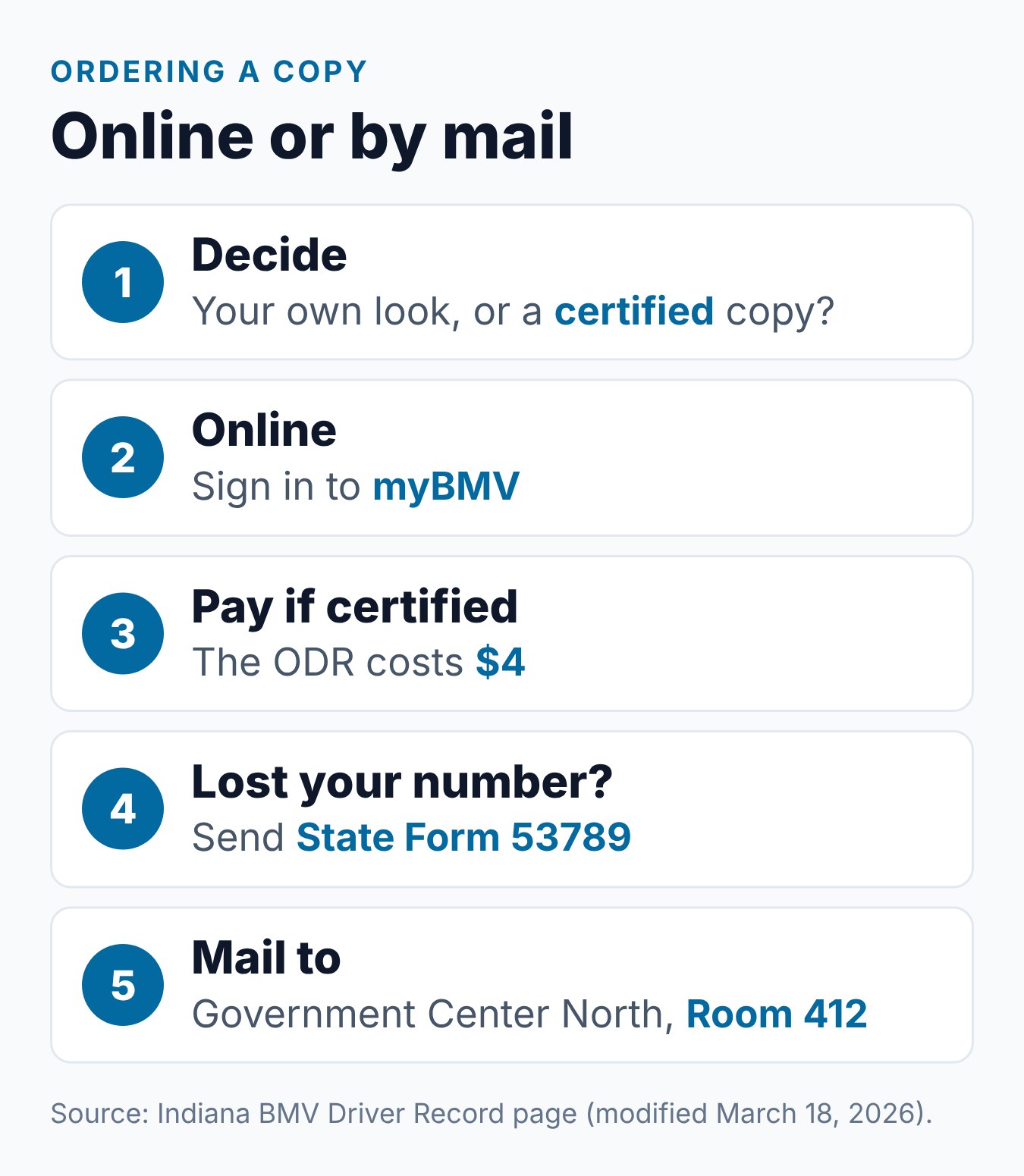
Both records start at myBMV, the BMV’s online service. The BMV’s record page links to the VDR and ODR from there.
Here is what to expect:
- VDR. Open it in myBMV at no charge.
- ODR. Order it in myBMV and pay the $4 fee.
- License number. Have your Indiana license number ready.
The license number matters. The BMV says that if you do not know it, “you will be required to request a copy of your Official Driver Record by mail.”
How to Request a Record by Mail
The mail option uses a state form. Its name is “Request for Certified Records – State Form 53789.”
Send the form to the BMV at:
- Indiana Government Center North, Room 412
- 100 North Senate Avenue
- Indianapolis, IN 46204
Mail is the path for anyone who does not know their license number. The BMV’s record page lists online and mail requests. It does not mention requesting a record at a branch.
What the Certified Copy Shows
The BMV publishes a legend (2022) that explains the ODR. It helps you read each line.
Key parts of the legend:
- Current Points. The legend defines this as the “Total of individual’s points on record.”
- Asterisk by a conviction. “The convictions for which points are currently active are denoted by an asterisk (*).”
- Asterisk by a suspension. It marks a suspension that is active now.
- Double asterisk by a suspension. It marks a stayed suspension.
- DSP credit. After the BMV gets Driver Safety Program results, “a four point credit will be applied to the driver record.”
The legend describes the ODR only. It does not say what the free VDR shows. If you need to see the point marks, the ODR is the record the legend covers.
How Points Show Up on the Record
Points are tied to convictions. The BMV’s points page says, “Points stay active on an individual’s driving record for two years from the conviction date.”
The state rule, 140 IAC 1-4.5-4, says the same thing in legal terms. Points become inactive 24 months after “the disposition date of the violation.”
That date is when the case ends in court. It is not the day you got the ticket. So if a case takes months to close, the two-year clock starts later.
The violation itself does not drop off. The rule says “the violation shall remain a part of the person’s record.” No official source gives an end date for it.
For more on counting active points, see how to check points on your Indiana license.
How the DSP Credit Appears
A Driver Safety Program (DSP) from a BMV-approved provider earns a 4-point credit on the ODR. The credit can be entered only once every three years.
The credit lowers the point total. It does not take anything off the list of entries. The BMV’s Driver Safety Program page says completion “will not remove a citation from your driver history.”
The provider tells the BMV when you finish. The BMV applies the credit within 7 to 14 business days of that notice. If it has not shown up by then, the BMV says to email your certificate to BMVDSP@bmv.IN.gov.
What the Point Total Means
The “Current Points” line feeds the BMV’s point rules. Those rules count active points within 24 months, after any DSP credit.
Two levels matter here:
- 14 to 18 active points. The rule calls for a warning notice.
- 20 or more active points. The rule calls for a suspension, starting at one month.
Our pillar on the Indiana BMV points system explains how each level works. Here, the key step is simple: find your point total on the ODR first.
Which Record Should You Order?
Pick the record that fits the job. These choices follow the BMV’s own descriptions:
- You only want a quick look. The free VDR is enough.
- An employer or school asks for a certified record. Order the ODR.
- You want to see the point marks the legend explains. Order the ODR.
- You do not know your license number. Mail State Form 53789 for the ODR.
The $4 fee is the BMV’s listed price for the ODR. The VDR has no fee, since the BMV says it can be viewed free of charge.
What the Record Does Not Tell You
Some questions have no answer on the BMV’s record page. It does not say how many years of history a record covers.
The 2022 legend does not give a lookback period either. So be careful with any claim that a violation drops off after a set number of years. The point rule says only that the violation stays part of the record.
Court Matters the BMV Cannot Change
Some entries come from a court, not the BMV. Per the BMV’s record page, the agency “cannot address these court actions,” so court judgments and child support matters go back to the court.
So if an entry stems from a court case, start with that court. The BMV records what the court reports.
Who Asks for a Certified Record
The BMV names two groups. Its record page says, “Some employers and school admission offices require a certified driver record.”
In those cases, the free VDR may not be enough. Ask the employer or school which record it wants before you order.
For what an employer reads on that record, see Indiana traffic violations and background checks.
If Something Looks Wrong
The BMV has a process for errors. It is called the Material Error Review.
Under IC 9-33-2-1, you notify the BMV in writing. The BMV must decide within 30 days whether a material error was made. If it was, the BMV must correct it.
Our guide to disputing an error on your Indiana BMV driving record walks through each step.
What We Found on the Official Pages
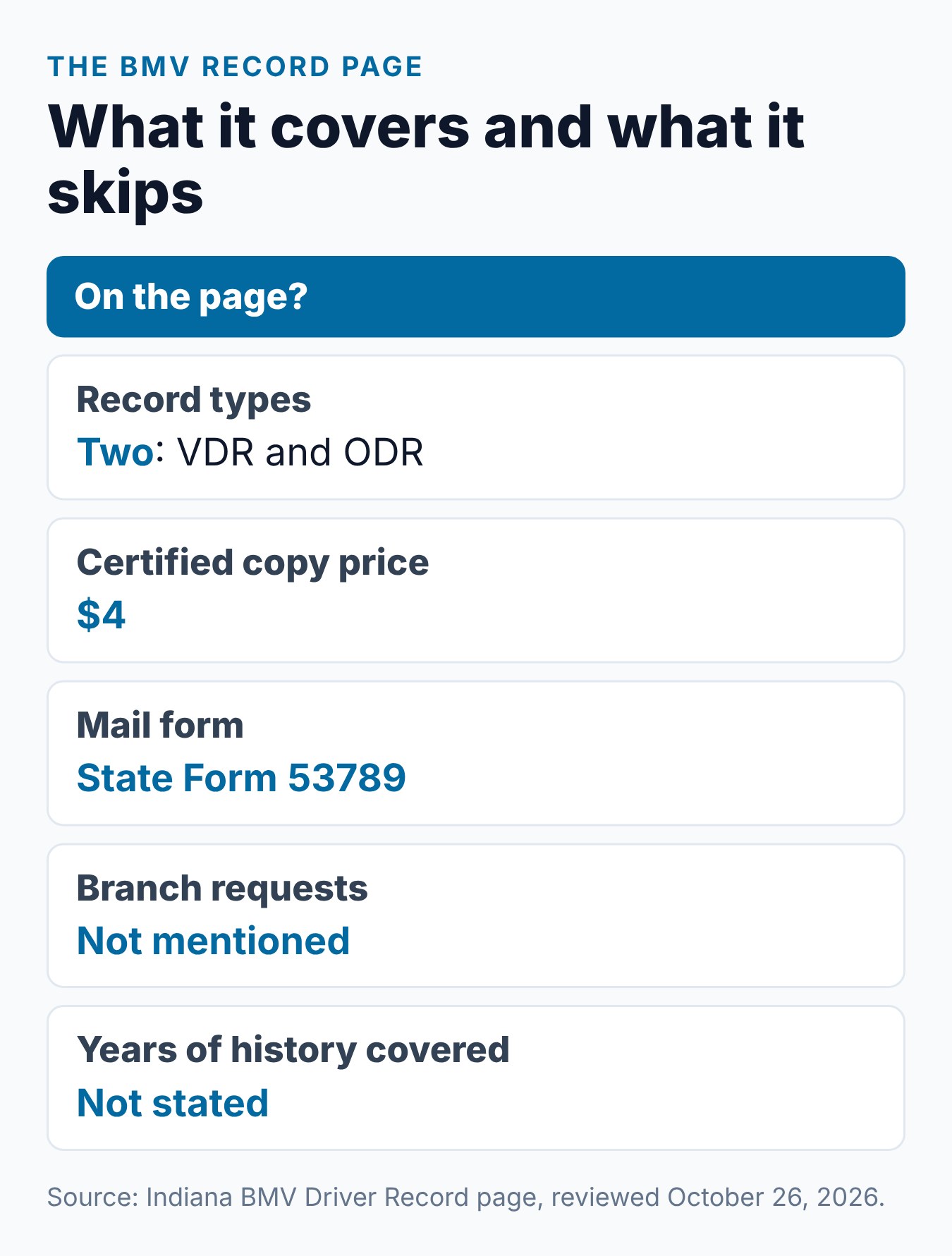
On the BMV pages checked on October 26, 2026, the driver record page showed a modified date of March 18, 2026. It listed two record types, the $4 ODR price and State Form 53789 for mail requests.
That page did not mention branch requests, points, the DSP credit or how many years a record covers. The point marks come from the separate 2022 ODR legend.
Common Mistakes to Avoid
Each point below comes from a BMV page or Indiana rule:
- Counting points from the ticket date. The two years run from the conviction date.
- Sending the free VDR when a certified copy is needed. Only the ODR comes with a letter of certification.
- Expecting a resolved suspension to vanish. The record shows current and resolved entries.
- Thinking the DSP erases a citation. It adds a 4-point credit; the citation stays.
- Expecting a new credit every year. Under 140 IAC 1-4.5-7, the credit may be entered only once every three years. The ODR legend says “only one four point credit is allowed per three year period.”
- Asking the BMV to change a court judgment. The BMV says those must be settled with the court.
How Requirements Can Vary
Indiana’s point rules, the 4-point credit and the BMV’s Driver Safety Program order come from state law and BMV rules, and they apply statewide. What you must do still depends on whether you take the course by choice, because of a BMV notice, or under a court order. A court order sets its own deadline and proof steps.
Laws, fees and court practice can change. Check your BMV notice, your court order and the Indiana BMV website for current rules before you enroll or file anything.
Frequently Asked Questions
How do I get my Indiana driving record?
Use myBMV online. The Viewable Driver Record is free, and the certified Official Driver Record costs $4. If you do not know your license number, request the ODR by mail with State Form 53789.
What is the difference between the VDR and the ODR?
The ODR is a certified copy with a BMV letter of certification. The VDR is a free view for your own use. Choose the ODR when someone needs a certified record.
Does my Indiana driving record show points?
The ODR does. Its legend lists “Current Points” and marks convictions with active points with an asterisk.
How long do points stay active?
The BMV says two years from the conviction date. The violation itself stays on the record, and no official source sets an end date.
Can I get my record at a BMV branch?
The BMV’s driver record page lists online and mail requests. It does not mention a branch option. Check the page for current options.
Will a DSP clean up my record?
No. A BMV-approved DSP adds a 4-point credit, once every three years. The BMV says it “will not remove a citation from your driver history.”
How can I tell if my DSP credit was applied?
Look for the four point credit on your ODR. The BMV applies it within 7 to 14 business days of the provider’s notice. If it is missing after that, email your certificate to BMVDSP@bmv.IN.gov.
What should I do if my record has an error?
Ask for a Material Error Review in writing. The BMV must decide within 30 days. For a court judgment, contact the court.
Conclusion
Your Indiana driving record comes in two forms: a free viewable record and a $4 certified Official Driver Record. Read the asterisks to see which convictions still carry active points, and remember that points go inactive two years after conviction.
If you want the 4-point credit, consider Driving Logic’s online Indiana Driver Safety Program. If a court ordered your course, check that the order allows an online course.
Related Articles
- Indiana Points on License: How the BMV System Works
- How to Check Points on License Indiana: myBMV Steps
- Indiana Driving Record Dispute: How to Fix a BMV Error
- Will an Indiana Traffic Violation Show Up on a Background Check?
Sources
- Indiana BMV — Driver Record
- Indiana BMV — myBMV
- Indiana BMV — Driver Record Points
- Indiana BMV — Citation Points & Driver Safety Program
- Indiana BMV — Material Error Review Request
- Indiana Code § 9-33-2-1 — Material errors in BMV records
- 140 IAC 1-4.5 — BMV point system rules
Billy Forte is the owner of Driving Logic, a state-approved driver improvement course provider serving Indiana and other U.S. states.
This article is general information, not legal advice. Indiana BMV rules, court orders, fines and penalties depend on your notice, citation, court and case facts, and they can change. Use official Indiana BMV and court sources, and consult a qualified Indiana attorney for advice about your own case.