
Updated October 2026 · Reviewed by Billy Forte
The Indiana teen driver safety program rule applies to drivers under 21: the BMV requires the Driver Safety Program (DSP) after a young driver has twice been the driver in an incident that can carry points. Unlike the adult rule, there is no 12-month limit on those two incidents. After the BMV mails its notice, the course must be finished within 90 days, or driving privileges are suspended.
Key Facts
- The trigger: two incidents that can carry points, both while under 21. See the rule.
- No time window: the two incidents do not have to fall within 12 months. See how it differs.
- The deadline: 90 days from the BMV’s mailed notice. See the notice.
- Not driver education: the DSP does not teach driving and does not replace driver ed. See not driver education.
- Same point levels: warning and suspension points are the same as for adults. See point levels.
The Indiana Teen Driver Safety Program Rule
The rule is in subsection (b) of IC 9-30-3-12. It says a person under 21 must complete a BMV-approved DSP if the person has, “at least twice when the individual was less than twenty-one (21) years of age, been the operator of a motor vehicle involved in an incident for which points may be assessed.”
In plain words, three things must be true:
- The driver was under 21 at the time of each incident.
- The driver was operating the vehicle, not riding as a passenger.
- Each incident was one the BMV can assign points for.
When those facts add up to two, the BMV requires the course. The driver pays the course fee, and the BMV caps the price of any approved course at $55.
How It Differs From the General Rule
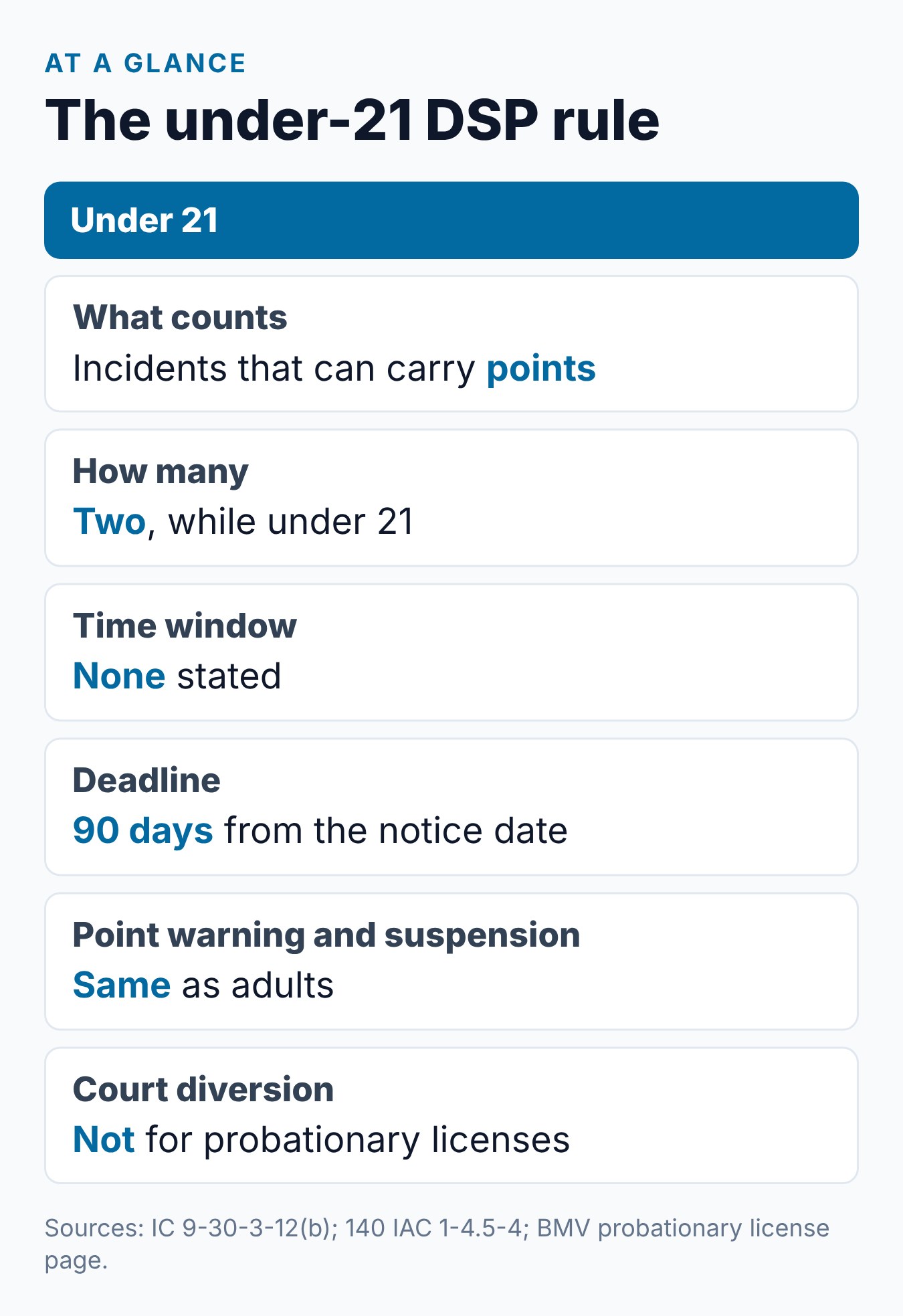
The general rule in subsection (a) has no age limit. It counts convictions and judgments within 12 months. The under-21 rule is broader in time.
| Rule detail | Rule (a), all drivers | Rule (b), drivers under 21 |
|---|---|---|
| What is counted | Traffic misdemeanor convictions and traffic judgments | Incidents that can carry points |
| How many | Two, or one of each | Two |
| Time window | Any 12-month period | None stated |
| Law | IC 9-30-3-12(a) | IC 9-30-3-12(b) |
So two incidents a year and a half apart can still lead to an order for a young driver. The same two incidents would not meet rule (a). Our BMV-ordered DSP guide explains rule (a).
What Counts as an Incident
The law points to incidents “for which points may be assessed.” The BMV’s point values are in 140 IAC 1-4.5-10. A few examples from that table:
- Speeding 1 to 15 mph over the limit: 2 points.
- Using a telecommunications device while driving: 4 points.
- Following too closely: 6 points.
- Driving under 21 with a blood alcohol level of .02 to under .08: 6 points.
Each of these is the kind of incident the rule counts. The full point chart is a separate topic, and the BMV’s points page links to it.
A license is not required for points to apply. Under 140 IAC 1-4.5-8, a person who commits a violation gets the same points or sanctions “even if the person does not hold a valid driver’s permit or license.”
Counting Incidents: Examples
These examples apply the words of subsection (b). They use point values from the BMV’s table:
- One at 18, one at 19. A speeding incident at 18 (2 points) and a following-too-closely incident at 19 (6 points) are two incidents while under 21. The rule is met.
- One at 19, one at 22. Only one incident happened while under 21. Subsection (b) is not met by those two alone.
- Two at 20, two years apart. Both happened while under 21. With no 12-month window, the rule is met.
In the second example, rule (a) may still apply. It counts convictions and judgments within 12 months, whatever the age.
Three Ways the Sources Word It
The official sources describe the rule in slightly different words:
- The statute says “involved in an incident for which points may be assessed,” at least twice while under 21.
- The BMV’s Driver Safety Program page says drivers under 21 must complete a DSP “if, they are convicted of two or more traffic offenses.”
- The Driver’s Manual says the requirement applies if it “has occurred more than once when the individual was under 21 years of age.”
None of the three sets a 12-month window. The statute is the law, so we follow its words here. If your notice uses different words, ask the BMV what it counted.
The Notice and the 90 Days
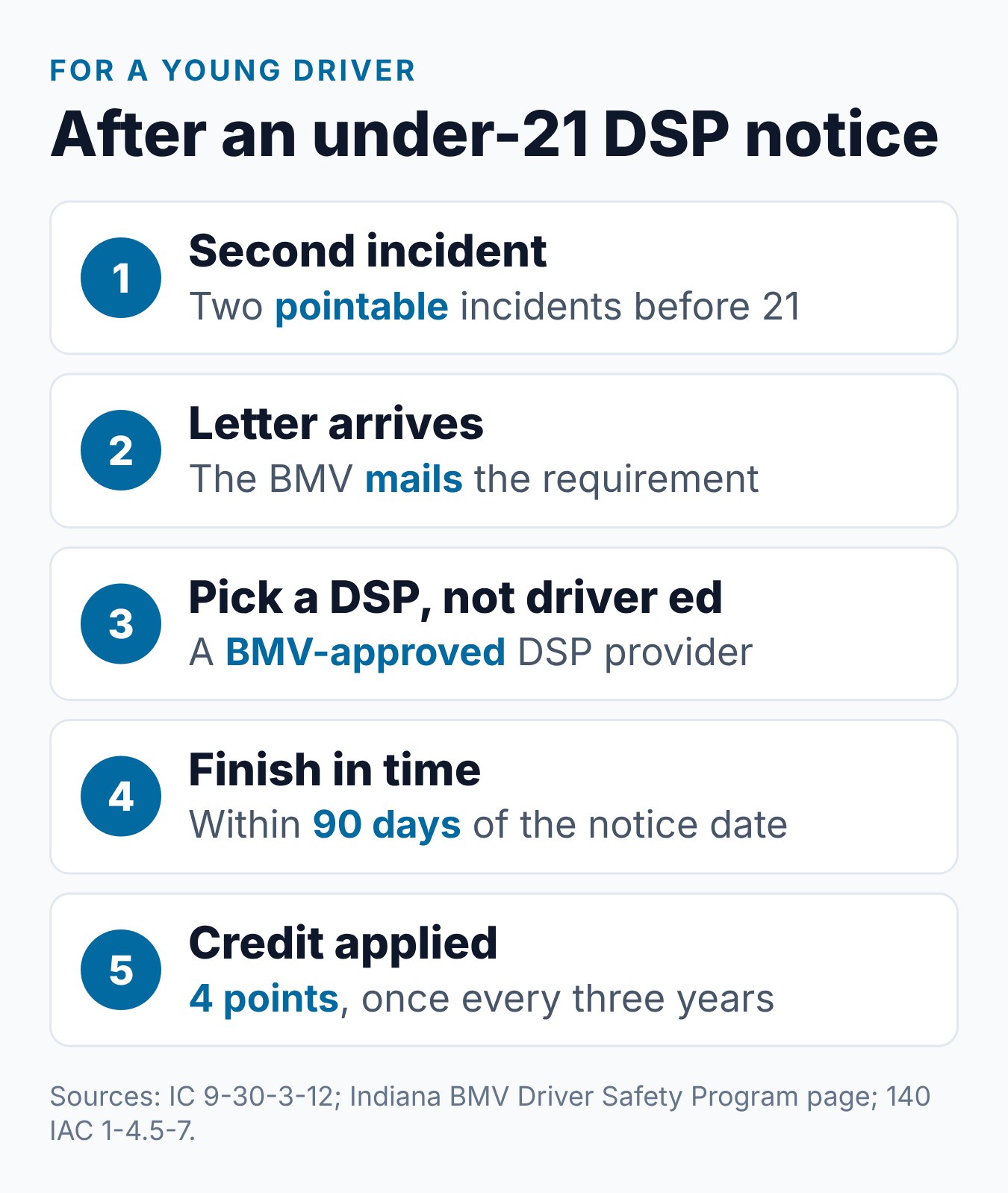
The BMV sends the requirement by mail. Its Driver Safety Program page says, “Notification of this requirement is mailed from the BMV.”
The course must be finished within 90 days. The Driver’s Manual counts them from “the date on the notification.” If the course is not done, the law says the BMV “shall suspend” driving privileges.
The manual says that suspension lasts until the course is completed “and the completion is processed by the BMV.” Our guide on missing a DSP deadline covers what to do if the date passes.
The DSP Is Not Driver Education
The two courses have similar goals, but they are separate programs with separate rules.
Driver education is for new drivers. The BMV says it includes 30 hours of classroom training and six hours of behind-the-wheel training with a BMV-licensed school.
The DSP is a different course. The BMV says, “The DSP courses do not teach an individual how to drive.” Instead, it gives information that helps improve defensive driving skills. Every approved DSP lasts at least 4 hours, in English or Spanish, in a classroom, on DVD or online.
Finishing driver education does not satisfy a DSP order. A DSP order needs a course from a BMV-approved DSP provider.
Taking the Course by Choice
A young driver does not need an order to take the course. The BMV says, “Any Indiana driver can take a DSP course.”
A BMV-approved course earns a 4-point credit on the Official Driver Record. The credit can be entered only once every three years, under 140 IAC 1-4.5-7. The BMV says completion “will not remove a citation from your driver history.”
The provider notifies the BMV when the course is done. The BMV applies the credit within 7 to 14 business days of that notice. If it does not appear, the BMV says to email the certificate to BMVDSP@bmv.IN.gov.
Who Pays and How to Sign Up
The law puts the cost on the driver. IC 9-30-3-12 says, “The individual shall pay all applicable fees required by the bureau.” The BMV says the maximum cost for any approved course is $55.
To sign up, the BMV says to “call or email the provider directly.” Pick a provider from the list on the BMV’s Driver Safety Program page.
Checking a Young Driver’s Record
The record shows the incidents behind an order. The BMV’s driver record page says the Viewable Driver Record is free on myBMV. The certified Official Driver Record costs $4.
On the official record, an asterisk marks convictions with active points. After a BMV-approved course, the record shows the four-point credit.
Probationary License Rules That Touch the DSP
The BMV’s probationary license page says licenses issued to drivers under 21 are probationary. A probationary license “expires 30 days following your 21st birthday.”
Three probationary facts matter for a young driver with points or a DSP order:
- No court diversion. The BMV says probationary license holders “will not qualify for court diversion programs.”
- Written test for a license. The BMV says a knowledge test is also required if there are any points on the record.
- Written test at renewal. Under IC 9-24-12-5, a driver under 21 with any active points must take a written test at renewal.
Our guide to Indiana teen driver points covers the probationary license in full.
Point Levels Are the Same
Young drivers do not have lower point limits. Under 140 IAC 1-4.5-4, 14 to 18 active points brings a warning notice for any driver. Twenty or more active points within 24 months brings a suspension, starting at 1 month.
The DSP credit counts before those steps. A driver with 14 active points who earns the credit is counted at 10, below the warning range. Points go inactive 24 months after each conviction date.
Court Cases for Young Drivers
A court can also order a DSP in a traffic case. The court’s order sets the deadline and how to prove completion. The 90-day rule belongs to BMV notices only.
Any court may suspend one-half of the court costs if the driver completes a DSP, under IC 9-30-3-12(d). See the court-ordered DSP guide for the steps.
What We Found on the Official Pages
On the BMV pages we checked on October 26, 2026, the Driver Safety Program page described the under-21 rule as two or more traffic offenses. The statute described it as two incidents that can carry points. Neither set a 12-month limit.
We found no separate DSP rule for any younger age group. The official sources mention only drivers under 21.
Common Mistakes to Avoid
Each item comes from Indiana law or a BMV source:
- Applying the 12-month window from rule (a). The under-21 rule has none.
- Counting on driver ed. It does not meet a DSP order.
- Picking a course off the list. An order needs a BMV-approved provider.
- Expecting lower point limits. Warning and suspension levels match the adult ones.
- Counting on diversion. Probationary license holders do not qualify.
- Waiting out the 90 days. The suspension lasts until the course is done and processed.
How Requirements Can Vary
Indiana’s point rules, the 4-point credit and the BMV’s Driver Safety Program order come from state law and BMV rules, and they apply statewide. What you must do still depends on whether you take the course by choice, because of a BMV notice, or under a court order. A court order sets its own deadline and proof steps.
Laws, fees and court practice can change. Check your BMV notice, your court order and the Indiana BMV website for current rules before you enroll or file anything.
Frequently Asked Questions
Does my teen need to take the Indiana Driver Safety Program?
Only if the BMV or a court requires it, or if your teen chooses to take it. The BMV requires it after two incidents that can carry points while under 21.
Do both incidents have to happen within 12 months?
No. The under-21 rule in IC 9-30-3-12(b) has no 12-month window. The 12-month window is part of rule (a).
How long does my teen have after the notice?
The BMV says 90 days. The Driver’s Manual counts them from the date on the notification.
Is the DSP the same as driver education?
No. Driver education is 30 classroom hours plus six hours behind the wheel. The DSP is a separate course of at least 4 hours that does not teach driving.
Can my teen take the DSP online?
Yes, if the provider is BMV-approved. The BMV says the course is available in classroom, DVD or online formats.
Does the course remove my teen’s tickets?
No. The BMV says completion “will not remove a citation from your driver history.” A BMV-approved course adds a 4-point credit, once every three years.
Who pays for a required course?
The driver does. The law says the individual “shall pay all applicable fees,” and the BMV caps the price of any approved course at $55.
Are point limits lower for young drivers?
No. The warning and suspension levels in 140 IAC 1-4.5-4 are the same for every driver.
Conclusion
The Indiana teen Driver Safety Program rule counts two pointable incidents while under 21, with no 12-month limit. If the BMV mails a notice, finish a BMV-approved course within 90 days and keep the certificate. You can complete it with Driving Logic’s online Indiana Driver Safety Program.
Related Articles
- Court Ordered Driver Safety Program Indiana: What to Do
- BMV Ordered Driver Safety Program Indiana: Who Gets One
- Probationary License Indiana: Points and Rules Under 21
- What Happens If You Don’t Complete a Court-Ordered DSP in Indiana?
Sources
- Indiana BMV — Citation Points & Driver Safety Program
- Indiana Code § 9-30-3-12 — Driver safety program
- Indiana BMV — Probationary License
- 140 IAC 1-4.5 — BMV point system rules
- Indiana BMV — Driver Record Points
- Indiana BMV — myBMV
- Indiana BMV — Driver Record
Billy Forte is the owner of Driving Logic, a state-approved driver improvement course provider serving Indiana and other U.S. states.
This article is general information, not legal advice. Indiana BMV rules, court orders, fines and penalties depend on your notice, citation, court and case facts, and they can change. Use official Indiana BMV and court sources, and consult a qualified Indiana attorney for advice about your own case.