
Updated October 2026 · Reviewed by Billy Forte
An Indiana driving record dispute runs through the BMV’s Material Error Review, where you tell the BMV in writing what is wrong and send proof. State law gives the BMV 30 days to decide whether a material error was made, and to fix it if so. Errors that come from a court case follow a different path, through the court.
Key Facts
- The law: IC 9-33-2-1 lets you notify the BMV in writing of a material error. See what the law says.
- Your request: it must state the error “with reasonable particularity” and include supporting documents. See what to include.
- How to send it: use the BMV’s online form or mail it to the Legal Division. See how to submit.
- Deadline for the BMV: a decision within 30 days. See after you submit.
- Court entries: court judgments must be settled with the court. See errors that come from a court.
- Missing DSP credit: that has its own fix by email. See a missing DSP credit.
Indiana Driving Record Dispute: What the Law Says
The process comes from IC 9-33-2-1. It has four parts that matter to you.
- (a) Notice. If you find that BMV records “contain a material error,” you “may notify the bureau in writing.”
- (b) Decision. “Not more than thirty (30) days after the bureau receives notice,” it “shall determine if a material error was made.”
- (c) Correction. If there was an error, the BMV must give written notice and correct it. That includes “removing any suspension” and “reinstating the person’s driving privileges or registration.”
- (e) Review. A person “aggrieved by the bureau’s determination” may seek judicial review.
The statute does not define “material error.” So focus your request on the facts of the entry and the proof you have.
Start With Your Official Driver Record
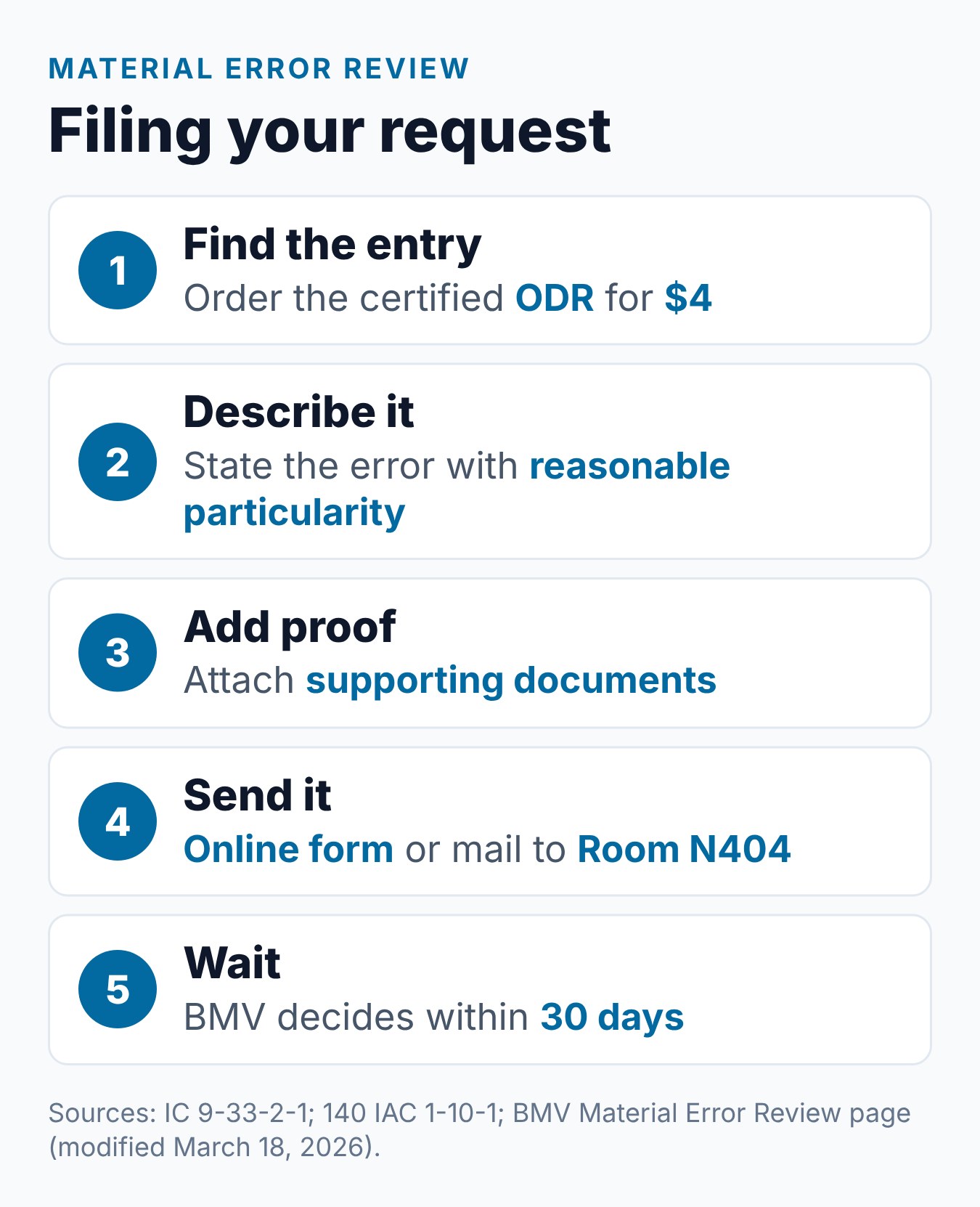
Find the exact entry before you write. The certified Official Driver Record (ODR) costs $4 on myBMV. If you do not know your license number, the BMV says to request it by mail with State Form 53789.
The BMV’s 2022 legend helps you read the entry:
- “Current Points” is the total of points on record.
- An asterisk marks convictions whose points are active.
- An asterisk marks an active suspension, and a double asterisk a stayed one.
- A four point credit line shows a completed Driver Safety Program.
Note the date, the violation and any suspension tied to the entry you think is wrong. You will need those details in your request. For more on each record type, see your Indiana driving record.
Before You File: Sort the Problem
Not every surprise on a record is a BMV error. A few quick questions point you to the right path:
- Did the entry come from a court case? Court judgments go back to the court.
- Is a DSP credit missing? Wait 7 to 14 business days after the provider’s notice, then email the BMV.
- Are the points just older than you expected? Points stay active two years from the conviction date, not the ticket date.
- Is the entry simply wrong in the BMV’s records? That is what a Material Error Review is for.
Sorting this out first saves time. It also keeps your request focused on a real error.
What to Include in Your Request
The BMV rule 140 IAC 1-10-1 sets the content. A request for review “must”:
- “set forth with reasonable particularity the error the person believes exists within the records of the bureau”; and
- “include any documentation supporting the claim.”
In plain words, say exactly which entry is wrong and why. Then attach your proof.
The BMV’s review page adds a reminder. “Be sure to attach any supporting documents that will help us review your record.”
Putting the Request in Writing
The statute sets one form rule. Under IC 9-33-2-1(a), you “may notify the bureau in writing” of a material error. The BMV’s page gives two ways to do that, online or by mail, covered below.
The content rules come from 140 IAC 1-10-1, quoted above. The request states the error “with reasonable particularity” and includes “any documentation supporting the claim.” The BMV’s page repeats the second point and asks you to attach documents “that will help us review your record.”
Those are the only content rules in the official sources we read. The entry details you noted from your ODR are the facts your request is about.
How to Submit a Material Error Review
The BMV’s Material Error Review page gives two ways to send a request:
- Online. Use the form labeled “Submit a Material Error Review.”
- By mail. Send it to the Bureau of Motor Vehicles, Legal Division, Room N404, 100 North Senate Avenue, Indianapolis, IN 46204-2214.
Either way, the request is in writing, as the statute requires. Keep a copy of what you send and the date you sent it.
After You Submit
The clock starts when the BMV receives your notice. Under IC 9-33-2-1(b), it has no more than 30 days to decide whether a material error was made.
If the BMV finds an error, the statute requires two things:
- Written notice to you.
- A correction. That includes removing any suspension and reinstating driving privileges or registration.
If you disagree with the decision, subsection (e) allows judicial review. That is a court process, so an Indiana attorney can advise you on it.
Keep a Record of What You Send
Your own file can help if questions come up later. Keep these items together:
- A copy of the request and every document you attached.
- The date you sent it, and how you sent it.
- The BMV’s written notice of its decision.
- A new copy of your ODR once any correction is made.
The new ODR lets you confirm the change for yourself. It is also the certified record to share if someone asks for one.
Errors That Come From a Court
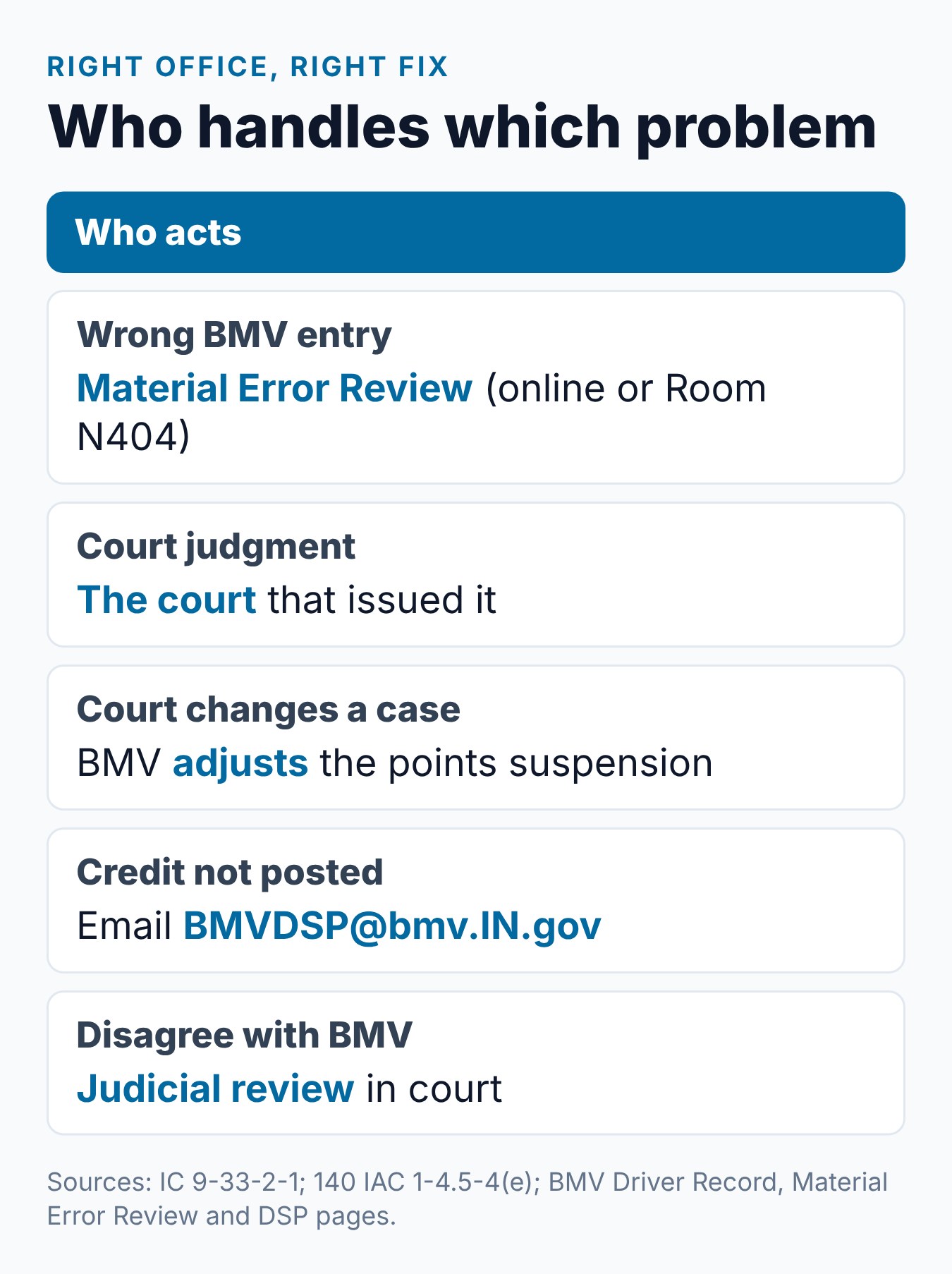
Some entries start in a court, not at the BMV. The BMV’s driver record page says court judgments and child support matters “must be settled with the court as the BMV cannot address these court actions.”
So if an entry reflects a court judgment, raise it with that court. The BMV records what the court sends.
When a court does change a case, a BMV rule follows. Rule 140 IAC 1-4.5-4(e) says that if a court “vacates, dismisses, amends, or otherwise modifies a violation,” the BMV must “modify the pending or existing excessive points suspension accordingly.” It does so after it receives the court’s record.
A Missing DSP Credit
A missing Driver Safety Program credit has its own fix. The BMV’s Driver Safety Program page says the credit “is applied within 7-14 business days of the BMV receiving notification of completion from the vendor.”
If more time than that has passed, the BMV says to email a copy of your completion certificate to BMVDSP@bmv.IN.gov. That is the BMV’s own path for this problem.
The credit is a 4-point credit, entered once every three years. It does not remove a citation from your record.
Which Path Fits Your Problem
Each problem has an official place to go:
| Problem | Where it goes | What the official source says |
|---|---|---|
| An error in BMV records | Material Error Review | Decision within 30 days (IC 9-33-2-1) |
| A court judgment you dispute | The court | The BMV cannot address court actions |
| A court changed your case | The BMV adjusts | Points suspension modified (140 IAC 1-4.5-4(e)) |
| DSP credit not posted | BMVDSP@bmv.IN.gov | After 7 to 14 business days |
A points suspension that is correct on the record is a different matter. The point rule gives administrative review rights under IC 4-21.5-3. For the suspension levels, see Indiana license suspension for points.
What a Dispute Can and Cannot Change
A material error review corrects errors in BMV records. The statute lets the BMV fix the error, remove a suspension and reinstate privileges.
It does not replace the court for court decisions. It also does not erase points that are correctly recorded. Correct points become inactive two years from the conviction date, and the violation stays on the record.
For every lawful way a point total can go down or be fixed, see how Indiana points can be reduced or corrected.
What We Found on the Official Pages
On the BMV pages checked on October 26, 2026, the Material Error Review page showed a modified date of March 18, 2026. It cited “Ind. Code § 9-33-2-1” and offered the online form and the Legal Division mailing address.
The page itself gave no time limit for asking, no response time and no appeal steps. Those come from the statute: the 30-day decision and judicial review. The DSP page, modified May 14, 2026, listed the BMVDSP@bmv.IN.gov address for missing credits.
Common Mistakes to Avoid
Each item comes from the statute, the rule or a BMV page:
- Calling instead of writing. The statute requires written notice.
- Being vague. The rule asks for the error “with reasonable particularity.”
- Leaving out proof. The rule and the BMV page both ask for documents.
- Sending a court dispute to the BMV. Court judgments must be settled with the court.
- Using the review for a late DSP credit. Email BMVDSP@bmv.IN.gov after 7 to 14 business days.
- Expecting correct points to vanish. Correct entries stay; points go inactive after two years.
How Requirements Can Vary
Indiana’s point rules, the 4-point credit and the BMV’s Driver Safety Program order come from state law and BMV rules, and they apply statewide. What you must do still depends on whether you take the course by choice, because of a BMV notice, or under a court order. A court order sets its own deadline and proof steps.
Laws, fees and court practice can change. Check your BMV notice, your court order and the Indiana BMV website for current rules before you enroll or file anything.
Frequently Asked Questions
How do I dispute an error on my Indiana driving record?
Send the BMV a written Material Error Review, online or by mail. Describe the error clearly and attach your proof. The BMV must decide within 30 days.
How long does the BMV have to answer?
IC 9-33-2-1 says no more than 30 days after the BMV receives your notice. If it finds an error, it must give written notice and correct it.
What documents should I send?
Send anything that supports your claim. The rule requires “any documentation supporting the claim,” and the BMV page asks you to attach supporting documents.
Where do I mail a Material Error Review?
Mail it to the Bureau of Motor Vehicles, Legal Division, Room N404, 100 North Senate Avenue, Indianapolis, IN 46204-2214. You can also use the online form.
Can the BMV remove a suspension caused by an error?
Yes. If it finds a material error, the statute says the correction includes removing any suspension and reinstating driving privileges.
What if I disagree with the BMV’s decision?
The statute allows judicial review for a person aggrieved by the decision. Talk with an Indiana attorney about that step.
Is there a deadline to ask for a review?
The BMV’s review page gives no time limit for asking. The 30-day limit in the statute applies to the BMV’s decision, not to you.
What if the error came from a court?
Contact the court. The BMV says court judgments must be settled with the court. If the court changes the case, the BMV adjusts any points suspension.
Conclusion
An Indiana driving record dispute starts with your certified record and a written Material Error Review with proof. The BMV must decide within 30 days, and court entries go back to the court.
If your record is correct and you want a 4-point credit, see Driving Logic’s online Indiana Driver Safety Program. If a court ordered your course, check that the order allows an online course.
Related Articles
- Indiana Points on License: How the BMV System Works
- Your Indiana Driving Record: How to Get It and What It Shows
- How Indiana Driver License Points Can Be Reduced or Corrected
- Indiana License Suspension for Points: Thresholds, What Happens, and How to Reinstate
Sources
- Indiana BMV — Material Error Review Request
- Indiana Code § 9-33-2-1 — Material errors in BMV records
- 140 IAC 1-4.5 — BMV point system rules
- Indiana BMV — Driver Record
- Indiana BMV — myBMV
- Indiana BMV — Citation Points & Driver Safety Program
Billy Forte is the owner of Driving Logic, a state-approved driver improvement course provider serving Indiana and other U.S. states.
This article is general information, not legal advice. Indiana BMV rules, court orders, fines and penalties depend on your notice, citation, court and case facts, and they can change. Use official Indiana BMV and court sources, and consult a qualified Indiana attorney for advice about your own case.