
Updated October 2026 · Reviewed by Billy Forte
If you searched how to check points on license Indiana, the answer is your BMV driver record: the Viewable Driver Record is free on myBMV, and the certified Official Driver Record costs $4. On the Official Driver Record, the “Current Points” line shows your total, and an asterisk marks each conviction whose points are still active. If something looks wrong, the BMV has a Material Error Review process.
Key Facts
- Free option: the Viewable Driver Record on myBMV. See the two records.
- Certified option: the Official Driver Record for $4, online or by mail with State Form 53789. See mail requests.
- Reading points: “Current Points” gives the total; an asterisk marks active-point convictions. See reading the record.
- After a course: a Driver Safety Program shows as a four-point credit. See checking after a DSP.
- Errors: ask for a Material Error Review; the BMV decides within 30 days. See if something looks wrong.
Two BMV Records That Show Your History
The BMV’s Driver Record page says, “Two types of driving records are available from the BMV.” It also says a driver record “contains your driving history.”
Here is how the two compare, based on that page and the BMV’s record legend:
| Feature | Viewable Driver Record | Official Driver Record |
|---|---|---|
| Price | Free | $4 |
| Certified by the BMV | No | Yes, with a letter of certification |
| How to get it | myBMV | myBMV, or by mail with Form 53789 |
| Point lines described in the BMV legend | Not described | “Current Points” and asterisks |
The BMV says, “A VDR can be viewed FREE OF CHARGE.” It calls the Official Driver Record “a certified copy of your driver record that is accompanied by a letter of certification from the BMV.”
For a full tour of both records, see your Indiana driving record.
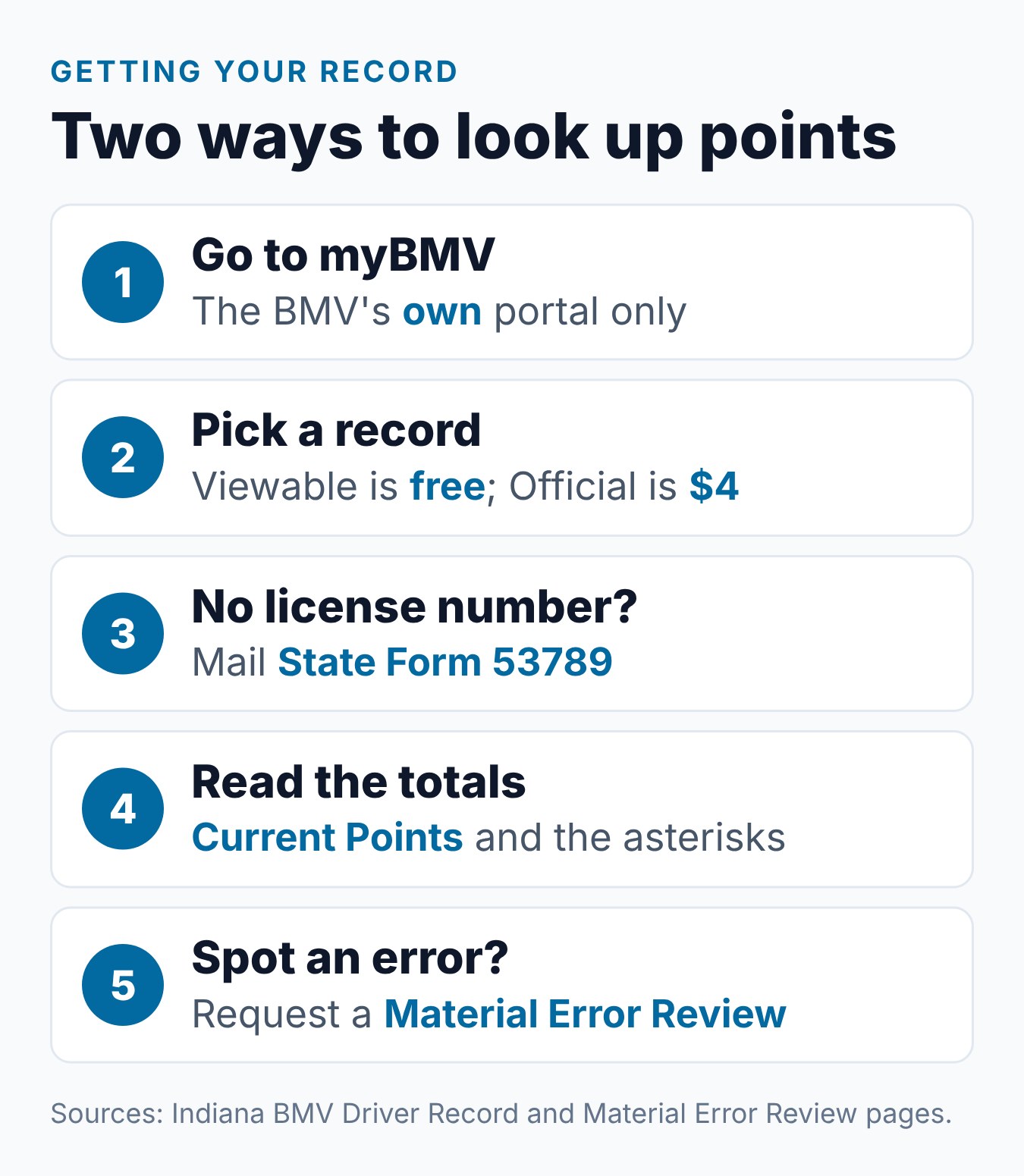
How to Check Points on License Indiana Online: myBMV Steps
The BMV’s online portal is myBMV. Both records start there.
Follow these steps:
- Open myBMV from the BMV’s website or the link above.
- Choose the driver record option you want: the free Viewable Driver Record or the Official Driver Record.
- For the Official Driver Record, pay the $4 fee.
- Look for the point lines and the list of convictions described below.
- Save or print a copy for your files.
Only use the BMV’s own site. The BMV’s scam alert page warns that look-alike sites such as DMV.org and DMV.com are not part of the Indiana BMV.
By Mail With State Form 53789
Some drivers cannot use the online request. The BMV says that if you do not know your license number, “you will be required to request a copy of your Official Driver Record by mail.”
The form is “Request for Certified Records – State Form 53789.” The BMV lists this mailing address:
- Indiana Government Center North, Room 412
- 100 North Senate Avenue
- Indianapolis, IN 46204
The Official Driver Record costs $4. Check the form for how to pay.
Reading the Points on Your Record
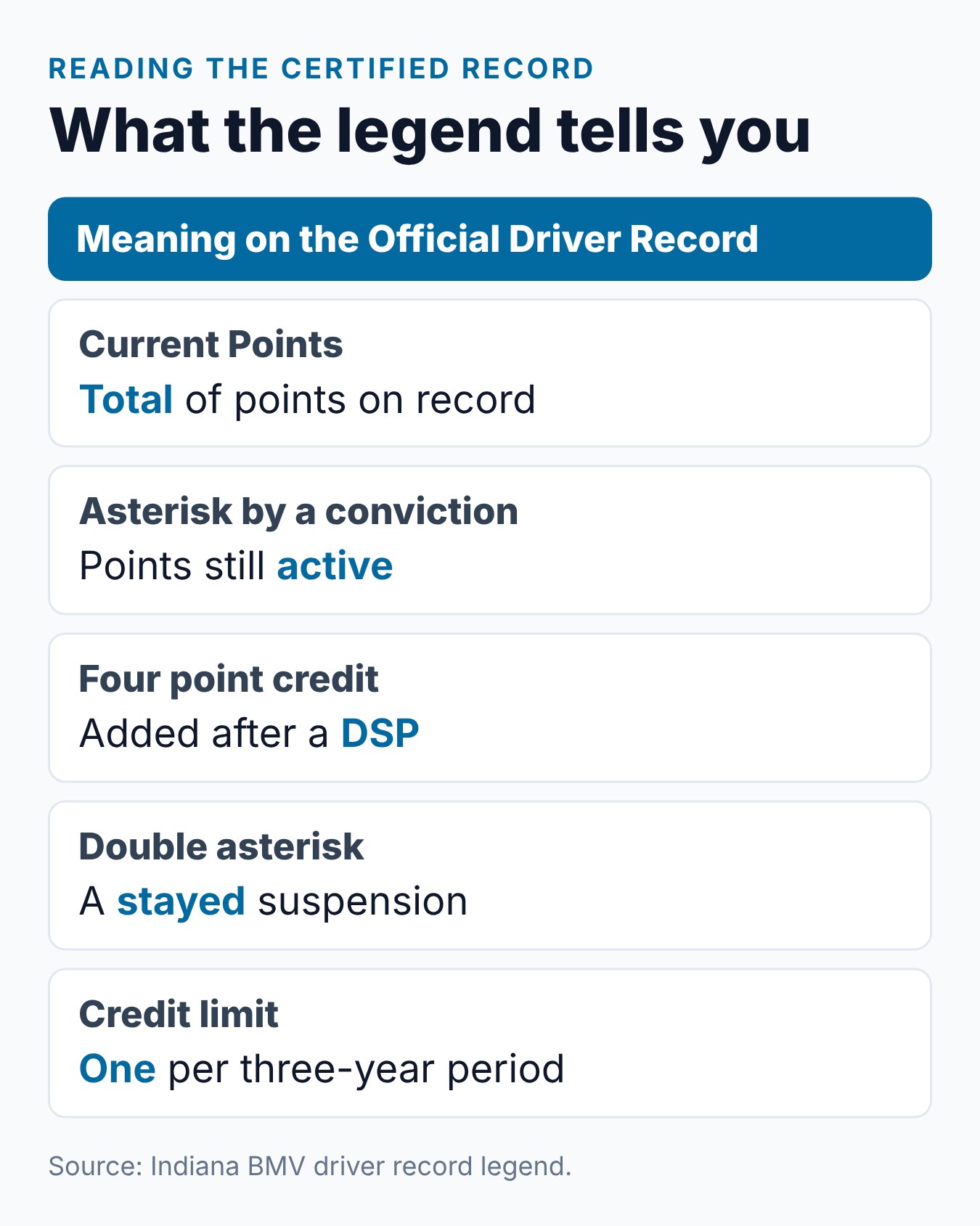
The BMV publishes a legend for the Official Driver Record. It explains the point lines in a few short phrases:
- “Current Points” is the “Total of individual’s points on record.”
- One asterisk next to a conviction means its points are currently active.
- A DSP credit appears after the BMV gets the course results: “a four point credit will be applied to the driver record.”
- Suspensions use asterisks too. One asterisk marks an active suspension, and two mark a stayed suspension.
The legend also repeats the credit limit: “only one four point credit is allowed per three year period.”
The legend we found covers the Official Driver Record. It does not say what the free Viewable Driver Record shows about points. If you need a point total you can rely on, the certified record is the one the legend explains.
What Else the Record Shows
Points are only part of the record. The BMV says, “The record shows current and resolved suspensions, citations, violations and other entries impacting your record.”
So an old violation can still appear after its points go inactive. Under 140 IAC 1-4.5-4, points become inactive 24 months after the conviction date, but “the violation shall remain a part of the person’s record.” See how long points stay.
The BMV also notes a limit on what it can fix. Court judgments and child support matters “must be settled with the court as the BMV cannot address these court actions.”
How Points Get Onto the Record
Knowing the path helps you read the result. Points post after a conviction. The court sends an abstract of the case to the BMV, which records the violation by its Indiana Code citation or BMV offense code.
The point value comes from Table 1 of 140 IAC 1-4.5-10. The table in effect on the date of the violation sets it. Our Indiana BMV points chart lists every value.
Tickets from other states can appear too. Under 140 IAC 1-4.5-5, the BMV assesses points when Indiana has a matching violation. Out-of-state violations are recorded by a national code.
A Simple Point Check
Once your record is open, you can check the math yourself. Say the record lists three convictions with an asterisk: 4, 4 and 6 points. That is 14 active points, the bottom of the warning range.
Now say one of those convictions has no asterisk. Its points are no longer active, so they do not count. If your own sum does not match “Current Points,” note the difference before you contact the BMV.
What Your Point Total Means
Once you have your total, compare it with the rule levels in 140 IAC 1-4.5-4. The BMV counts active points after any DSP credit:
- 6 or more active points: a written test to renew your license, under IC 9-24-12-5.
- 14 to 18 active points: a warning notice.
- 20 or more within 24 months: a suspension, starting at one month.
A driver under 21 with any active points also needs the written test at renewal. See what 8 points means and suspension for points.
Checking Points as a Driver Under 21
Young drivers have extra reasons to look. Licenses issued before 21 are probationary. The BMV’s probationary license page says, “A knowledge (written) test is also required if you have any points on your driver record.”
The point levels for a warning and a suspension are the same as for adults. But even a 2-point ticket can mean a written test. See points and rules under 21.
Checking After a Driver Safety Program
The Driver Safety Program (DSP) is a BMV-approved course of at least 4 hours. The BMV’s maximum price for an approved course is $55.
You do not send the result to the BMV yourself. The BMV’s Driver Safety Program page says the credit “is applied within 7-14 business days of the BMV receiving notification of completion from the vendor.” The vendor is your course provider.
If that time passes with no credit, the BMV says to email your completion certificate to BMVDSP@bmv.IN.gov. Then check your record again. See how the 4-point credit works.
If Something Looks Wrong
If your record seems to contain a mistake, you can raise it with the BMV. Under IC 9-33-2-1, you notify the BMV in writing of a material error. The BMV must decide within 30 days whether an error was made.
The BMV’s Material Error Review page offers an online form. You can also mail the request to the Legal Division, Room N404, at 100 North Senate Avenue, Indianapolis, IN 46204-2214. Attach any documents that support your claim.
See how to dispute a BMV record error.
Who Else May Ask for Your Record
You are not the only one who may want to see it. The BMV’s Driver Record page says, “Some employers and school admission offices require a certified driver record.” That is the $4 Official Driver Record.
See traffic violations and background checks for what a record can show.
Good Times to Check Your Points
Checking is free, so it costs nothing to look. These moments line up with Indiana’s rules:
- After a conviction. Confirm the points match the violation.
- Before renewal. Six or more active points means a written test.
- After a DSP. The credit should post within 7 to 14 business days of the provider’s notice.
- After a court change. The BMV acts on the new court record.
- When a conviction turns two years old. Its points should no longer be active.
What We Found on the Official Pages
On October 26, 2026, the BMV’s Driver Record page showed a last-modified date of March 18, 2026. It listed the free Viewable Driver Record, the $4 Official Driver Record and State Form 53789.
The page did not mention branch requests, points or the DSP credit. The point lines we describe come from the BMV’s separate record legend. The Material Error Review page also showed March 18, 2026.
Common Mistakes
Each item ties to a BMV page or rule:
- Using a look-alike website. The BMV warns that DMV.org and DMV.com are not affiliated with it.
- Adding up every old ticket. Only active points, marked by an asterisk, count.
- Mailing the certificate right away. The provider notifies the BMV; email only if 7 to 14 business days pass.
- Asking the BMV to fix a court judgment. The BMV says those must be settled with the court.
- Ignoring an error. A written Material Error Review gets a decision within 30 days.
How Requirements Can Vary
Indiana’s point rules, the 4-point credit and the BMV’s Driver Safety Program order come from state law and BMV rules, and they apply statewide. What you must do still depends on whether you take the course by choice, because of a BMV notice, or under a court order. A court order sets its own deadline and proof steps.
Laws, fees and court practice can change. Check your BMV notice, your court order and the Indiana BMV website for current rules before you enroll or file anything.
Frequently Asked Questions
Is it free to check my points in Indiana?
The Viewable Driver Record is free on myBMV. The certified Official Driver Record costs $4.
What does “Current Points” mean?
The BMV’s legend says it is the “Total of individual’s points on record.” It appears on the Official Driver Record.
What does an asterisk next to a conviction mean?
It means the points for that conviction are currently active. Active points count toward the warning, suspension and renewal-test levels.
Can I get my record if I do not know my license number?
Yes, by mail. The BMV says you must request the Official Driver Record with State Form 53789 in that case.
When will my DSP credit show?
The BMV applies it within 7 to 14 business days of getting the provider’s notice. If it does not appear, email your certificate to BMVDSP@bmv.IN.gov.
What if my record has a mistake?
Ask for a Material Error Review, online or by mail, with supporting documents. The BMV must decide within 30 days.
Does the free record show my point total?
The BMV’s legend describes the point lines on the certified Official Driver Record. We found no BMV page that says what the free Viewable Driver Record shows about points.
Conclusion
How to check points on license Indiana records comes down to two BMV options: the free Viewable Driver Record and the $4 certified Official Driver Record. Read the “Current Points” line and the asterisks, and use the Material Error Review if anything is wrong.
If your total is climbing, you can earn the 4-point credit, allowed once every three years, with Driving Logic’s online Indiana Driver Safety Program. If a court ordered your course, check that the order allows an online course.
Related Articles
- Indiana Points on License: How the BMV System Works
- Your Indiana Driving Record: How to Get It and What It Shows
- Indiana Driving Record Dispute: How to Fix a BMV Error
- How Long Do Points Stay on Your License in Indiana?
Sources
- Indiana BMV — Driver Record
- Indiana BMV — myBMV
- Indiana BMV — Driver Record Points
- Indiana BMV — Material Error Review Request
- Indiana Code § 9-33-2-1 — Material errors in BMV records
- Indiana BMV — Citation Points & Driver Safety Program
- 140 IAC 1-4.5 — BMV point system rules
- Indiana BMV — Consumer Scam Alerts
- Indiana BMV — Probationary License
Billy Forte is the owner of Driving Logic, a state-approved driver improvement course provider serving Indiana and other U.S. states.
This article is general information, not legal advice. Indiana BMV rules, court orders, fines and penalties depend on your notice, citation, court and case facts, and they can change. Use official Indiana BMV and court sources, and consult a qualified Indiana attorney for advice about your own case.