
Updated October 2026 · Reviewed by Billy Forte
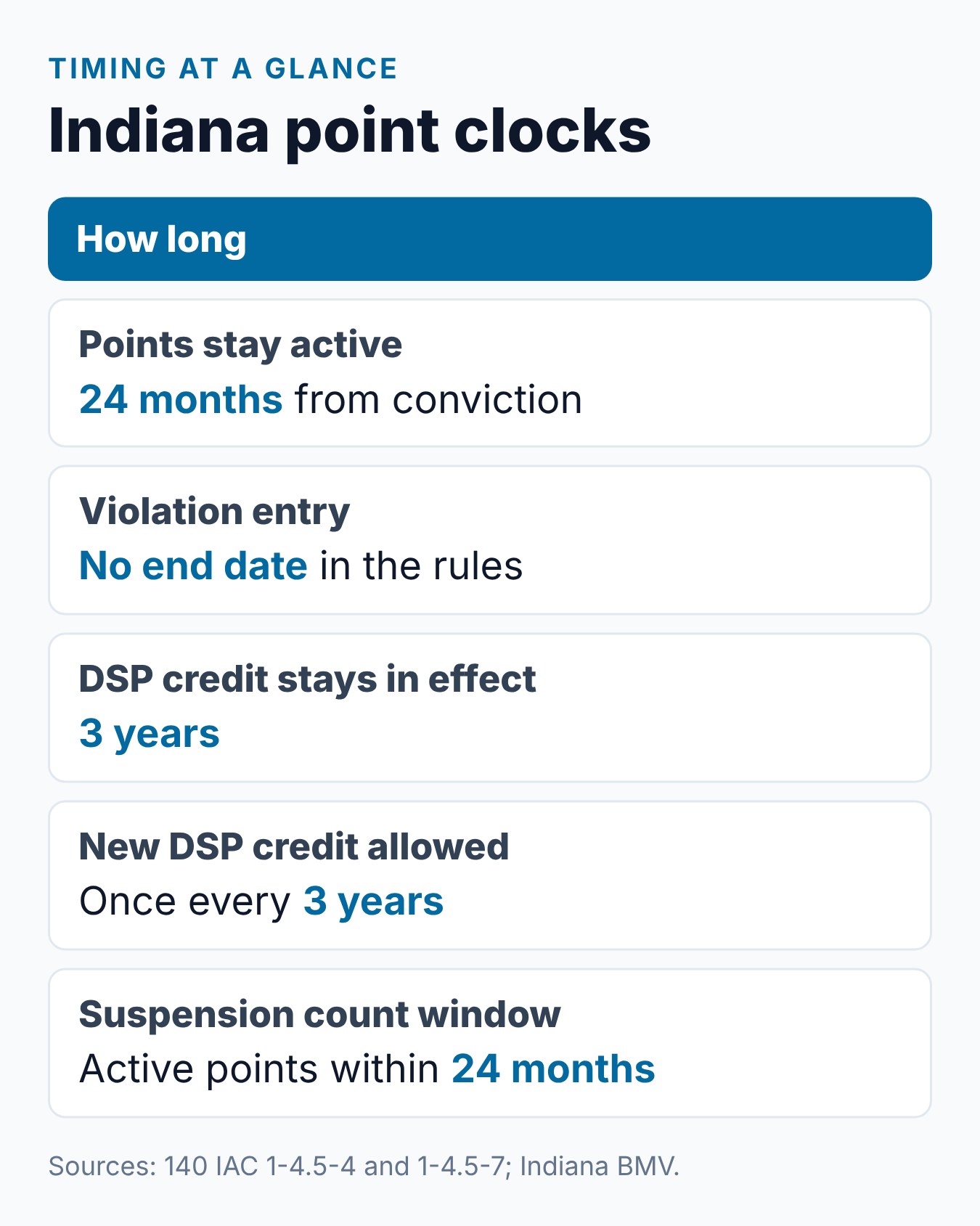
If you are asking how long do points stay on your license in Indiana, the answer is 24 months: the BMV says points stay active for two years from the conviction date. After that, those points no longer count toward a BMV warning or suspension. The violation itself stays on your driving record, and no official source sets an end date for it.
Key Facts
- Active period: 24 months from the conviction date. See the 24-month rule.
- Start date: the conviction (disposition) date, not the date of the stop. See which date starts the clock.
- After 24 months: the points go inactive, but the violation stays on the record. See what stays.
- Counting window: the warning and suspension levels count active points within 24 months, after any DSP credit. See the rolling window.
- DSP credit: in effect for three years, entered once every three years. See the credit timeline.
How Long Do Points Stay on Your License in Indiana?
Two official sources give the same answer in different words. The BMV’s Driver Record Points page gives the plain version: two years from the conviction date.
The BMV rule, 140 IAC 1-4.5-4, says points “shall become inactive twenty-four (24) months after the disposition date of the violation.” The disposition date is the date the case is decided. For a conviction, that is the conviction date.
So the active life of every point is fixed at 24 months. A 2-point ticket and an 8-point offense both go inactive on the same schedule.
Which Date Starts the Clock
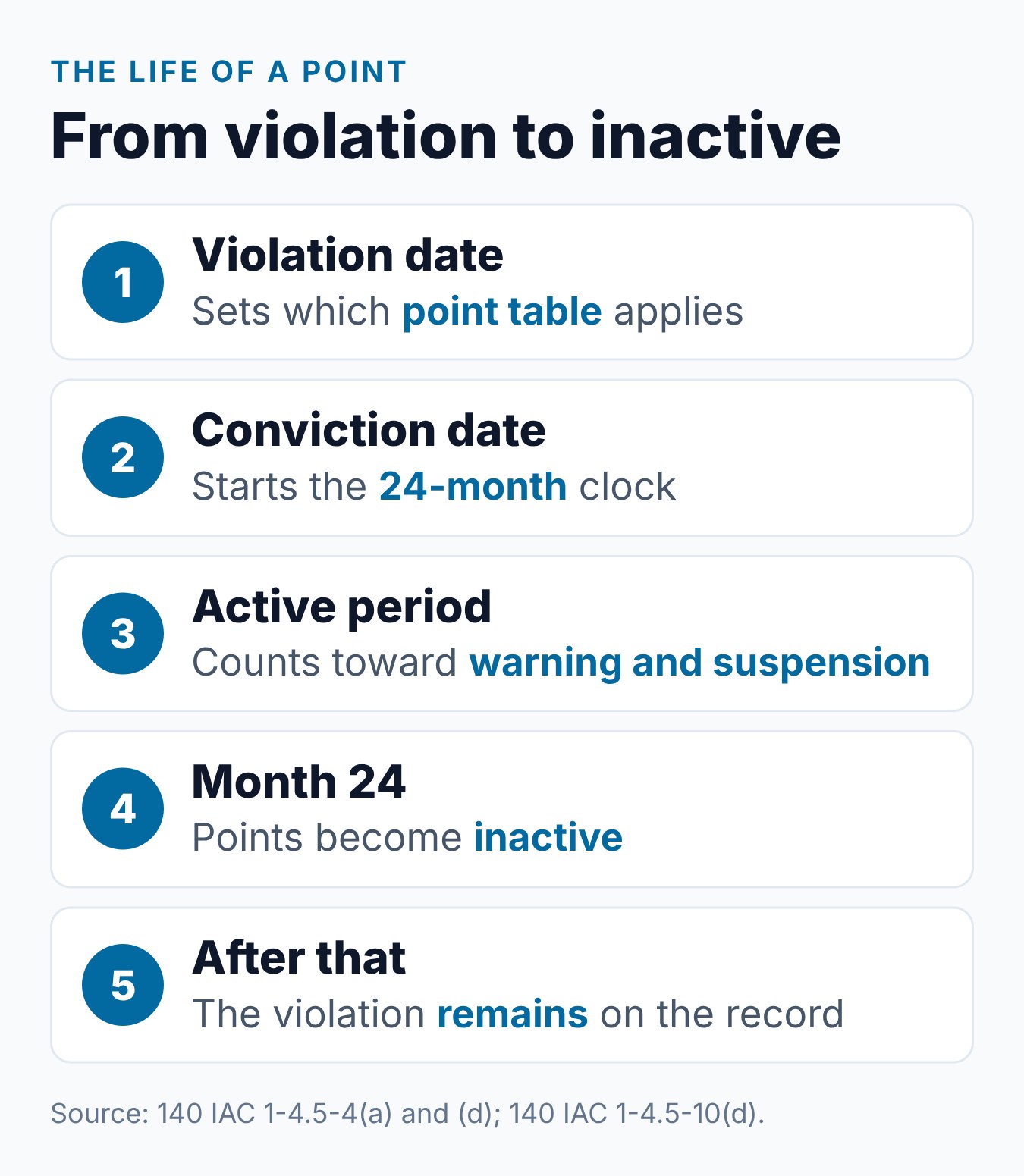
Three dates touch every ticket. Each one does a different job:
| Date | What it controls |
|---|---|
| Date of the violation | Which point table sets the value |
| Conviction (disposition) date | When the 24-month clock starts |
| 24 months after conviction | When the points go inactive |
| Any time after that | The violation still shows on the record |
The stop and the court result can fall on different days. The clock waits for the court result. So use the conviction date, not the date on the ticket, when you count.
When Do Points Fall Off Your License in Indiana?
People say points “fall off,” but the rule says they “become inactive.” That difference matters. Inactive points no longer count, yet the entry stays.
Here are simple date examples:
- Convicted on January 15, 2026: points go inactive on January 15, 2028.
- Convicted on June 30, 2026: points go inactive on June 30, 2028.
- Convicted on November 3, 2025: points go inactive on November 3, 2027.
To find your own dates, look up each conviction date on your record and add two years.
Active vs Inactive Points
Only active points count toward these rules:
- Warning notice: 14 to 18 active points.
- Suspension: 20 or more active points within 24 months, starting at one month.
- Renewal test: under IC 9-24-12-5, 6 or more active points means a written test to renew. Under 21, any active points do.
Inactive points do none of these things. On the Official Driver Record, the BMV’s legend says an asterisk marks “convictions for which points are currently active.” A conviction without one is not adding active points.
The Violation Stays on the Record
The rule is direct: “The violation shall remain a part of the person’s record.” It gives no time limit, and we found no official source that sets one.
The BMV’s Driver Record page says a record shows “current and resolved suspensions, citations, violations and other entries.” So an old ticket can still appear after its points expire.
For the ticket itself, see how long a speeding ticket stays on your record. For what employers may see, see traffic violations and background checks.
The Rolling 24-Month Window
The suspension rule looks at “twenty (20) or more active points, after any credit earned by completion of a driver safety program, within a twenty-four (24) month period.” Since each set of points has its own clock, your total rises and falls over time.
Here is an example with three convictions:
- April 1, 2026: 6 points.
- August 1, 2026: 4 points.
- February 1, 2027: 6 points.
On February 1, 2027, the driver has 16 active points. That is in the 14 to 18 warning range.
On April 1, 2028, the first 6 points go inactive, and the total drops to 10. On August 1, 2028, it drops to 6.
How the DSP Credit Fits the Timeline
The Driver Safety Program (DSP) does not shorten the 24-month clock. It adds a separate credit. Under 140 IAC 1-4.5-7, a BMV-approved course earns a 4-point credit that “shall remain in effect for a three (3) year period.”
The credit can be entered only once every three years. The BMV’s Driver Safety Program page adds that a second course extends the credit period three years from the new completion date.
So two clocks run side by side. Points last 24 months. The credit lasts three years.
The BMV pages we read do not explain more about how the two interact, so check your Official Driver Record for your own numbers. See how the 4-point credit works.
Other Time Windows in Indiana’s Rules
The 24-month rule is not the only clock. Several rules use their own window:
| Rule | Window | What it counts |
|---|---|---|
| Points active (140 IAC 1-4.5-4) | 24 months | Points from each conviction |
| BMV hearing (140 IAC 1-4.5-4) | 12 months | Three moving traffic offenses |
| BMV-ordered DSP, any age | 12 months | Two qualifying convictions or judgments |
| BMV-ordered DSP, under 21 | No set window | Two pointable incidents while under 21 |
| DSP credit (140 IAC 1-4.5-7) | 3 years | One 4-point credit |
The DSP order comes from IC 9-30-3-12. Points alone never trigger it.
Why the Rule Uses Two Words for One Date
The BMV page says “conviction date.” The rule says “disposition date.” A disposition is the way a court case ends. When the case ends in a conviction or a judgment, that date starts the clock.
This matters when you read your record. Look for the date the court decided the case, not the date of the stop. If a court later changes the result, the BMV acts on the new court record.
Drivers Under 21 Use the Same Clock
Points stay active for 24 months at every age. The warning and suspension levels are the same too.
One under-21 rule works differently, though. Under IC 9-30-3-12, a young driver must complete a Driver Safety Program after two pointable incidents behind the wheel before turning 21.
That rule counts incidents, and it has no 12-month limit. See points and rules under 21.
Out-of-State Tickets and the Clock
A ticket from another state can carry Indiana points if Indiana has the same kind of pointable offense, under 140 IAC 1-4.5-5. The rule says the points are assessed “as if the person had committed the violation in Indiana.”
So those points follow the Indiana rules, including the 24-month active period. See moving out of state for the other direction.
How to Track Your Own Dates
You can map your own timeline in a few steps:
- Get your record. The Viewable Driver Record is free on myBMV, and the certified Official Driver Record costs $4.
- List each conviction marked with an asterisk, which shows active points.
- Write the conviction date next to each one, and add two years.
- Note any DSP credit and its completion date.
- Mark your license renewal date. Six or more active points then means a written test.
Our guide on how to check your points explains each record.
What Does Not Shorten the Clock
Only time makes points inactive. These things do not speed it up:
- Finishing a DSP. It adds a credit; it does not make points expire sooner.
- Paying the ticket. Paying resolves the case; it does not shorten the 24 months.
- Waiting for the ticket’s anniversary. The clock runs from the conviction date.
Two things can change the count in other ways. Under 140 IAC 1-4.5-4(e), if a court vacates, dismisses or amends a violation, the BMV must modify any points suspension within a reasonable time after it gets the court record.
And a BMV record error can go to Material Error Review. See how points can be reduced or corrected.
Using the Dates When You Are Near a Limit
Dates help most when your total is close to 14 or 20 points. Each conviction date tells you when that total will drop. A new conviction adds points with a fresh 24 months.
A BMV-approved Driver Safety Program is the only course that adds a credit against the total. It takes at least 4 hours, and the BMV caps the price at $55. If the BMV mails you a notice to take a DSP, that notice has its own deadline: 90 days, or your driving privileges are suspended.
What We Found on the Official Pages
On October 26, 2026, the BMV’s points page still said points stay active “two years from the conviction date.” The 2026 edition of 140 IAC 1-4.5-4 used “twenty-four (24) months after the disposition date.”
Neither source gave an end date for the violation entry itself. The Driver Record page showed a last-modified date of March 18, 2026.
Common Mistakes
Each item below ties to an Indiana rule or BMV page:
- Counting from the ticket date. The BMV counts from the conviction date.
- Thinking the ticket vanishes. The violation stays on the record.
- Adding up all old points. Only active points count toward the warning and suspension levels.
- Forgetting the renewal test. Six or more active points means a written test to renew.
- Expecting the DSP to end the clock. It adds a credit; the 24 months still run.
How Requirements Can Vary
Indiana’s point rules, the 4-point credit and the BMV’s Driver Safety Program order come from state law and BMV rules, and they apply statewide. What you must do still depends on whether you take the course by choice, because of a BMV notice, or under a court order. A court order sets its own deadline and proof steps.
Laws, fees and court practice can change. Check your BMV notice, your court order and the Indiana BMV website for current rules before you enroll or file anything.
Frequently Asked Questions
Do Indiana points go away after two years?
Two years after the conviction date, the points turn inactive and drop out of the BMV count. The violation entry remains.
Does the clock start on the ticket date?
No. The BMV says points stay active for two years from the conviction date. The rule calls it the disposition date.
How long does a violation stay on my Indiana record?
The rule says the violation “shall remain a part of the person’s record.” No official source gives an end date.
How can I tell which points are still active?
Check your Official Driver Record. The BMV’s legend says an asterisk marks convictions whose points are currently active.
Does the DSP make points expire sooner?
No. A BMV-approved course adds a 4-point credit to your record, once every three years. Each set of points still runs its own 24 months.
Do inactive points affect license renewal?
The renewal rule in IC 9-24-12-5 looks at active points. A written test is required with 6 or more active points, or any active points under 21.
Do points from another state last 24 months?
The BMV assesses them as if the violation happened in Indiana. So the Indiana rules apply, including the 24-month active period.
Conclusion
How long do points stay on your license in Indiana has a fixed answer: 24 months from the conviction date, while the violation stays on the record. Track each conviction date to know when its points stop counting.
You can earn the 4-point credit, allowed once every three years, with Driving Logic’s online Indiana Driver Safety Program. If a court ordered your course, check that the order allows an online course.
Related Articles
- Indiana Points on License: How the BMV System Works
- How to Check Points on License Indiana: myBMV Steps
- How Long Does a Speeding Ticket Stay on Your Record in Indiana?
- Indiana DSP 4 Point Credit: How It Works
Sources
- Indiana BMV — Driver Record Points
- 140 IAC 1-4.5 — BMV point system rules
- Indiana BMV — Driver Record
- Indiana BMV — Citation Points & Driver Safety Program
- Indiana Code § 9-30-3-12 — Driver safety program
- Indiana BMV — myBMV
Billy Forte is the owner of Driving Logic, a state-approved driver improvement course provider serving Indiana and other U.S. states.
This article is general information, not legal advice. Indiana BMV rules, court orders, fines and penalties depend on your notice, citation, court and case facts, and they can change. Use official Indiana BMV and court sources, and consult a qualified Indiana attorney for advice about your own case.