
Updated October 2026 · Reviewed by Billy Forte
If you searched how long does speeding ticket stay on record in Indiana, the short answer has two parts: the points go inactive 24 months after the conviction date, but the ticket itself stays on your Indiana driving record. No official Indiana source sets an end date for that entry. Along the way, the same ticket can count in other time windows, from 12 months for a BMV course order to 5 years for court fine caps.
Key Facts
- Points: active for two years from the conviction date, not the ticket date. See the conviction date.
- The entry: the violation remains part of the record after its points go inactive. See points vs. the entry.
- Other clocks: the same ticket can count for 12 months, 3 years or 5 years under other rules. See time windows.
- Suspension: it starts at 20 active points within 24 months, after any credit. See warnings and suspension.
- The DSP: a 4-point credit, but it does not remove the citation. See what the DSP changes.
- Your record: the Viewable Driver Record is free on myBMV. See checking your record.
How Long Does Speeding Ticket Stay on Record in Indiana: The Short Answer
There are two different things to track. The first is the points. The second is the entry for the ticket.
The points have a clear clock. The BMV driver record points page says, “Points stay active on an individual’s driving record for two years from the conviction date.”
The entry does not have that clock. Under the BMV point rules, the violation “remains part of the record” even after its points go inactive. We found no official Indiana page that gives a date when the entry leaves.
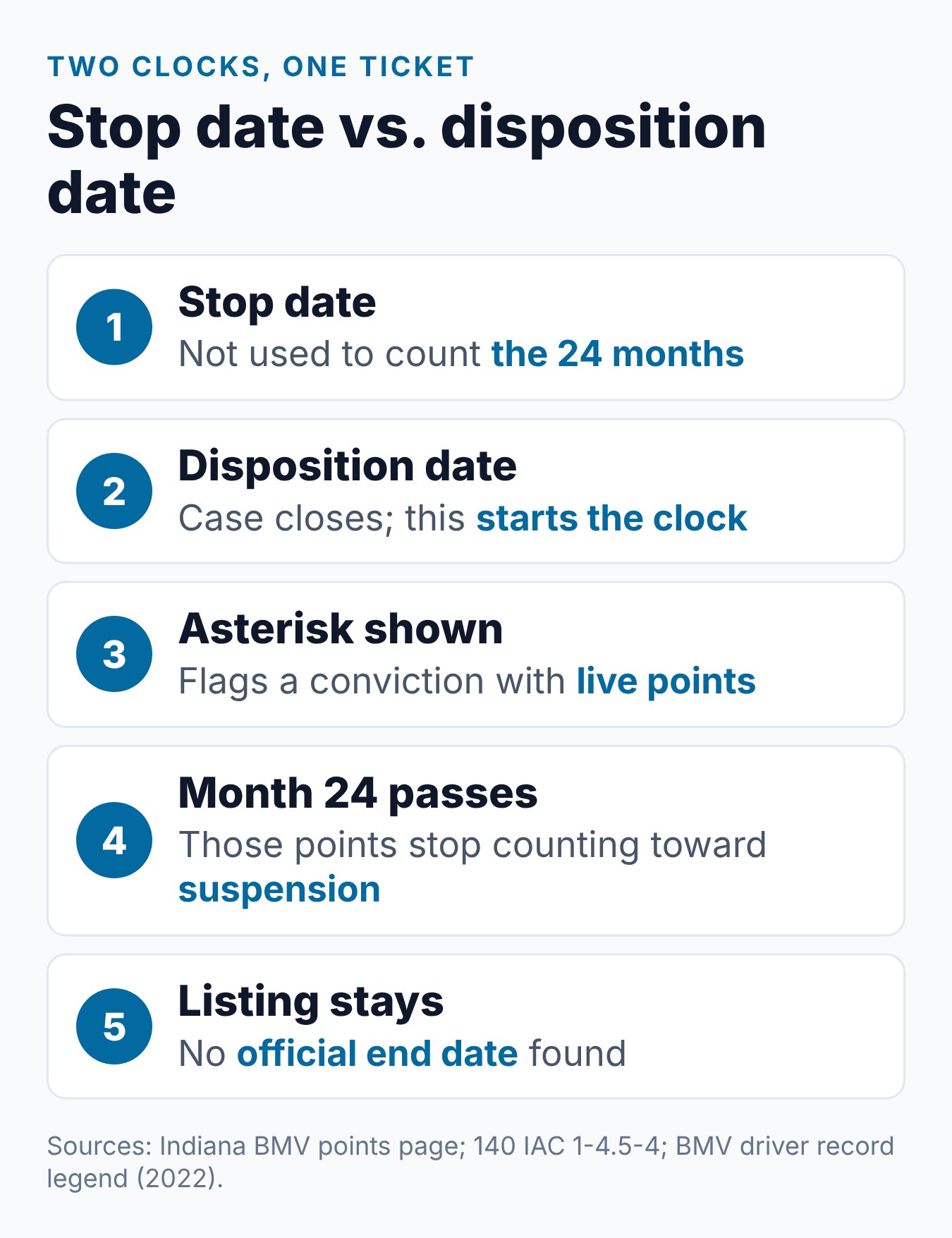
The Clock Starts at the Conviction Date
The 24 months do not start on the day you were stopped. They start when the case ends. The BMV page calls this the conviction date.
The BMV point rules in 140 IAC 1-4.5 use the term “disposition date.” Section 1-4.5-4 says points become inactive 24 months after the disposition date of the violation.
So a case that ends after the stop starts its clock on that later date. Check the conviction date on your record to find your own end date for active points.
Active Points vs. the Ticket Entry
An Indiana driving record can show a speeding conviction in two states. While its points count, it is active. After 24 months, its points are inactive, but the conviction is still listed.
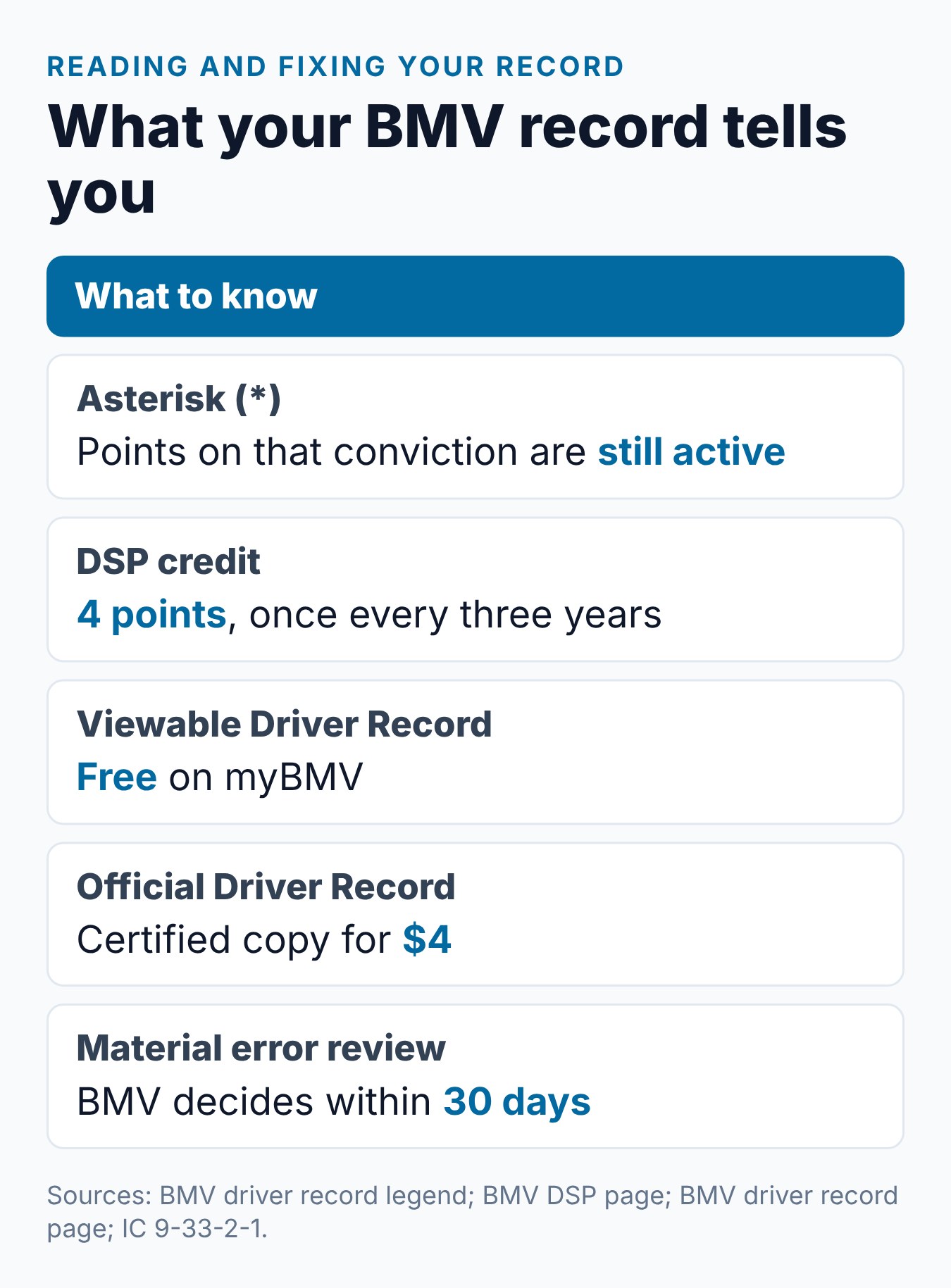
The BMV’s driver record legend explains how to tell them apart. “The convictions for which points are currently active are denoted by an asterisk (*).” No asterisk means the points no longer count toward your total.
Inactive points do not add to warnings or suspensions under the point system. But the entry is still on the full record.
How Many Points One Speeding Ticket Adds
The BMV point table sets speeding points by how far over the limit you were:
- 1 to 15 mph over: 2 points
- 16 to 25 mph over: 4 points
- More than 25 mph over: 6 points
In a school zone or work site, the values are higher: 4, 6 and 8. If the ticket does not show the speed, it counts 2 points, or 4 in those zones. Our guide on speeding ticket points in Indiana covers each tier.
Each of these point values stays active for the same 24 months. A bigger ticket adds more points, but not more time.
Time Windows Where One Ticket Can Count
The 24-month point clock is not the only one. Other Indiana and federal rules look back over different periods. One speeding conviction can matter in each of these:
| Look-back period | What the ticket can count toward | Where the rule is |
|---|---|---|
| 12 months | A BMV-ordered DSP, together with another qualifying conviction or judgment | IC 9-30-3-12 |
| 12 months | A possible BMV hearing, as one of three moving offenses | 140 IAC 1-4.5-4 |
| 24 months | Active points toward a warning or suspension | 140 IAC 1-4.5-4 |
| 3 years | A higher minimum fine for a new work zone ticket | IC 9-21-5-11 |
| 3 years | A CDL disqualification, if 15 mph or more over (a second conviction is needed; a personal-vehicle ticket counts only if it leads to a suspension) | 49 CFR 383.51 |
| 5 years | A higher cap if you contest a new ticket in the same county and lose | IC 34-28-5-4(f) |
| No set end | The entry itself on your BMV record | 140 IAC 1-4.5-4 |
The 12-month course order comes from IC 9-30-3-12. It applies after two traffic misdemeanor convictions, two traffic judgments, or one of each, for moving violations.
Points alone do not trigger it. If the BMV orders the course, it must be finished within 90 days of the notice, or driving privileges are suspended.
The 5-year window is in IC 34-28-5-4. If you contest a Class C ticket and lose, the cap is $35.50, $250.50 or $500. It depends on moving violations found by a court in that county in the past 5 years.
The work zone rule is in IC 9-21-5-11. One prior in the past 3 years raises the minimum fine to at least $500.
For commercial drivers, see 49 CFR 383.51. A ticket in a personal vehicle counts there only if the conviction leads to a license suspension.
When Active Points Lead to a Warning or Suspension
Only active points count here. Under 140 IAC 1-4.5-4, the BMV looks at active points after any DSP credit:
- 14 to 18 active points: a warning notice
- 20 or more active points within 24 months: a suspension, starting at 1 month
- Each 2 more points: one more month, up to 12 months at 42 or more
Here is simple math. A driver with 16 active points who gets a 4-point speeding ticket reaches 20. If that driver then earns the 4-point DSP credit, the total drops back to 16.
Once a ticket’s 24 months pass, its points leave the active total. That is why the conviction date matters so much.
What the Driver Safety Program Changes and What It Does Not
People sometimes search for a “defensive driving” course to clear a ticket. In Indiana, the official course is the Driver Safety Program (DSP), from a provider on the BMV’s approved list.
The BMV Driver Safety Program page says the BMV applies a 4-point credit for completing a BMV-approved DSP. The credit may be applied only once every three years. It is applied within 7 to 14 business days after the provider notifies the BMV.
The same page is clear on the limit. Completion “will not remove a citation from your driver history.” So the course lowers your point total, but it does not shorten how long the ticket is listed.
If the credit does not show up, you can email your certificate to BMVDSP@bmv.IN.gov.
Deferral: A Case That Ends Without a Conviction
Some prosecutors offer a deferral program under IC 34-28-5-1. You sign an agreement, pay fees and meet the terms. Then the court “shall dismiss the action,” and it may not be filed again.
Points are counted from a conviction date. Ask the court how a dismissed case will appear on your BMV record. Deferral does not apply to commercial motor vehicle offenses.
Insurance Uses Its Own Clock
The Indiana Department of Insurance lists “Driver Record” as one rating factor insurers may use. It does not set how far back an insurer may look.
The same page says a Certificate of Compliance must be filed by your insurance agent “after an accident or following a traffic violation.” It does not say for how long.
Each insurer sets its own rules. Ask yours how long a speeding conviction affects your rate. Our insurance guide explains what is and is not known.
How to Check What Your Record Shows
You do not have to guess. The BMV offers two kinds of records:
- Viewable Driver Record: free on myBMV.
- Official Driver Record: a certified copy for $4, or by mail with State Form 53789.
The BMV driver record page has the details. Look for the asterisk next to each conviction to see which points are still active. Our guide on reading your Indiana driving record walks through it.
If an entry is wrong, you can ask for a material error review. Under IC 9-33-2-1, the BMV must decide within 30 days.
Reckless Driving Follows a Longer Rule
A plain speeding ticket is a Class C infraction. Reckless driving is a separate criminal charge, and it has an extra look-back.
The BMV Driver’s Manual lists reckless driving among the offenses for Habitual Traffic Violator status. Three such judgments within 10 years can lead to a 10-year suspension. This matters only if your record also has reckless driving judgments.
What We Found on the Official Pages
On the BMV pages we checked on October 26, 2026, the points page said points stay active “for two years from the conviction date.” The DSP page said completion “will not remove a citation from your driver history.”
Neither page gave a date when a conviction leaves the record. The BMV rule says the violation “remains part of the record.”
Common Mistakes to Avoid
Each item comes from a BMV page, a BMV rule or Indiana law:
- Counting from the ticket date. The clock starts at the conviction date.
- Thinking the ticket disappears at 2 years. Only the points go inactive.
- Expecting the DSP to erase the ticket. It adds a credit; it does not remove the citation.
- Taking a second course too soon. The credit is applied only once every three years.
- Forgetting other windows. A ticket can still matter for 3 or 5 years under other rules.
- Guessing instead of checking. The Viewable Driver Record is free on myBMV.
For costs, points and options, see our Indiana speeding ticket guide.
How Requirements Can Vary
Indiana’s point rules, the 4-point credit and the BMV’s Driver Safety Program order come from state law and BMV rules, and they apply statewide. What you must do still depends on whether you take the course by choice, because of a BMV notice, or under a court order. A court order sets its own deadline and proof steps.
Laws, fees and court practice can change. Check your BMV notice, your court order and the Indiana BMV website for current rules before you enroll or file anything.
Frequently Asked Questions
Does a speeding ticket fall off my Indiana record after 2 years?
The points go inactive after 24 months. The BMV rule says the violation remains part of the record, and we found no official end date for it.
When does the 24-month clock start?
It starts on the conviction date, also called the disposition date. That is when the case ends, not when you got the ticket.
How can I tell which points are still active?
Look at your driving record. The BMV marks convictions with active points with an asterisk.
Does the Driver Safety Program shorten how long the ticket stays?
No. The DSP adds a 4-point credit to your point total. The BMV says it will not remove a citation from your driver history.
Can an old speeding ticket still count against me?
Yes, in some rules. For example, prior moving violations found in the same county in the past 5 years can raise the cap if you contest a new ticket and lose.
How long will my insurance use the ticket?
No official Indiana source sets that period. Each insurer sets its own rules, so ask yours.
Can one speeding ticket lead to a BMV course order?
Not by itself. The BMV must order a DSP after two qualifying convictions or judgments for moving violations within 12 months. Points alone do not trigger the order.
How do I see my own record?
Log in to myBMV for a free Viewable Driver Record. A certified Official Driver Record costs $4.
Conclusion
So how long does a speeding ticket stay on your record in Indiana? Its points count for 24 months from the conviction date, while the entry itself stays listed with no official end date.
To add a 4-point credit to your active total, see Driving Logic’s online Indiana Driver Safety Program. If a court ordered a course, check that the order allows an online course.
Related Articles
- Indiana Speeding Ticket: Costs, Points, and What to Know
- How Long Do Points Stay on Your License in Indiana?
- Your Indiana Driving Record: How to Get It and What It Shows
- How Does an Indiana Speeding Ticket Affect Your Car Insurance?
Sources
- Indiana BMV — Driver Record Points
- 140 IAC 1-4.5 — BMV point system rules
- Indiana BMV — Citation Points & Driver Safety Program
- Indiana Code § 9-30-3-12 — Driver safety program
- Indiana Code § 34-28-5-4 — Infraction judgments
- Indiana Code § 34-28-5-1 — Infraction actions and deferral
- Indiana Code § 9-21-5-11 — Worksite speed limits
- 49 CFR § 383.51 — CDL disqualifications
- Indiana BMV — myBMV
- Indiana BMV — Driver Record
- Indiana BMV — Material Error Review Request
- Indiana Code § 9-33-2-1 — Material errors in BMV records
Billy Forte is the owner of Driving Logic, a state-approved driver improvement course provider serving Indiana and other U.S. states.
This article is general information, not legal advice. Indiana BMV rules, court orders, fines and penalties depend on your notice, citation, court and case facts, and they can change. Use official Indiana BMV and court sources, and consult a qualified Indiana attorney for advice about your own case.