
Updated October 2026 · Reviewed by Billy Forte
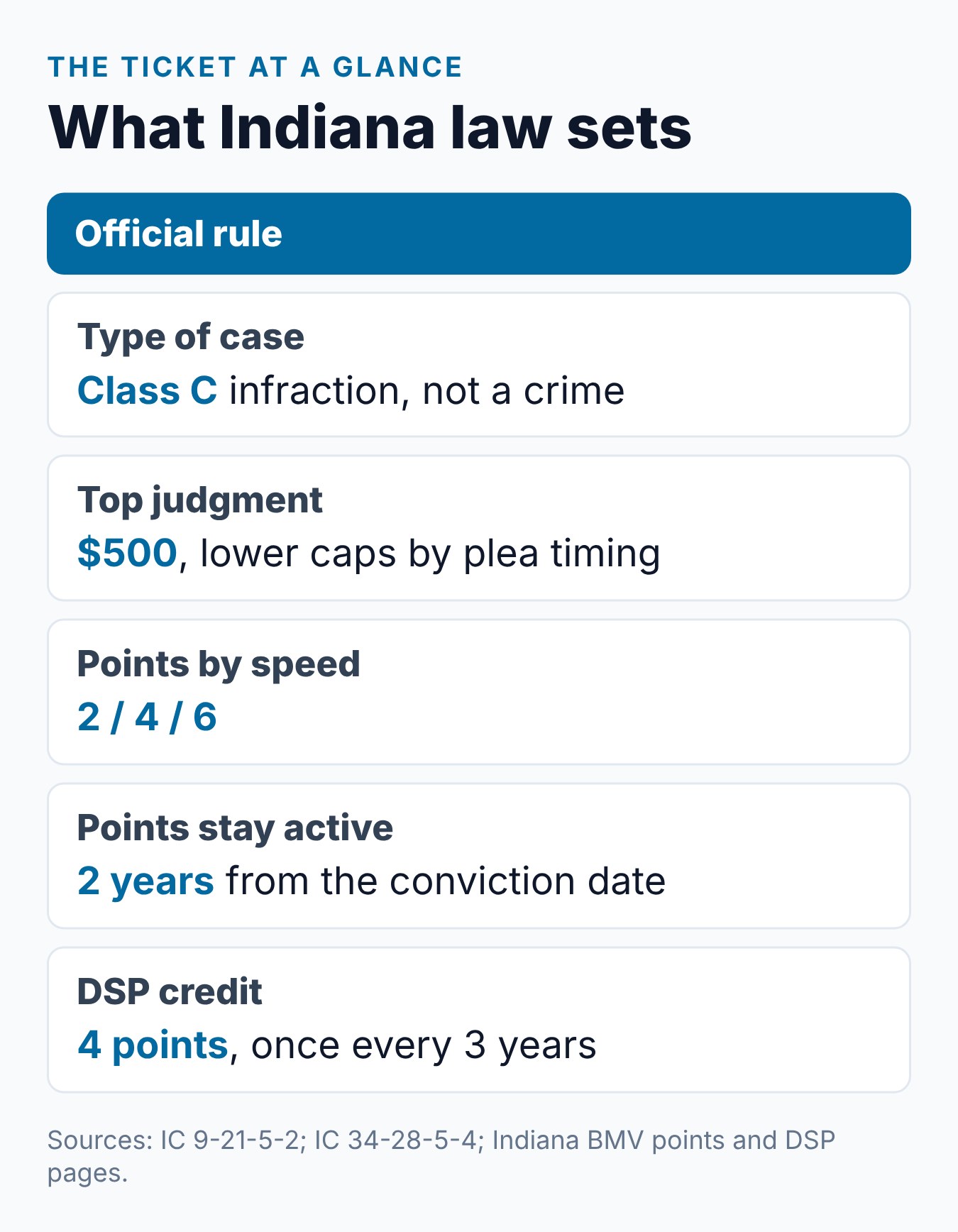
An Indiana speeding ticket is a Class C infraction, which is a civil case and not a crime. If you admit it on or before your appearance date, the judgment can be no more than $35.50, plus statutory court costs of $139. The ticket also brings 2, 4 or 6 BMV points, based on how far over the limit you were.
Key Facts
- What it is: a Class C infraction under state law, not a crime. See what the ticket is.
- Cost: a judgment of up to $500, capped at $35.50 if you admit it on time, plus court costs. See what it costs.
- Points: 2, 4 or 6 on ordinary roads, and 4, 6 or 8 in school zones and work sites. See points.
- Options: pay and admit, contest it on the appearance date, or ask if deferral is offered. See your options.
- DSP: a 4-point credit, once every three years, that does not erase the citation. See the DSP.
What an Indiana Speeding Ticket Is
Indiana’s speed limit law is IC 9-21-5-2. It sets the top limits, such as 30 mph in an urban district and 55 mph on other roads unless a different limit applies.
Breaking one of these limits is a Class C infraction. Driving faster than is reasonable for the conditions is also a Class C infraction under IC 9-21-5-1.
An infraction is not a crime. Indiana law defines a crime as a felony or a misdemeanor (IC 35-31.5-2-75). Still, the case goes through a court, and a judgment is reported to the BMV.
Limits Set in State Law
The statute lists the top speed for each kind of road. A few examples:
- 15 mph in an alley
- 30 mph in an urban district
- 55 mph as the general limit, unless another limit applies
- 65 mph on Interstate 465
- 70 mph on interstates outside urbanized areas of 50,000 or more people, with 65 mph for vehicles over 26,000 pounds
Local governments can set some limits under IC 9-21-5-6, so check the limit posted where you were stopped.
Higher Classes
Two kinds of speeding are more serious. Speeding in a posted school zone or a highway work site is a Class B infraction. Our school zone and work zone guide covers those tickets, and our infraction or misdemeanor guide explains the class system.
What It Costs
The bill has two parts: the judgment and the court costs. Under IC 34-28-5-4, the top judgment for a Class C infraction is $500. For a Class C moving violation, subsection (f) sets lower caps:
| Piece of the bill | Amount set by law | Source |
|---|---|---|
| Judgment if you admit on or before the appearance date | No more than $35.50 | IC 34-28-5-4(f) |
| Judgment if you contest and lose | Up to $35.50, $250.50 or $500, based on prior findings | IC 34-28-5-4(f) |
| Statutory court costs | $139 in total | Trial Court Fee Manual |
| Court costs where the sheriff’s fee is collected | $167 in total | Trial Court Fee Manual |
The “prior findings” are moving violations found by a court in that same county in the past 5 years. The cost figures come from the Indiana Trial Court Fee Manual.
Two smaller rules also apply. In Marion County, the judgment may not be less than $35 (IC 34-28-5-4(h)).
A judge may add some other fees, so confirm your exact amount with the county court. Our guide to what affects the cost breaks down each factor.
Where to Pay or Respond
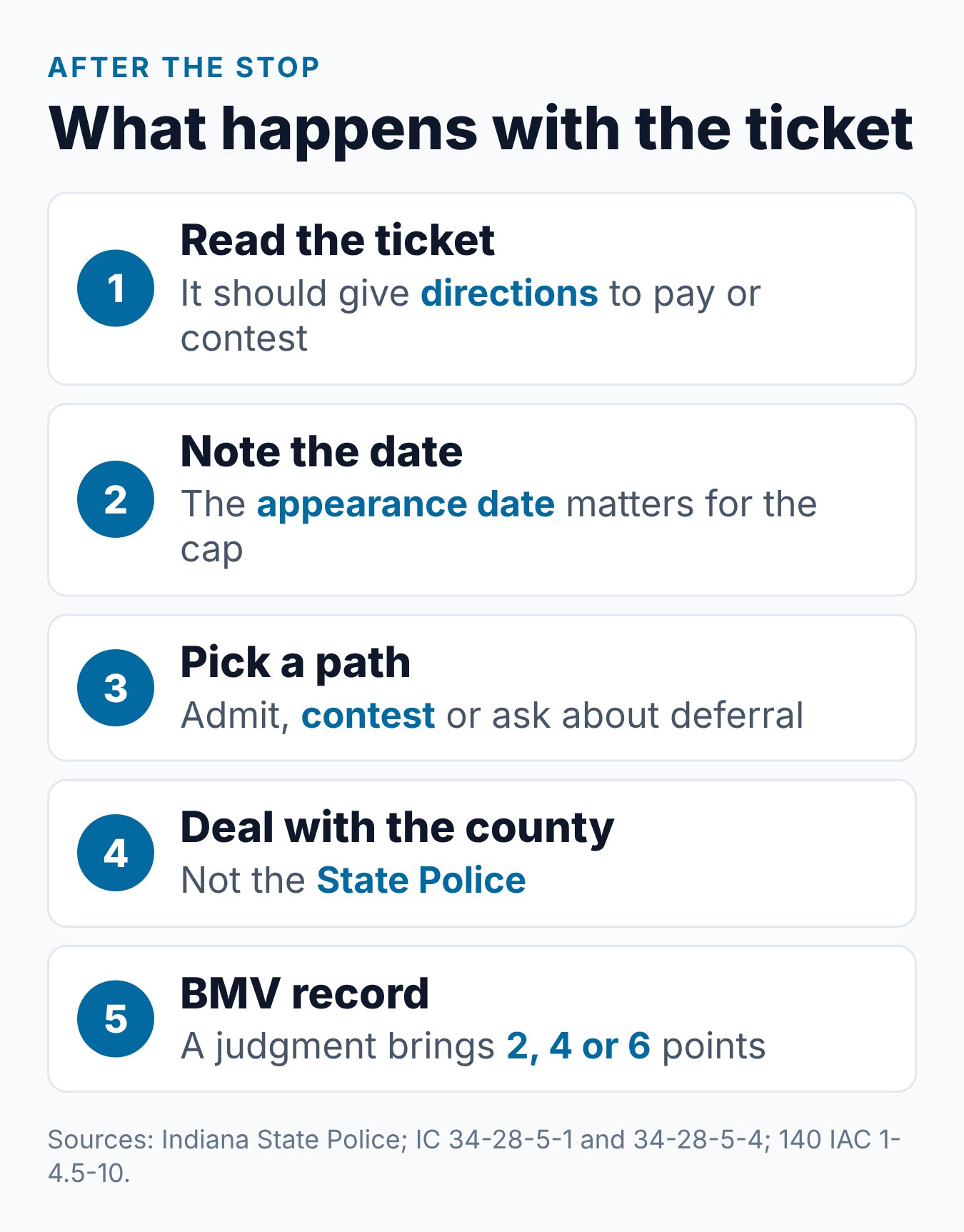
You deal with the county, not the police agency. The Indiana State Police say they do “not receive payments for traffic tickets.” All payments go “to the county in which the ticket was issued.”
The ISP also says you “should also receive directions on how to pay or contest the fine” with your ticket. So read the ticket first. It tells you where to go and by when.
How Many Points It Adds
The BMV assigns points under its rule, 140 IAC 1-4.5-10. For speeding, the points depend on how far over the limit you were:
- 1 to 15 mph over: 2 points
- 16 to 25 mph over: 4 points
- More than 25 mph over: 6 points
- Speed not shown: 2 points
In a school zone or work site, each tier is higher: 4, 6 or 8 points. The BMV points page says points “stay active” for two years from the conviction date.
The violation itself stays on your record after that. See how many points a speeding ticket adds for more.
When the BMV Steps In
Active points add up. Under 140 IAC 1-4.5-4, 14 to 18 active points bring a warning notice.
At 20 or more active points within 24 months, the BMV suspends the license, starting at one month. Our suspension points guide has the full scale.
A second rule is based on convictions, not points. Under IC 9-30-3-12, two traffic convictions or judgments for moving violations within 12 months mean the BMV must order a Driver Safety Program.
You then have 90 days, or your driving privileges are suspended. See BMV-ordered DSP.
Your Options
The law gives you three paths. Which one fits is your decision, and an Indiana attorney can help with your case.
- Pay and admit. You admit the violation, and a judgment is entered. Doing this on or before the appearance date keeps the judgment at $35.50 or less.
- Contest it. You appear on the appearance date. The prosecutor must prove the infraction “by a preponderance of the evidence” under IC 34-28-5-1.
- Ask about deferral. A prosecutor may run a deferral program. If you meet its terms, the court dismisses the case, and it may not be refiled.
Deferral does not apply to commercial motor vehicle offenses. Our pay or contest guide compares the paths in detail.
Speeding vs Reckless Driving
Reckless driving is a separate, criminal charge. IC 9-21-8-52 covers driving “at such an unreasonably high rate of speed” under the circumstances as to “endanger the safety or the property of others.” The law sets no mph figure.
At its base level, reckless driving is a Class C misdemeanor and carries 6 points. See when speeding becomes reckless driving, our reckless driving guide and what counts as reckless driving.
The Driver Safety Program and Your Points
The BMV’s Driver Safety Program (DSP) can lower your point total. The BMV DSP page says it applies a 4-point credit when you finish an approved course. The credit “may only be applied once every three years.”
The credit does not erase the ticket. The BMV says completion “will not remove a citation from your driver history.” For example, a driver with 6 active points who finishes a DSP has 2 after the credit.
Some people search for a defensive driving course. In Indiana, the course that earns the credit is the Driver Safety Program from a BMV-approved provider.
Each one runs at least 4 hours, and the BMV caps the price at $55. Under IC 9-30-3-12(d), a court may also suspend half of the court costs if you complete a DSP.
Insurance, Out-of-State and CDL Drivers
Three groups have extra questions:
- Insurance. No official source sets a rate increase. Insurers decide how a ticket affects your rate. See speeding tickets and insurance.
- Out-of-state drivers. The ticket is still answered in the Indiana county court. See out-of-state tickets.
- CDL holders. Federal rules treat 15 mph or more over as a serious violation. In a personal vehicle, a conviction counts only if it leads to a license suspension. The rules also bar deferral for CDL holders. See CDL speeding tickets.
Indiana Speeding Ticket Guides in This Series
Each guide covers one question in depth:
- What affects the cost: class, plea timing, prior findings and court costs.
- Speeding vs reckless driving: how a separate charge is decided.
- 20 over: the 4-point tier and zone rules.
- Pay or contest: the caps and deferral.
- Insurance: what is official and what is up to your insurer.
- Out of state: drivers licensed in other states.
- How long it stays: points and the record over time.
- Misdemeanor or infraction: why speeding is not a crime.
- School and work zones: Class B tickets and cameras.
- CDL drivers: federal rules for commercial licenses.
What We Found on the Official Pages
On the official pages we checked on October 26, 2026, the Trial Court Fee Manual said it was “Current through 2026 Legislative Session.” It listed “Total Infraction/Ordinance Violations Fees $139.00.”
The BMV points page said points stay active for two years from the conviction date. The ISP page said it does not take ticket payments. None of these pages listed a fine that rises with each mph over the limit.
Common Mistakes to Avoid
Each item comes from Indiana law or an official page:
- Sending payment to the police. The ISP says payments go to the county.
- Missing the appearance date. The $35.50 cap applies to an admission on or before that date.
- Thinking points last forever. They go inactive two years after the conviction date.
- Thinking the DSP erases the ticket. It adds a credit; the citation stays.
- Counting on deferral with a CDL. Federal rules bar it for CDL holders.
- Assuming high speed alone is reckless driving. The statute has no mph figure.
How Requirements Can Vary
Indiana’s point rules, the 4-point credit and the BMV’s Driver Safety Program order come from state law and BMV rules, and they apply statewide. What you must do still depends on whether you take the course by choice, because of a BMV notice, or under a court order. A court order sets its own deadline and proof steps.
Laws, fees and court practice can change. Check your BMV notice, your court order and the Indiana BMV website for current rules before you enroll or file anything.
Frequently Asked Questions
How much is a speeding ticket in Indiana?
If you admit it on or before the appearance date, the judgment can be no more than $35.50. Statutory court costs add $139, or $167 where the sheriff’s fee is collected. Check the exact amount with your county court.
Is a speeding ticket a crime in Indiana?
No. Ordinary speeding is a Class C infraction, and Indiana defines a crime as a felony or a misdemeanor. The judgment still goes on your BMV record.
How many points is a speeding ticket in Indiana?
It is 2 points for 1 to 15 mph over, 4 for 16 to 25 over and 6 for more than 25 over. In a school zone or work site, it is 4, 6 or 8.
Where do I pay my Indiana speeding ticket?
You pay the county where the ticket was issued. The Indiana State Police do not take payments, and your ticket should include directions.
Can a Driver Safety Program help after a ticket?
It can lower your active point total by 4 points, once every three years. It does not remove the citation from your driver history.
Can I get my ticket dismissed?
Some prosecutors run deferral programs. If you meet the terms, the court dismisses the case. Deferral is not available for commercial motor vehicle offenses or to CDL holders.
How long do speeding points stay active?
Points stay active for two years from the conviction date. After that, they no longer count toward your total, but the violation stays on your record.
Conclusion
An Indiana speeding ticket is a Class C infraction with a capped judgment, statutory court costs and 2 to 6 points. Read your ticket, note the appearance date and pay or respond to the county court.
To work on your point total, see Driving Logic’s online Indiana Driver Safety Program. If a court ordered your course, check that the order allows an online course.
Related Articles
- Indiana Speeding Ticket Cost: What Affects the Fine?
- When Does Speeding Become Reckless Driving in Indiana?
- 20 Over Speeding Ticket in Indiana: What to Know About Cost and Points
- Indiana Speeding Ticket: What to Know Before You Pay or Contest It
- How Does an Indiana Speeding Ticket Affect Your Car Insurance?
- Indiana Speeding Ticket from Out of State: What Happens to Your License
- How Long Does a Speeding Ticket Stay on Your Record in Indiana?
- Is an Indiana Speeding Ticket a Misdemeanor or Just a Traffic Infraction?
- Indiana Work Zone and School Zone Speeding Tickets: Higher Fines
- Indiana CDL Speeding Ticket: Federal Rules Apply
Sources
- Indiana Code § 9-21-5-2 — Maximum speed limits
- Indiana Code § 34-28-5-4 — Infraction judgments
- Indiana Code § 34-28-5-1 — Infraction actions and deferral
- Indiana Office of Judicial Administration — Trial Court Fee Manual (PDF)
- Indiana State Police — Traffic Tickets
- 140 IAC 1-4.5 — BMV point system rules
- Indiana BMV — Driver Record Points
- Indiana BMV — Citation Points & Driver Safety Program
- Indiana Code § 9-30-3-12 — Driver safety program
- Indiana Code § 9-21-8-52 — Reckless driving
Billy Forte is the owner of Driving Logic, a state-approved driver improvement course provider serving Indiana and other U.S. states.
This article is general information, not legal advice. Indiana BMV rules, court orders, fines and penalties depend on your notice, citation, court and case facts, and they can change. Use official Indiana BMV and court sources, and consult a qualified Indiana attorney for advice about your own case.