
Updated October 2026 · Reviewed by Billy Forte
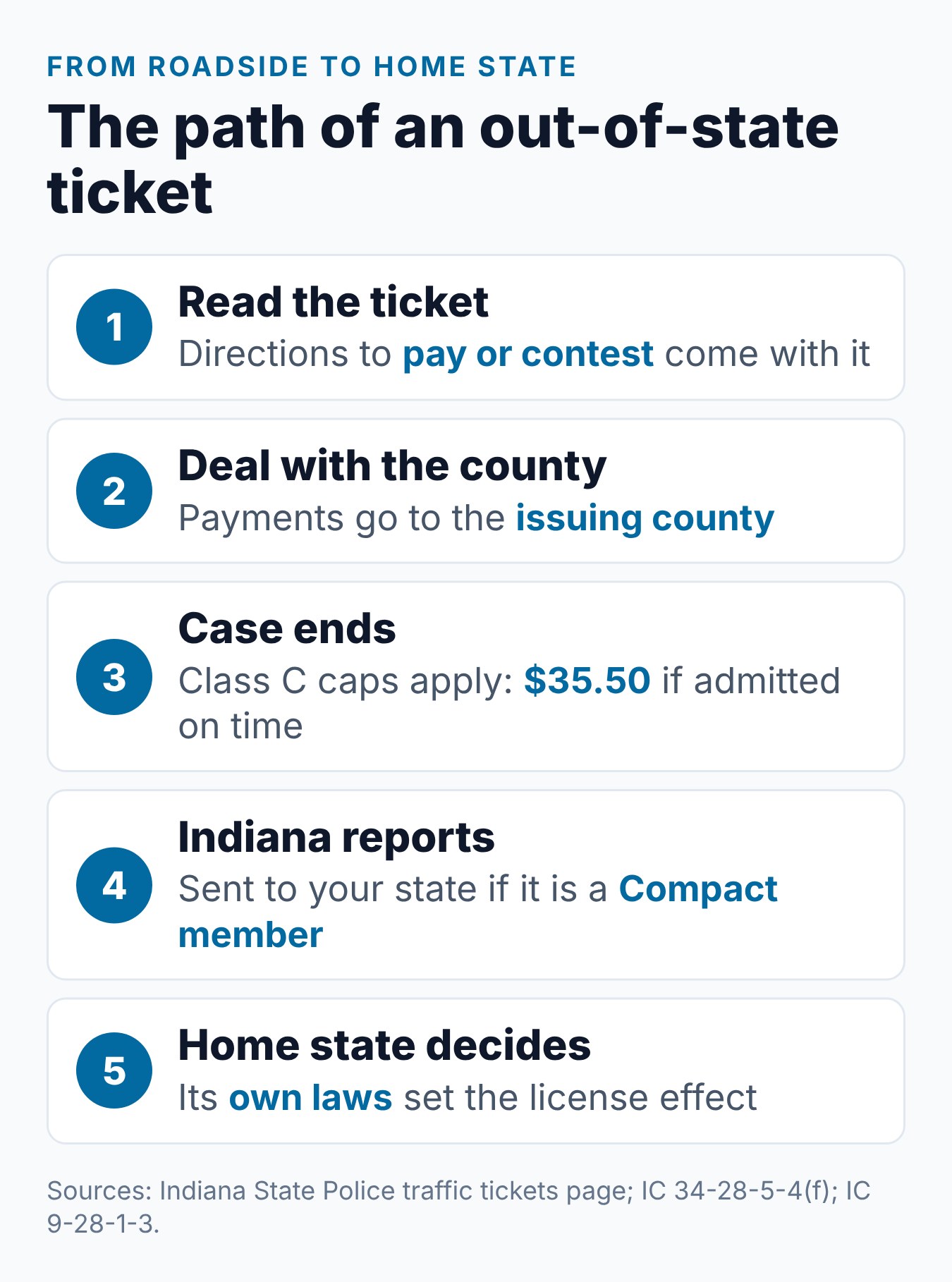
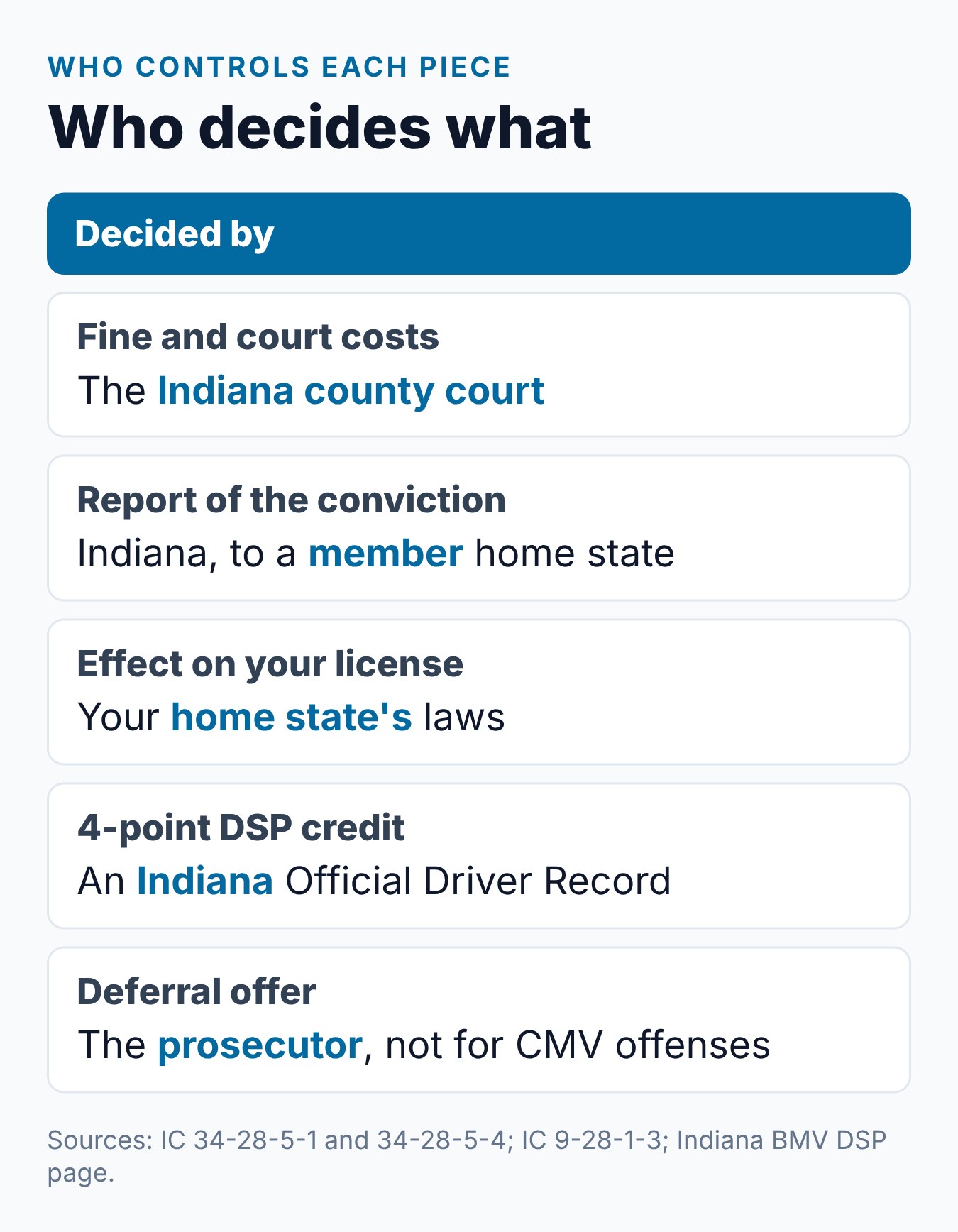
If you have an Indiana speeding ticket out of state, meaning you live in another state but were stopped here, you answer it in the Indiana county court named on the ticket, under the same rules as an Indiana driver. If you are convicted and your home state is a member of the Driver License Compact, Indiana reports the conviction there, and your home state applies its own laws to your license. The Indiana Driver Safety Program (DSP) credit goes on an Indiana record, so it does not change your home-state record.
Key Facts
- Where to answer: the county where the ticket was issued, not the State Police. See answering the ticket.
- Same money rules: a Class C infraction, with the same caps and court costs. See the Class C rules.
- Your home state: Compact members report convictions to each other. See how your home state learns.
- Home-state effect: for ordinary tickets, your home state uses its own laws. See what your home state does.
- DSP credit: it is entered on an Indiana Official Driver Record. See the DSP question.
- Indiana drivers ticketed elsewhere: the BMV can add points for reported violations. See the reverse case.
Answering an Indiana Speeding Ticket Out of State
The ticket belongs to the Indiana county where you were stopped. The Indiana State Police traffic ticket page says the State Police “does not receive payments for traffic tickets.” It also says, “All payments must be sent to the county in which the ticket was issued.”
That holds even if a state trooper wrote the ticket. The same page says you “should also receive directions on how to pay or contest the fine” with your ticket. So the ticket itself is your first guide.
Living far away does not change the court. The case stays with that county. Read the appearance date on the ticket, and contact the court clerk named there if anything is unclear.
The Same Class C Rules Apply to Nonresidents
Ordinary speeding is a Class C infraction under IC 9-21-5-2. An infraction is not a crime. The law does not set a different class for drivers from other states.
The money rules come from IC 34-28-5-4. They are the same for every driver:
- Top judgment: up to $500 for a Class C infraction.
- Admit on time: if you admit it, or plead nolo contendere, on or before the appearance date, the judgment can be no more than $35.50, plus court costs.
- Contest and lose: the cap is $35.50, $250.50 or $500. It depends on moving violations found by a court in that county in the past 5 years.
Court costs are on top of the judgment. The Indiana Trial Court Fee Manual lists statutory infraction costs of $139.
The total is $167 where the office collects the sheriff’s service fee. Ask the county court for your exact amount.
School zone and work zone speeding follow other rules. Both are Class B infractions, so the Class C caps above do not apply to them.
How Your Home State Learns About It
Indiana is part of the Driver License Compact, found at IC 9-28-1-3. Under Article III, the licensing agency of a member state “shall report each conviction of a person from another party state” to that person’s home state.
The report names the driver and the violation. It also names the court and says whether the driver pleaded guilty or not guilty.
So a conviction on an Indiana speeding ticket can reach your home licensing agency. This depends on your home state being a member.
We did not find an official list of member states on the Indiana pages we read. Your home state’s licensing agency can tell you whether it is one.
What Your Home State Does With It
The Compact splits convictions into two groups. Article IV(a) covers a short list of serious offenses:
- Manslaughter or negligent homicide
- Driving under the influence
- A felony that used a motor vehicle
- Failing to stop and render aid after a crash with death or injury
For those, the home state “shall give the same effect to the conduct reported” as if it happened there. A speeding ticket is not on that list.
For every other conviction, Article IV(b) applies. The home state “shall give such effect to the conduct as is provided by the laws of the home state.” In plain words, your home state’s own rules decide what a speeding conviction means for your license.
Indiana’s point values are Indiana’s rules. Do not assume your home state will copy them. Its licensing agency can explain how it treats a reported speeding conviction.
If You Do Not Answer the Ticket
Not answering is not a safe choice. Indiana law has a chapter on nonresident violator agreements, IC 9-28-2. It covers agreements between Indiana and other places.
Under these agreements, a member state may act against a driver’s license when it learns that the driver did not meet the terms of a citation. One section heading in the chapter names “Suspension of Driving Privileges” as a possible result.
Indiana’s code does not list how each state acts, so this guide cannot say what a given state will do. The safe path is to follow the steps on the ticket and meet the appearance date.
Can the Driver Safety Program Help?
The DSP is Indiana’s course for drivers, offered by providers on the BMV’s approved list. The BMV Driver Safety Program page says the BMV “will apply a 4 point credit to an Indiana Official Driver Record.” The credit may be applied only once every three years.
That wording matters for nonresidents. The credit is an entry on an Indiana record. It does not change a record kept by your home state.
The BMV page also says completion “will not remove a citation from your driver history.” We found no BMV statement on how the credit works for a driver licensed in another state. Ask the BMV before you count on it.
A court is a separate matter. Under IC 9-30-3-12(d), any court may suspend one-half of the court costs if the driver completes a DSP. That is the court’s choice, so ask the court whether it applies in your case.
Deferral and Commercial Drivers
Some prosecutors run a deferral program under IC 34-28-5-1. The driver signs an agreement, pays fees and meets the conditions. Then the court “shall dismiss the action,” and it may not be filed again.
Whether one is offered is up to the prosecutor in that county, so ask the court or prosecutor named on the ticket.
The same section does not apply to commercial motor vehicle offenses. Federal rule 49 CFR 384.226 also bars states from deferring or hiding a CDL holder’s traffic conviction. Our CDL speeding ticket guide covers those rules.
Indiana Drivers Ticketed in Another State
The reverse case has its own rule. The BMV point rules in 140 IAC 1-4.5 apply points to “out-of-state violations reported to the bureau from any state for which an equivalent violation exists in Indiana.”
The BMV records each one using a national code that the reporting state provides. The point value comes from the table “in effect on the date the violation was committed.”
For speeding, Indiana’s table gives 2 points for 1 to 15 mph over, 4 for 16 to 25 over and 6 for more than 25 over. The BMV points page says points stay active for two years from the conviction date. If you are moving away from Indiana, see our guide on your Indiana driving record after a move.
Nonresident vs. Indiana Licensee: Side by Side
This table sorts out who handles what in each case:
| Question | Licensed elsewhere, ticketed in Indiana | Licensed in Indiana, ticketed elsewhere |
|---|---|---|
| Where the case is heard | The Indiana county on the ticket | The court in the other state |
| Whose fine rules apply | Indiana’s (IC 34-28-5-4) | The other state’s |
| Who sees the conviction | Your home state, if a Compact member | The Indiana BMV, if reported |
| How license effects are set | By your home state’s laws | By Indiana’s point rules, where an equivalent violation exists |
| Where the DSP credit is entered | On an Indiana record only | On your Indiana Official Driver Record |
What We Found on the Official Pages
On the official pages we checked on October 26, 2026, the State Police page sent all ticket payments to the county that issued the ticket. The BMV’s DSP page described the 4-point credit as applying to “an Indiana Official Driver Record.”
We did not find an Indiana page that lists the Compact’s member states. We also found no BMV page on how the credit works for drivers licensed in other states.
Common Mistakes to Avoid
Each item below comes from Indiana law, the BMV or the State Police:
- Sending payment to the State Police. Payments go to the county that issued the ticket.
- Assuming distance ends the case. Nonresident violator agreements let other states act on unmet citations.
- Expecting Indiana’s points to follow you. For ordinary tickets, your home state applies its own laws.
- Counting on the DSP credit at home. It is entered on an Indiana Official Driver Record.
- Thinking the course erases the ticket. Completion “will not remove a citation from your driver history.”
- Assuming a CDL holder can use deferral. Federal rules bar it.
For a full overview of costs and points, see our Indiana speeding ticket guide.
How Requirements Can Vary
Indiana’s point rules, the 4-point credit and the BMV’s Driver Safety Program order come from state law and BMV rules, and they apply statewide. What you must do still depends on whether you take the course by choice, because of a BMV notice, or under a court order. A court order sets its own deadline and proof steps.
Laws, fees and court practice can change. Check your BMV notice, your court order and the Indiana BMV website for current rules before you enroll or file anything.
Frequently Asked Questions
Do I have to go back to Indiana for my ticket?
The case stays in the Indiana county court on the ticket. Your ticket should come with directions on how to pay or contest it. Ask that court clerk what your options are.
Will my home state find out about an Indiana speeding ticket?
If your home state is a member of the Driver License Compact, Indiana reports convictions to it. Your home state’s licensing agency can confirm whether it is a member.
Will Indiana points go on my home state license?
Your home state decides. For ordinary convictions, the Compact says it gives the conduct the effect “provided by the laws of the home state.”
Are the fines higher for out-of-state drivers?
No. The law does not set a separate class for nonresidents. The same Class C caps and statutory court costs apply.
Can I take the Indiana Driver Safety Program if I live in another state?
The BMV says the credit applies to an Indiana Official Driver Record. We found no BMV rule on how it works for out-of-state licensees, so ask the BMV first.
What if I ignore the ticket?
Indiana has nonresident violator agreements with other places. Under them, a home state may act against your license when a citation’s terms are not met.
I have an Indiana license and got a ticket in another state. Does it count here?
It can. The BMV adds points for reported out-of-state violations when Indiana has an equivalent violation.
Conclusion
An Indiana speeding ticket out of state is handled in the Indiana county court, under the same Class C rules as any driver. Your home state learns of a conviction through the Driver License Compact and applies its own laws.
If you want the 4-point credit on an Indiana record, see Driving Logic’s online Indiana Driver Safety Program. If a court ordered a course, check that the order allows an online course.
Related Articles
- Indiana Speeding Ticket: Costs, Points, and What to Know
- What Happens to Your Indiana Driving Points If You Move Out of State?
- Indiana Speeding Ticket: What to Know Before You Pay or Contest It
- Indiana CDL Speeding Ticket: Federal Rules Apply
Sources
- Indiana State Police — Traffic Tickets
- Indiana Code § 9-21-5-2 — Maximum speed limits
- Indiana Code § 34-28-5-4 — Infraction judgments
- Indiana Code § 34-28-5-1 — Infraction actions and deferral
- Indiana Office of Judicial Administration — Trial Court Fee Manual (PDF)
- Indiana BMV — Citation Points & Driver Safety Program
- Indiana BMV — Driver Record Points
- 140 IAC 1-4.5 — BMV point system rules
- Indiana Code § 9-30-3-12 — Driver safety program
- 49 CFR § 384.226 — Prohibition on masking convictions
Billy Forte is the owner of Driving Logic, a state-approved driver improvement course provider serving Indiana and other U.S. states.
This article is general information, not legal advice. Indiana BMV rules, court orders, fines and penalties depend on your notice, citation, court and case facts, and they can change. Use official Indiana BMV and court sources, and consult a qualified Indiana attorney for advice about your own case.