
Updated October 2026 · Reviewed by Billy Forte
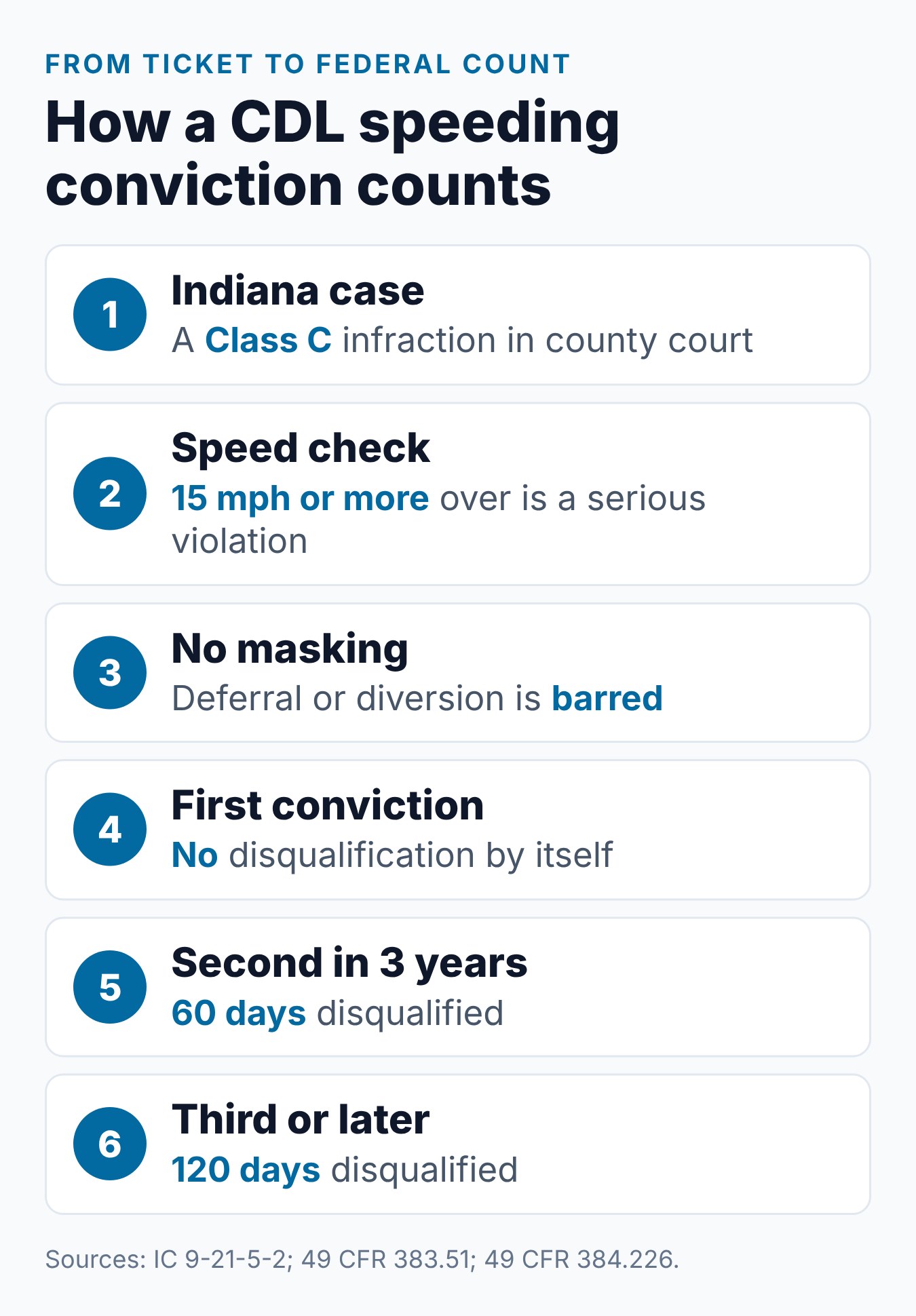
An Indiana CDL speeding ticket goes through an Indiana court like any other ticket, but federal rules decide what it means for your commercial license. Under 49 CFR 383.51, speeding 15 mph or more over the limit is a serious traffic violation, and a second conviction within 3 years brings a 60-day disqualification. Federal rules also bar the deferral programs that could keep a CDL holder’s conviction off the record.
Key Facts
- In court: a Class C infraction, with the same caps and court costs as any driver. See in court.
- Serious violation: speeding 15 mph or more over, and reckless driving, among others. See the federal list.
- Disqualification: 60 days for a second conviction within 3 years; 120 days for a third. See the periods.
- Personal vehicle: it counts only if the conviction leads to a revocation, cancellation or suspension. See personal vehicle tickets.
- No deferral: federal rules bar hiding a CDL holder’s conviction in any vehicle. See deferral.
- Indiana points: they apply as for any driver. See Indiana points.
How an Indiana CDL Speeding Ticket Is Handled in Court
Holding a CDL does not change the Indiana case. Ordinary speeding is a Class C infraction under IC 9-21-5-2. It is not a crime.
The money rules in IC 34-28-5-4 apply to every driver. The top Class C judgment is $500.
If you admit it on or before the appearance date, the judgment is capped at $35.50. If you contest and lose, the cap is $35.50, $250.50 or $500, based on moving violations found in that county in the past 5 years.
Court costs are added. The Indiana Trial Court Fee Manual lists $139 in statutory infraction costs, or $167 with the sheriff’s service fee. The State Police say payments go to the county where the ticket was issued.
What changes for a CDL holder is what happens after the case. That part is federal.
The Federal List of Serious Traffic Violations
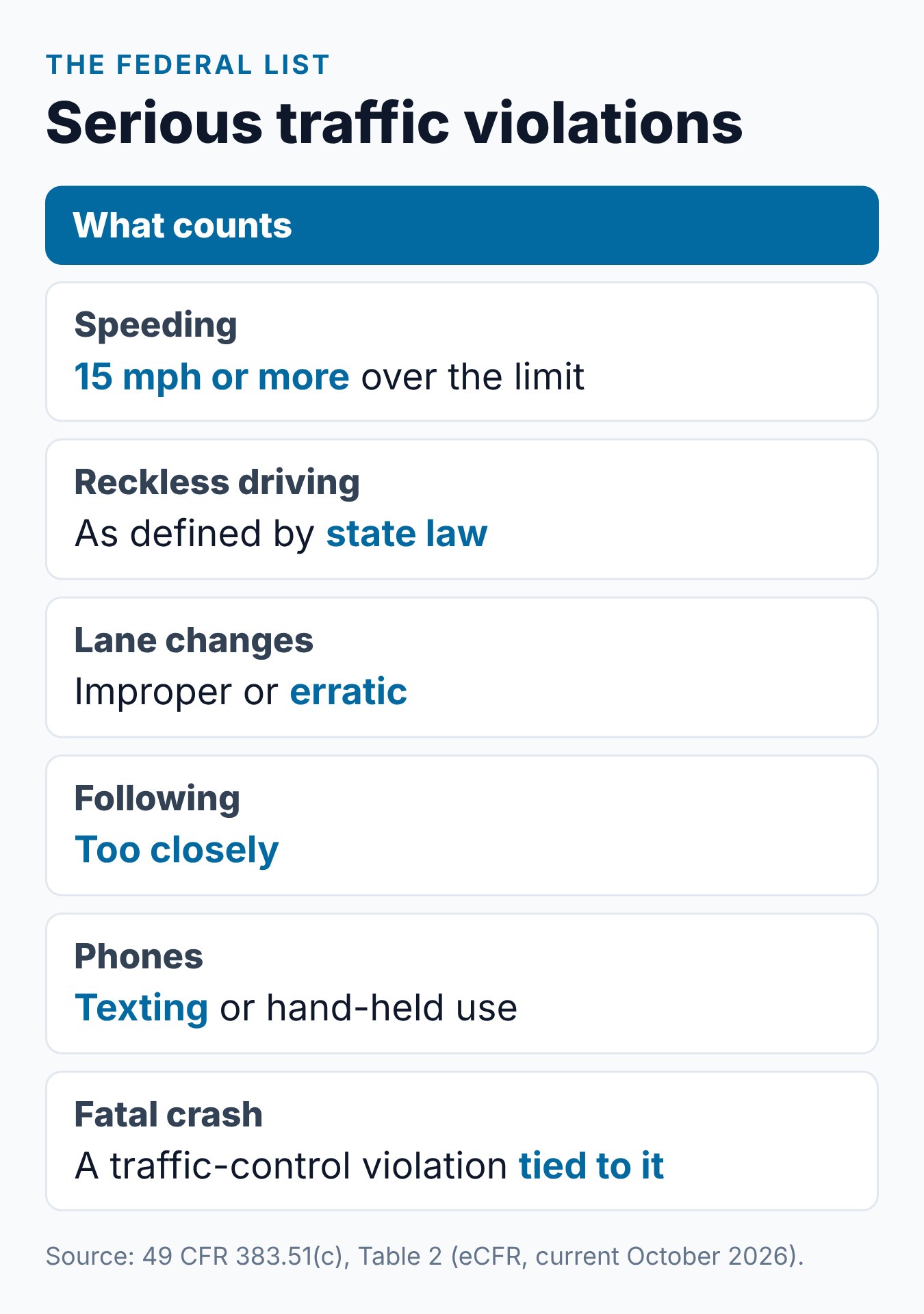
The federal rule 49 CFR 383.51 lists “serious traffic violations.” They include:
- Speeding “involving any speed of 24.1 kmph (15 mph) or more above the regulated or posted speed limit”
- Reckless driving, “as defined by State or local law or regulation”
- Improper or erratic lane changes
- Following too closely
- A traffic-control violation connected to a fatal crash
- CDL violations, such as driving without the right license or class
- Texting or hand-held phone use while driving
A speeding ticket for less than 15 mph over is not on this list. It still counts in Indiana as a normal speeding conviction with points.
Disqualification Periods
One serious violation does not, by itself, disqualify you. The count is what matters. Under 49 CFR 383.51:
- First conviction: no disqualification for that one alone
- Second conviction in a separate incident within 3 years: 60 days
- Third or later conviction within 3 years: 120 days
The 3-year window looks at convictions from separate incidents.
Your Indiana case and the federal count are separate steps. The Indiana conviction is what feeds the federal count.
The 15 mph Line vs. Indiana’s Point Tiers
The federal line and Indiana’s point tiers do not match exactly. Indiana’s point table in 140 IAC 1-4.5-10 uses these tiers:
- 1 to 15 mph over: 2 points
- 16 to 25 mph over: 4 points
- More than 25 mph over: 6 points
The federal rule starts at 15 mph or more. So a ticket for exactly 15 mph over falls in Indiana’s 2-point tier, yet it meets the federal speed mark. Read the speed on your ticket with both rules in mind.
Tickets in Your Personal Vehicle
Federal rules also reach tickets in your own car, but with a condition. Under 49 CFR 383.51, a serious violation in a non-commercial vehicle counts toward disqualification only “if the conviction results in the revocation, cancellation, or suspension” of the CDL or CLP holder’s license or non-CMV driving privileges.
In plain words, a personal-vehicle speeding conviction counts on the federal list only when it leads to a loss of license or driving privileges. Without that result, it does not count toward the 60-day or 120-day periods.
It still counts in Indiana. The BMV adds the same points to your record no matter which vehicle you drove.
Why Deferral Is Not an Option
Some Indiana prosecutors offer a deferral program under IC 34-28-5-1. When a driver meets its terms, the court dismisses the case. That section says it does not apply to offenses under IC 9-24-6.1 “involving the operation of a commercial motor vehicle.”
The federal rule goes further. 49 CFR 384.226 says, “The State must not mask, defer imposition of judgment, or allow an individual to enter into a diversion program” that would keep a CLP or CDL holder’s conviction off the federal CDLIS driver record.
This applies in any type of motor vehicle. It covers state or local traffic control violations, other than parking, vehicle weight or vehicle defect violations. So a CDL holder should not expect deferral, even for a ticket in a personal car.
Personal Vehicle vs. Commercial Vehicle
This table sums up how the vehicle changes the rules for a CDL holder:
| Question | In a commercial motor vehicle | In your personal vehicle |
|---|---|---|
| Is 15 mph or more over a serious violation? | Yes | Yes, but it counts only if the conviction leads to a revocation, cancellation or suspension |
| Can a deferral program keep it off the record? | No: IC 34-28-5-1 excludes CMV offenses, and federal rules bar it | No: federal rules bar it in any vehicle |
| Do Indiana BMV points apply? | Yes, on the same tiers | Yes, on the same tiers |
| Does the 3-year federal count apply? | Yes | Only for convictions that meet the condition above |
Indiana Points Still Apply
A CDL holder’s Indiana record works like anyone’s. The BMV points page says points stay active for two years from the conviction date. In a school zone or work site, speeding points rise to 4, 6 or 8.
Under the BMV point rules, 14 to 18 active points bring a warning notice. A suspension starts at 20 or more active points within 24 months, after any credit. Reckless driving carries 6 points, and reckless driving in a tractor-trailer combination carries 8.
Two tickets close together can also bring a BMV course order. Under IC 9-30-3-12, the BMV must order a Driver Safety Program after two traffic judgments, two traffic misdemeanor convictions, or one of each, for moving violations within 12 months. The course must be finished within 90 days of the notice, or driving privileges are suspended.
Zone tickets have their own fines. Our guide on school zone and work zone speeding covers them.
When Speed Leads to a Reckless Driving Charge
Reckless driving is on the federal list too, “as defined by State or local law.” In Indiana, it is a separate criminal charge under IC 9-21-8-52, not a speeding ticket.
The statute covers driving at an unreasonably high or low speed under the circumstances, among other acts. It sets no mph figure. Its base level is a Class C misdemeanor, rising to Class B with property damage and Class A with bodily injury.
Speed Limits for Heavy Vehicles
Some Indiana limits depend on vehicle weight. Under IC 9-21-5-2:
- Interstates outside urbanized areas of 50,000 or more people: 70 mph, but 65 mph for vehicles over 26,000 pounds
- Indiana Finance Authority highways: 70 or 65 mph, by vehicle weight
- Interstate 465: 65 mph
So a heavy truck can be over the limit at a speed that is legal for a car on the same road. Watch the posted signs for your vehicle class.
Where the Driver Safety Program Fits
The Driver Safety Program (DSP) is the BMV’s point-credit course. The BMV Driver Safety Program page says the BMV applies a 4-point credit for a BMV-approved course, once every three years.
The credit lowers your Indiana point total. But the BMV says completion “will not remove a citation from your driver history.” The conviction is still there, so the course does not change the federal count of serious violations.
Before You Pay
Paying a ticket means admitting the violation. A judgment is then entered, and the conviction is part of your record. For a CDL holder, that conviction may count under 49 CFR 383.51.
For that reason, CDL holders should talk to an Indiana attorney before paying any moving violation. The rules here are general information. They cannot tell you whether to pay or contest your own ticket.
What We Found on the Official Pages
On the eCFR pages we checked on October 26, 2026, both rules were shown as up to date. The 15 mph speed mark and the 60-day and 120-day periods in 49 CFR 383.51 had not changed.
The masking rule in 49 CFR 384.226 still applied to a CDL holder’s conviction “in any type of motor vehicle.”
Common Mistakes to Avoid
Each point below comes from federal rules, Indiana law or the BMV:
- Assuming one ticket disqualifies you. One serious violation alone does not.
- Forgetting the 3-year window. A second conviction in a separate incident within 3 years means 60 days.
- Counting on deferral. Federal rules bar it for CDL holders in any vehicle.
- Thinking a car ticket never counts. It counts if the conviction leads to a revocation, cancellation or suspension.
- Reading 15 over as minor. It is only 2 Indiana points, but it meets the federal speed mark.
- Expecting the DSP to clear a conviction. It adds a point credit; the citation stays.
For costs and points for all drivers, see our Indiana speeding ticket guide.
How Requirements Can Vary
Indiana’s point rules, the 4-point credit and the BMV’s Driver Safety Program order come from state law and BMV rules, and they apply statewide. What you must do still depends on whether you take the course by choice, because of a BMV notice, or under a court order. A court order sets its own deadline and proof steps.
Laws, fees and court practice can change. Check your BMV notice, your court order and the Indiana BMV website for current rules before you enroll or file anything.
Frequently Asked Questions
Does one speeding ticket disqualify a CDL?
No. Under 49 CFR 383.51, a single serious traffic violation does not disqualify you. A second conviction in a separate incident within 3 years brings 60 days.
How fast is a serious speeding violation for CDL holders?
The federal rule covers speeding of 15 mph or more above the posted or regulated limit.
Does a ticket in my own car count against my CDL?
Only if the conviction results in the revocation, cancellation or suspension of your license or non-commercial driving privileges. Indiana points still apply either way.
Can I get deferral on a speeding ticket if I have a CDL?
No. Federal rule 49 CFR 384.226 bars states from deferring or diverting a CDL holder’s traffic conviction in any type of vehicle. Indiana’s deferral law also excludes commercial vehicle offenses.
Does the Indiana Driver Safety Program help a CDL holder?
It can lower your Indiana point total by 4, once every three years. It does not remove the citation, so it does not change the federal count.
Are the fines higher for CDL drivers in Indiana?
The Indiana fine rules are the same for every driver. The added risk for a CDL holder is federal disqualification, not a higher fine.
Is reckless driving a serious violation for a CDL?
Yes. The federal list includes driving recklessly “as defined by State or local law or regulation.” In Indiana, reckless driving is a separate criminal charge from a speeding ticket.
Who can tell me what to do about my ticket?
An Indiana attorney can advise on your own case. Talk to one before you pay any moving violation.
Conclusion
An Indiana CDL speeding ticket is decided in an Indiana court, but federal rules decide how it counts against your commercial license. Two serious violations in 3 years mean 60 days, and deferral is off the table.
To add the 4-point credit to your Indiana record, see Driving Logic’s online Indiana Driver Safety Program. If a court ordered a course, check that the order allows an online course.
Related Articles
- Indiana Speeding Ticket: Costs, Points, and What to Know
- Indiana Speeding Ticket: What to Know Before You Pay or Contest It
- Indiana Work Zone and School Zone Speeding Tickets: Higher Fines
Sources
- 49 CFR § 383.51 — CDL disqualifications
- 49 CFR § 384.226 — Prohibition on masking convictions
- Indiana Code § 9-30-3-12 — Driver safety program
- Indiana Code § 9-21-8-52 — Reckless driving
- Indiana Code § 34-28-5-1 — Infraction actions and deferral
- Indiana Code § 34-28-5-4 — Infraction judgments
- Indiana Code § 9-21-5-2 — Maximum speed limits
- Indiana State Police — Traffic Tickets
- Indiana Office of Judicial Administration — Trial Court Fee Manual (PDF)
- Indiana BMV — Driver Record Points
- 140 IAC 1-4.5 — BMV point system rules
- Indiana BMV — Citation Points & Driver Safety Program
Billy Forte is the owner of Driving Logic, a state-approved driver improvement course provider serving Indiana and other U.S. states.
This article is general information, not legal advice. Indiana BMV rules, court orders, fines and penalties depend on your notice, citation, court and case facts, and they can change. Use official Indiana BMV and court sources, and consult a qualified Indiana attorney for advice about your own case.