
Updated October 2026 · Reviewed by Billy Forte
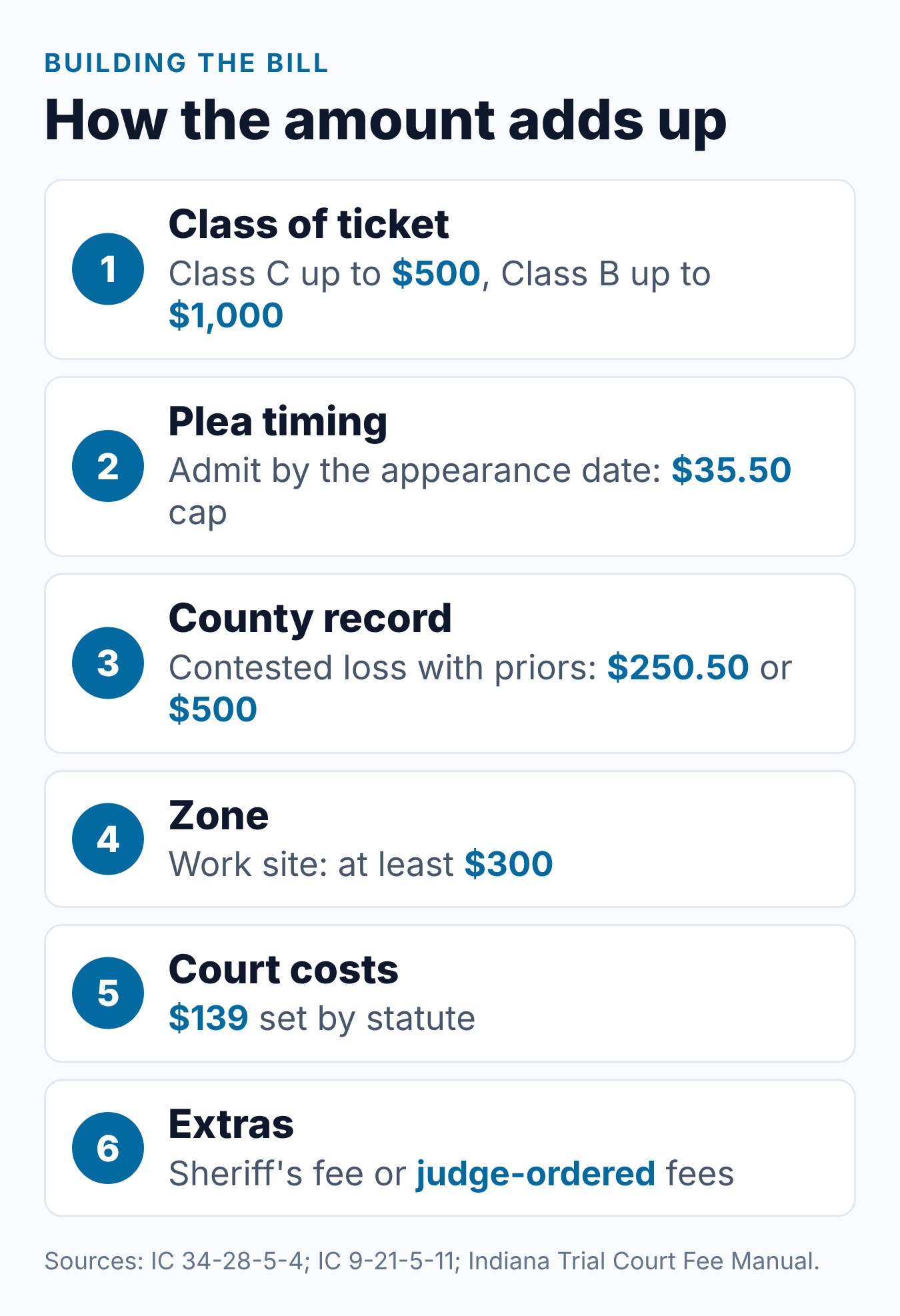
Your Indiana speeding ticket cost does not go up with each mile per hour over the limit, because no Indiana law sets fines by speed. Instead, the amount turns on five things: the class of the ticket, whether you admit or contest it, prior findings in that county, the zone and the court costs. Speed changes your BMV points, not the judgment cap.
Key Facts
- Speed: no statewide fine schedule by mph exists in Indiana law. See why speed does not set the fine.
- Class C cap: up to $500, or no more than $35.50 if you admit on time. See the class of the ticket.
- Prior findings: a contested loss can cost up to $250.50 or $500 with priors in that county. See prior findings.
- Zones: school and work zone speeding are Class B, with higher limits and minimums. See zones.
- Court costs: $139 in statutory costs, or $167 with the sheriff’s fee. See court costs.
Why Speed Does Not Set the Fine
You may want a price list by speed, such as 10 over or 30 over. Indiana law does not have one. The judgment caps in IC 34-28-5-4 turn on plea timing and prior findings, not on mph.
Here is how the same ordinary-road ticket looks at three speeds, if you admit it on or before the appearance date:
| Speed over the limit | Judgment cap on a timely admission | BMV points |
|---|---|---|
| 10 mph | $35.50 plus court costs | 2 |
| 20 mph | $35.50 plus court costs | 4 |
| 30 mph | $35.50 plus court costs | 6 |
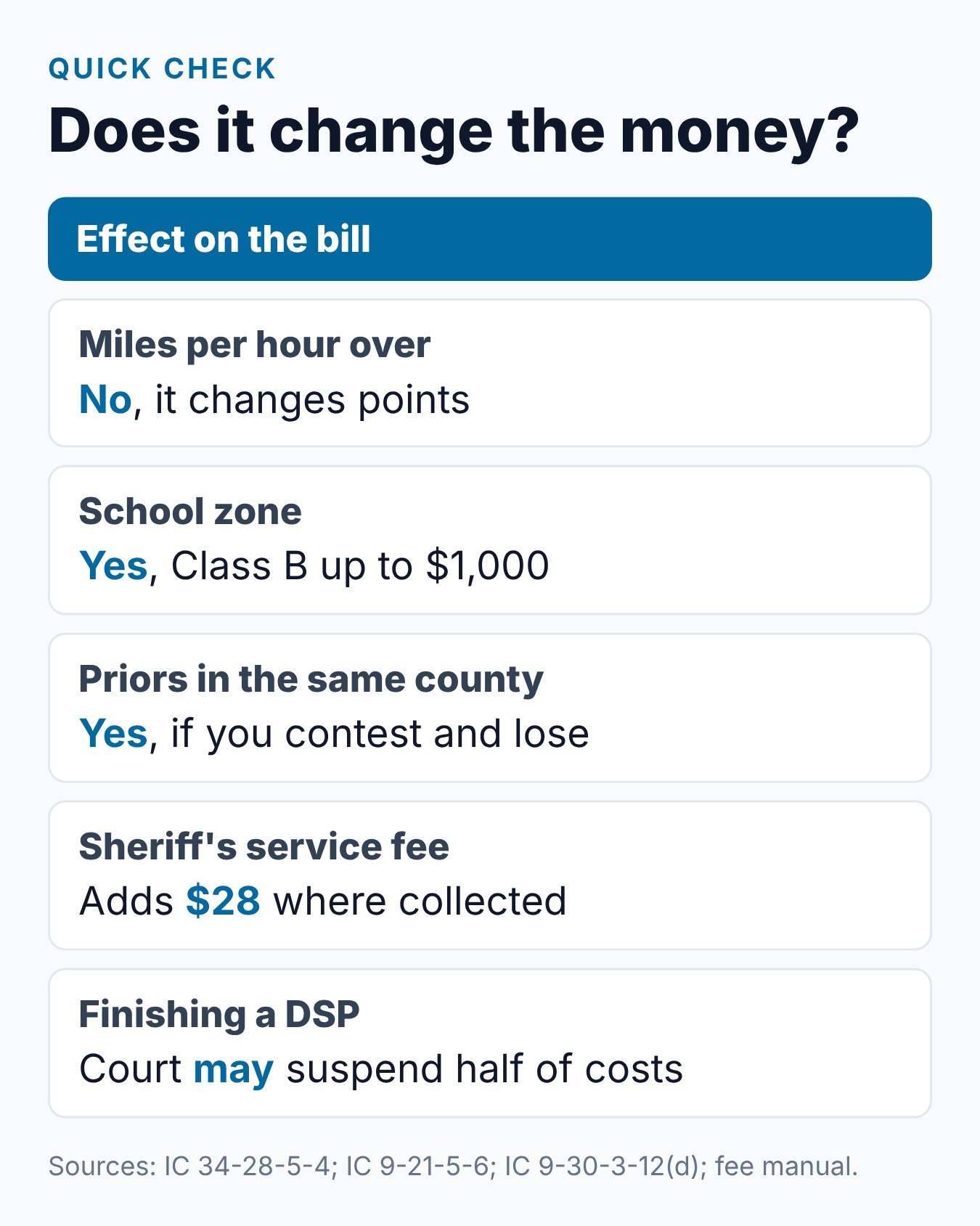
Speed does matter in one place: your BMV points. Even more than 25 mph over the limit is still a Class C infraction under IC 9-21-5-2, with 6 points.
Reckless driving is a separate criminal charge with no mph threshold. See when speeding becomes reckless driving.
Factor 1: The Class of the Ticket
Every infraction has a class, and each class has a top judgment. Under IC 34-28-5-4:
- Class B: up to $1,000
- Class C: up to $500, subject to the lower caps in subsection (f)
- Class D: up to $25
Ordinary speeding is Class C. School zone and work zone speeding are Class B, so the ceiling doubles. The class is the first thing to check when you estimate a bill.
Factor 2: Admitting on Time
Timing changes the cap for a Class C moving violation. If you admit it, or plead nolo contendere, on or before the appearance date, you cannot be made to pay more than “court costs and a judgment that does not exceed” $35.50.
That cap is tied to the date. Our pay or contest guide explains both paths without telling you which to pick.
Factor 3: Prior Findings in the Same County
If you contest a Class C moving violation and the court finds you committed it, the cap depends on your recent record. The law counts moving violations found “by a court in the county” in the 5 years before.
| Moving violations found in that county, past 5 years | Highest judgment after a contested loss |
|---|---|
| None | $35.50 |
| One | $250.50 |
| Two or more | $500 |
Priors matter only on the contested path. If you admit on or before the appearance date, the statute keeps the cap at $35.50, whatever your county record shows.
This lookback is local. Findings in a different county do not count toward these caps under the statute’s wording.
Factor 4: School Zones and Work Zones
Zones change the class, and the class changes the money.
- School zone. Going over a school zone limit set under IC 9-21-5-6 is a Class B infraction, up to $1,000.
- Work site. Under IC 9-21-5-11, a first violation brings a fine of at least $300. With one prior in 3 years, it is at least $500. With two or more priors, it is $1,000.
The $35.50 and $250.50 caps cover Class C cases only, so they do not apply here. See our school zone and work zone guide.
Factor 5: Court Costs
Court costs are set by statute, not by each judge. The Indiana Trial Court Fee Manual lists an infraction costs fee of $70 under IC 33-37-4-2. With the add-on fees, the total is $139.
The manual adds that the “Total is $167 if office is collecting the sheriff’s service of process fee of $28.” So the sheriff’s fee is one reason two counties can differ.
A judge may also order certain extra fees. The manual names fees such as an alcohol and drug program fee and a countermeasures fee. These depend on the case.
Factor 6: Deferral Fees
Some prosecutors offer a deferral program under IC 34-28-5-1. It has its own costs:
- Clerk fee. $70 for a moving traffic offense, paid to the clerk of court.
- User fees. An initial fee and a monthly fee set by the prosecutor.
- Fee manual limits. Up to $52 for the initial fee and $10 a month.
If you meet the terms, the court dismisses the case, and it may not be refiled. Deferral does not apply to commercial motor vehicle offenses.
Indiana Speeding Ticket Cost Pieces That Can Shrink or Grow
Two more rules touch the total. First, IC 9-30-3-12(d) lets any court suspend one-half of each court cost for a traffic violation if you complete a Driver Safety Program. That choice belongs to the court.
Second, IC 34-28-5-4(g) says the capped amounts are “in addition to” the cost of a “defensive driving school program.” As a separate fact, the BMV DSP page caps the price of any approved Driver Safety Program (DSP) course at $55.
In Marion County, there is also a floor. The judgment there may not be less than $35 (IC 34-28-5-4(h)).
Who Sets Each Piece
Several people and offices shape the final amount. Knowing who sets what helps you ask the right office:
- The legislature. State law sets the class limits, the Class C caps and the statutory court costs.
- The prosecutor. Where a deferral program exists, the prosecutor sets its user fees.
- The judge. The judge enters the judgment within the caps, may order certain extra fees and may suspend half of the costs after a DSP.
- The county clerk. The clerk’s office takes the payment and can tell you the amount due.
When the BMV Adds Costs Later
A ticket can lead to costs outside the court case. Under IC 9-30-3-12, two traffic convictions or judgments for moving violations within 12 months mean the BMV must order a Driver Safety Program. You pay for that course, up to the $55 cap, and must finish within 90 days of the notice.
If you do not finish, the BMV suspends your driving privileges. Read our BMV-ordered DSP guide for the full rule.
Points Are Not Part of the Bill
Points go on your BMV record, not your court bill. Under 140 IAC 1-4.5-10, speeding brings 2, 4 or 6 points by speed, and 4, 6 or 8 in a school zone or work site.
Points can still lead to costs later, such as a suspension at 20 active points. See how many points a speeding ticket adds.
How to Find Your Exact Amount
Only your court can confirm your bill. Use these steps:
- Read the ticket. The Indiana State Police say it should include directions to pay or contest.
- Find the county. Payments go to the county where the ticket was issued.
- Check the class. Class B zone tickets follow different rules than Class C.
- Ask the clerk. Confirm the judgment, court costs and any added fees before you pay.
Questions to Ask the Clerk
A short call or visit can clear up the amount. Useful questions include:
- What is the judgment amount if I admit the violation by the appearance date?
- Are the court costs $139 here, or $167 with the sheriff’s fee?
- Has the judge ordered any other fees in my case?
- Is my ticket a Class C infraction or a Class B zone infraction?
- Does the prosecutor run a deferral program, and what are its fees?
The clerk can tell you amounts and dates. For advice about your own case, talk with an Indiana attorney.
What We Found on the Official Pages
On the official pages we checked on October 26, 2026, the fee manual was marked “Current through 2026 Legislative Session.” It listed the $139 infraction total and the $167 total with the sheriff’s fee. It also listed a $0.50 highway worksite fee among its traffic fees, and the $70 court cost for deferral cases.
The statutes we used set caps by plea timing, prior findings and class. None of them set a fine for a given number of mph over the limit.
Common Mistakes to Avoid
Each item comes from Indiana law or the fee manual:
- Looking for a price per mph. The law ties the cap to timing and priors.
- Applying Class C caps to a zone ticket. School and work zone speeding are Class B.
- Counting priors from other counties. The lookback counts findings in the same county.
- Treating work zone amounts as ceilings. $300 and $500 are minimums.
- Forgetting court costs. They are added to the judgment.
- Paying the police. Payments go to the county.
- Thinking the course replaces the judgment. Course costs are in addition to the capped amounts.
How Requirements Can Vary
Indiana’s point rules, the 4-point credit and the BMV’s Driver Safety Program order come from state law and BMV rules, and they apply statewide. What you must do still depends on whether you take the course by choice, because of a BMV notice, or under a court order. A court order sets its own deadline and proof steps.
Laws, fees and court practice can change. Check your BMV notice, your court order and the Indiana BMV website for current rules before you enroll or file anything.
Frequently Asked Questions
How much is a speeding ticket in Indiana by mph over?
Indiana law sets no fine by mph over the limit. For ordinary speeding, the judgment is capped at $35.50 if you admit on time, plus court costs. Speed changes your points.
What are court costs on an Indiana speeding ticket?
The fee manual lists $139 in statutory infraction costs. The total is $167 where the office collects the $28 sheriff’s fee.
Why can my ticket cost more if I contest it?
If you contest and lose, the cap depends on moving violations found in that county in the past 5 years. It can be $35.50, $250.50 or $500.
How much is a school zone speeding ticket?
School zone speeding is a Class B infraction, with a judgment of up to $1,000. The lower Class C caps do not apply.
Is the work zone fine $300?
That is the minimum for a first violation. It is at least $500 with one prior in 3 years and $1,000 with two or more.
Can a Driver Safety Program lower my court costs?
A court may suspend half of each court cost if you complete a DSP. It is the court’s choice, so ask your court.
Does Marion County have its own rule?
Yes, one. In Marion County, the judgment may not be less than $35 under IC 34-28-5-4(h). The other caps still apply.
Is deferral cheaper than paying?
It has its own fees: $70 to the clerk plus user fees set by the prosecutor. Compare the amounts your county quotes. Deferral is not available for commercial motor vehicle offenses.
Conclusion
Indiana speeding ticket cost comes from the class, your plea timing, prior county findings, the zone and statutory court costs. Ask your county clerk for the exact amount before you pay.
To work on your point total, see Driving Logic’s online Indiana Driver Safety Program. If a court ordered a course, check that the order allows an online course.
Related Articles
- Indiana Speeding Ticket: Costs, Points, and What to Know
- Indiana Speeding Ticket: What to Know Before You Pay or Contest It
- 20 Over Speeding Ticket in Indiana: What to Know About Cost and Points
- Indiana Work Zone and School Zone Speeding Tickets: Higher Fines
Sources
- Indiana Code § 34-28-5-4 — Infraction judgments
- Indiana Code § 34-28-5-1 — Infraction actions and deferral
- Indiana Code § 9-21-5-2 — Maximum speed limits
- Indiana Code § 9-21-5-6 — Local and school zone speed limits
- Indiana Code § 9-21-5-11 — Worksite speed limits
- Indiana Office of Judicial Administration — Trial Court Fee Manual (PDF)
- Indiana State Police — Traffic Tickets
- Indiana Code § 9-30-3-12 — Driver safety program
- Indiana BMV — Citation Points & Driver Safety Program
- 140 IAC 1-4.5 — BMV point system rules
Billy Forte is the owner of Driving Logic, a state-approved driver improvement course provider serving Indiana and other U.S. states.
This article is general information, not legal advice. Indiana BMV rules, court orders, fines and penalties depend on your notice, citation, court and case facts, and they can change. Use official Indiana BMV and court sources, and consult a qualified Indiana attorney for advice about your own case.