
Updated October 2026 · Reviewed by Billy Forte
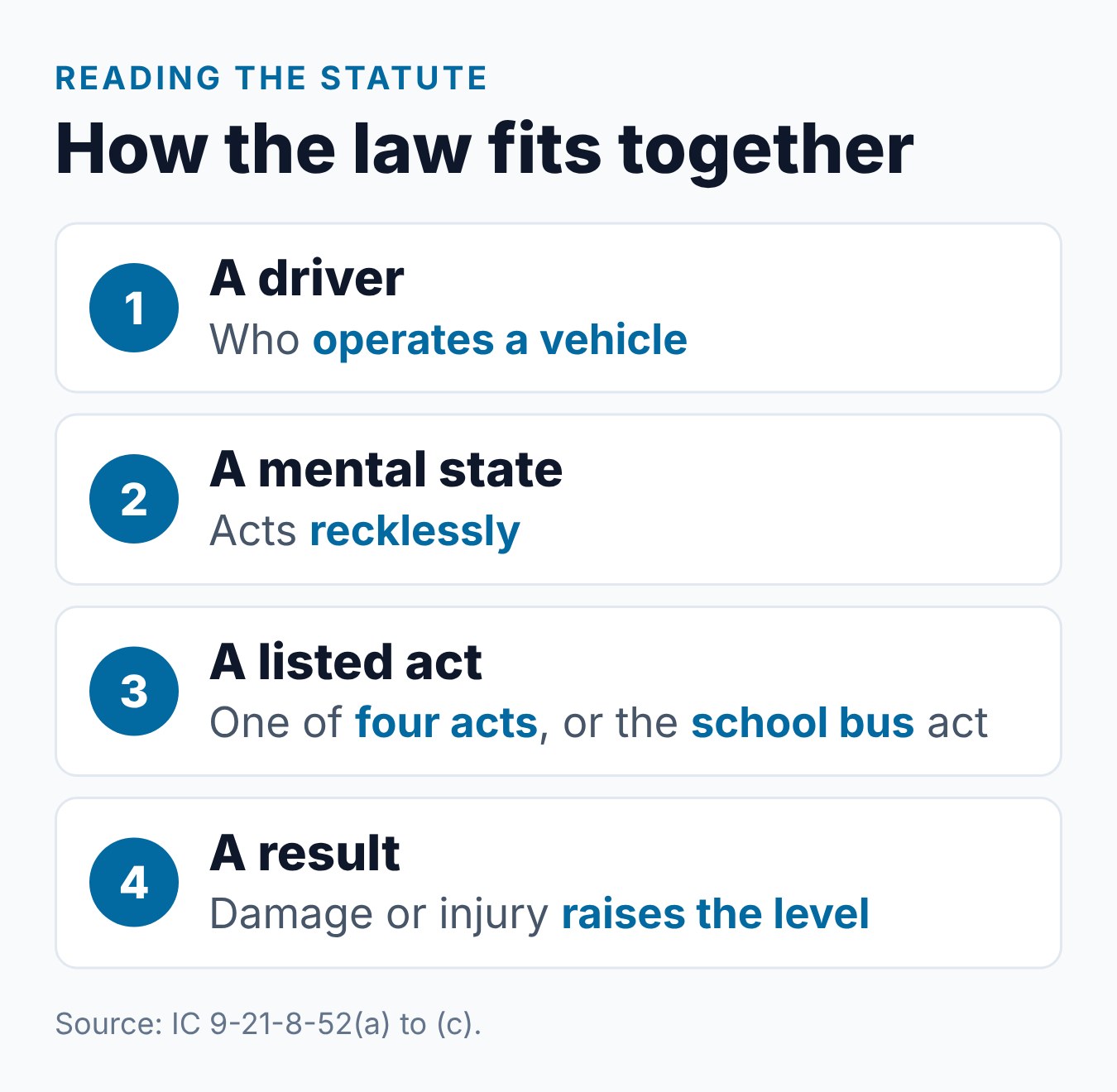
If you are asking what is reckless driving in Indiana, the answer sits in one statute, IC 9-21-8-52. It covers a driver who acts “recklessly” in one of four listed ways, plus a fifth act about passing a stopped school bus. Below, each act is quoted from the law and then put into plain words.
Key Facts
- One statute: IC 9-21-8-52 defines the offense. See how the law is built.
- Four acts: unreasonable speed, blind passing, weaving through a line of traffic, and blocking a pass. See the four acts.
- Slow can count: an unreasonably low speed can be reckless too. See act 1.
- School bus act: recklessly passing a stopped bus with its stop arm out. See the school bus act.
- Not in the law: no speed number and no first-offense tier. See what the statute leaves out.
What Is Reckless Driving in Indiana Under the Statute?
The law opens with these words: “A person who operates a vehicle and who recklessly:”. A list of four acts follows. Each act is one complete way to commit the offense.
So two things must line up in every case. First, the person was operating a vehicle. Second, the person did one of the listed acts, and did it recklessly.
You can read the full text at IC 9-21-8-52 in the official 2026 Indiana Code. The sections below take each part in turn.
What “Recklessly” Means in Plain Words
“Recklessly” is the key word in the statute. It sits in front of every act on the list. A driver who does a listed act without acting recklessly does not fit the words of this law.
In everyday English, reckless means acting with no real care for a clear danger. It is more than a small slip. How a court applies the word to a real drive is a legal question for that court or an Indiana attorney.
What “Under the Circumstances” Means
The speed act adds a second phrase: “under the circumstances.” It ties the speed to the setting at that moment. Road shape, traffic, weather and people nearby are all part of the setting.
This is why the law can treat the same speed in two ways. A speed that is safe on an open road may be unsafe in heavy traffic. The statute asks whether the speed was unreasonable for the conditions, not whether it passed a set number.
Act 1: Unreasonable Speed, High or Low
The first act covers a driver who “drives at such an unreasonably high rate of speed or at such an unreasonably low rate of speed under the circumstances as to:”. Two results follow:
- “(A) endanger the safety or the property of others; or”
- “(B) block the proper flow of traffic;”
Note both directions. Driving far too slowly can also be reckless driving when it blocks traffic or puts others at risk. The speed must also cause one of those two results.
Act 2: Passing on a Slope or Curve
The second act covers a driver who “passes another vehicle from the rear while on a slope or on a curve where vision is obstructed for a distance of less than five hundred (500) feet ahead.”
In plain words, this is passing when you cannot see far enough ahead. The law names two places, a hill and a bend. It also names a distance, under 500 feet of clear view.
Act 3: In and Out of a Line of Traffic
The third act covers a driver who “drives in and out of a line of traffic, except as otherwise permitted.” People call this weaving.
The last four words matter. Lane moves that traffic law allows are not what this act targets. The act is about cutting in and out of a line of cars in a way the law does not permit.
Act 4: Not Letting Another Driver Pass
The fourth act covers a driver who “speeds up or refuses to give one-half (1/2) of the roadway to a driver overtaking and desiring to pass.”
So this act has two forms. One is speeding up while someone is trying to pass you. The other is refusing to give them half the road.
The School Bus Act
Subsection (b) adds a separate act. It covers a person “who operates a vehicle and who recklessly passes a school bus stopped on a roadway or a private road” while the bus’s arm signal device “is in the device’s extended position.” The arm signal device is the one described in IC 9-21-12-13.
This act has its own penalty levels. It can reach felony levels when it causes injury or death.
The Five Acts Side by Side
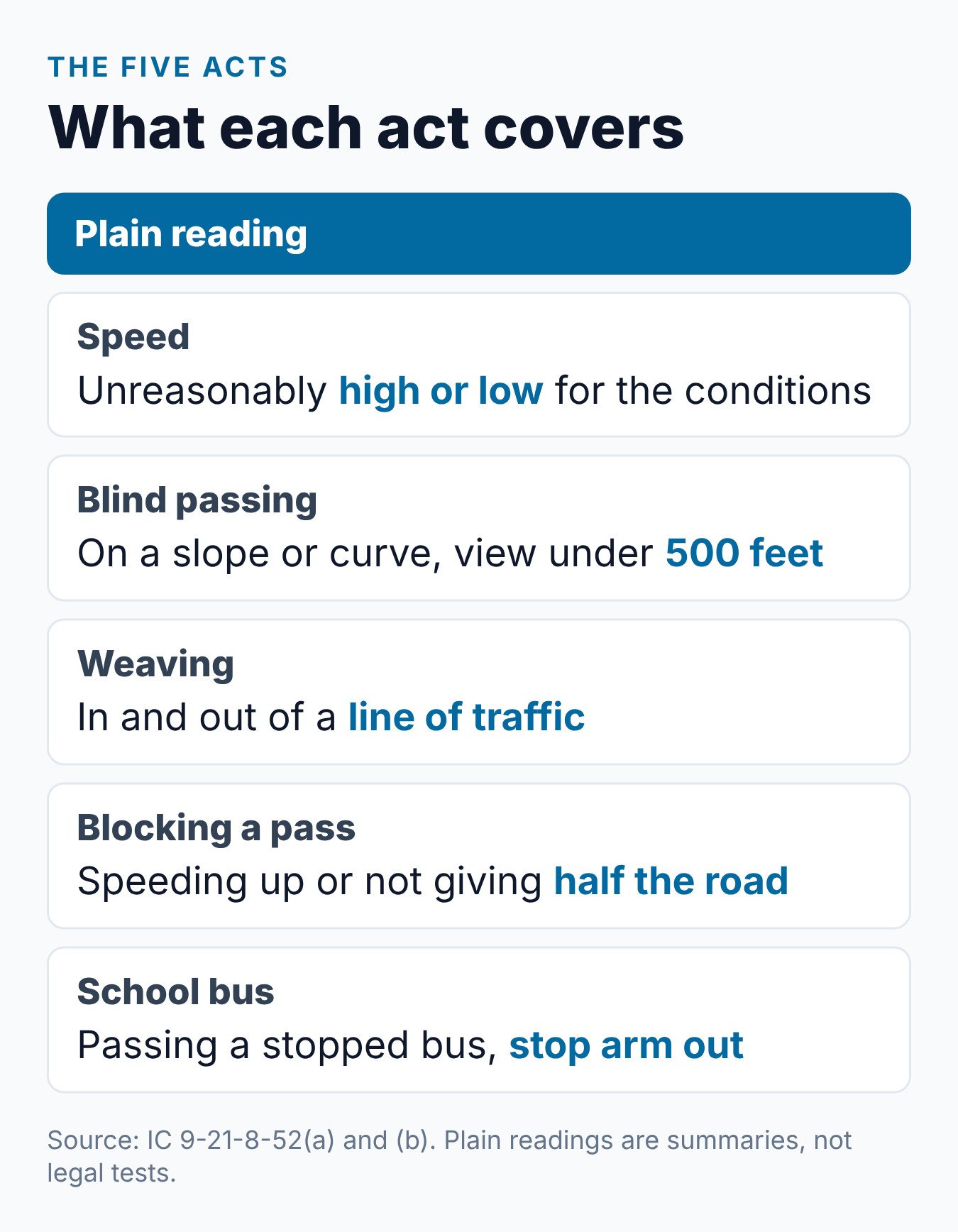
This table puts each act’s key statute words next to a plain reading. The plain reading is a summary, not a legal test.
| Act | Key words in the law | Plain reading |
|---|---|---|
| Speed | “unreasonably high” or “unreasonably low rate of speed under the circumstances” | Too fast or too slow for the conditions, with danger or blocked traffic |
| Blind passing | “on a slope or on a curve” with vision blocked “less than five hundred (500) feet ahead” | Passing on a hill or bend without a clear view |
| Weaving | “in and out of a line of traffic, except as otherwise permitted” | Cutting through a line of cars in a way the law does not allow |
| Blocking a pass | “speeds up or refuses to give one-half (1/2) of the roadway” | Speeding up or crowding a driver who is passing you |
| School bus | “recklessly passes a school bus stopped” with the arm “in the device’s extended position” | Going past a stopped bus while its stop arm is out |
What the Statute Leaves Out
Some things people expect to find are not in the text:
- No speed number. The law never names a speed that counts as reckless. Our guide to reckless driving speed looks at that wording.
- No first-offense tier. The level depends on what the driving caused, not on a count of past cases.
- No felony for the four acts. The felony levels in this section apply only to the school bus act.
The Rest of the Statute: Subsections (c) to (e)
The later parts of the law deal with results and the license. They do not add new acts.
- Subsection (c): if an act under (a) damages another person’s property, it is a Class B misdemeanor. The court may recommend a license suspension of up to 1 year.
- Subsection (d): if an act under (a) causes bodily injury, the court may recommend a suspension of driving privileges for up to 1 year.
- Subsection (e): for the school bus act, the court may suspend driving privileges for 90 days, or 1 year with a prior offense.
So the acts tell you what the offense is. The results tell you how serious the charge becomes.
Who Decides If a Drive Was Reckless
The statute sets the words, but people apply them. A prosecutor decides which charge to file, based on the facts of the drive. The court then decides the case.
That is why two drives that look alike on paper can end in different charges. The circumstances are part of the law’s own test.
Related Offenses That Are Separate
Other Indiana laws cover driving that can look similar. Each is its own offense with its own text:
- Aggressive driving is a separate section, IC 9-21-8-55.
- Reckless operation in a highway work zone applies near a worksite when workers are present, under IC 9-21-8-56.
- Criminal recklessness is a crime in the criminal code, IC 35-42-2-2.
A prosecutor decides which law fits the facts. For felony routes under these other laws, see is reckless driving a felony in Indiana.
Penalties in Brief
For the four acts, the base charge is a Class C misdemeanor. Damage to another person’s property makes it Class B. Bodily injury makes it Class A.
The school bus act starts at Class A. It is a Level 6 felony with bodily injury and a Level 5 felony with death. The reckless driving penalties guide gives jail and fine limits for each level.
Points in Brief
A conviction also adds points to your BMV record under 140 IAC 1-4.5-10. The values are 6 points for reckless driving, 8 with property damage and 10 with bodily injury.
The Driver Safety Program (DSP) is a BMV-approved course of at least 4 hours. Completing one adds a 4-point credit to your record, once every three years. The BMV DSP page says it “will not remove a citation from your driver history.”
What to Look for on Your Paperwork
Court papers name the law, and they may list the subsection. A few details are worth checking:
- The section number. IC 9-21-8-52 is reckless driving; IC 9-21-8-56 is the work zone law.
- The subsection. Subsection (a) is one of the four acts, and (b) is the school bus act.
- Damage or injury. The BMV does not assume either one for points. The higher point value applies when the court order or court record says so.
If anything on your BMV record looks wrong, the BMV has a material error review process. Ask the court or an Indiana attorney about the charge itself.
What We Found on the Official Pages
On the official 2026 Indiana Code we checked on October 26, 2026, IC 9-21-8-52 still had the four acts in subsection (a). It also had the school bus act in subsection (b). The text contained no speed figure.
The section’s most recent change was in 2019. That change set the school bus penalties.
Common Mistakes to Avoid
Each item comes from the statute’s own words:
- Thinking only fast driving counts. An unreasonably low speed can count too.
- Leaving out “recklessly.” Each act needs it.
- Treating every lane change as weaving. The act excepts moves that are “otherwise permitted.”
- Forgetting the 500-foot detail. The passing act is about a blocked view on a slope or curve.
- Mixing up the laws. Aggressive driving and criminal recklessness are separate sections.
How Requirements Can Vary
Indiana’s point rules, the 4-point credit and the BMV’s Driver Safety Program order come from state law and BMV rules, and they apply statewide. What you must do still depends on whether you take the course by choice, because of a BMV notice, or under a court order. A court order sets its own deadline and proof steps.
Laws, fees and court practice can change. Check your BMV notice, your court order and the Indiana BMV website for current rules before you enroll or file anything.
Frequently Asked Questions
What is the Indiana reckless driving law?
It is IC 9-21-8-52. It lists four reckless acts in subsection (a) and a school bus act in subsection (b).
Can driving too slowly be reckless driving?
Yes. The law includes an “unreasonably low rate of speed” that endangers others or blocks the proper flow of traffic.
Is weaving through traffic reckless driving?
It can be. The law covers driving “in and out of a line of traffic, except as otherwise permitted.” The driver must also act recklessly.
Is passing a stopped school bus reckless driving?
Recklessly passing a stopped school bus with its stop arm out is a separate act in subsection (b). It is a Class A misdemeanor at the base level.
Does the law say what speed is reckless?
No. It asks whether the speed was unreasonable “under the circumstances.” No number appears in the text.
Is aggressive driving the same as reckless driving?
No. Aggressive driving is a separate section, IC 9-21-8-55. Each law has its own text.
Conclusion
Reckless driving in Indiana means doing one of the acts in IC 9-21-8-52, and doing it recklessly. The law names conduct and results, not a speed.
For your own case, ask the court or an Indiana attorney how the law applies. If you plan to take a course for the 4-point credit, see Driving Logic’s online Indiana Driver Safety Program.
Related Articles
- Reckless Driving in Indiana: Penalties, Points, and Driver Safety Options
- Indiana Reckless Driving Speed: Is There an MPH Limit?
- Is Reckless Driving a Felony in Indiana? What to Know
Sources
- Indiana Code § 9-21-8-52 — Reckless driving
- Indiana Code § 9-21-8-56 — Reckless operation in a highway worksite
- 140 IAC 1-4.5 — BMV point system rules
- Indiana BMV — Citation Points & Driver Safety Program
Billy Forte is the owner of Driving Logic, a state-approved driver improvement course provider serving Indiana and other U.S. states.
This article is general information, not legal advice. Indiana BMV rules, court orders, fines and penalties depend on your notice, citation, court and case facts, and they can change. Use official Indiana BMV and court sources, and consult a qualified Indiana attorney for advice about your own case.