
Updated October 2026 · Reviewed by Billy Forte
A defensive driving course Indiana drivers search for is, in BMV terms, the Driver Safety Program (DSP), but only a course from a provider on the BMV’s approved list counts as that program. The name in Indiana law and on BMV pages is “driver safety program.” A class from a provider that is not on the list does not earn the BMV’s 4-point credit, whatever it is called.
Key Facts
- Official name: Driver Safety Program, from IC 9-30-3-12 and the BMV. See where the name comes from.
- The test that matters: the provider must be on the BMV’s approved list. See what makes a course count.
- The credit: only BMV-approved courses earn the 4-point credit. See why the name matters.
- Courts: an order may accept a course the BMV does not list. See court orders.
- Not driver ed: the DSP does not teach you how to drive. See DSP versus driver education.
The Short Answer
They can be the same course, but not always. The search phrase is broad. Indiana’s program has a legal name and a fixed list of providers.
So the question to ask is not “What is the course called?” It is “Is the provider on the BMV’s list?” If yes, you are taking Indiana’s DSP. If no, the BMV will not apply its credit.
Where the Name Comes From
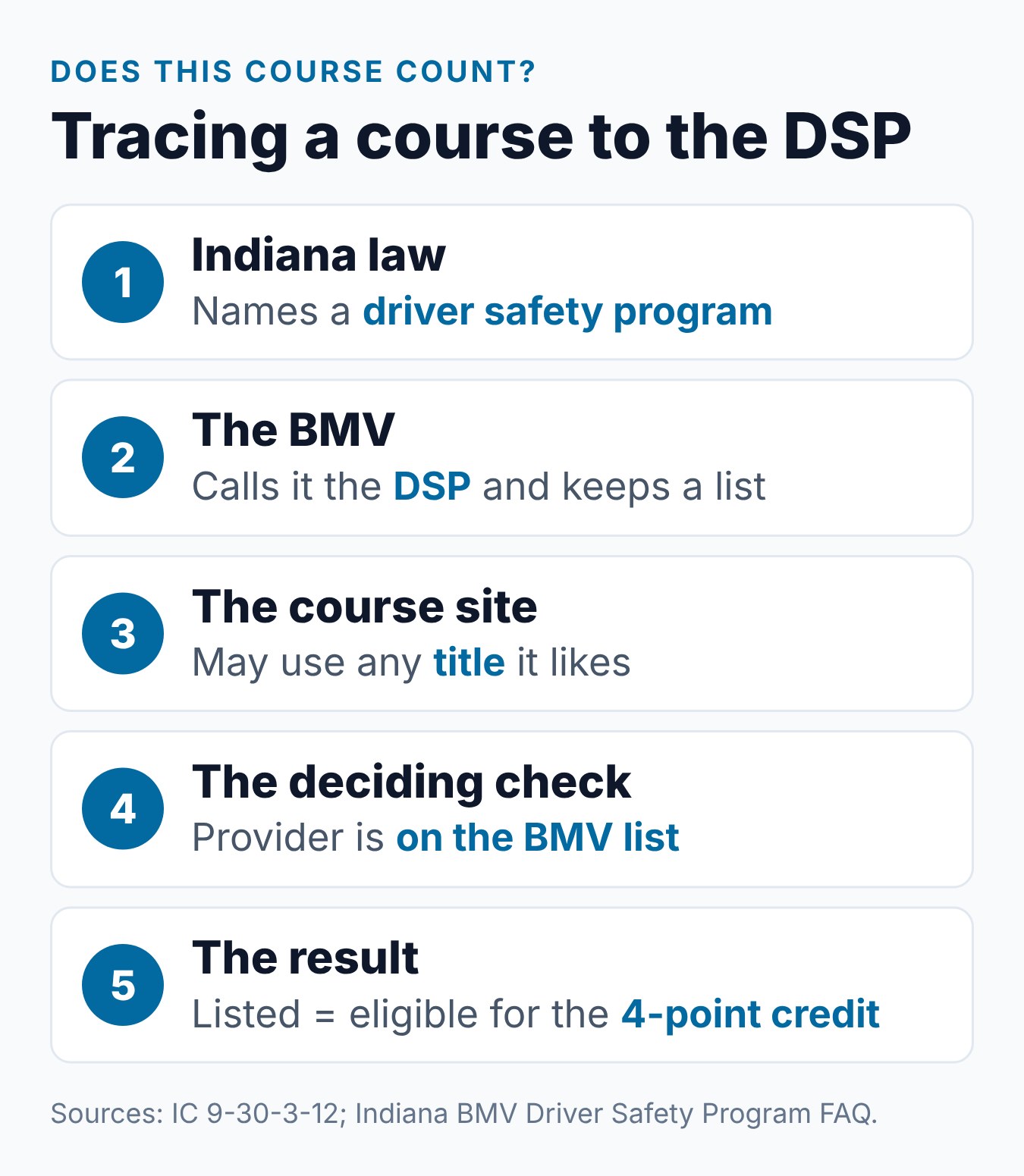
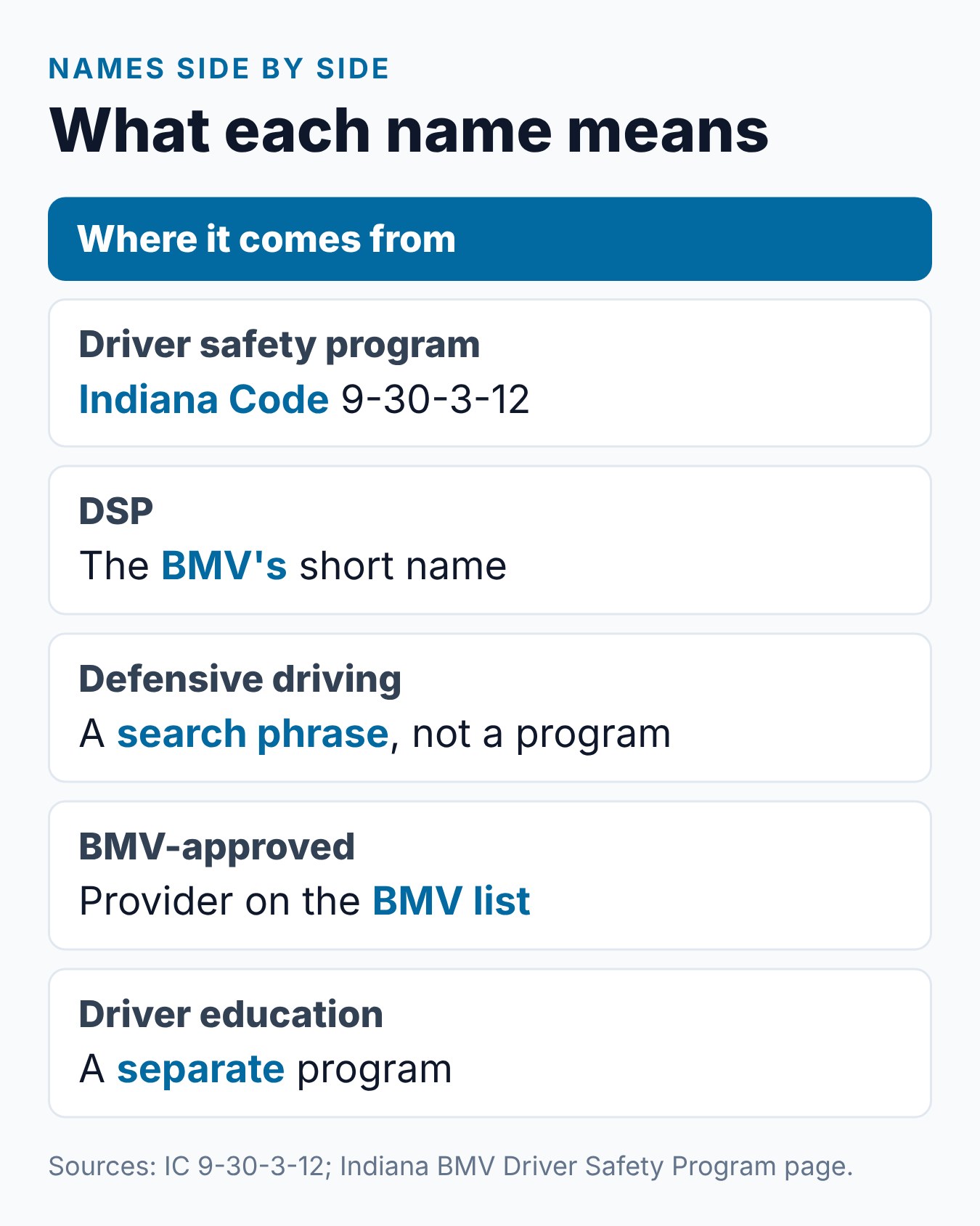
The name comes from state law. IC 9-30-3-12 refers to “a driver safety program approved by the bureau.” The bureau is the Bureau of Motor Vehicles.
The BMV uses the same name. Its page is titled “Citation Points & Driver Safety Program,” and it shortens the name to DSP.
The statute was last amended in 2021. The 2026 Indiana Code text still uses the same name.
Defensive Driving Course Indiana Searches and the DSP
The everyday phrase is close to what the course does. The BMV’s FAQ says the DSP provides information “that will help improve defensive driving skills.”
That is why the two names get mixed up. One is a plain description. The other is the program the BMV approves and tracks.
The BMV’s FAQ speaks of the Driver Safety Program and of DSP providers. Those are the terms to look for.
What Makes a Course Count
The BMV Driver Safety Program page answers this in its FAQ. It asks, “Can I use any Driver Safety Program vendor?” The answer is “No.”
The BMV goes on to say that credit reaches your Official Indiana Driver Record only when a BMV-approved DSP provider gave the course. The approved providers are listed on that same page.
Here is how different course types line up:
| Course | Indiana DSP for BMV purposes? | Earns the 4-point credit? |
|---|---|---|
| Course from a provider on the BMV list | Yes | Yes, once every three years |
| Class from a provider not on the list | No | No |
| Class from another state, provider not on the list | No | No |
| Indiana driver education | No, it is a different program | No |
| Course a court accepts, provider not on the list | Only for that court’s order | No |
Where to Find the Official List
The list sits on the BMV’s Driver Safety Program page. Each entry gives the provider’s name, contact details and formats.
To sign up, the BMV says to “call or email the provider directly.” Our guide to checking BMV approval walks through the check one step at a time.
One Course, Three Reasons to Take It
The name stays the same no matter why you enroll. What changes is who asks for it:
- The BMV. A mailed notice after two qualifying convictions or judgments for moving violations in 12 months, or two pointable incidents while under 21.
- A judge. A court order, with the court’s own terms.
- You. The BMV says “Any Indiana driver can take a DSP course.”
In every case, a course from a listed provider is the one the BMV credits.
Court Orders Are a Special Case
A judge may order a driver to take a course. The BMV says a court may use a DSP “as an alternative to suspension of driving privileges.” It also says “the court order may not specifically require participation in a BMV-approved DSP.”
That means a court can accept a course for its own case that is not on the BMV list. But the BMV credit still depends on the list. If you want both, a listed provider covers both.
The order sets the deadline and how to prove you finished. Read it closely. Our court-ordered DSP guide explains more.
DSP Versus Driver Education
The DSP is not driver education. The BMV FAQ says the courses “do not teach an individual how to drive.”
Driver education is a separate program tied to getting a first license. A DSP course does not stand in for it. A driver education class also does not stand in for the DSP.
What Every Approved Course Shares
Once a provider is on the list, the BMV sets the same base rules for all of them:
- Time. Every course is “a minimum of four hours in duration.”
- Curriculum. “All providers have the same curriculum standards.”
- Format. Classroom, DVD or online.
- Language. English and Spanish.
- Price. The BMV’s maximum is $55, and the driver pays.
These shared rules make the provider list the deciding factor. See our guides on checking BMV approval and what the course costs.
What the BMV Leaves to Providers
The BMV sets the length, the curriculum standards, the languages and the price cap. It does not publish rules on quizzes, pass marks, timers or how a site looks. Those are each provider’s choices.
So two listed courses can feel different and still both be Indiana’s DSP. Our guide to the DSP quiz and test covers what the BMV does set.
A Note on Insurance
Insurance is a separate question. The BMV’s DSP page and the credit rule do not mention insurance discounts. Whether an insurer gives a discount for any course is up to that insurer, so ask yours.
Why the Name Matters for Your Record
The name is not just a label. It decides what the BMV will do with your completion.
The 4-Point Credit
Rule 140 IAC 1-4.5-7 gives a 4-point credit to a person who completes and pays for a “bureau approved driver safety program.” The credit can be entered only once every three years. A class not on the BMV list earns none of it.
A BMV Order
A BMV order comes after a driver collects, within 12 months, two moving-violation convictions for traffic misdemeanors, two traffic judgments, or one of each. For drivers under 21, two incidents that can carry points while under 21 are enough, with no 12-month window. A notice comes by mail, and the course must be done within 90 days.
A class from an unlisted provider does not satisfy that order. Missing the deadline leads to a suspension of driving privileges.
Points After the Credit
The BMV counts active points after any DSP credit, under rule 140 IAC 1-4.5-4. Points go inactive 24 months after the conviction date.
The credit can move a driver below a penalty level. For example, a driver with 22 active points who earns the credit has 18 counted.
Under the rule, 14 to 18 points brings a warning notice, while 20 or more brings a suspension. A class from an unlisted provider would leave all 22 points counted.
The Citation Stays
Even the right course has limits. The BMV says completion “will not remove a citation from your driver history.” The credit lowers the active point count; it does not erase the ticket.
Reading a Course Website
Course sites can use any wording they like. Look past the headline and check three things:
- The provider name. It should match a name on the BMV’s list.
- The price. It should be $55 or less.
- The time. It should be at least four hours.
The BMV’s scam alerts page names DMV.org and DMV.com among sites it says have no tie to the Indiana BMV. For more warning signs, read is the online DSP legit.
Questions to Ask Before You Pay
A short check can save you from paying twice:
- Is this provider on the BMV’s list? If not, it is not Indiana’s DSP for the BMV.
- Why am I taking it? A BMV order needs a listed provider. A court order may say more.
- When was my last credit? The credit is entered only once every three years.
- Does the price fit the cap? No approved course may cost more than $55.
What We Found on the Official Pages
We read the BMV’s DSP page again on October 26, 2026. Its FAQ used the name Driver Safety Program and the short form DSP. It described the course as information to help improve driving skills.
The page listed 17 approved providers. It told drivers to contact a provider directly to sign up.
Common Mistakes to Avoid
Each item comes from the BMV page or Indiana law:
- Trusting the course title. Only the BMV list decides.
- Using another state’s class. It earns no Indiana credit unless the provider is on the list.
- Counting driver education. It is a different program.
- Assuming a court-accepted class earns credit. The credit needs a BMV-approved provider.
- Expecting the ticket to disappear. The citation stays in your driver history.
How Requirements Can Vary
Indiana’s point rules, the 4-point credit and the BMV’s Driver Safety Program order come from state law and BMV rules, and they apply statewide. What you must do still depends on whether you take the course by choice, because of a BMV notice, or under a court order. A court order sets its own deadline and proof steps.
Laws, fees and court practice can change. Check your BMV notice, your court order and the Indiana BMV website for current rules before you enroll or file anything.
Frequently Asked Questions
Is a defensive driving course the same as the DSP in Indiana?
Only when the provider is on the BMV’s approved list. Then it is Indiana’s Driver Safety Program. Otherwise it is a different class.
What is the official name of the course?
Driver Safety Program, or DSP. Indiana law, IC 9-30-3-12, and the BMV both use that name.
Will an out-of-state course give me the Indiana credit?
Not unless its provider is on the Indiana BMV’s approved list. The BMV applies credit only for courses from listed providers.
Can a court accept a course that is not on the BMV list?
Yes, for its own order. The BMV says a court order may not require a BMV-approved DSP. The BMV credit still requires a listed provider.
Do I need a BMV notice to take the DSP?
No. The BMV says any Indiana driver can take a DSP course. The credit rules are the same whether you are ordered or not.
Does the right course lower my points?
A course from a listed provider adds a 4-point credit to your record. The BMV then counts your active points after that credit. The ticket itself stays on your record.
Is the DSP the same as driver education?
No. The BMV says DSP courses do not teach a person how to drive. Driver education is a separate program.
Do all approved courses cover the same material?
Yes, at the standards level. The BMV holds every provider to the same curriculum standards, and each course lasts at least four hours in English or Spanish.
Conclusion
Whatever name a course site uses, Indiana’s program is the Driver Safety Program, and the BMV’s provider list decides what counts. Pick a listed provider if you want the 4-point credit or must meet a BMV order.
If a court ordered your course, check that the order allows an online course. To start, see Driving Logic’s online Indiana Driver Safety Program.
Related Articles
- Indiana Driver Safety Program: The Complete Guide
- Indiana BMV-Approved Driver Safety Program: What It Means and How to Verify
- Indiana Online Driver Safety Program: Is It Legit?
- Court Ordered Driver Safety Program Indiana: What to Do
Sources
- Indiana BMV — Citation Points & Driver Safety Program
- Indiana Code § 9-30-3-12 — Driver safety program
- 140 IAC 1-4.5 — BMV point system rules
- Indiana BMV — Consumer Scam Alerts
Billy Forte is the owner of Driving Logic, a state-approved driver improvement course provider serving Indiana and other U.S. states.
This article is general information, not legal advice. Indiana BMV rules, court orders, fines and penalties depend on your notice, citation, court and case facts, and they can change. Use official Indiana BMV and court sources, and consult a qualified Indiana attorney for advice about your own case.