
Updated October 2026 · Reviewed by Billy Forte
If you are asking how many points is a speeding ticket in Indiana, the answer depends on how far over the limit you were: 2 points for 1 to 15 mph over, 4 for 16 to 25 over, and 6 for more than 25 over. In a school zone or work site, the same speeds carry 4, 6 or 8 points. The points post after a conviction and stay active for 24 months.
Key Facts
- Regular roads: 2, 4 or 6 points, based on mph over the limit. See points by speed.
- School zones and work sites: 4, 6 or 8 points for the same speeds. See zone tickets.
- Speed not shown: 2 points on a regular road, or 4 in a zone. See when the speed is not shown.
- Timing: points count for 24 months after the conviction date. See when points post.
- Two tickets in 12 months: two speeding judgments can lead to a BMV-ordered Driver Safety Program. See how tickets add up.
How Many Points Is a Speeding Ticket in Indiana by Speed
Indiana sets speeding points by rule, in Table 1 of 140 IAC 1-4.5-10. The value depends on one number: how many miles per hour over the posted limit.
There are three tiers on a regular road:
- 1 to 15 mph over: 2 points.
- 16 to 25 mph over: 4 points.
- More than 25 mph over: 6 points.
Here is how the tiers apply in a 55 mph zone:
| Recorded speed in a 55 zone | Miles over | Points |
|---|---|---|
| 64 | 9 | 2 |
| 70 | 15 | 2 |
| 71 | 16 | 4 |
| 80 | 25 | 4 |
| 81 | 26 | 6 |
Notice the edges. Going 15 over stays at 2 points, while 16 over moves to 4. Going 25 over stays at 4, while 26 over moves to 6.
One mile per hour can change the tier. So check the speed shown in the court record.
When the Speed Is Not Shown
Table 1 has a row called “Excessive speed not indicated.” It covers a speeding conviction where the record does not show how far over the limit the driver was.
On a regular road, that row carries 2 points. In a school zone or work site, it carries 4 points.
The BMV records each violation by the Indiana Code citation or offense code the court reports. If you are unsure which row applies, look at the court record or your Official Driver Record.
School Zone and Work Site Speeding
Speeding in a school zone or a work site costs more points. The rule uses the same speed tiers but starts higher:
| Miles over the limit | Zone points | Same speed on a regular road |
|---|---|---|
| Speed not shown | 4 | 2 |
| Up to 15 over | 4 | 2 |
| 16 to 25 over | 6 | 4 |
| Over 25 | 8 | 6 |
The offense level is higher too. Exceeding a school zone limit under IC 9-21-5-6 is a Class B infraction.
So is speeding in a work site under IC 9-21-5-11, with a fine of at least $300 for a first violation. Our guide to school zone and work zone speeding covers the fines and cameras.
A Speeding Ticket Is an Infraction
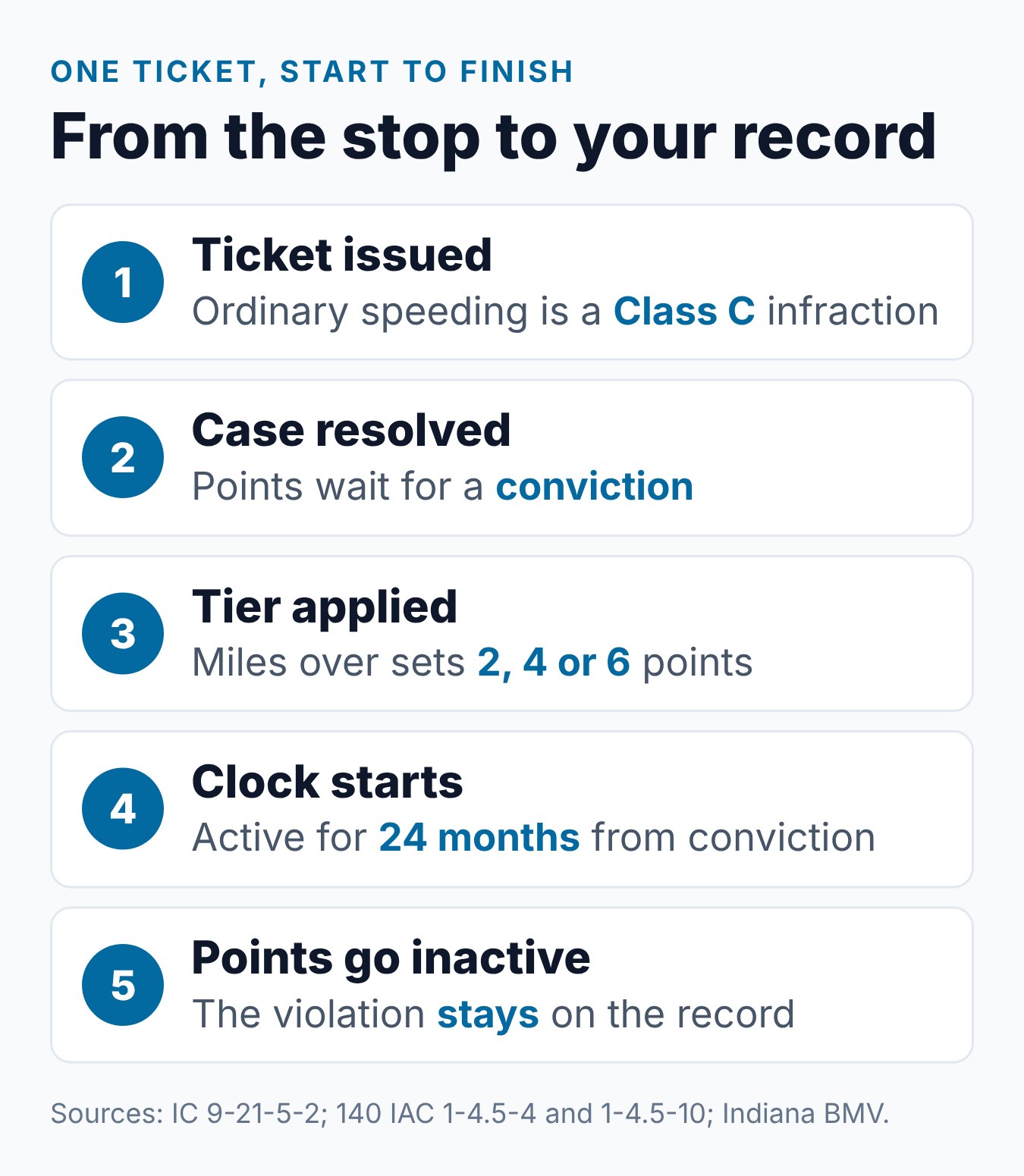
Ordinary speeding is a Class C infraction under IC 9-21-5-2. It is not a crime. The court case decides the fine and costs, and the BMV adds the points.
So there are two separate results from one ticket. The court sets what you pay.
The BMV chart sets the points, and paying the fine does not change the point value. See our Indiana speeding ticket guide for the cost side.
When Speeding Points Post
Points do not post on the day of the stop. They post after a conviction, when the court sends the case result to the BMV.
Three timing rules apply:
- Value. The point table in effect on the date of the violation sets the value.
- Clock. The BMV counts two years from the conviction date before the points go inactive.
- Record. The speeding violation stays on the record after the points go inactive. No official source sets an end date for it.
A speeding ticket from another state can add Indiana points, too. Under 140 IAC 1-4.5-5, the BMV assesses points when Indiana has a matching violation. See how long points stay.
How Speeding Points Add Up
Each conviction adds its own points. They stack while they are active.
Here are simple sums:
- Two tickets at 16 to 25 over: 4 + 4 = 8 points.
- Add one ticket at more than 25 over: 8 + 6 = 14 points.
- Add two more at 1 to 15 over: 14 + 2 + 2 = 18 points.
Under 140 IAC 1-4.5-4, 14 to 18 active points brings a warning notice. At 20 or more active points within 24 months, the BMV suspends the license, starting at one month. Our points system guide explains each level.
The number of tickets matters too, not just points. Under IC 9-30-3-12, two traffic judgments for moving violations within 12 months means the BMV must require a Driver Safety Program.
That can happen at only 4 points. The course must be done within 90 days of the BMV notice, or privileges are suspended.
A third moving offense within 12 months adds one more possible step: the BMV may send written notice of an administrative hearing.
A Two-Ticket Timeline
Dates matter as much as values. Here is a simple timeline with two convictions:
- Conviction 1, March 2, 2026: 18 over on a highway. That is 4 points, active until March 2, 2028.
- Conviction 2, September 14, 2026: 9 over on a city street. That is 2 points, active until September 14, 2028.
Between those dates, the driver has 6 active points. After March 2, 2028, only the second ticket’s 2 points still count. Both violations stay on the record.
The 12-month test for a BMV-ordered course counts the dates the violations were committed, not the conviction dates. If both violations were committed within 12 months and both became traffic judgments for moving violations, the BMV must require a Driver Safety Program.
Speeding Points and License Renewal
One large speeding ticket can matter at renewal. Under IC 9-24-12-5, a driver with 6 or more active points must pass a written test to renew.
A single conviction for more than 25 over is 6 points. So is 16 to 25 over in a school zone. A driver under 21 needs the written test with any active points at all.
Drivers Under 21 With Speeding Points
The speeding values are the same at every age. Two other rules hit young drivers harder.
First, a teen or young adult who drives in two pointable incidents before age 21 must complete a Driver Safety Program. Unlike the adult rule, there is no 12-month limit. Second, the BMV’s probationary license page says holders “will not qualify for court diversion programs.”
See points and rules under 21.
Deferral and Speeding Points
Under IC 34-28-5-1, a prosecutor may set up a deferral program for infractions. When a driver meets the terms of the agreement, the court dismisses the case. A dismissed case has no conviction to send to the BMV.
The prosecutor decides whether to offer deferral. It does not apply to commercial motor vehicle offenses.
We cannot say whether it fits your case; ask the court or an Indiana attorney. Our guide on paying or contesting a speeding ticket explains the options without picking one.
What the DSP Credit Does for Speeding Points
The Driver Safety Program (DSP) runs at least 4 hours with an approved provider. Finishing it earns a 4-point credit on the Indiana Official Driver Record, once every three years. The BMV’s maximum price for an approved course is $55.
In point terms, the credit equals one ticket at 16 to 25 over. For example, 18 active points becomes 14 after the credit.
The ticket itself stays. The BMV’s Driver Safety Program page says completion “will not remove a citation from your driver history.” See what the DSP can and cannot do.
Checking Speeding Points on Your Record
The BMV’s Driver Record page lists two records. The Viewable Driver Record is free on myBMV. The certified Official Driver Record costs $4.
On the Official Driver Record, an asterisk marks each conviction whose points are still active. See how to check your points.
What We Found on the Official Pages
We read the speeding rows of 140 IAC 1-4.5-10 in the 2026 edition of the rule on October 26, 2026. The values were 2, 4 and 6 on regular roads and 4, 4, 6 and 8 for school zones and work sites.
The 2026 Indiana Code still listed ordinary speeding as a Class C infraction. It listed school zone and work site speeding as Class B infractions.
Common Mistakes
Each item ties to an Indiana rule:
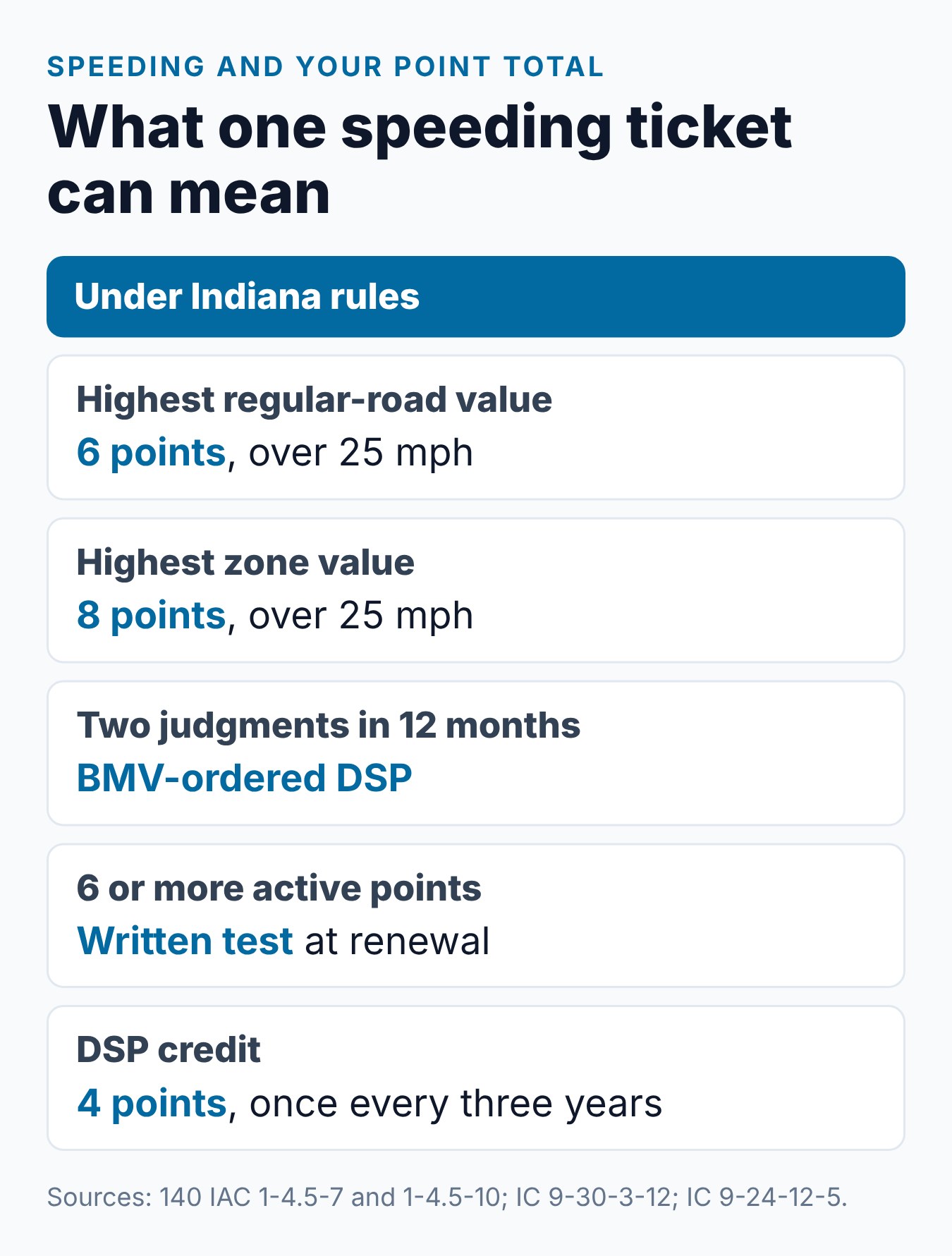
- Reading 15 over as 4 points. It is 2; the 4-point tier starts at 16 over.
- Forgetting the zone tiers. A school zone or work site adds points at every speed.
- Counting from the stop date. The clock runs from the conviction date.
- Watching only the point total. Two judgments in 12 months can bring a BMV-ordered DSP.
- Expecting the course to erase the ticket. The citation stays on your driver history.
- Ignoring renewal. Six or more active points means a written test to renew.
How Requirements Can Vary
Indiana’s point rules, the 4-point credit and the BMV’s Driver Safety Program order come from state law and BMV rules, and they apply statewide. What you must do still depends on whether you take the course by choice, because of a BMV notice, or under a court order. A court order sets its own deadline and proof steps.
Laws, fees and court practice can change. Check your BMV notice, your court order and the Indiana BMV website for current rules before you enroll or file anything.
Frequently Asked Questions
How many points is 10 over in Indiana?
Two points on a regular road, because 10 over falls in the 1 to 15 mph tier. In a school zone or work site, it is 4 points.
How many points is 20 over?
Four points on a regular road, since 20 over is in the 16 to 25 mph tier. In a school zone or work site, it is 6 points.
How many points is 30 over?
Six points on a regular road, because it is more than 25 over. In a school zone or work site, it is 8 points.
How long do speeding points last?
They stay active for 24 months after the conviction date. After that they stop counting, but the violation stays on your record.
Can one speeding ticket suspend my license?
Not through points alone. The highest speeding value is 8 points, and suspension starts at 20. But under IC 9-21-5-11, a court may suspend a license after two work site speeding violations in one year.
Does the Driver Safety Program remove speeding points?
No. It adds a 4-point credit to your record once every three years. The speeding conviction stays on your driver history.
How many points is 12 over in a school zone?
Four points. In a school zone or work site, 1 to 15 mph over carries 4 points instead of 2.
Is 25 over 4 points or 6 points?
Four points on a regular road. The 16 to 25 mph tier includes 25 over. The 6-point tier starts at 26 over, which the table calls over 25 mph.
Conclusion
How many points is a speeding ticket in Indiana comes down to the speed tier: 2, 4 or 6 points, or 4 to 8 in a school zone or work site. Those points count for 24 months and add toward the warning and suspension levels.
To earn the 4-point credit, which is allowed once every three years, you can take Driving Logic’s online Indiana Driver Safety Program. If a court ordered your course, check that the order allows an online course.
Related Articles
- Indiana Points on License: How the BMV System Works
- Indiana BMV Demerit Points Chart: How Many Points for Each Violation
- How Long Do Points Stay on Your License in Indiana?
- Indiana Speeding Ticket: Costs, Points, and What to Know
Sources
- 140 IAC 1-4.5 — BMV point system rules
- Indiana BMV — Driver Record Points
- Indiana Code § 9-21-5-2 — Maximum speed limits
- Indiana Code § 9-21-5-6 — Local and school zone speed limits
- Indiana Code § 9-21-5-11 — Worksite speed limits
- Indiana Code § 9-30-3-12 — Driver safety program
- Indiana Code § 34-28-5-1 — Infraction actions and deferral
- Indiana BMV — Citation Points & Driver Safety Program
- Indiana BMV — Driver Record
- Indiana BMV — Probationary License
Billy Forte is the owner of Driving Logic, a state-approved driver improvement course provider serving Indiana and other U.S. states.
This article is general information, not legal advice. Indiana BMV rules, court orders, fines and penalties depend on your notice, citation, court and case facts, and they can change. Use official Indiana BMV and court sources, and consult a qualified Indiana attorney for advice about your own case.