
Updated October 2026 · Reviewed by Billy Forte
The Indiana speeding ticket pay or court choice has clear rules on each side: paying means you admit the violation, and contesting means the state must prove it. Admitting on or before your appearance date caps the judgment at $35.50 plus court costs, while a contested loss can cost more if you have prior findings in that county. A prosecutor may also offer a deferral program, so you have three paths to weigh with the court or an attorney.
Key Facts
- Paying: you admit the violation, a judgment is entered and points go to the BMV. See what paying means.
- Contesting: you appear on the appearance date, and the state must prove the infraction. See what contesting means.
- The money: a $35.50 cap on a timely admission; up to $250.50 or $500 after a contested loss with priors. See side by side.
- Deferral: a dismissal if you meet the terms, but not for CDL holders. See deferral.
- No advice here: the factors are listed, but the choice is yours. See factors to consider.
Start With the Ticket
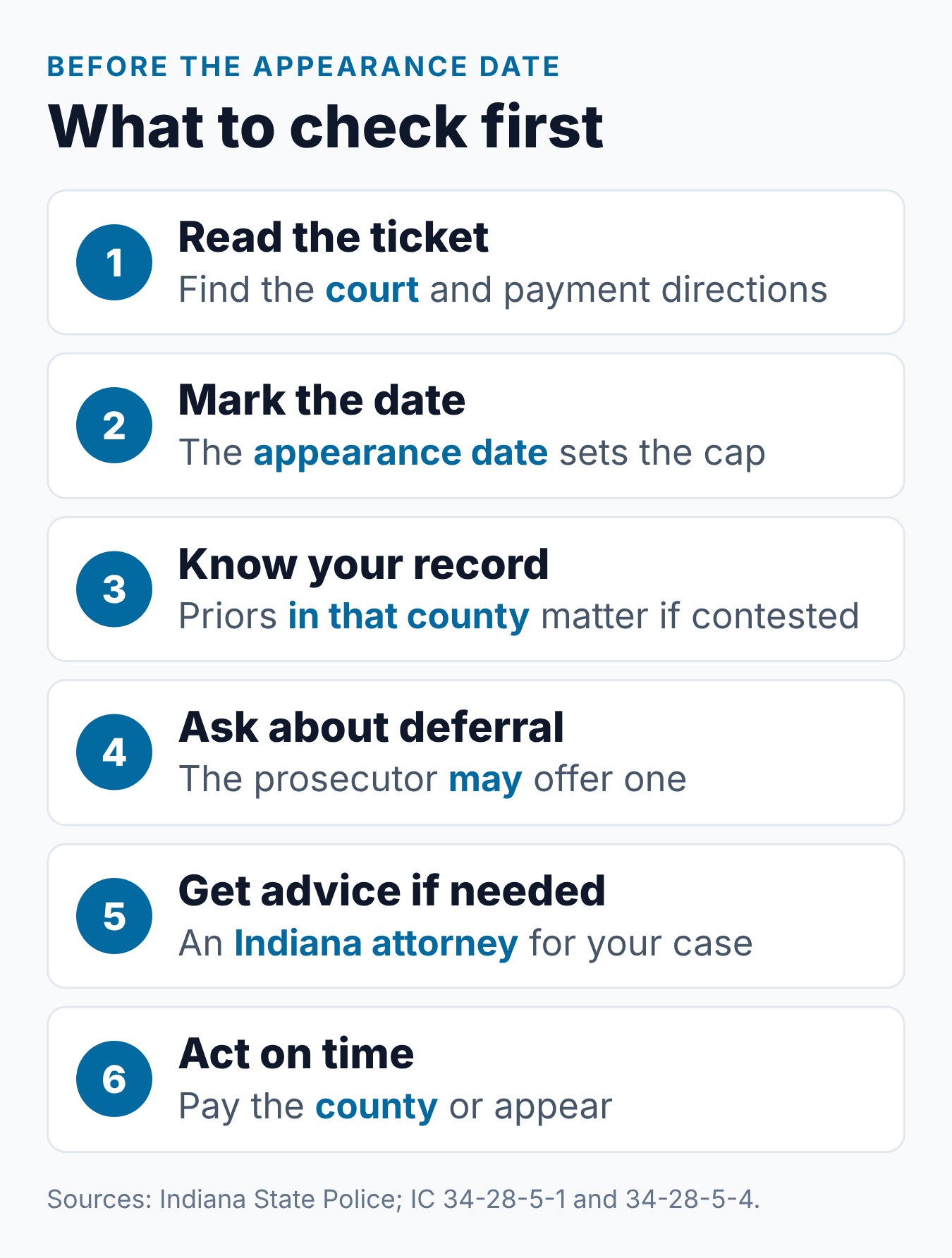
Your ticket is the first source. The Indiana State Police say, “When you receive a ticket, you should also receive directions on how to pay or contest the fine.”
The ISP adds that it “does not receive payments for traffic tickets.” All payments go to the county where the ticket was issued. So look for three things on your ticket: the court, the appearance date and the payment directions. Keep a copy of the ticket and of any receipt you get.
What Paying Means
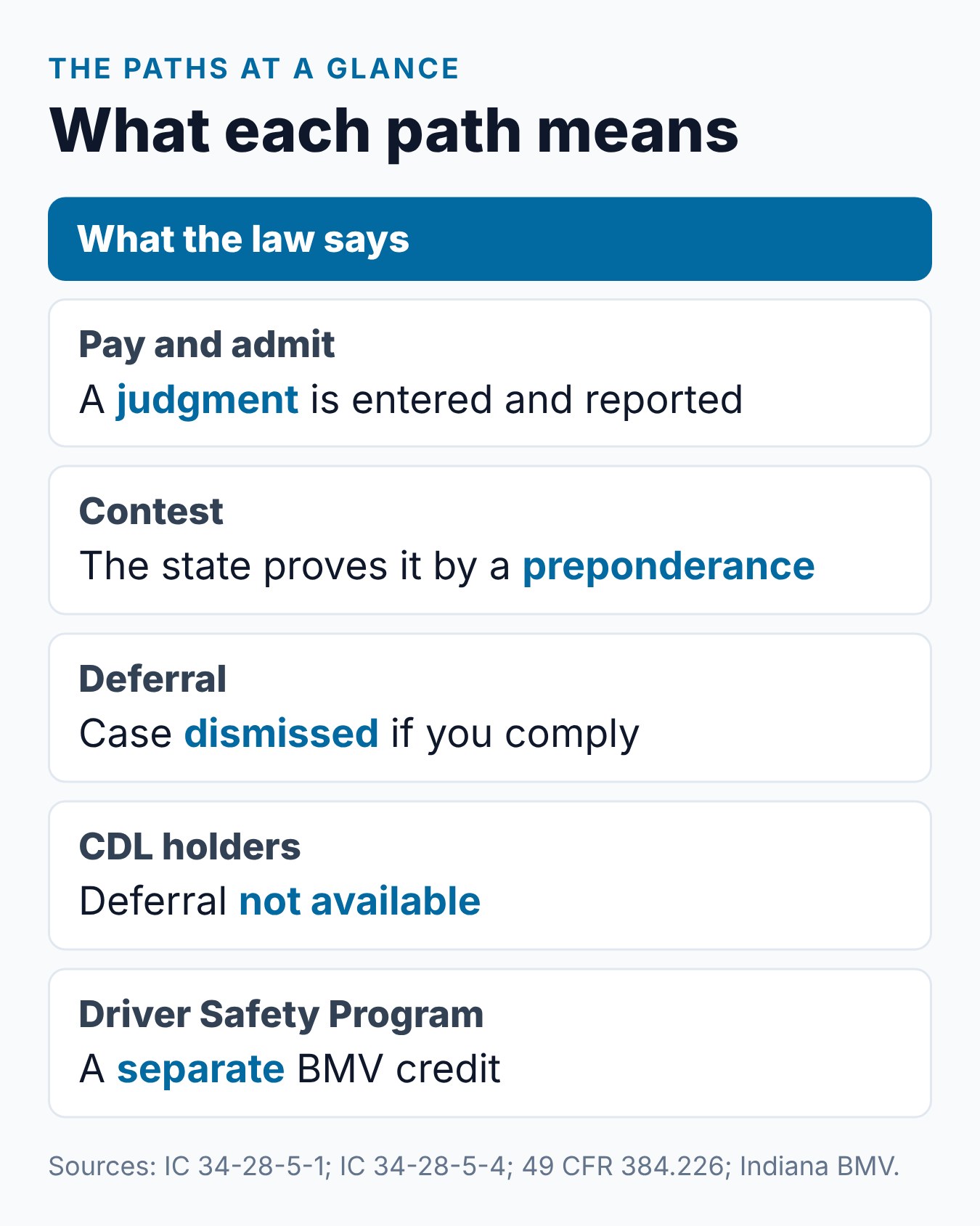
Paying is not just settling a bill. For an infraction, paying means you admit the violation. Indiana law uses the words “admits” or “pleads nolo contendere” for this step.
Once you admit it, a judgment is entered. The conviction is reported to the BMV, and points follow under 140 IAC 1-4.5-10: 2, 4 or 6 on ordinary roads, based on speed.
Timing sets the cap. Under IC 34-28-5-4(f), admitting a Class C moving violation on or before the appearance date limits you to “court costs and a judgment that does not exceed” $35.50.
What Contesting Means
Contesting means you deny the violation and go to court on your appearance date. Your ticket or the court clerk can tell you where to appear.
Under IC 34-28-5-1, the prosecuting attorney brings the case in the name of the state. The state must prove the infraction “by a preponderance of the evidence.”
If the court finds that you committed the violation, the cap depends on your county record. It stays at $35.50 with no moving violations found by a court in that county in the past 5 years.
It rises to $250.50 with one, and to $500 with two or more. Our cost guide explains this lookback.
Indiana Speeding Ticket Pay or Court: Side by Side
Here is how the two paths compare under the statutes:
| Question | Paying (admitting) | Contesting |
|---|---|---|
| What you do | Admit or plead nolo contendere by the appearance date | Appear and deny on the appearance date |
| Who has to prove the violation | No proof is needed after an admission | The state, by a preponderance of the evidence |
| Judgment limit | $35.50, plus court costs | $35.50, $250.50 or $500, by county priors |
| What the BMV receives | The judgment and its points | The judgment and its points, if the court finds you committed it |
Statutory court costs for an infraction total $139, or $167 where the sheriff’s fee is collected, per the Indiana Trial Court Fee Manual.
What the Points Mean After an Admission
Points are the part of an admission that lasts. The BMV points page says points stay active for two years from the conviction date. The violation stays on your record after that.
The total matters more than one ticket. For example, a driver with 16 active points who admits a 4-point ticket reaches 20. That is the level where a one-month suspension starts under 140 IAC 1-4.5-4.
Zone Tickets Follow Other Money Rules
The caps above are for Class C tickets. Speeding in a school zone or a work site is a Class B infraction, so the $35.50 and $250.50 caps do not apply.
A school zone ticket can reach $1,000. A work site ticket starts at a fine of at least $300 and rises with priors.
Points in both zones are 4, 6 or 8. See our school zone and work zone guide.
The Third Path: Deferral
IC 34-28-5-1 lets a prosecutor “establish a deferral program.” Not every county has to offer one. Where it exists, the steps are set by law:
- Agreement. You sign a deferral agreement with the prosecutor.
- Fees. You pay the prosecutor’s initial and monthly user fees, plus $70 to the clerk for a moving traffic offense.
- Result. If you comply, “the court shall dismiss the action,” and it “may not be refiled.”
One county’s 2023 traffic pamphlet shows how this can look. The Clark County Clerk listed a deferral cost of $192.50, “if accepted by the Prosecutor,” with dismissal after 6 months without another violation.
The same pamphlet said that for deferral, no “points” or convictions relating to the citation would appear on the BMV driving record. That is one county’s description, so ask your own county how its program works.
Deferral has a firm limit. It does not apply to commercial motor vehicle offenses, and 49 CFR 384.226 bars states from deferring or masking a CDL holder’s traffic conviction. See our CDL guide.
Factors to Consider
These facts can affect your situation. They are not advice on which path to take:
- Your county record. Prior findings in that county raise the cap only on a contested loss.
- Your license type. CDL holders face federal rules and cannot use deferral.
- Your active points. Under 140 IAC 1-4.5-4, 14 to 18 active points bring a warning, and 20 or more bring a suspension.
- Other recent tickets. Two moving-violation judgments or convictions within 12 months mean a BMV-ordered DSP under IC 9-30-3-12.
- The date. The $35.50 cap for an admission depends on the appearance date.
- Deferral. Whether your prosecutor runs a program, and its fees.
- Your schedule. Contesting means being in court on the appearance date.
An Indiana attorney can help you weigh these for your own case.
Where the Driver Safety Program Fits
The Driver Safety Program (DSP) is separate from the court case. It is a BMV course that gives a 4-point credit on your record. The BMV DSP page says the credit “may only be applied once every three years.”
The course does not decide the ticket. The BMV says completion “will not remove a citation from your driver history.” Separately, IC 9-30-3-12(d) lets a court suspend half of each court cost if you complete a DSP.
Some drivers search for a defensive driving course. In Indiana, the Driver Safety Program is the course the BMV approves. Each runs at least 4 hours, and the BMV caps the price at $55.
Questions for the Prosecutor and the Clerk
Two offices can answer factual questions before your date:
- The prosecutor’s office: Do you run a deferral program? What are its fees and terms? How long does it last?
- The court clerk: What amount is due if I admit by the appearance date? Where and how do I pay? What time is my court date?
Neither office can give you legal advice. For that, talk with an Indiana attorney.
Insurance Is a Separate Question
Your insurer is not part of the court case. The Indiana Department of Insurance lists “Driver Record” as one rating factor insurers may use, and each company sets its own rules. See speeding tickets and insurance.
If You Miss the Date
Missing the appearance date can cost you the $35.50 cap that comes with a timely admission. It can also lead to more trouble with your license.
Clark County’s 2023 pamphlet, for example, said non-payment within its 30-day grace period leads to a BMV notice and suspension. Other counties may set different steps, so follow the directions on your ticket.
If you cannot make the date, contact the court before it passes. Never ignore a court date or a BMV notice.
What We Found on the Official Pages
On the official pages we checked on October 26, 2026, the ISP page said payments go “to the county in which the ticket was issued.” The fee manual listed a $70 “Moving Traffic Offense Court Cost” for deferral cases.
It also listed deferral program fees of up to $52 initial and $10 monthly. The infraction statutes used the words “admits” and “nolo contendere,” not “guilty.” The deferral statute said it does not apply to an offense involving the operation of a commercial motor vehicle.
Common Mistakes to Avoid
Each item comes from Indiana law, a federal rule or an official page:
- Thinking paying ends the matter quietly. Paying admits the violation, and points follow.
- Paying after the appearance date. The $35.50 cap is tied to admitting by that date.
- Sending payment to the police. Payments go to the county.
- Assuming deferral is offered everywhere. The law says a prosecutor “may” set one up.
- Asking for deferral with a CDL. Federal rules bar it.
- Calling it a guilty plea. For an infraction, the law speaks of admitting or pleading nolo contendere.
- Treating the DSP as a court result. It is a BMV credit, not a dismissal.
How Requirements Can Vary
Indiana’s point rules, the 4-point credit and the BMV’s Driver Safety Program order come from state law and BMV rules, and they apply statewide. What you must do still depends on whether you take the course by choice, because of a BMV notice, or under a court order. A court order sets its own deadline and proof steps.
Laws, fees and court practice can change. Check your BMV notice, your court order and the Indiana BMV website for current rules before you enroll or file anything.
Frequently Asked Questions
Is paying an Indiana speeding ticket an admission?
Yes. Paying means you admit the violation, and a judgment is entered. The judgment and its points are reported to the BMV.
What happens if I contest and lose?
The judgment cap depends on moving violations found in that county in the past 5 years. It is $35.50 with none, $250.50 with one and $500 with two or more.
Who has to prove the ticket in court?
The state does. The prosecuting attorney brings the case and must prove the infraction by a preponderance of the evidence.
What is a deferral program?
It is an agreement with the prosecutor. You pay fees and meet the terms, and the court dismisses the case. It may not be refiled.
Can CDL holders use deferral?
No. Indiana’s deferral law does not apply to commercial motor vehicle offenses, and federal rules bar masking a CDL holder’s conviction.
Does the DSP help with the court case?
The DSP is a BMV course, separate from the case. A court may suspend half of each court cost if you complete one. It also gives a 4-point credit, once every three years.
Where do I pay if I decide to admit it?
You pay the county where the ticket was issued, using the directions on the ticket. The Indiana State Police do not take payments.
Should I hire a lawyer for a speeding ticket?
That is your choice. An Indiana attorney can explain how the rules apply to your record and your court.
Conclusion
Paying admits the violation, contesting puts the state to its proof, and deferral may be offered by some prosecutors. Read your ticket, mark the appearance date and get advice if you need it.
To work on your point total, see Driving Logic’s online Indiana Driver Safety Program. If a court ordered a course, check that the order allows an online course.
Related Articles
- Indiana Speeding Ticket: Costs, Points, and What to Know
- Indiana Speeding Ticket Cost: What Affects the Fine?
- Indiana CDL Speeding Ticket: Federal Rules Apply
- How Does an Indiana Speeding Ticket Affect Your Car Insurance?
Sources
- Indiana State Police — Traffic Tickets
- Indiana Code § 34-28-5-1 — Infraction actions and deferral
- Indiana Code § 34-28-5-4 — Infraction judgments
- Indiana Office of Judicial Administration — Trial Court Fee Manual (PDF)
- 140 IAC 1-4.5 — BMV point system rules
- Indiana BMV — Driver Record Points
- Indiana BMV — Citation Points & Driver Safety Program
- Indiana Code § 9-30-3-12 — Driver safety program
- 49 CFR § 384.226 — Prohibition on masking convictions
Billy Forte is the owner of Driving Logic, a state-approved driver improvement course provider serving Indiana and other U.S. states.
This article is general information, not legal advice. Indiana BMV rules, court orders, fines and penalties depend on your notice, citation, court and case facts, and they can change. Use official Indiana BMV and court sources, and consult a qualified Indiana attorney for advice about your own case.