
Updated October 2026 · Reviewed by Billy Forte
A work zone speeding ticket Indiana police issue is a Class B infraction with a fine of at least $300 for a first offense, rising to at least $500 and then $1,000 with priors. School zone speeding is also a Class B infraction, with a judgment of up to $1,000, while an ordinary speeding ticket is a Class C infraction with a $500 limit. Both zones also carry higher BMV points, and work zone cameras send separate civil notices by mail.
Key Facts
- Work zone fines: at least $300, then at least $500, then $1,000, under IC 9-21-5-11. See work zone fines.
- When it applies: when workers are present, or when the authority decides safety requires it. See when the limit applies.
- Cameras: Safe Zones notices start at 11 mph over, only with workers present. See Safe Zones cameras.
- School zones: a Class B infraction, up to $1,000, when children are present. See school zone tickets.
- Points: 4, 6 or 8 in both zones, against 2, 4 or 6 elsewhere. See zone points.
How Much More a Zone Ticket Costs
The answer starts with the class. Ordinary speeding is a Class C infraction, with a judgment of up to $500 under IC 34-28-5-4. For a Class C moving violation, admitting it on or before the appearance date caps the judgment at $35.50.
Zone tickets are a step up. Both school zone and work site speeding are Class B infractions, with a judgment of up to $1,000. The $35.50 cap is written for Class C cases, so it does not apply to them.
Work site tickets add a floor. The law sets a minimum fine, so a first work zone ticket cannot be less than $300. School zone tickets have no minimum set in statute.
Court costs come on top in every case. The Indiana Trial Court Fee Manual lists statutory infraction costs of $139, or $167 where the sheriff’s service fee is collected. Among its traffic fees, it also lists a Highway Worksite Fee of $0.50.
Work Zone Speeding Ticket Indiana Fines
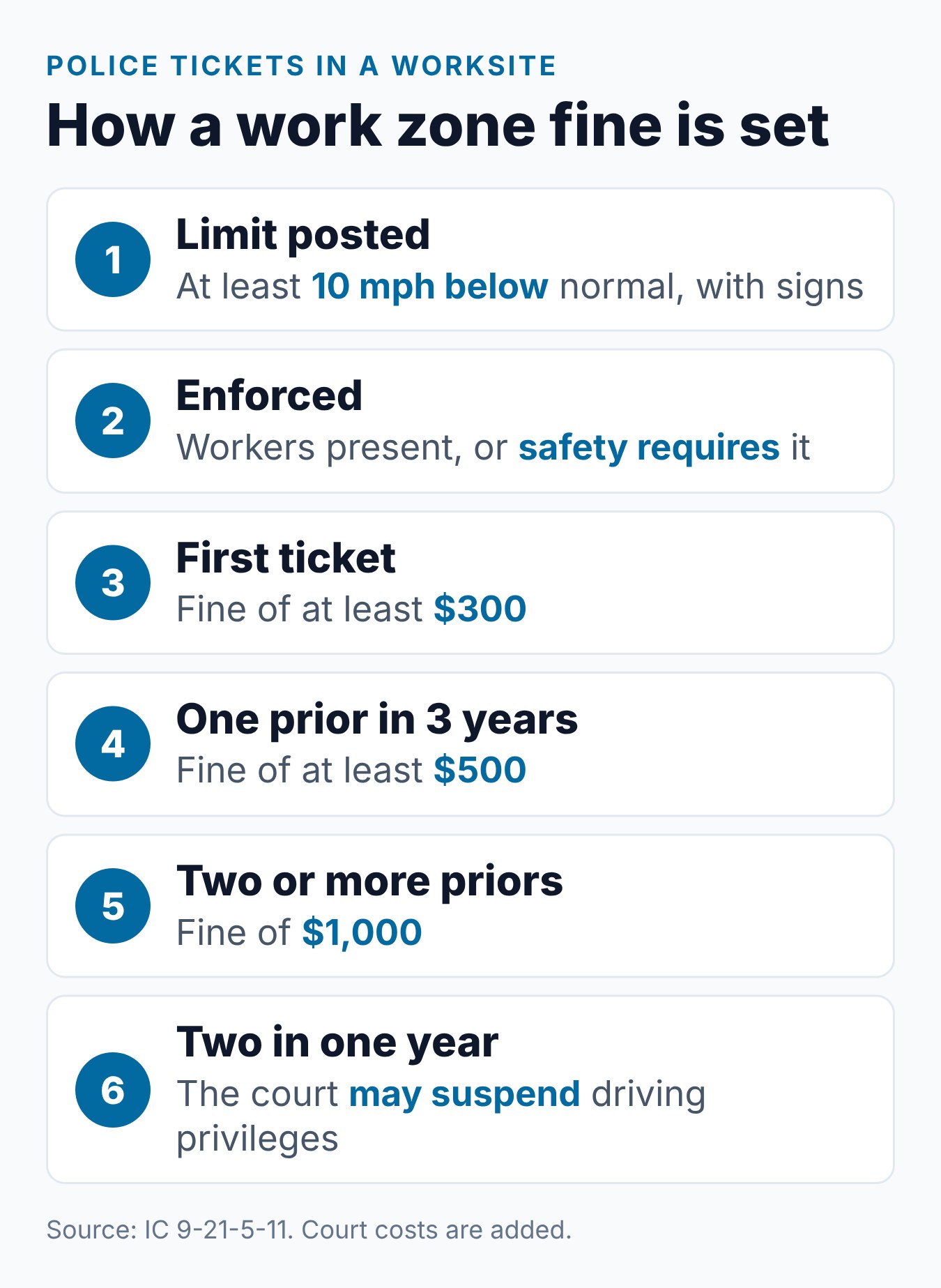
The fines are set in IC 9-21-5-11. They depend on how many work zone tickets you had before:
- First violation: a Class B infraction judgment and a fine of at least $300
- One prior in the past 3 years: a fine of at least $500
- Two or more priors: a fine of $1,000
These are minimums, not top amounts. The judgment for a Class B infraction can go up to $1,000.
The same section adds a license rule. If a driver commits two work zone infractions within one year, the court “may” also suspend driving privileges. It also says these fines go to INDOT to pay for off-duty police in work zones.
When a Work Zone Limit Applies
INDOT, the Indiana Finance Authority or a local authority may set a temporary limit near a worksite. Under IC 9-21-5-11, it must be at least 10 mph below the normal limit. The authority must post signs.
The limit is enforced in two cases:
- When workers are present in the immediate vicinity of the worksite
- When no workers are present, but the authority decides that the safety of the public requires enforcement
So a posted work zone limit can apply even when you see no workers. Read the signs as you enter the zone.
Indiana Safe Zones Camera Notices
Indiana also uses cameras in some work zones. The INDOT Indiana Safe Zones page says the pilot “permits the use of four automated systems to monitor speeds in work zones.” House Enrolled Act 1015 (2023) authorized it, effective July 1, 2023.
The rules differ from a police ticket:
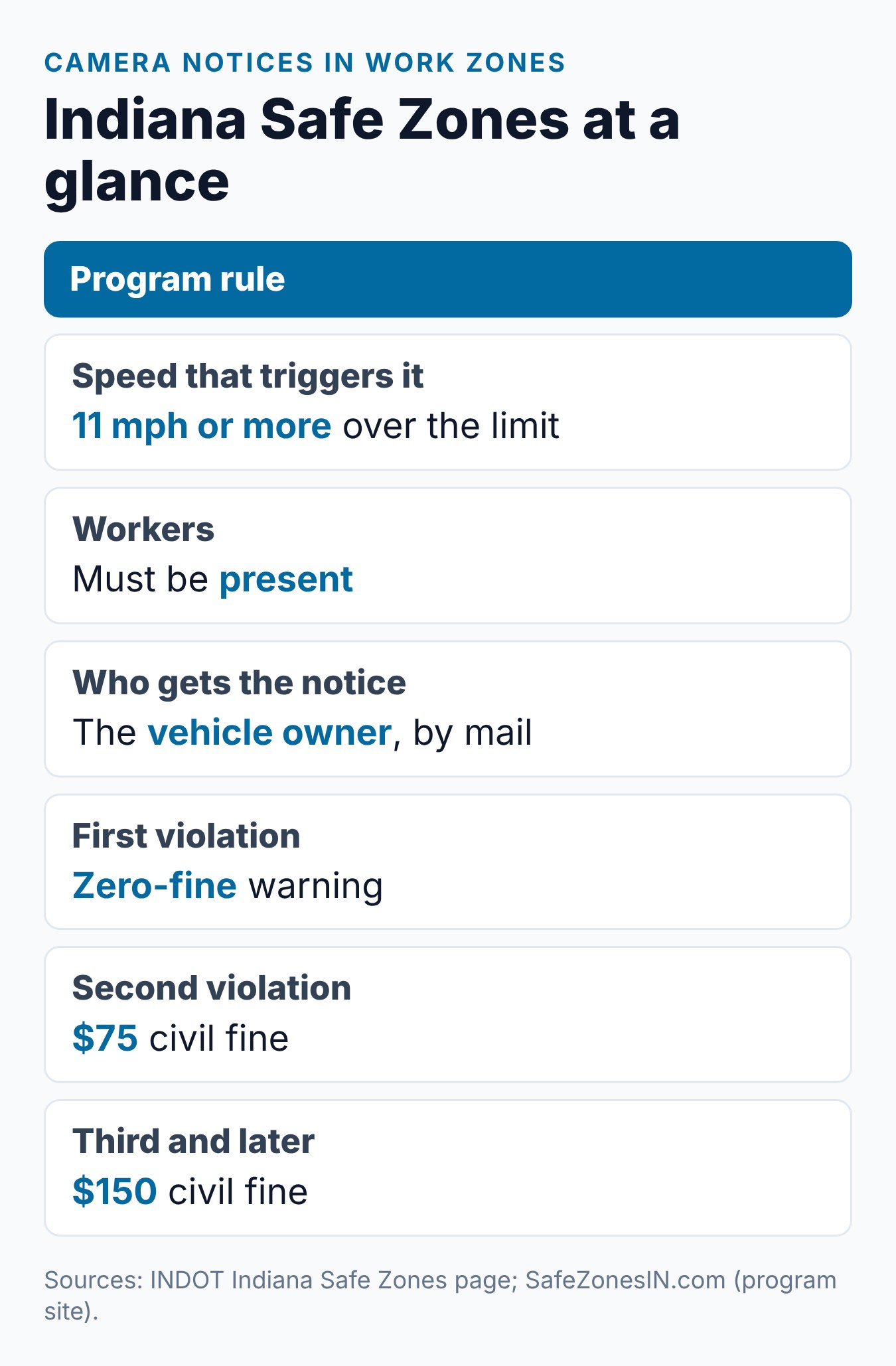
- Speed: cameras record vehicles “traveling 11 mph or more over the posted speed limit.”
- Workers: “Workers must be present for violations to be valid.”
- Who gets it: notices go to the vehicle owner by mail.
- What it is: a civil penalty under IC 8-23-32. The police-ticket fine and suspension rules in IC 9-21-5-11 do not apply to camera cases.
The program’s site, SafeZonesIN.com, which says it is administered by INDOT, lists the amounts. A first violation is a zero-fine warning. A second is a $75 civil fine, and a third or later is $150.
Neither page says whether a camera notice adds points. Follow the directions on the notice itself.
School Zone Speeding Tickets
School zone limits come from IC 9-21-5-6. A city or town may set them on a state highway where a school is located. A city, town or county may also set them on its own streets.
The law sets conditions for these limits:
- The limit is not less than 20 mph.
- It applies only in the immediate vicinity of the school.
- It applies when children are present.
- The zone must be marked with signs, and a school that runs all year needs an extra sign.
Under subsection (h), a driver who exceeds one of these limits “commits a Class B infraction.” The judgment can be up to $1,000. The statute sets no added fine on top of that.
Points Are Higher in Both Zones
The BMV point table in 140 IAC 1-4.5-10 gives school zones and work sites their own lines. Each tier is 2 points higher than on other roads:
- 1 to 15 mph over: 4 points in a zone, against 2 elsewhere
- 16 to 25 mph over: 6 points, against 4
- More than 25 mph over: 8 points, against 6
- Speed not shown on the ticket: 4 points, against 2
The BMV points page says points stay active for two years from the conviction date. Our guide to speeding ticket points covers every tier.
Reckless Driving in a Work Zone
Some work zone cases are crimes, not tickets. Under IC 9-21-8-56, reckless operation near a highway worksite when workers are present is a Class A misdemeanor.
It becomes a Level 6 felony in three cases: a prior conviction under that section in the past 5 years, operating while intoxicated, or bodily injury to a worker. It is a Level 5 felony if a worker dies. The BMV point table gives reckless operation in a highway work zone 8 points.
The same section makes certain aggressive driving acts in a worksite a Class B infraction. Passing where it is not allowed in a worksite also carries 8 points.
Compare the Four Kinds of Zone Cases
This table sets the main zone rules side by side with an ordinary ticket:
| Kind of case | How the law treats it | Money rule | BMV points by mph over |
|---|---|---|---|
| Speeding on other roads | Class C infraction | Up to $500; $35.50 cap if admitted on time | 2, 4 or 6 |
| Speeding in a marked school zone | Class B infraction | Up to $1,000; no minimum in statute | 4, 6 or 8 |
| Police ticket in a work site | Class B infraction | At least $300, $500 or $1,000 by priors | 4, 6 or 8 |
| Safe Zones camera notice | Civil penalty to the owner | Warning, then $75, then $150 | Not stated on official pages |
Court costs are added to each police ticket. For the wider question of what sets a fine, see our guide on what affects the cost of a speeding ticket.
Where the Driver Safety Program Fits
The Driver Safety Program (DSP) is the BMV’s point-credit course. The BMV Driver Safety Program page says the BMV applies a 4-point credit for completing a BMV-approved course, once every three years.
The credit lowers your point total. It does not lower the fine, and the BMV says completion “will not remove a citation from your driver history.” For example, a driver with a 6-point school zone ticket and no other points has 2 active points after the credit.
What to Check on Your Ticket or Notice
The paper you got tells you which rules apply. Look for these details:
- Police ticket or camera notice. A police ticket goes to court. A Safe Zones notice is a civil penalty to the owner.
- The class. Zone tickets are Class B infractions.
- The speed and the limit. How far over you were sets the points.
- The court and the appearance date. These are your deadlines.
For a police ticket, the Indiana State Police traffic ticket page says you should get directions on how to pay or contest it. All payments go to the county where the ticket was issued.
What We Found on the Official Pages
On the INDOT Safe Zones page we checked on October 26, 2026, the pilot covered four automated systems. It required workers to be present and a speed of 11 mph or more over the limit.
That page gave no fine amounts and said nothing about points. The amounts above come from the program’s site, SafeZonesIN.com.
Common Mistakes to Avoid
Each item comes from Indiana law, the BMV or INDOT:
- Reading $300 as a top fine. It is the minimum for a first work zone ticket.
- Assuming no workers means no limit. The authority can require enforcement for safety.
- Expecting the $35.50 cap. It is written for Class C cases, and zone tickets are Class B.
- Assuming the same points as other roads. Zone points are 2 higher in every tier.
- Treating a camera notice like a police ticket. It is a civil penalty with its own amounts.
- Missing the school zone conditions. The limit applies near the school when children are present and signs are posted.
For costs and points across all speeding tickets, see our Indiana speeding ticket guide.
How Requirements Can Vary
Indiana’s point rules, the 4-point credit and the BMV’s Driver Safety Program order come from state law and BMV rules, and they apply statewide. What you must do still depends on whether you take the course by choice, because of a BMV notice, or under a court order. A court order sets its own deadline and proof steps.
Laws, fees and court practice can change. Check your BMV notice, your court order and the Indiana BMV website for current rules before you enroll or file anything.
Frequently Asked Questions
How much is a work zone speeding ticket in Indiana?
A police ticket carries a fine of at least $300 for a first offense. With one prior in 3 years it is at least $500, and with two or more it is $1,000. Court costs are added.
Do work zone limits apply when no workers are there?
They can. A police-enforced limit applies when workers are present, or when the authority decides safety requires it. Camera notices are valid only when workers are present.
Is a school zone ticket more expensive?
It is a higher class. A school zone ticket is a Class B infraction with a judgment of up to $1,000, against $500 for ordinary speeding. The statute sets no minimum fine.
How many points is a school zone speeding ticket?
It is 4 points for 1 to 15 mph over, 6 for 16 to 25 over and 8 for more than 25 over. The same values apply in a work site.
Does a Safe Zones camera notice add points?
The official INDOT pages do not say. The notice is a civil penalty sent to the vehicle owner, so follow the directions on it.
Can a work zone ticket lead to a suspension?
Yes. If a driver commits two work zone infractions within one year, the court may suspend driving privileges.
Is a work zone speeding ticket a crime?
No. Speeding in a work site is a Class B infraction. Reckless operation near a worksite with workers present is a separate charge, and that one is a Class A misdemeanor.
Can the Driver Safety Program lower my fine?
No. The DSP adds a 4-point credit to your BMV record, once every three years. It does not change the fine or remove the citation.
Conclusion
A police work zone speeding ticket in Indiana starts at a $300 minimum, and a school zone ticket can reach $1,000, with higher points in both. Camera notices follow separate civil rules.
To earn the 4-point credit, see Driving Logic’s online Indiana Driver Safety Program. If a court ordered a course, check that the order allows an online course.
Related Articles
- Indiana Speeding Ticket: Costs, Points, and What to Know
- Indiana Speeding Ticket Cost: What Affects the Fine?
- 20 Over Speeding Ticket in Indiana: What to Know About Cost and Points
- How Many Points Is a Speeding Ticket in Indiana?
Sources
- Indiana State Police — Traffic Tickets
- Indiana Code § 9-21-5-11 — Worksite speed limits
- Indiana Code § 9-21-5-6 — Local and school zone speed limits
- INDOT — Indiana Safe Zones
- Indiana Code § 34-28-5-4 — Infraction judgments
- Indiana Office of Judicial Administration — Trial Court Fee Manual (PDF)
- 140 IAC 1-4.5 — BMV point system rules
- Indiana BMV — Driver Record Points
- Indiana Code § 9-21-8-56 — Reckless operation in a highway worksite
- Indiana BMV — Citation Points & Driver Safety Program
Billy Forte is the owner of Driving Logic, a state-approved driver improvement course provider serving Indiana and other U.S. states.
This article is general information, not legal advice. Indiana BMV rules, court orders, fines and penalties depend on your notice, citation, court and case facts, and they can change. Use official Indiana BMV and court sources, and consult a qualified Indiana attorney for advice about your own case.