
Updated October 2026 · Reviewed by Billy Forte
If you searched reckless driving vs speeding indiana, the core difference is this: an ordinary speeding ticket is a Class C infraction, and reckless driving is a crime. The two also differ in how they are proved, what they can cost and how many BMV points they add. One thing is the same: the Driver Safety Program (DSP) credit works the same way after either one.
Key Facts
- Type of case: speeding is an infraction; reckless driving is a misdemeanor. See the comparison table.
- Cost limits: a Class C speeding judgment tops out at $500; reckless fines reach $5,000 at the misdemeanor levels. See costs.
- Points: speeding adds 2, 4 or 6; reckless driving adds 6, 8 or 10. See points.
- Deferral: a prosecutor may offer one for an infraction. See deferral.
- DSP: a 4-point credit once every three years, for either charge. See the DSP.
Reckless Driving vs Speeding Indiana: Side by Side
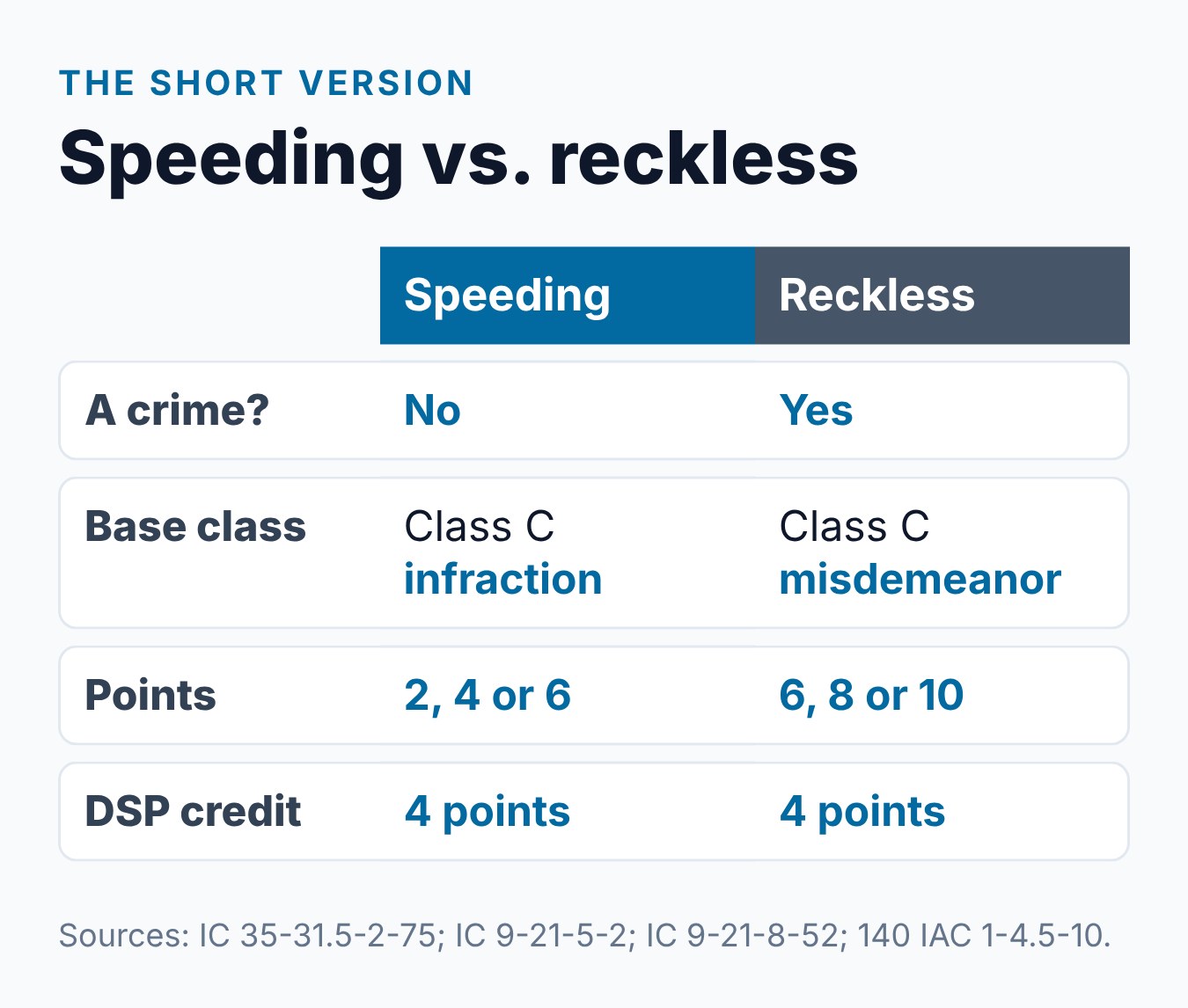
This table compares an ordinary speeding ticket with a reckless driving charge. Each row comes from Indiana law or the BMV point rules.
| Feature | Ordinary speeding ticket | Reckless driving charge |
|---|---|---|
| Main law | IC 9-21-5-2 | IC 9-21-8-52 |
| Kind of case | Class C infraction | Class C, B or A misdemeanor, by result |
| Counts as a crime | No | Yes |
| Proof standard set in statute | Preponderance of the evidence | Criminal case rules apply |
| Money limit | Judgment up to $500 | Fine up to $500, $1,000 or $5,000 |
| BMV points | 2, 4 or 6 | 6, 8 or 10 |
| Deferral program | May be offered by the prosecutor | Ask the court or an attorney |
| DSP 4-point credit | Yes, once every three years | Yes, once every three years |
Indiana defines a crime as a felony or a misdemeanor, under IC 35-31.5-2-75. An infraction is neither one.
The Speeding Side
Going over a posted limit breaks IC 9-21-5-2, which makes it a Class C infraction. A prosecutor brings the case in the name of the State of Indiana. Under IC 34-28-5-1, the state must prove it by a preponderance of the evidence.
Two places raise the class. Speeding in a school zone is a Class B infraction, with a judgment of up to $1,000. Speeding in a work site is also a Class B infraction, with a fine of at least $300.
What a Speeding Ticket Can Cost
Under IC 34-28-5-4, a Class C judgment can be up to $500. For a Class C moving violation, the law sets lower caps:
- Admit or plead nolo contendere on or before the appearance date: at most a $35.50 judgment, plus court costs.
- Contest and lose: up to $35.50, $250.50 or $500, based on moving violations found by a court in that county in the past 5 years.
Court costs for an infraction total $139, or $167 where the sheriff’s service fee is collected, per the Indiana Trial Court Fee Manual. The Indiana State Police say payments go to the county where the ticket was issued.
Deferral for Speeding Tickets
A prosecutor may offer a deferral program for an infraction. The driver signs an agreement, pays fees and meets the terms.
The court then dismisses the case, and it may not be filed again. For a moving traffic offense, the law adds a $70 fee paid to the clerk.
Deferral does not apply to commercial motor vehicle offenses. Federal rule 49 CFR 384.226 also bars states from hiding a CDL holder’s traffic conviction.
The Reckless Driving Side
Reckless driving under IC 9-21-8-52 is a misdemeanor, which makes it a crime. The level depends on the result:
- Class C with no damage or injury: up to 60 days and $500.
- Class B with damage to another person’s property: up to 180 days and $1,000.
- Class A with bodily injury: up to 1 year and $5,000.
Recklessly passing a stopped school bus with its stop arm out has its own levels. It is a Level 6 felony with bodily injury and a Level 5 felony with death. The reckless driving penalties guide has every level in one place.
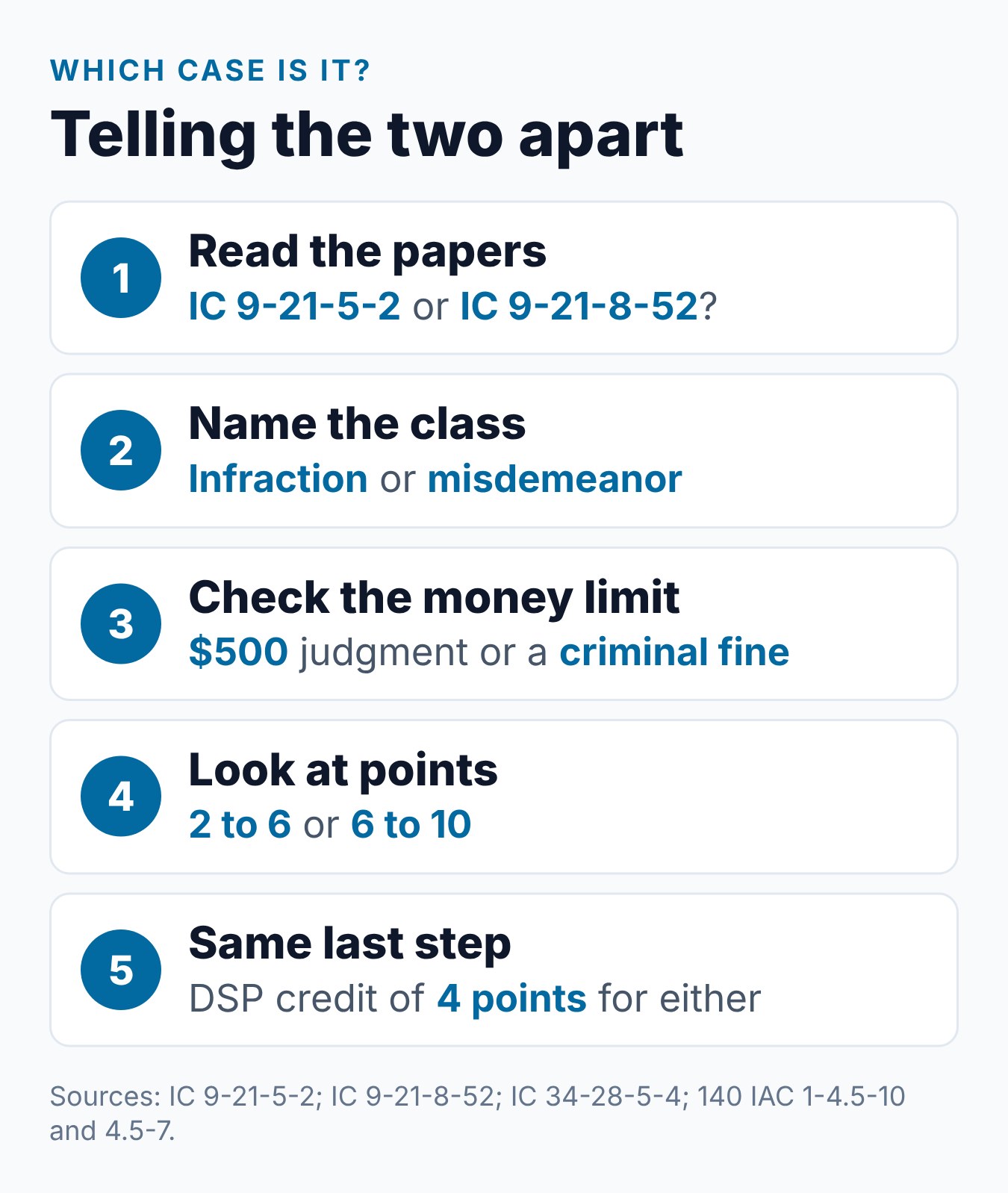
What Separates the Two
A speeding ticket is about a limit. You went faster than a posted or legal maximum, and that is the violation.
Reckless driving is about conduct. The law lists four acts, such as unreasonable speed for the conditions or weaving through a line of traffic. The driver must also act “recklessly.” No speed number turns one charge into the other, as the article on reckless driving speed explains.
Points for Each Charge
The BMV point table in 140 IAC 1-4.5-10 treats the two charges in different ways:
- Speeding: 2, 4 or 6 points, based on how far over the limit the ticket shows.
- Speeding in a school zone or work site: 4, 6 or 8 points.
- Reckless driving: 6 points, 8 with property damage and 10 with bodily injury.
The point rule is the same for both after that. Points become inactive 24 months after the conviction date, and the violation stays on the record.
Points Can Add Up Across Both
Points from both kinds of case go into one total. Here is simple math. A driver with 6 points from a speeding ticket and 8 from reckless driving with property damage has 14 active points.
That brings a warning notice. After a 4-point DSP credit, the total is 10.
Effects on Your License
Both charges feed the same BMV point count. At 14 to 18 active points, the BMV sends a warning notice. At 20 or more active points within 24 months, it suspends the license, starting at 1 month.
Both can also lead to a BMV-ordered DSP. Under IC 9-30-3-12, the BMV must order one after two traffic misdemeanor convictions, two traffic judgments, or one of each, for moving violations within 12 months. The driver then has 90 days from the notice.
One of Each Within 12 Months
The BMV’s DSP rule counts both kinds of case. A traffic judgment is the result of an infraction case, such as a speeding ticket. A traffic misdemeanor conviction can come from a reckless driving case.
One of each for moving violations within 12 months is enough for the BMV to order a DSP. Points alone do not trigger that order.
A Difference in the Long Run
Reckless driving has one more license effect. The BMV Driver’s Manual lists it among the offenses that count toward Habitual Traffic Violator status. Three such judgments within 10 years bring a 10-year suspension.
Insurance and Background Checks
No official source sets how either charge affects insurance rates. The Indiana Department of Insurance lists “Driver Record” as a rating factor insurers may use. Each insurer sets its own rules, so ask yours.
The same goes for background checks. No official source gives figures. A criminal conviction is a different kind of record from an infraction judgment.
The DSP Credit Works the Same
The Driver Safety Program is a BMV-approved course of at least 4 hours. Completing one adds a 4-point credit to your record, once every three years. It does not matter whether the points came from speeding or reckless driving.
The BMV DSP page says completion “will not remove a citation from your driver history.” For example, a driver with 10 active points from a reckless conviction has 6 after the credit. A driver with 4 points from a speeding ticket has 0.
How Each Case Shows on Your Record
Both a speeding judgment and a reckless driving conviction appear on your BMV driving record with their points. The BMV’s record legend marks convictions with active points with an asterisk. You can view your record free on myBMV, and a certified Official Driver Record costs $4.
Work Zones Change Both Sides
Work zones have their own rules for each charge. Speeding in a work site is a Class B infraction with 4, 6 or 8 points.
Reckless driving near a worksite with workers present is a Class A misdemeanor under IC 9-21-8-56, with 8 points. That law can reach felony levels in listed cases.
Questions to Ask Before Your Court Date
The right questions depend on which charge you face. These come straight from the rules above:
- Which law is on the ticket or charge, IC 9-21-5-2 or IC 9-21-8-52?
- What is the appearance date?
- Does the prosecutor offer a deferral program for this infraction?
- If a court orders a course, does the order allow an online course?
An Indiana attorney can explain your choices. This article does not tell you which one to make.
What We Found on the Official Pages
On the official pages we checked on October 26, 2026, the Trial Court Fee Manual, marked current through the 2026 legislative session, listed $139 in total infraction fees. It listed $167 where the sheriff’s fee of $28 is collected.
The 2026 Indiana Code still made ordinary speeding a Class C infraction. Reckless driving was still a misdemeanor, with no speed figure in the text.
Common Mistakes to Avoid
Each item comes from Indiana law or a BMV rule:
- Calling a speeding ticket a crime. An infraction is not a felony or misdemeanor.
- Thinking a high speed is automatically reckless. Reckless driving depends on conduct, not a number.
- Using 2 to 4 points for speeding. The tiers are 2, 4 and 6, or 4, 6 and 8 in zones.
- Counting 6 points for every reckless case. Damage means 8 and injury means 10.
- Assuming deferral fits every driver. It does not cover commercial motor vehicle offenses.
- Expecting the DSP to remove a charge. It adds a credit; the citation stays.
How Requirements Can Vary
Indiana’s point rules, the 4-point credit and the BMV’s Driver Safety Program order come from state law and BMV rules, and they apply statewide. What you must do still depends on whether you take the course by choice, because of a BMV notice, or under a court order. A court order sets its own deadline and proof steps.
Laws, fees and court practice can change. Check your BMV notice, your court order and the Indiana BMV website for current rules before you enroll or file anything.
Frequently Asked Questions
Is reckless driving worse than a speeding ticket in Indiana?
It is a higher class of case. Reckless driving is a misdemeanor, which is a crime, while ordinary speeding is a Class C infraction.
Can a speeding ticket become a reckless driving charge?
No speed does it on its own. A prosecutor may file a separate reckless charge when the facts fit IC 9-21-8-52.
Which adds more points?
Reckless driving adds 6, 8 or 10 points. Ordinary speeding adds 2, 4 or 6, and 4, 6 or 8 in school zones and work sites.
Can either charge be a felony?
Ordinary speeding cannot; it is an infraction. Reckless driving under the four main acts tops out at a Class A misdemeanor. The school bus act can be a Level 6 or Level 5 felony when it causes injury or death.
Can I get deferral for reckless driving?
The deferral rules in IC 34-28-5-1 are written for infractions. For a reckless charge, ask the court or an Indiana attorney what options exist.
Does a DSP help with both?
Yes, in the same way. It adds a 4-point credit to your record once every three years and does not remove the citation.
Which one affects insurance more?
No official source says. Insurers may use your driver record as a rating factor, and each one sets its own rules.
Conclusion
A speeding ticket is a Class C infraction, while reckless driving is a misdemeanor graded by its result. Points, costs and license effects all differ, but the 4-point DSP credit works the same for both.
If a court ordered a course, check that the order allows an online course. You can read about Driving Logic’s online Indiana Driver Safety Program here.
Related Articles
- Reckless Driving in Indiana: Penalties, Points, and Driver Safety Options
- Indiana Reckless Driving Speed: Is There an MPH Limit?
- Is an Indiana Speeding Ticket a Misdemeanor or Just a Traffic Infraction?
- Indiana Speeding Ticket: Costs, Points, and What to Know
Sources
- Indiana Code § 9-21-5-2 — Maximum speed limits
- Indiana Code § 9-21-8-56 — Reckless operation in a highway worksite
- Indiana BMV — myBMV
- Indiana Code § 9-21-8-52 — Reckless driving
- Indiana Code § 34-28-5-1 — Infraction actions and deferral
- Indiana Code § 34-28-5-4 — Infraction judgments
- Indiana Office of Judicial Administration — Trial Court Fee Manual (PDF)
- Indiana State Police — Traffic Tickets
- 140 IAC 1-4.5 — BMV point system rules
- Indiana Code § 9-30-3-12 — Driver safety program
- Indiana BMV — Citation Points & Driver Safety Program
- 49 CFR § 384.226 — Prohibition on masking convictions
Billy Forte is the owner of Driving Logic, a state-approved driver improvement course provider serving Indiana and other U.S. states.
This article is general information, not legal advice. Indiana BMV rules, court orders, fines and penalties depend on your notice, citation, court and case facts, and they can change. Use official Indiana BMV and court sources, and consult a qualified Indiana attorney for advice about your own case.