
Updated October 2026 · Reviewed by Billy Forte
If you searched how to remove points from license Indiana, the short answer is that points cannot be deleted early: they go inactive on their own 24 months after the conviction date. Until then, a BMV-approved Driver Safety Program can add a 4-point credit, a court can change the case, and the BMV can correct a record error. Each path works differently, and none of them erases a valid conviction.
Key Facts
- No early deletion: points become inactive 24 months after the conviction date. See why points stay.
- DSP credit: a BMV-approved course adds a 4-point credit on the Indiana Official Driver Record, once every three years. See the credit path.
- Court change: if a court vacates, dismisses or amends a violation, the BMV modifies any points suspension. See court changes.
- Record errors: the BMV must decide a Material Error Review within 30 days. See fixing an error.
- What stays: the violation remains part of your record. See what does not remove points.
Why Points Cannot Be Removed Early
Indiana’s point rules are in 140 IAC 1-4.5. Section 4 sets one clock for every point: they “shall become inactive twenty-four (24) months after the disposition date of the violation.”
No rule lets a driver pay, file or ask to make points inactive sooner. The BMV’s Driver Record Points page says the same thing in simpler words: points stay active “for two years from the conviction date.”
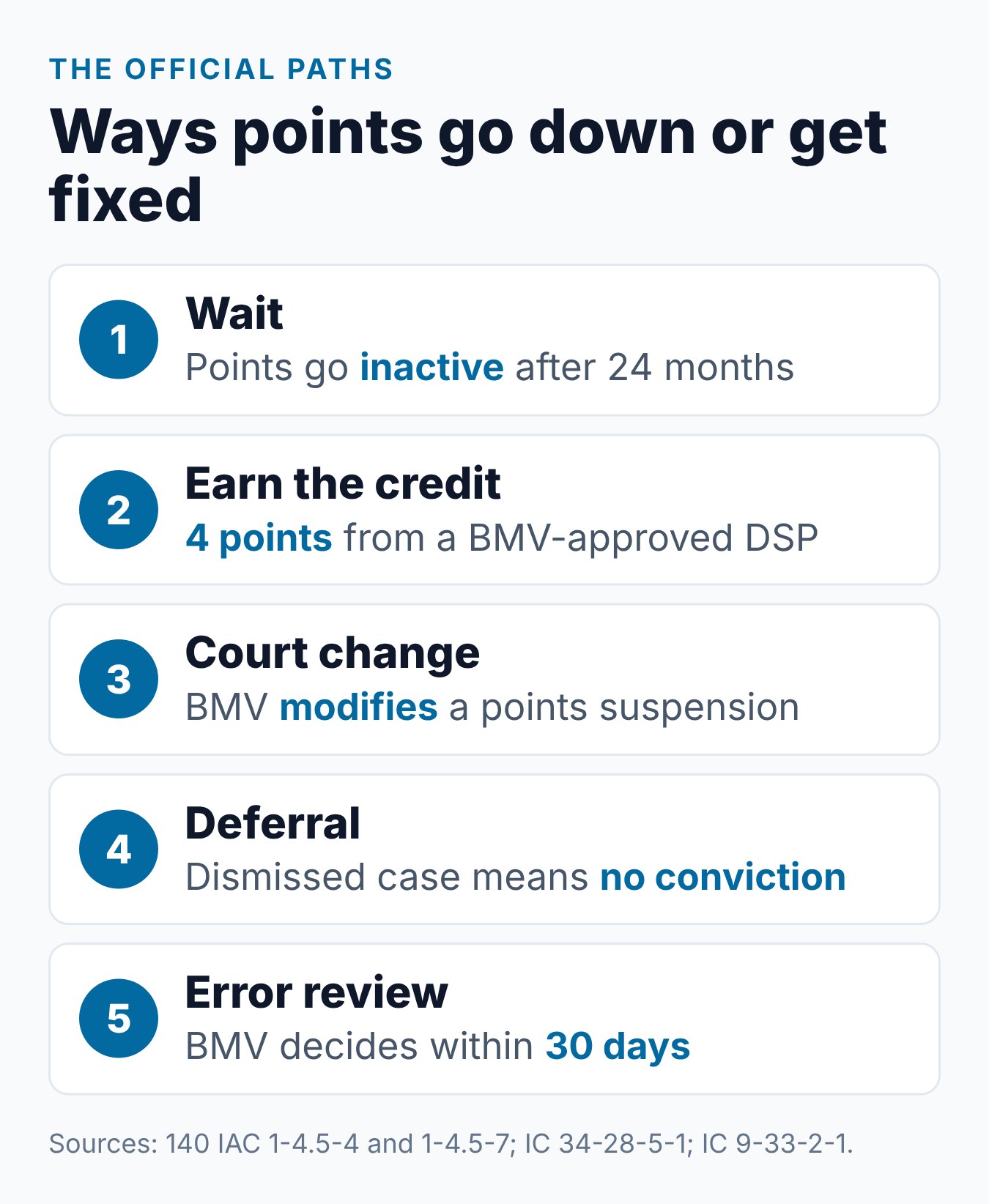
Even then, the entry does not leave. The rule says, “The violation shall remain a part of the person’s record.” So “removing” points really means one of five things.
How to Remove Points From License Indiana: What the Rules Allow
| Path | Who acts | What it changes | Rule |
|---|---|---|---|
| Time | No one | Points go inactive after 24 months | 140 IAC 1-4.5-4(a) |
| DSP credit | You and a BMV-approved provider | Adds a 4-point credit | 140 IAC 1-4.5-7 |
| Court change | The court | BMV modifies a points suspension | 140 IAC 1-4.5-4(e) |
| Deferral | The prosecutor and court | Case dismissed, so no conviction | IC 34-28-5-1 |
| Error review | The BMV | A wrong entry is corrected | IC 9-33-2-1 |
Each path is explained below. Which one fits depends on your case, so check with the court, the BMV or an Indiana attorney.
Path 1: Time
Time is the only path that applies to every conviction. Once a conviction is 24 months old, its points stop counting toward the warning notice at 14 to 18 points and the suspension at 20 or more.
For example, a conviction on May 5, 2026, stops adding points on May 5, 2028.
Each conviction runs its own clock. A driver with a 4-point conviction from May 2026 and a 6-point conviction from January 2027 has 10 active points in early 2027.
In May 2028 the total drops to 6, and in January 2029 it drops to 0. See how long points stay on your license.
Path 2: The DSP 4-Point Credit
The Driver Safety Program (DSP) is the one course that changes your point count. Under 140 IAC 1-4.5-7, a person who completes and pays for a BMV-approved DSP gets a 4-point credit entered on the record. It can be entered only once every three years.
The BMV’s Driver Safety Program page sets the course basics:
- Every approved course is at least 4 hours.
- It is offered in English and Spanish, online, by DVD or in a classroom.
- The maximum price for any approved course is $55, and the driver pays.
- Only courses from BMV-approved providers earn the credit.
The credit is a 4-point credit on the Indiana Official Driver Record. It does not remove the conviction. The BMV says completion “will not remove a citation from your driver history.” See what the DSP can and cannot do.
Here is how the credit changes the count. The suspension rule counts active points “after any credit earned by completion of a driver safety program.” So a driver with 22 active points who earns the credit is counted at 18. That is in the warning range, below the 20-point suspension level.
The provider notifies the BMV when you finish. The BMV applies the credit within 7 to 14 business days of that notice.
Path 3: A Court Changes the Case
A court can change its own result. Under 140 IAC 1-4.5-4(e), if a court “vacates, dismisses, amends, or otherwise modifies a violation,” the BMV must act. Within a reasonable time after it gets the court record, the BMV modifies any pending or existing points suspension.
The change starts in court, not at the BMV. The BMV’s Driver Record page says court judgments “must be settled with the court as the BMV cannot address these court actions.”
Whether a court will change a case is up to the court. We cannot predict that result. Ask an Indiana attorney about your own case.
Path 4: Deferral Before a Conviction
Deferral works before a conviction exists. Under IC 34-28-5-1, a prosecutor may set up a deferral program for infraction cases. When the driver meets the terms of the agreement, the court dismisses the case, and it may not be filed again.
A dismissed case leaves no conviction to carry points. But deferral has limits:
- The prosecutor decides whether to offer it.
- It does not apply to commercial motor vehicle offenses.
- The BMV’s probationary license page says holders “will not qualify for court diversion programs.”
We do not say whether to seek deferral. That choice belongs to you and, if you have one, your lawyer.
Path 5: Fixing a BMV Record Error
Sometimes the record itself is wrong. Under IC 9-33-2-1, a person who finds a material error may notify the BMV in writing. The BMV must decide within 30 days whether an error was made.
The request must meet a BMV rule, 140 IAC 1-10-1. It must state the error “with reasonable particularity” and include supporting documents. You can send it two ways:
- The online form on the BMV’s Material Error Review page.
- By mail to the BMV Legal Division, Room N404, 100 North Senate Avenue, Indianapolis, IN 46204-2214.
If the BMV finds an error, it must correct it. That can include removing a suspension and reinstating driving privileges.
A person who disagrees with the decision may seek judicial review. See how to dispute a BMV record error.
When the BMV Requires the Course Anyway
A DSP can also be required, whether or not a new credit is possible. Under IC 9-30-3-12, the BMV must order a DSP after two traffic misdemeanor convictions, two traffic judgments, or one of each, for moving violations within 12 months. A driver under 21 must take it after twice being the driver in an incident that can carry points.
The course must be done within 90 days of the BMV notice. If not, driving privileges are suspended until the course is completed and processed. Points alone never trigger this order.
A court may also order a DSP, and its order sets the deadline. See BMV-ordered DSP rules.
Gather Your Record First
Every path is easier with your record in hand. The Viewable Driver Record is free on myBMV, and the certified Official Driver Record costs $4.
On the Official Driver Record, an asterisk marks each conviction whose points are still active. Note each conviction date and any DSP credit. See how to check your points.
What Does Not Remove Points
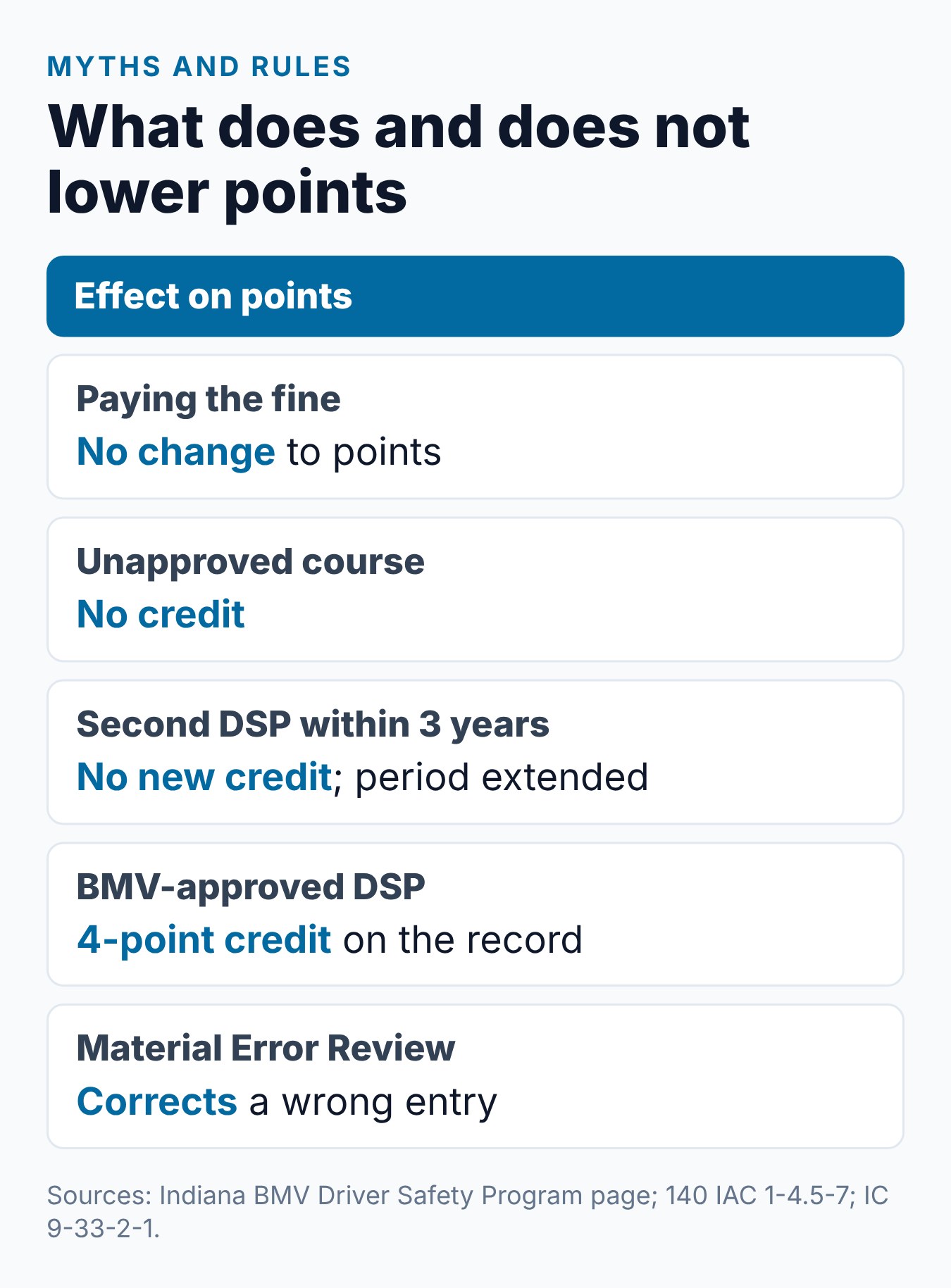
Some steps sound helpful but do not change points under the rules. Each one below comes from a BMV page or rule:
- Paying the fine. Paying ends the court case. It does not make points inactive.
- A course that is not BMV-approved. The BMV says credit applies only for an approved provider.
- A second DSP within three years. No second credit. The BMV says another course extends the credit period three years from the new completion date.
- Waiting from the ticket date. The clock runs from the conviction date.
How to Get Points Off Your License in Indiana by Situation
Here is which path the rules point to in these situations:
- Points from a valid conviction: wait for the 24 months, and a BMV-approved DSP can add a 4-point credit.
- A case still open in court: the court and prosecutor decide the result, including any deferral.
- A conviction the court later changed: the BMV acts on the new court record.
- A conviction or suspension that is not yours: ask for a Material Error Review.
- A missing DSP credit after 7 to 14 business days: email the certificate to BMVDSP@bmv.IN.gov.
What We Found on the Official Pages
On October 26, 2026, the BMV’s Material Error Review page cited IC 9-33-2-1. It offered an online form and a mailing address, and it said to “attach any documents that will help us review your record.”
That page did not list a response time. The 30-day decision comes from the statute itself. The Driver Safety Program page still listed the $55 maximum price.
Common Mistakes
Each item ties to an Indiana rule or BMV page:
- Paying someone to “erase” points. No rule allows early removal.
- Expecting the DSP to delete a ticket. It adds a 4-point credit; the citation stays.
- Taking an unapproved course. Only BMV-approved providers earn the credit.
- Asking the BMV to change a court result. The BMV says court actions must be settled with the court.
- Sending a vague error request. The rule asks for the error with reasonable particularity, plus documents.
How Requirements Can Vary
Indiana’s point rules, the 4-point credit and the BMV’s Driver Safety Program order come from state law and BMV rules, and they apply statewide. What you must do still depends on whether you take the course by choice, because of a BMV notice, or under a court order. A court order sets its own deadline and proof steps.
Laws, fees and court practice can change. Check your BMV notice, your court order and the Indiana BMV website for current rules before you enroll or file anything.
Frequently Asked Questions
Can I remove points from my Indiana license early?
No. Points become inactive 24 months after the conviction date. A BMV-approved DSP can add a 4-point credit before then, once every three years.
How do I get points off my license in Indiana?
Points go inactive with time. You can also earn a 4-point DSP credit. A court change or a BMV error correction can change the record in specific cases.
Does the Driver Safety Program remove a ticket?
No. The BMV says completion “will not remove a citation from your driver history.” It adds a 4-point credit on the Indiana Official Driver Record.
How long does a BMV error review take?
The BMV must decide within 30 days after it gets your written notice. That deadline is in IC 9-33-2-1.
What if a court dismisses my ticket after points were added?
Under 140 IAC 1-4.5-4(e), the BMV must modify any points suspension after it receives the court record. Ask the court clerk if you are unsure the record was sent.
How much does the DSP cost?
The BMV’s maximum price for any approved course is $55. The driver pays the course fee.
Can a court order a DSP if I already earned a credit?
Yes. A court may require a DSP, and the BMV must order one after qualifying convictions or judgments. The 4-point credit can still be entered only once every three years.
Conclusion
How to remove points from license Indiana records has a plain answer: points cannot be deleted early, but time, a DSP credit, a court change or a BMV error review can lower or fix them. The violation stays on your record either way.
For the credit, you can take Driving Logic’s online Indiana Driver Safety Program. If a court ordered your course, check that the order allows an online course.
Related Articles
- Indiana Points on License: How the BMV System Works
- Indiana Driving Record Dispute: How to Fix a BMV Error
- Indiana Driver Safety Program and Points: What It Can and Cannot Do
- Indiana DSP 4 Point Credit: How It Works
Sources
- 140 IAC 1-4.5 — BMV point system rules
- Indiana BMV — Driver Record Points
- Indiana BMV — Citation Points & Driver Safety Program
- Indiana BMV — Material Error Review Request
- Indiana Code § 9-33-2-1 — Material errors in BMV records
- Indiana Code § 34-28-5-1 — Infraction actions and deferral
- Indiana Code § 9-30-3-12 — Driver safety program
- Indiana BMV — Driver Record
- Indiana BMV — Probationary License
Billy Forte is the owner of Driving Logic, a state-approved driver improvement course provider serving Indiana and other U.S. states.
This article is general information, not legal advice. Indiana BMV rules, court orders, fines and penalties depend on your notice, citation, court and case facts, and they can change. Use official Indiana BMV and court sources, and consult a qualified Indiana attorney for advice about your own case.