
Updated October 2026 · Reviewed by Billy Forte
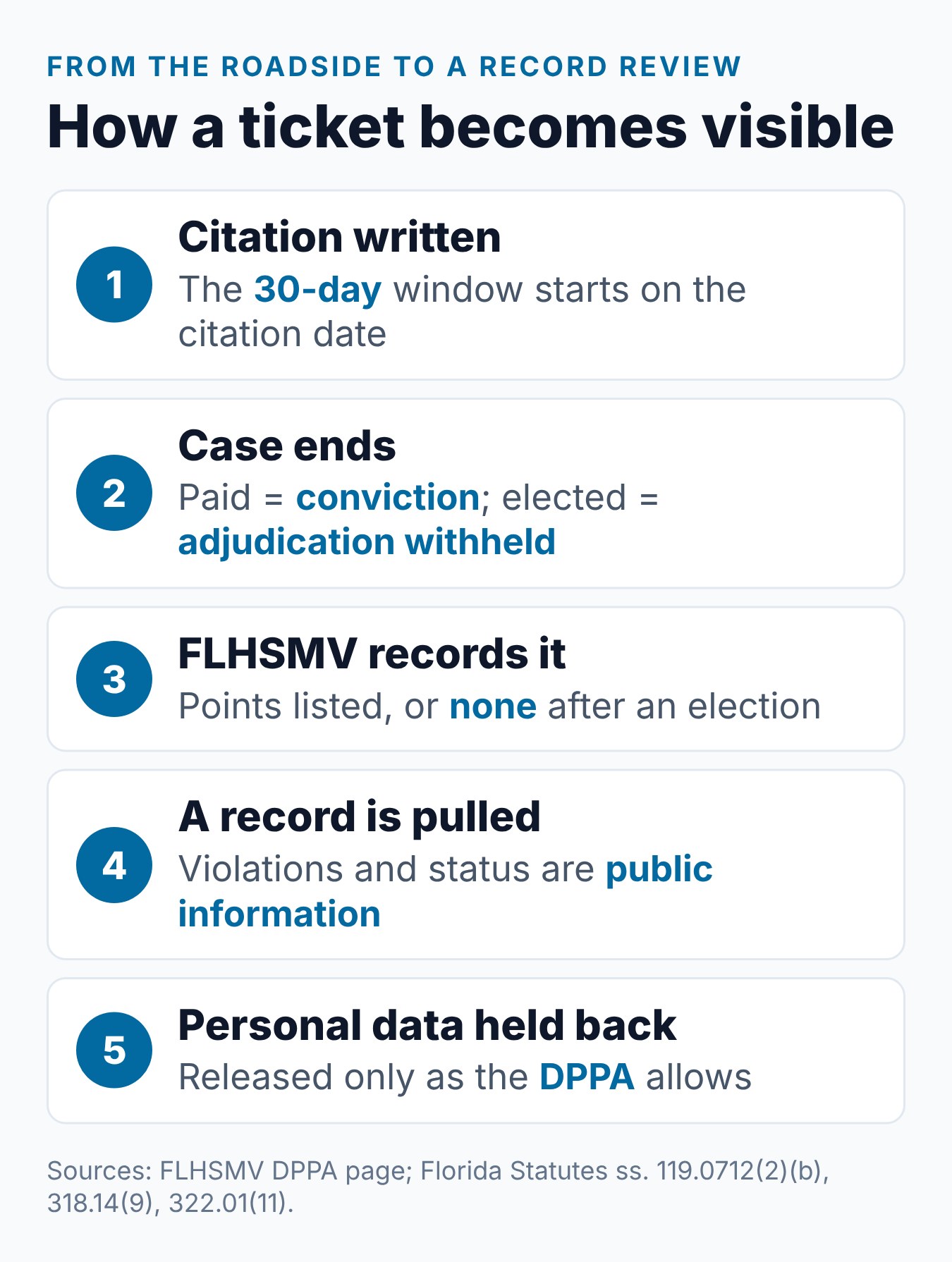
If you are asking is your driving record available to the public in Florida, the answer is yes: FLHSMV says “Driving violations and driver status information are considered public information.” That means a job screen that pulls your driving record can show your tickets, points and license status. Your personal details, such as your Social Security number and address, stay protected under the federal Driver’s Privacy Protection Act (DPPA).
Key Facts
- Public: driving violations and driver license status, says FLHSMV. See what the law makes public.
- Protected: personal details such as your Social Security number, address and phone number. See what stays private.
- Points on view: they stay on the record at least 5 years from the disposition date. See how long entries stay visible.
- BDI election: the ticket shows as adjudication withheld, with no points. See how an elected ticket looks.
- Crashes: a crash shows only if you got a ticket for it. See what a reviewer can see.
Is Your Driving Record Available to the Public in Florida?
Yes, in part. Florida splits a driving record into two kinds of facts.
The facts about your driving are public. The facts about you as a person are protected.
The FLHSMV Driver Privacy Protection Act page states both sides. It says “motor vehicle, driver license and vehicular crash record information are public information.” It also explains that federal law protects the personal details in those records.
So a reviewer can see what you did on the road. A reviewer cannot freely get your Social Security number or your medical details from FLHSMV.
What the Law Makes Public
FLHSMV names the public parts of a record in plain terms. On its DPPA page, it says: “Driving violations and driver status information are considered public information.”
That covers two main things:
- Driving violations. Your traffic tickets and how each case ended.
- Driver status. Whether your license is valid, suspended or in another status.
The same page lists crash record information as public, too. Under s. 322.20(3), your driving record notes a crash only if you “received a traffic citation as a direct result of the crash.”
What Stays Private
Personal information gets a different rule. Under s. 119.0712(2)(b), “Personal information, including highly restricted personal information as defined in 18 U.S.C. s. 2725, contained in a motor vehicle record is confidential pursuant to the federal Driver’s Privacy Protection Act of 1994.”
The statute adds: “Such information may be released only as authorized by that act.” So the DPPA, not a public request, decides who may get those details.
The FLHSMV DPPA page lists examples of protected details:
- your Social Security number;
- your name and address;
- your telephone number; and
- medical or disability information.
Public Facts and Protected Facts
| Item in a Florida motor vehicle record | How Florida treats it | Source |
|---|---|---|
| Traffic violations | Public | FLHSMV DPPA page |
| Driver license status | Public | FLHSMV DPPA page |
| Crash record information | Public | FLHSMV DPPA page |
| Social Security number | Protected | DPPA; s. 119.0712(2)(b) |
| Name, address and phone number | Protected | DPPA; s. 119.0712(2)(b) |
| Medical or disability information | Protected | DPPA; s. 119.0712(2)(b) |
What a Reviewer Can See
When a driving record is part of a job screen, the record itself sets what shows up. FLHSMV says a driving record “will indicate the number of points.” It also lists each ticket and its disposition, which is how the case ended.
Points come from convictions under s. 322.27. A few examples a reviewer might see:
- 3 points for speeding 15 mph or less over the limit, or for careless driving.
- 4 points for speeding more than 15 mph over, or for running a red light when an officer writes the ticket.
- 6 points for leaving the scene of a crash with more than $50 in damage.
Some tickets show no points at all. A red light camera or school zone speed camera violation adds none.
When a Paid Ticket Becomes a Conviction
Paying a ticket is not a neutral step on your record. Section 322.01(11) defines a conviction to cover an admission or a finding on a noncriminal ticket.
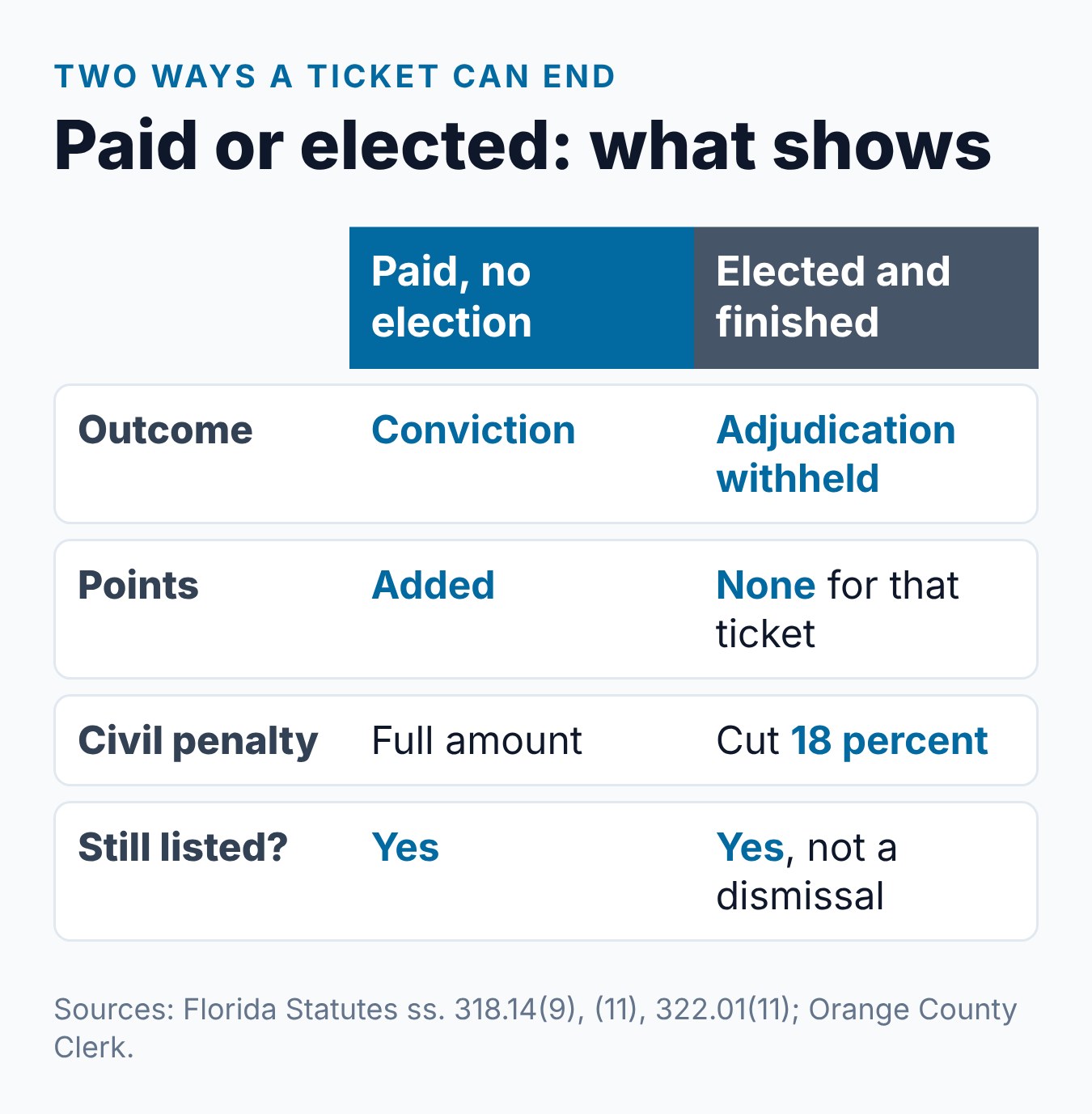
The Orange County Clerk’s ticket options page treats payment of the civil penalty as a conviction. So a paid ticket shows up as a conviction, with its points.
How an Elected Ticket Looks
A Basic Driver Improvement (BDI) election changes how a ticket appears. Under s. 318.14(9), an eligible driver who elects and finishes on time gets three results:
- Adjudication is withheld. That outcome appears as a disposition in the 2016 FLHSMV court guide Reading a Driving Record.
- No points. Points “may not be assessed” for that ticket.
- A reduced fine. The civil penalty is still paid, but cut by 18 percent.
Section 318.14(11) says a withheld adjudication “is not a conviction.” Still, it is not a dismissal. The ticket stays listed on your record, with no points next to it.
Who Can Elect
To elect, you tell the Clerk of Court in the county on the ticket within 30 days of the citation date. You do this before you take the course, and you pay the clerk’s election fee. The FLHSMV BDI page sets out these steps.
Some drivers and tickets are left out:
- holders of a commercial driver license (CDL) or commercial learner’s permit;
- speeding 30 mph or more over the limit;
- tickets that need a court hearing under s. 318.19;
- a driver who elected in the preceding 12 months; and
- a driver who has made eight elections in a lifetime.
How Long Entries Stay Visible
Per the FLHSMV points page, points stay on view for at least 5 years after the case is decided, which FLHSMV calls the date of disposition.
Our guides on how long points stay and how long a speeding ticket stays cover the timing in detail.
Suspensions and License Status
Driver status is public, so a suspension can be seen too. A suspension changes your license status, and FLHSMV treats status as public information.
Points can lead to a suspension. Under s. 322.27(3), FLHSMV may suspend a license for up to 30 days at 12 points in 12 months. The limits rise to 3 months at 18 points in 18 months, and 1 year at 24 points in 36 months.
A missed course date can also matter. Under s. 318.15(1)(b), a driver who elects BDI and pays but does not attend is adjudicated guilty, and points are assessed. Separately, s. 318.15(1)(a) lists failing to attend driver improvement school among the failures the clerk reports to FLHSMV, which then suspends the license.
Tickets From Other States
Your Florida record can include tickets from other states. Section 322.27(3)(e) lets an out-of-state conviction be recorded with the points the same offense would carry in Florida.
Florida is part of the Driver License Compact under s. 322.44. It reports convictions of drivers from other member states to their home state, and the home state applies its own law.
Commercial Drivers
CDL and permit holders face a stricter record rule. A federal rule, 49 CFR 384.226, says a state “must not mask” a CDL or permit holder’s conviction. That applies to a violation “in any type of motor vehicle.”
The rule also bars keeping that conviction from “appearing on the CDLIS driver record.” Florida law also bars CDL and permit holders from electing BDI, under s. 318.14(9).
Some tickets weigh more on a CDL record. Under 49 CFR 383.51 and s. 322.61, serious traffic violations include speeding 15 mph or more over, reckless driving, improper lane change and following too closely.
Two in 3 years bring a 60-day commercial vehicle disqualification, and three bring 120 days. Convictions in a personal vehicle count only if they lead to a suspension, revocation or cancellation of the license.
Records and Insurance Rates
A public record does not mean every entry can raise your rates. Florida law limits how insurers use some tickets:
- Elected tickets. Section 626.9541(1)(o)12 bars an insurer from adding a premium, canceling or sending a nonrenewal notice over a ticket where adjudication was withheld and no points were assessed after an election. This does not cover a crash where the insurer had a loss due to your fault.
- Camera tickets. Under s. 322.27(3)(d), violations caught by a red light camera or a school zone speed camera may not be used to set insurance rates.
Seeing Your Record First
You can see what a reviewer would see by ordering your own record. FLHSMV and clerks offer 3-year and 7-year records for $8 and $10, under s. 322.20. Our guide to the Florida driving record explains how to order and read one.
What We Found on the Official Pages
When we read the FLHSMV DPPA page and s. 119.0712 on October 27, 2026, the DPPA page used the word “public” for violations, driver status and crash record information. It set personal details apart and pointed to the federal law.
Section 119.0712(2)(b) matched that split. It makes personal information in a motor vehicle record confidential and ties its release to the 1994 federal act.
Common Mistakes
These mistakes are checked against Florida law or FLHSMV:
- Thinking a driving record is fully private. Violations and license status are public information.
- Thinking all of it is open. Personal details are protected under the DPPA.
- Reading “adjudication withheld” as a dismissal. The ticket stays listed, with no points.
- Treating payment as a quiet close. Paying the civil penalty counts as a conviction.
- Expecting every crash to show. A crash appears only if you got a ticket for it.
- Counting on BDI with a commercial license. Commercial license and permit holders are barred from the election.
How Requirements Can Vary
Florida’s election rules, point values and suspension levels come from Florida Statutes and FLHSMV, and they apply statewide. The election fee, the date to finish the course and how proof is filed are set by the Clerk of Court in the county on your ticket, or by the court. A court order sets its own deadline and proof steps.
Laws, fees and clerk practice can change. Check your citation, your clerk’s instructions, any court order and the FLHSMV website before you enroll or file anything.
Frequently Asked Questions
Will my Florida traffic tickets show up on a driving record check?
Yes. FLHSMV says driving violations and driver status are public information. A driving record lists your tickets, how each case ended and your points.
Is my address on the public record?
No. FLHSMV lists your name, address, phone number and Social Security number as personal details protected by the federal DPPA. Under s. 119.0712(2)(b), they may be released only as that act allows.
Does an elected ticket show on my record?
Yes. After an eligible BDI election, the ticket shows as adjudication withheld, with no points. It is not a dismissal.
How long do points stay on view?
FLHSMV says points stay on the driver record at least 5 years from the date of disposition.
Do camera tickets show points?
No. A violation caught by a red light camera or a school zone speed camera adds no points, and insurers may not use it to set rates.
Does a crash show if I did not get a ticket?
No. Section 322.20(3) says the driving record notes a crash only if you received a traffic citation as a direct result of it.
Does a license suspension show up?
Driver status is public information, and a suspension changes that status. Points totals of 12 in 12 months, 18 in 18 months or 24 in 36 months can lead to a suspension.
Can a CDL holder keep a ticket off the record with BDI?
No. CDL and permit holders cannot elect BDI for any ticket. Federal rule 49 CFR 384.226 bars masking their convictions in any type of vehicle.
Conclusion
Florida treats driving violations and license status as public, while the DPPA protects your personal details. Points stay on the record at least 5 years from disposition, and an elected ticket shows as adjudication withheld with no points.
For a new eligible ticket, the election must be made with the clerk within 30 days. When you have elected, you can take the Florida BDI course online.
Related Articles
- Florida Driver License Points System: Suspensions, Point Values, and BDI Options
- Your Florida Driving Record: How to Get It and What It Shows
- How Long Do Points Stay on Your License in Florida?
- How Long Does a Speeding Ticket Stay on Your Florida Driving Record?
Sources
- 49 CFR § 383.51 — CDL disqualifications
- Florida Statutes s. 322.61 — Disqualification from operating a commercial motor vehicle
- Florida Statutes s. 318.15 — Failure to comply with civil penalty or to appear
- Florida Statutes s. 322.44 — Driver License Compact
- FLHSMV — Driver Privacy Protection Act
- Florida Statutes s. 119.0712 — Public records exemptions (driver records)
- FLHSMV — Points and Point Suspensions
- FLHSMV — Reading a Driving Record (court training document, 2016, PDF)
- FLHSMV — Basic Driver Improvement (BDI) Approved Course Providers
- Florida Statutes s. 318.14 — Noncriminal traffic infractions; procedures
- Florida Statutes s. 322.20 — Records of the department; fees
- Florida Statutes s. 322.01 — Definitions
- Florida Statutes s. 322.27 — Authority to suspend or revoke a license (point system)
- Florida Statutes s. 626.9541 — Unfair insurance trade practices
- 49 CFR § 384.226 — Prohibition on masking convictions
- Orange County Clerk — Traffic Ticket Options
Billy Forte is the owner of Driving Logic, a driver improvement course provider serving Florida and other U.S. states.
This article is general information, not legal advice. Election rules, deadlines, fines and penalties depend on your citation, county, court and case facts, and they can change. Use official FLHSMV, Florida Statutes and Clerk of Court sources, and consult a qualified Florida attorney for advice about your own case.