
Updated October 2026 · Reviewed by Billy Forte
If you searched how long do tickets stay on your record in Florida, the answer for a speeding ticket is that its points stay at least 5 years from the disposition date, according to FLHSMV. Suspension totals use a separate clock, with 12, 18 and 36-month windows counted from the offense date. An eligible Basic Driver Improvement (BDI) election means adjudication is withheld and no points are added for that ticket.
Key Facts
- On the record: speeding points stay at least 5 years from the disposition date. See the record clock.
- For suspensions: totals are counted in 12, 18 and 36-month windows from the offense date. See the suspension clock.
- Points per ticket: 3 for 15 mph or less over, 4 for more than 15 over. See speeding points.
- After an election: adjudication is withheld, no points are added, and insurers face limits. See what an election changes.
- A newer crime: going 50 mph or more over can be dangerous excessive speeding since July 1, 2025. See when speeding is a crime.
How Long Do Tickets Stay on Your Record in Florida?
The FLHSMV points page gives the main rule. It says points “remain on the driver record for at least five years from the date of disposition.”
Two words in that line are key:
- “At least.” Five years is the minimum, not a set end date.
- “Disposition.” The clock starts when the case is decided, not on the day you got the ticket.
The record itself has no set end date in the statute. Section 322.20, which covers FLHSMV’s driver records, does not set a fixed number of years for keeping them.
The Record Clock
The disposition is how the case ended. For a speeding ticket, the possible outcomes look like this:
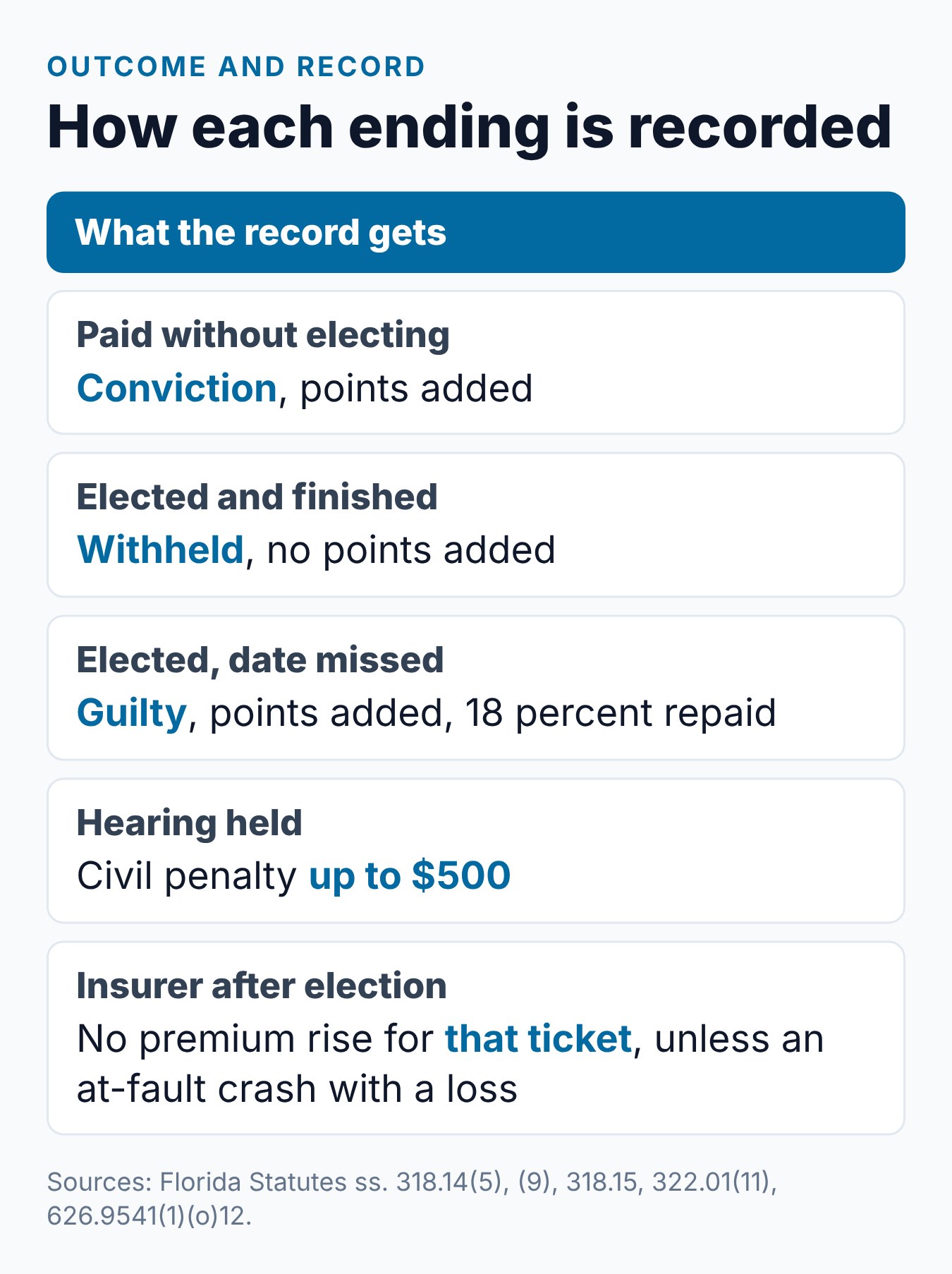
- You pay without electing. Under s. 322.01(11), that counts as a conviction, and points are added. The Orange County Clerk says “Payment of the civil penalty is considered a conviction.”
- You elect BDI and finish on time. Adjudication is withheld, and no points are added.
- You ask for a hearing. Under s. 318.14(5), the hearing official may impose a civil penalty of up to $500.
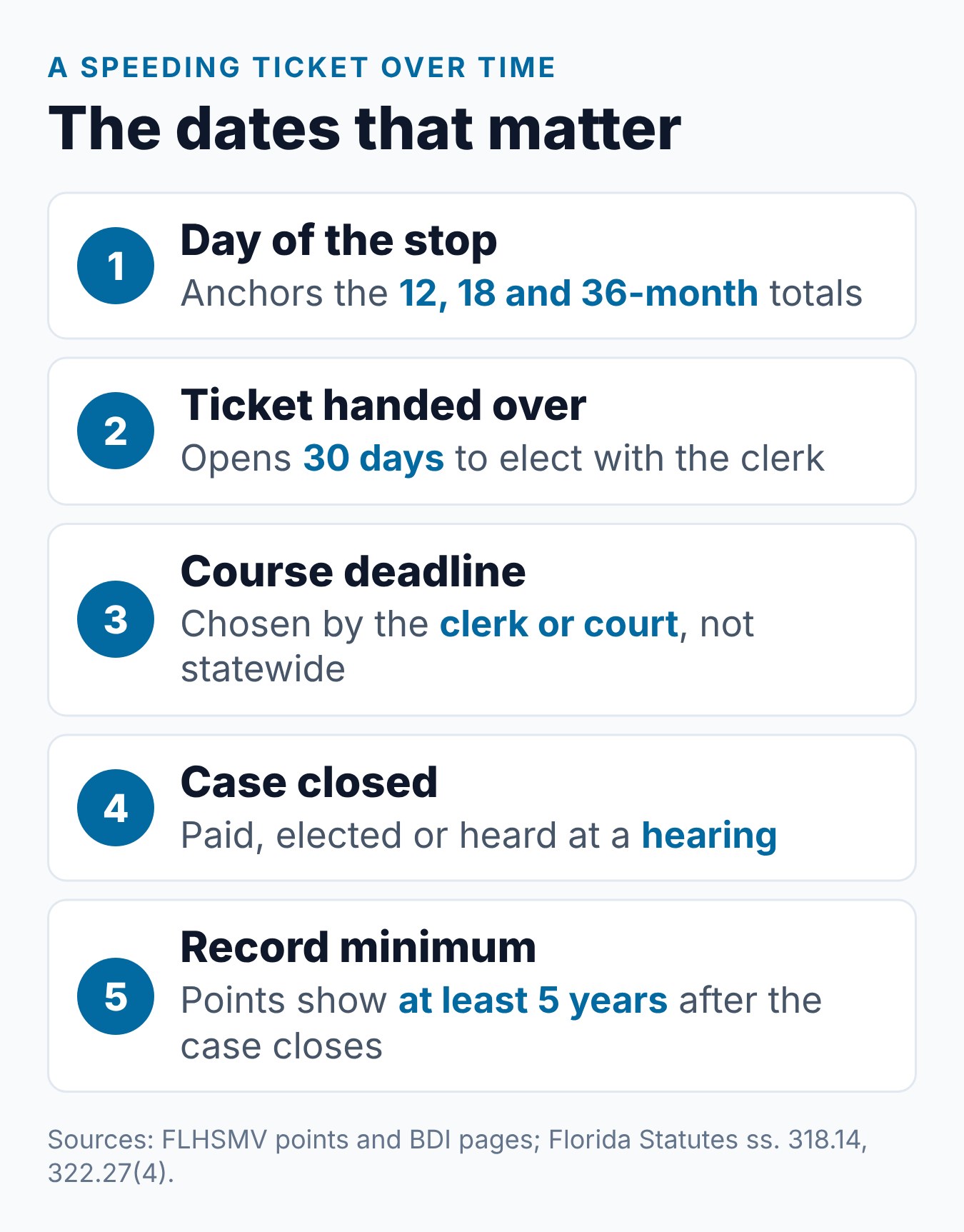
The disposition date and the offense date can fall on different days. Once points are added, they stay on the record for at least 5 years from the disposition date. Our guide on how long points stay covers this record clock for every kind of ticket.
The Suspension Clock
A second clock decides whether points lead to a suspension. Under s. 322.27(4), FLHSMV “shall use the offense date of all convictions” when it counts points for a suspension.
The windows come from s. 322.27(3). At 12 points in 12 months, FLHSMV may suspend for up to 30 days. At 18 in 18 months, the limit is 3 months, and at 24 in 36 months, it is 1 year.
Two Clocks Side by Side
| Clock | Starts on | What it decides |
|---|---|---|
| Record clock | The disposition date | How long points show, at least 5 years |
| Suspension windows | The offense date | Whether totals reach 12, 18 or 24 points |
| Election window | The citation date | 30 days to tell the clerk you elect BDI |
| Course finish date | A date the clerk or court sets | When the BDI course must be done |
So a speeding ticket can drop out of a 12-month window and still show on your record. The two clocks answer different questions.
How Speeding Points Build Up
Simple math shows why the suspension clock matters. Four 3-point speeding tickets with offense dates inside 12 months reach 12 points. Three 4-point tickets inside 12 months reach the same total.
Each ticket also keeps its own record clock. Every one of them stays on the record at least 5 years from its own disposition date.
Speeding Points
Speeding points come from s. 322.27(3)(d). The law uses two levels:
- Not in excess of 15 mph over the limit: 3 points.
- In excess of 15 mph over the limit: 4 points.
Here is how that works. A ticket for 12 mph over is 3 points. A ticket for 22 mph over is 4 points.
A few speed rules add or remove points:
- Speed causing a crash is 6 points.
- Illegal phone use in a school safety zone adds 2 points to the moving violation.
- School zone speed camera tickets add no points.
School zone and work zone speeding do not carry extra points beyond these rules. Our guide on speeding ticket points covers each case.
What an Election Changes
An election changes how the ticket is recorded. Under s. 318.14(9), when an eligible driver elects BDI and finishes on time:
- Adjudication is withheld. Section 318.14(11) says this “is not a conviction.”
- No points are added for that ticket.
- The civil penalty drops by 18 percent. You still pay it.
It is not a dismissal. The ticket stays listed, with “adjudication withheld” as the outcome.
To elect, the FLHSMV BDI page says you tell the Clerk of Court in the county on the ticket within 30 days. You also pay the clerk’s election fee. You cannot elect if you hold a commercial driver license or permit, made an election in the preceding 12 months, or have made eight elections in your lifetime.
The clerk or court sets the finish date. The Miami-Dade Clerk gives 120 days, for example, and there is no statewide window.
Insurance After an Election
Florida law limits how insurers can use an elected ticket. Under s. 626.9541(1)(o)12, an insurer may not raise your premium, cancel or non-renew because of a ticket with adjudication withheld and no points. The exception is a crash where the insurer had a loss due to your fault.
A second rule covers a single noncriminal ticket. Under s. 626.9541(1)(o)4, an insurer may not add a premium or refuse to renew solely for one noncriminal infraction. The exceptions are a second infraction in 18 months, a third in 36 months, or speeding more than 15 mph over.
Missing the Finish Date
The election only helps if you finish on time. Under s. 318.15(1)(b), a driver who elects and pays but does not attend is “deemed to have admitted the infraction” and adjudicated guilty, and points are assessed.
The driver also pays back the 18 percent cut, plus a processing fee of up to $18, and the clerk notifies FLHSMV. Separately, s. 318.15(1)(a) lists failing to attend driver improvement school among the failures the clerk reports to FLHSMV, which then suspends the license. The points then start their own record clock.
Fines Are a Separate Question
How long a ticket stays is not tied to its fine. The base fine comes from s. 318.18(3). It rises with speed, from $25 for 6 to 9 mph over to $250 for 30 mph or more over.
Court costs set by law, such as $35 for a moving infraction, are added on top. The Florida speeding ticket cost guide lists every speed range.
Speeding Tickets You Cannot Elect
Not every speeding ticket can go to BDI. Under s. 318.14(9) and s. 318.19, these cannot be elected:
- speeding 30 mph or more over the limit, which needs a court hearing;
- speeding 50 mph or more over, which also needs a court hearing; and
- any ticket for a holder of a commercial driver license or commercial learner’s permit.
For those tickets, points follow any conviction. They then stay at least 5 years from disposition, like other points.
When Speeding Is a Crime
Regular speeding is a noncriminal moving violation under s. 316.183. Since July 1, 2025, extreme speed can be a crime called dangerous excessive speeding.
Under s. 316.1922, it covers driving:
- 50 mph or more over the speed limit; or
- 100 mph or more in a way that threatens people or property.
A first conviction can bring up to 30 days in jail or a $500 fine. That is a criminal case, so the BDI election does not apply. For a criminal charge, talk to the court or a Florida attorney.
Tickets From Other States
An out-of-state speeding ticket can also appear. Under s. 322.27(3)(e), a conviction in another state may be recorded with the same points as a Florida conviction. Those points then follow the same Florida rules.
To see what is on your record now, order a 3-year or 7-year record. Our guide to the Florida driving record explains how.
What We Found on the Official Pages
On the FLHSMV pages and statutes we checked on October 27, 2026, the points page listed a general “SPEEDING” row at 3 points. It did not show the 4-point rule for more than 15 mph over, which is in s. 322.27(3)(d).
The same page listed 4 points for a speed “in excess of 50 MPH” under the speeding sections. When the page and the statute read differently, we used the statute for point values. The statute controls.
Common Mistakes
Watch for these errors, each checked against Florida law or FLHSMV:
- Counting from the ticket date for the record. The record clock starts at disposition.
- Counting from the court date for a suspension. Suspension windows use the offense date.
- Treating 5 years as an end date. FLHSMV says “at least” five years.
- Calling an election a dismissal. The ticket stays listed as adjudication withheld.
- Counting 15 mph over as 4 points. It takes more than 15 mph over to reach 4.
- Planning to elect at 30 mph or more over. Those tickets need a court hearing.
How Requirements Can Vary
Florida’s election rules, point values and suspension levels come from Florida Statutes and FLHSMV, and they apply statewide. The election fee, the date to finish the course and how proof is filed are set by the Clerk of Court in the county on your ticket, or by the court. A court order sets its own deadline and proof steps.
Laws, fees and clerk practice can change. Check your citation, your clerk’s instructions, any court order and the FLHSMV website before you enroll or file anything.
Frequently Asked Questions
How long does a speeding ticket stay on my Florida record?
FLHSMV says points stay on the driver record at least 5 years from the date of disposition. That is a minimum, not a set end date.
Does the clock start on the ticket date?
Not for the record. The record clock starts at the disposition date. Suspension windows, though, count from the offense date.
How many points is a Florida speeding ticket?
Three points for 15 mph or less over the limit. Four points for more than 15 mph over.
Does an elected speeding ticket stay on my record?
The ticket stays listed as adjudication withheld, but no points are added. It is not a dismissal.
Can an insurer raise my rate after I elect BDI?
Not because of that ticket, under s. 626.9541(1)(o)12. The exception is a crash where the insurer had a loss due to your fault.
What if I elect but miss the course date?
Under s. 318.15(1)(b), you are adjudicated guilty and points are assessed. You pay back the 18 percent cut plus a processing fee of up to $18, and the clerk notifies FLHSMV.
Does a school zone speeding ticket carry extra points?
No. School zone speeding uses the same point values. The only extra is 2 points for illegal phone use in a school safety zone, and school zone camera tickets carry no points.
Is going 50 mph over a crime in Florida?
It can be. Since July 1, 2025, going 50 mph or more over the limit can be dangerous excessive speeding under s. 316.1922. A first conviction can bring up to 30 days in jail or a $500 fine.
Conclusion
A Florida speeding ticket’s points stay at least 5 years from the disposition date, while suspension totals use the offense date. Speeding is 3 points up to 15 mph over and 4 points above that.
An eligible BDI election within 30 days means no points for that ticket. When you have elected, you can take the Florida BDI course online.
Related Articles
- Florida Driver License Points System: Suspensions, Point Values, and BDI Options
- How Long Do Points Stay on Your License in Florida?
- How Many Points Is a Speeding Ticket in Florida?
- Your Florida Driving Record: How to Get It and What It Shows
Sources
- Florida Statutes s. 318.15 — Failure to comply with civil penalty or to appear
- Florida Statutes s. 318.18 — Amount of penalties
- FLHSMV — Points and Point Suspensions
- FLHSMV — Basic Driver Improvement (BDI) Approved Course Providers
- Florida Statutes s. 626.9541 — Unfair insurance trade practices
- Florida Statutes s. 322.27 — Authority to suspend or revoke a license (point system)
- Florida Statutes s. 322.20 — Records of the department; fees
- Florida Statutes s. 318.14 — Noncriminal traffic infractions; procedures
- Florida Statutes s. 318.19 — Infractions requiring a mandatory hearing
- Florida Statutes s. 316.1922 — Dangerous excessive speeding
- Florida Statutes s. 316.183 — Unlawful speed
- Florida Statutes s. 322.01 — Definitions
- Orange County Clerk — Traffic Ticket Options
- Miami-Dade Clerk of the Court — Traffic School
Billy Forte is the owner of Driving Logic, a driver improvement course provider serving Florida and other U.S. states.
This article is general information, not legal advice. Election rules, deadlines, fines and penalties depend on your citation, county, court and case facts, and they can change. Use official FLHSMV, Florida Statutes and Clerk of Court sources, and consult a qualified Florida attorney for advice about your own case.