
Updated October 2026 · Reviewed by Billy Forte
If you searched how long do points stay on your license in florida, the answer from FLHSMV is at least 5 years from the disposition date. A second rule decides suspensions, and it only counts points from offenses inside 12-, 18- or 36-month windows. A Basic Driver Improvement (BDI) election can keep points off a new ticket, but a course taken later does not take points off your record.
Key Facts
- Record period: points stay listed at least 5 years from the disposition date. See the 5-year rule.
- Suspension windows: 12, 18 and 36 months, counted from offense dates. See the two clocks.
- The one deduction: 3 points after a first points suspension and reinstatement. See the 3-point deduction.
- New tickets: an eligible BDI election within 30 days means no points for that ticket. See the BDI election.
- Old points: a course after conviction does not remove them. See points cannot be cleared early.
How Long Do Points Stay on Your License in Florida?
The Florida Department of Highway Safety and Motor Vehicles (FLHSMV) answers this on its Points and Point Suspensions page. It says points “remain on the driver record for at least five years from the date of disposition.”
Two words in that quote matter:
- “At least” means 5 years is the minimum. The rule sets a floor, not an end date.
- “Disposition” is the date your case is resolved.
So the 5-year count does not start on the day you got the ticket. It starts when the case is closed.
The state’s records law, s. 322.20, does not set a fixed number of years for keeping driver records. The FLHSMV page is the source for the 5-year rule.
Two Clocks on One Ticket
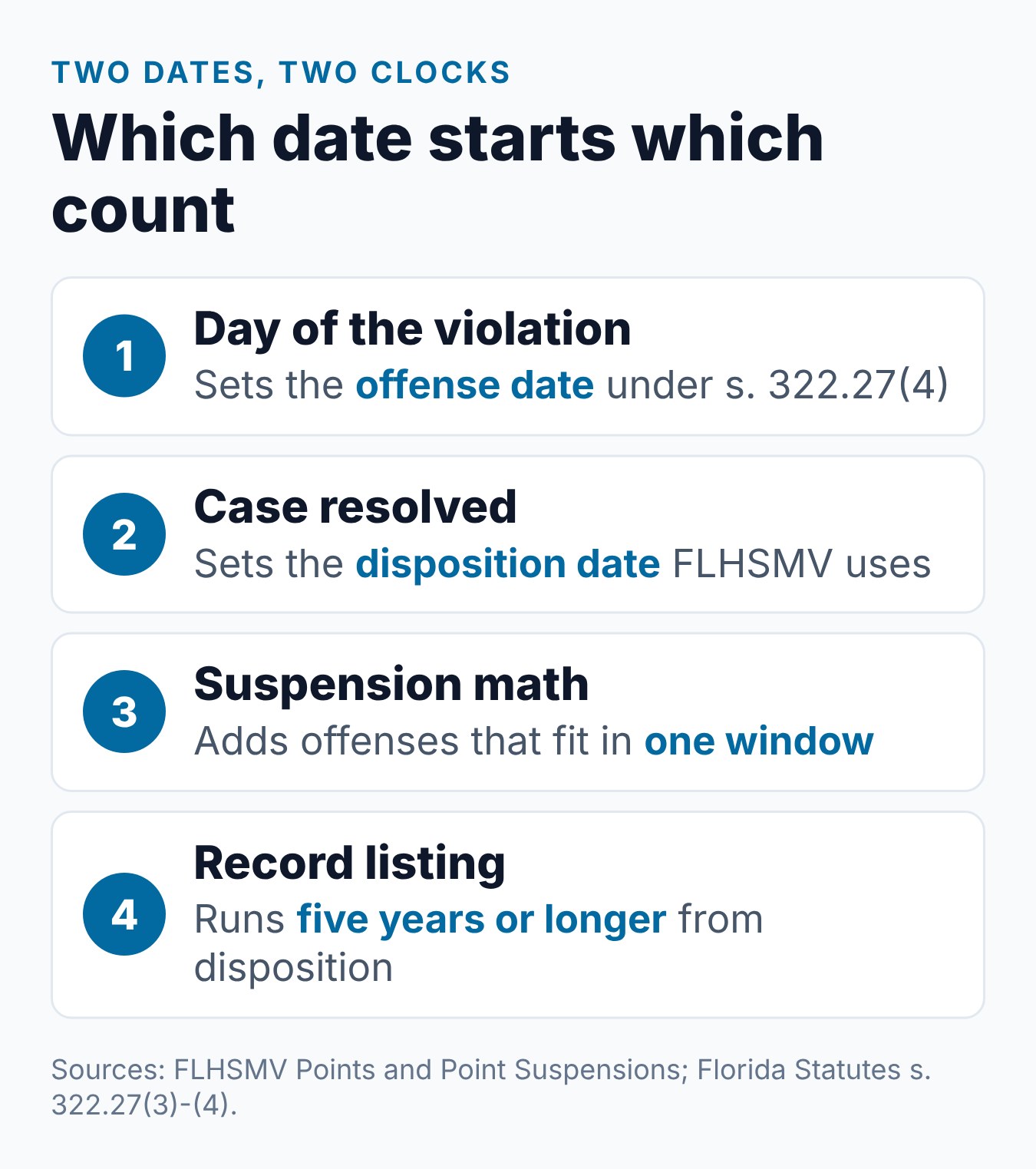
Every ticket that brings points has two dates. Each date runs a different clock.
The first is the offense date, the day of the violation. Under s. 322.27(4), FLHSMV “shall use the offense date of all convictions” when it computes points for a suspension.
The second is the disposition date, the day the case ends. FLHSMV uses it for the 5-year record period.
| Question | Record period | Suspension windows |
|---|---|---|
| What it controls | How long points stay listed | Whether FLHSMV may suspend |
| Date it starts from | Disposition date | Offense date |
| How long it runs | At least 5 years | 12, 18 or 36 months |
| Official source | FLHSMV points page | s. 322.27(3)-(4) |
How the Suspension Windows Work
Section 322.27(3) gives FLHSMV authority to suspend at three levels:
- 12 points from offenses within 12 months: up to 30 days.
- 18 points from offenses within 18 months: up to 3 months.
- 24 points from offenses within 36 months: up to 1 year.
These windows look back from offense dates. Points from an offense outside a window do not count toward that level. They still appear on your record for the full 5-year period.
Here is the math with offense dates. Three 4-point tickets inside 12 months reach 12 points.
If the same three offenses spread over 14 months, one 12-month window may hold only two of them. That window then holds 8 points.
A points suspension calls for Advanced Driver Improvement (ADI), not BDI. To drive on a hardship license, you show ADI completion.
To reinstate, you show ADI enrollment, and each step has a fee. Our license suspension guide explains what happens when you reach a level.
Why an Older Offense Can Still Count
It is easy to think points are gone once some months pass. That is not what FLHSMV says.
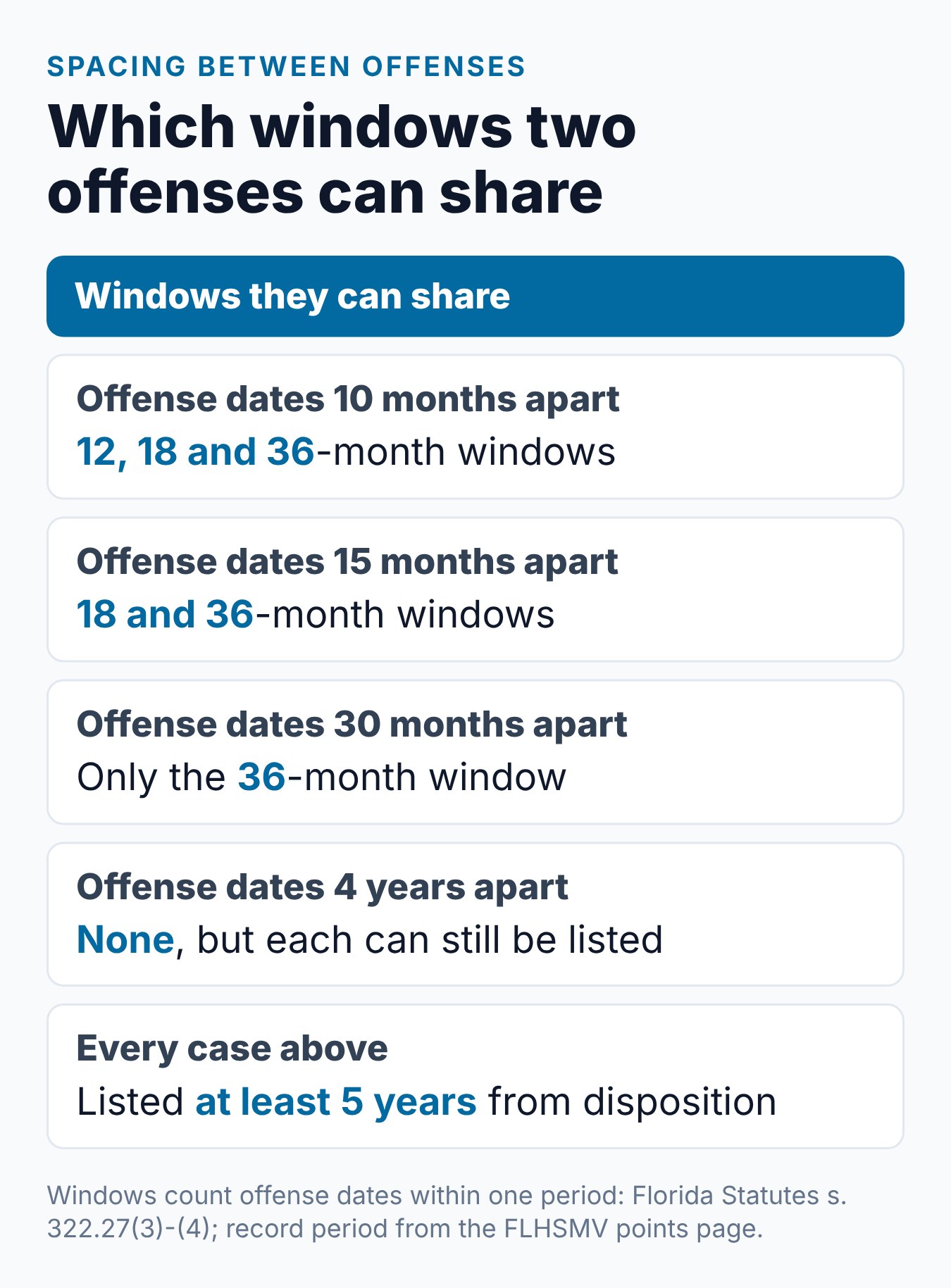
The windows measure the spacing between offense dates. Two offenses 20 months apart cannot share a 12-month or 18-month window. They can still share one 36-month window, and each stays listed under the 5-year rule.
So the record and the suspension math answer different questions. The record shows your history. The windows decide whether a suspension is possible now.
The 3-Point Deduction
Florida law has one rule that takes points off a record. Section 322.27(3)(h) says 3 points are deducted for a person whose license “has been suspended only once” under the point rules and then reinstated.
The person must also have met all other requirements of chapter 322. This is not something you can request with a course. It happens only after a first points suspension and reinstatement.
A BDI Election and the Clock
A Basic Driver Improvement (BDI) election works before points are added, not after. FLHSMV and clerks also call this course “traffic school.”
Under s. 318.14(9), an eligible driver can elect the course for a new ticket. When the election is valid:
- The court withholds adjudication.
- That ticket brings zero points.
- You pay the civil penalty minus 18 percent.
Because no points are assessed, that ticket adds nothing to the 5-year listing or to the windows. The election goes through the Clerk of Court within 30 days of the citation date, with the clerk’s election fee paid. A driver who elected in the past 12 months, or who has used all eight lifetime elections, cannot elect again.
Some tickets and drivers are excluded, such as CDL or CLP holders and speeding 30 mph or more over. Our guide on traffic school and points covers the election in depth.
Paying Without Electing
Paying the ticket without a course election closes the case as a conviction. Under s. 322.01(11), a conviction includes an admission of a noncriminal traffic infraction. Points are then added at the value the law sets.
From that point, both clocks apply. The offense date places the points in the suspension windows. The disposition date starts the 5-year listing.
If an Elected Course Is Not Finished
An election only keeps points off if you finish the course by the date the court or clerk sets. There is no statewide finish window.
Under s. 318.15(1)(b), a driver who elects but does not finish in time is found guilty. The points are added, and the driver pays back the 18 percent reduction plus a processing fee of up to $18.
Points Cannot Be Cleared Early
A course taken after a conviction does not shorten the 5-year period. It also does not take points off your record.
FLHSMV’s Reading a Driving Record training document says points that have been added “cannot be removed.” The one exception it gives is when the court that assigned them tells FLHSMV to remove them.
Our guide on whether traffic school helps with points already listed explains each option and its limits.
Points Versus the Ticket Entry
FLHSMV’s 2016 training document on reading a record says each violation entry shows the disposition, such as guilty or “adjudication withheld,” and any points. This guide covers how long the points stay.
For how long the ticket entry stays, see how long a speeding ticket stays on your record. For the full picture of values and levels, read the Florida points system guide.
Out-of-State Tickets
Points can also come from another state. Section 322.27(3)(e) lets FLHSMV record an out-of-state conviction using the Florida point value for the same offense.
Once recorded, those points follow the same Florida rules. The offense date drives the windows, and the record period comes from FLHSMV.
Tickets That Never Start a Points Clock
Some tickets carry no points, so there is nothing to time. Under s. 322.27(3)(d), red light camera tickets and school zone speed camera tickets get no points when a traffic infraction enforcement officer enforces them.
A seat belt ticket is a nonmoving violation under s. 316.614(8). Our points chart shows the value for each moving violation.
A Separate Window for Drivers Under 18
Teen drivers have one more time rule. Under s. 322.161, a Class E licensee aged 15 through 17 with 6 or more points in 12 months is limited to “business purposes only.”
That restriction lasts at least 1 year, plus 90 days for each extra point. FLHSMV says it lasts 12 months or until age 18, whichever happens first. See our teen points guide.
How to See Your Own Dates
Your driving record shows each conviction and its points. FLHSMV says you can buy your own 3-year, 7-year or complete record, and “the record will indicate the number of points.”
Look for two things on each entry. Find the offense date, which drives the suspension windows. Then find the disposition date, which starts the 5-year listing.
A free online license status check also exists, but it does not list points. Our guide on how to check points on your license lists the record options and fees.
What We Found on the Official Pages
On the FLHSMV page we checked on October 27, 2026, the record rule read “at least five years from the date of disposition.” That wording sets a minimum, not an end date.
Section 322.27(4), checked the same day, still told FLHSMV to use offense dates for suspensions. Section 322.20 set fees for records but no fixed time to keep them.
Common Mistakes
We drew each mistake below from FLHSMV or the Florida Statutes:
- Using the 3-year figure. FLHSMV says at least 5 years from disposition.
- Counting the 5 years from the ticket date. The record period starts at disposition.
- Counting suspension windows from the court date. The law uses offense dates.
- Thinking a passed window clears the record. Points stay listed for the full record period.
- Taking a course to shorten the time. No course shortens the 5-year period.
- Missing the 30-day election. After 30 days, points are assessed if you pay.
How Requirements Can Vary
Florida’s election rules, point values and suspension levels come from Florida Statutes and FLHSMV, and they apply statewide. The election fee, the date to finish the course and how proof is filed are set by the Clerk of Court in the county on your ticket, or by the court. A court order sets its own deadline and proof steps.
Laws, fees and clerk practice can change. Check your citation, your clerk’s instructions, any court order and the FLHSMV website before you enroll or file anything.
Frequently Asked Questions
Do Florida points expire after 3 years?
No. FLHSMV says points stay on the record at least 5 years from the disposition date. The 36-month figure is only the longest suspension window.
When does the 5-year count start?
It starts at the disposition date, when your case is resolved. The suspension windows start from the offense date instead.
Can points be removed before 5 years?
Only in narrow cases. The law deducts 3 points after a first points suspension and reinstatement. FLHSMV also says a court that assigned points can tell it to remove them.
Does a BDI course shorten how long points stay?
No. A BDI election keeps points off one eligible new ticket. It does not change points from earlier convictions.
Do old points still count toward a suspension?
Only if the offenses fall inside the same window. The 12-point level counts offenses within one 12-month period, and the 24-point level counts offenses within one 36-month period.
Do points from other states stay on my Florida record?
They may. Florida can record an out-of-state conviction with the same points it would get in Florida. Florida rules then apply to those points.
Does a camera ticket add to my point count?
No. When a traffic infraction enforcement officer handles a red light camera or school zone speed camera violation, the law imposes no points. Nothing is added to the record period or the windows.
Conclusion
Points stay on a Florida driving record at least 5 years from the disposition date, while suspension windows look back 12, 18 or 36 months from offense dates. Check your record, note both dates, and act within 30 days of any new ticket if you are eligible to elect. Anyone with a court order should follow it and check with the court or clerk on any doubt. Take the Florida BDI course online when you are ready.
Related Articles
- Florida Driver License Points System: Suspensions, Point Values, and BDI Options
- How Long Does a Speeding Ticket Stay on Your Florida Driving Record?
- Does Florida Traffic School Remove Points Already on Your Record?
- Florida License Suspension for Points: What Happens and Reinstatement Options
Sources
- FLHSMV — Points and Point Suspensions
- Florida Statutes s. 322.27 — Authority to suspend or revoke a license (point system)
- Florida Statutes s. 318.14 — Noncriminal traffic infractions; procedures
- Florida Statutes s. 318.15 — Failure to comply with civil penalty or to appear
- Florida Statutes s. 322.01 — Definitions
- Florida Statutes s. 322.161 — High-risk drivers; restricted licenses
- Florida Statutes s. 316.614 — Safety belt usage
- Florida Statutes s. 322.20 — Records of the department; fees
- FLHSMV — Basic Driver Improvement (BDI) Approved Course Providers
- FLHSMV — Reading a Driving Record (court training document, 2016, PDF)
Billy Forte is the owner of Driving Logic, a driver improvement course provider serving Florida and other U.S. states.
This article is general information, not legal advice. Election rules, deadlines, fines and penalties depend on your citation, county, court and case facts, and they can change. Use official FLHSMV, Florida Statutes and Clerk of Court sources, and consult a qualified Florida attorney for advice about your own case.