
Updated October 2026 · Reviewed by Billy Forte
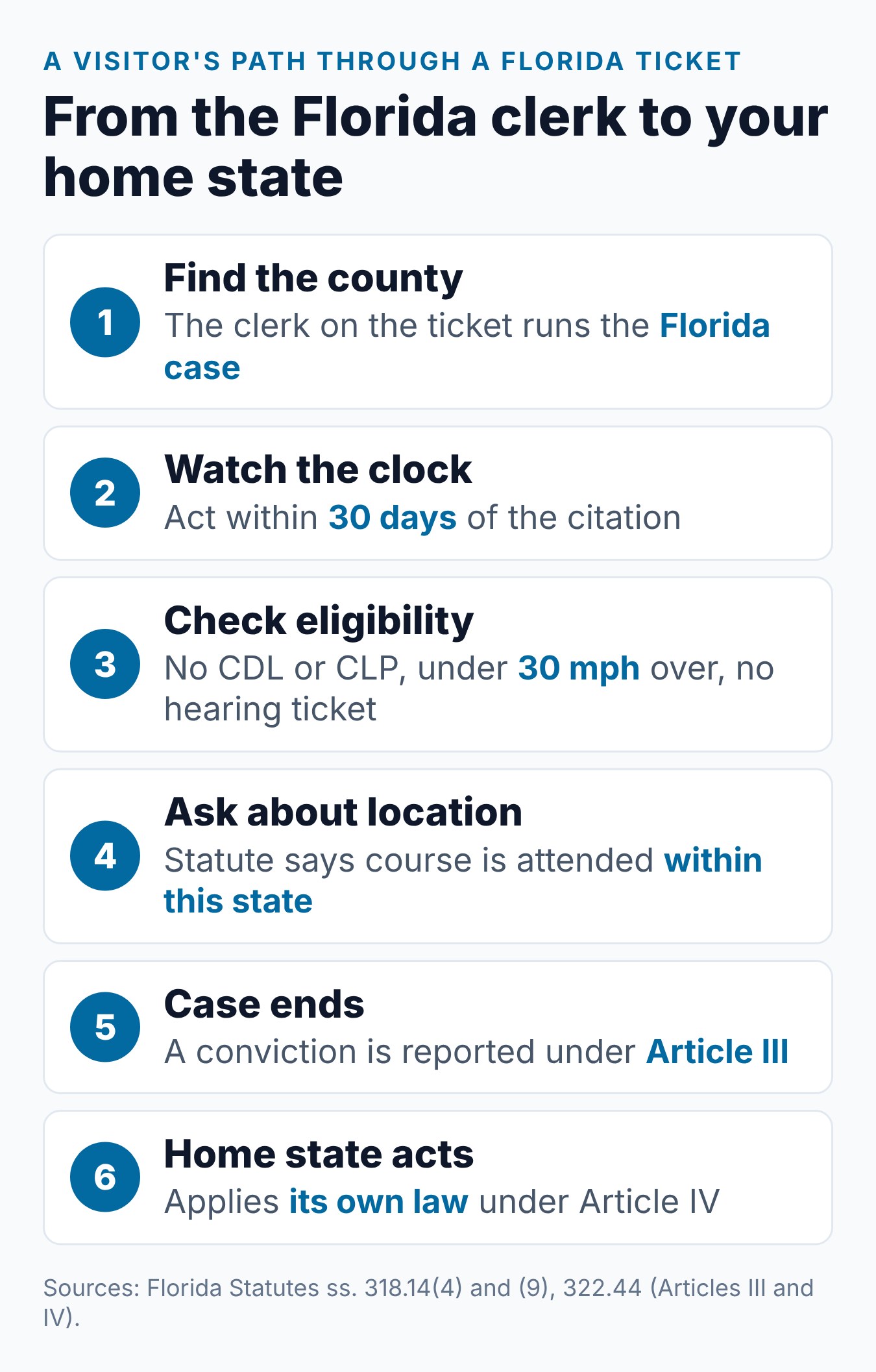
When you get a Florida speeding ticket out of state, meaning your license comes from another state, the Florida county on the ticket handles the case under Florida law. If the case ends in a conviction, Florida reports it to your home state when that state is a member of the Driver License Compact. Your home state then applies its own law to decide what the Florida conviction means for your license.
Key Facts
- Who handles it: the Clerk of Court in the Florida county on the ticket. See who handles the case.
- The compact: Florida reports each conviction to the home state of a driver from another member state. See the Driver License Compact.
- Your home state: it gives the conviction the effect its own laws provide. See your home state’s role.
- Your deadline: you have the same 30 days as a Florida driver to respond. See the 30-day window.
- Ignoring it: the clerk tells FLHSMV, which must issue a suspension order. See ignoring the ticket.
A Florida Speeding Ticket Out of State: Who Handles the Case
Your Florida ticket stays a Florida case. The Clerk of Court in the county where the ticket was written handles it.
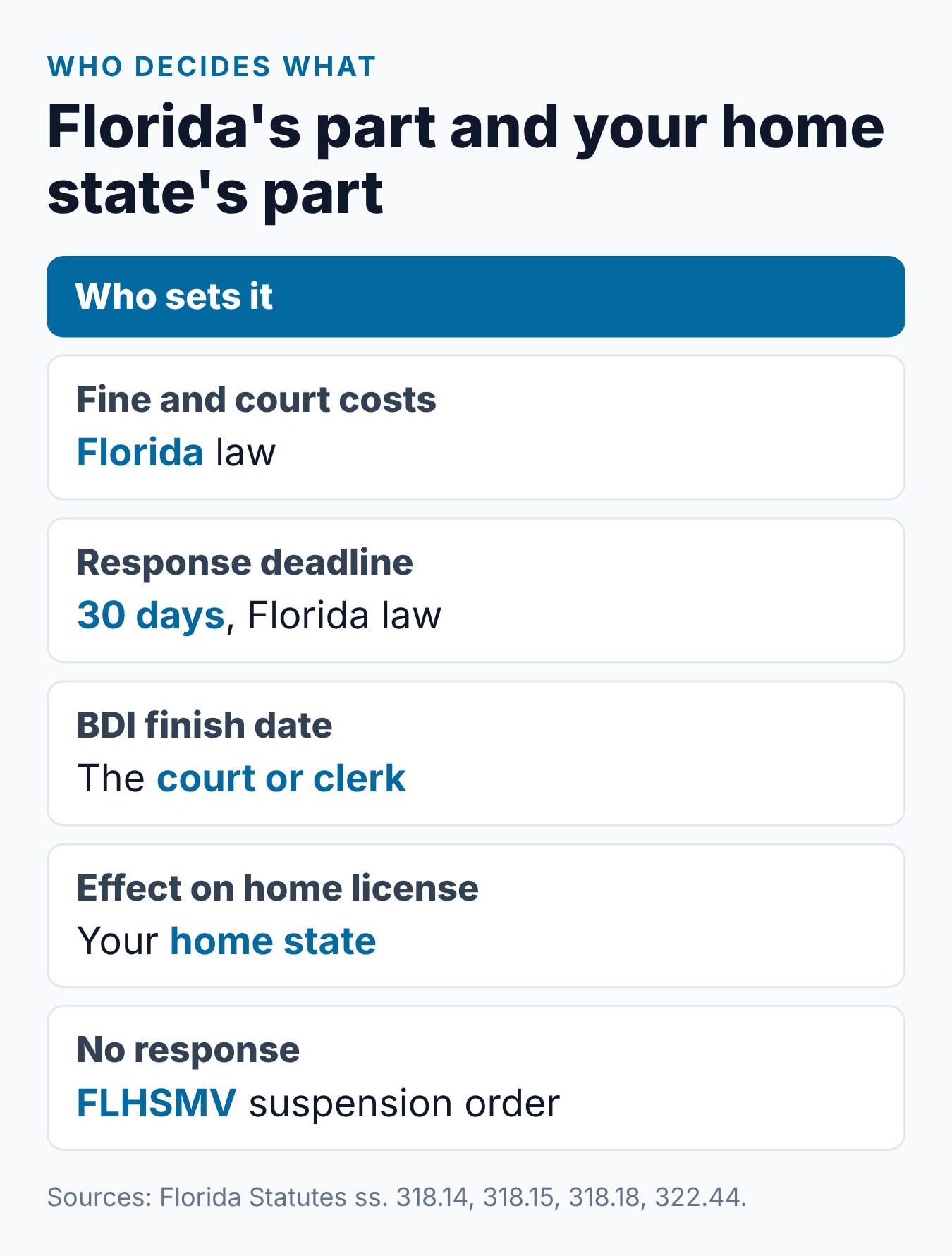
Florida law sets the rules for the ticket. The base fines in s. 318.18 apply to every driver cited in Florida.
For speeding, the fine depends on how far over the limit you were. Court costs set by law are added on top.
Your license state does not change the Florida process. What it controls is what happens to your home license after the Florida case ends.
The Driver License Compact
Florida joined an agreement among states called the Driver License Compact. Section 322.43 says sections 322.43 through 322.48 “shall be known as the ‘Florida Driver License Compact Act.'”
The compact text is in s. 322.44. Two parts matter most for visitors:
- Article III (reports). A member state “shall report each conviction of a person from another party state occurring within its jurisdiction” to the licensing authority of that person’s home state.
- Article IV (effect). The home state “shall give such effect to the conduct as is provided by the laws of the home state.”
The Florida statute page does not list which states are members. To learn whether your state is one, ask your own state’s licensing agency.
What the Compact Covers
Article III speaks of convictions. In Florida, paying a civil traffic penalty is treated as a conviction. The Orange County Clerk says “Payment of the civil penalty is considered a conviction.”
So if you simply pay, expect that result to be a conviction under Florida law. What your home state does next depends on its own rules.
Your Home State’s Role
Florida does not decide what your home state does. Under Article IV, your home state applies its own laws to the Florida conduct.
That covers questions such as these:
- whether your home state adds points of its own;
- whether the conviction counts toward any limit it sets; and
- how your home record shows the Florida case.
We cannot answer those for you, because each state writes its own rules. Your home licensing agency is the place to ask.
Florida does the same thing in reverse for its own drivers. Under s. 322.27(3)(e), FLHSMV may record another state’s conviction against a Florida licensee with the points it would carry in Florida.
The 30-Day Window
Living elsewhere does not give you more time. Under s. 318.14(4), a driver who does not elect to appear must act within 30 days after the date the citation was issued.
Within that window, the choices for a civil ticket are:
- Pay the civil penalty, or set up a payment plan with the clerk.
- Elect the Basic Driver Improvement (BDI) course, if you are eligible.
- Ask for a hearing before the court.
At a hearing, the official may impose a civil penalty of up to $500 under s. 318.14(5). Our guide to Florida traffic ticket options compares the three paths.
The clerk for the county named on your ticket can tell you how to pay or respond.
The BDI Election for Visitors
The election rule in s. 318.14(9) starts with “Any person who does not hold a commercial driver license or commercial learner’s permit.” It does not limit the election to Florida licensees. The same eligibility rules apply to you.
If you can and do elect, the statute says:
- Adjudication is withheld. Section 318.14(11) says this “is not a conviction.” It is not a dismissal.
- No points are assessed for that ticket under s. 322.27.
- The civil penalty is cut by 18 percent. You still pay the reduced amount.
To elect, tell the Clerk of Court in the county where the ticket was issued within 30 days of the citation date. Do this before you take the course, and pay the clerk’s election fee. The FLHSMV BDI page lists both steps.
The “Within This State” Wording
One phrase matters for visitors. Section 318.14(9) lets a driver “attend in the location of his or her choice within this state” an FLHSMV-approved basic driver improvement course.
FLHSMV approves courses delivered online, too, under s. 318.1451. The statute does not explain how “within this state” applies to an online course taken from another state. Ask the clerk before you enroll.
Our guide for out-of-state drivers taking BDI covers the course side.
Who Cannot Elect
You cannot elect if any of these apply:
- you hold a CDL or commercial learner’s permit, in any vehicle;
- you were cited for speeding 30 mph or more over the limit;
- the ticket needs a mandatory hearing under s. 318.19;
- you made an election in the preceding 12 months; or
- you have already made eight elections in your lifetime.
The lifetime limit was five before July 1, 2024. Some FLHSMV and clerk pages still say five, but the statute says eight, and the statute controls.
Finishing on Time
The court or clerk sets the date to finish the course. Florida has no single statewide window. Clerk pages give examples:
- 60 calendar days in Hillsborough County, per the Hillsborough Clerk.
- 120 days in Miami-Dade County, per the Miami-Dade Clerk.
Missing the date has a cost. Under s. 318.15(1)(b), a driver who elects and pays but does not finish in time is deemed to have admitted the infraction and is adjudicated guilty.
Points are assessed. The driver must also pay back the 18 percent cut plus a processing fee of up to $18.
Tickets That Need You in Court
Some tickets cannot be handled by mail or by election. Section 318.19 requires a hearing for these infractions:
- a crash that causes the death of another person;
- a crash that causes serious bodily injury of another person;
- passing a stopped school bus on the side children enter and exit;
- certain load violations under s. 316.520;
- speeding 30 mph or more over the limit; and
- speeding 50 mph or more over, under s. 316.1926(2).
Criminal traffic charges also require you to sign and accept a citation that shows a promise to appear, under s. 318.14(2). Since July 1, 2025, going 50 mph or more over the limit, or 100 mph or more in a way that threatens people or property, can be dangerous excessive speeding under s. 316.1922.
Our guide to mandatory court appearance tickets explains these cases.
Ignoring the Ticket
Distance does not make a Florida ticket go away. Under s. 318.15(1)(a), if a driver does not pay, does not appear at a scheduled hearing, or does not attend driver improvement school, the clerk must notify FLHSMV within 10 days.
FLHSMV then “must immediately issue an order suspending the driver license and privilege to drive” of that person.
So skipping the ticket does not keep it off the books. It adds a suspension order on top of the original case.
Your Choices Side by Side
| If you… | What Florida law or the clerk says | Who to ask |
|---|---|---|
| Pay the penalty | Treated as a conviction, and points follow | Clerk of Court |
| Elect BDI | Withheld, no points, penalty cut 18 percent | Clerk of Court |
| Request a hearing | Official may impose up to $500 | The court |
| Do nothing | Clerk notifies FLHSMV, which issues a suspension order | FLHSMV |
What We Found on the Official Pages
On the statute pages we checked on October 27, 2026, s. 322.44 had the Article III reporting duty and the Article IV home-state rule. Neither s. 322.43 nor s. 322.44 listed the member states.
The FLHSMV BDI page said drivers must tell the clerk “in the county where the citation was issued.” It still listed “five elections in a lifetime” as a bar, while the 2026 statute says eight. The statute controls.
Common Mistakes
Each item below comes from a Florida statute or an official page:
- Assuming a visitor gets extra time. The 30-day window in s. 318.14(4) applies to everyone.
- Thinking Florida decides your home points. Under Article IV, your home state applies its own law.
- Skipping the clerk. You must tell the clerk before taking the course.
- Assuming online is fine from anywhere. The statute says “within this state,” so ask the clerk first.
- Treating payment as neutral. In Florida, paying the penalty is treated as a conviction.
- Ignoring the ticket. FLHSMV must issue a suspension order.
How Requirements Can Vary
Florida’s election rules, point values and suspension levels come from Florida Statutes and FLHSMV, and they apply statewide. The election fee, the date to finish the course and how proof is filed are set by the Clerk of Court in the county on your ticket, or by the court. A court order sets its own deadline and proof steps.
Laws, fees and clerk practice can change. Check your citation, your clerk’s instructions, any court order and the FLHSMV website before you enroll or file anything.
Frequently Asked Questions
Will a Florida ticket show up in my home state?
If the case ends in a conviction and your state is in the Driver License Compact, Florida reports it there. Your home state then decides the effect under its own laws. Ask your home licensing agency what it does with an out-of-state conviction.
Do I get Florida points on my out-of-state license?
Your home state controls your license and applies its own law to the Florida conduct. Ask your home licensing agency whether it adds points. A valid BDI election means no Florida points are assessed for that ticket.
Can I elect traffic school if I do not live in Florida?
The statute opens the election to any person who meets its rules, not only Florida licensees. But it says the course is attended “within this state,” so ask the clerk how that applies to you before you enroll.
How long do I have to respond?
You have 30 days after the date the citation was issued. That is the same deadline a Florida driver has. The clerk can tell you the payment and election steps for that county.
What happens if I ignore a Florida ticket?
The clerk notifies FLHSMV, which must issue an order suspending your license and privilege to drive. The suspension order is added on top of the original ticket case.
Can I elect BDI if I hold a CDL from another state?
No. Section 318.14(9) bars anyone who holds a CDL or a commercial learner’s permit, in any vehicle. Ask the clerk about your other options.
Conclusion
A Florida ticket stays in the Florida county that wrote it, and your home state decides what a conviction means for your license. Respond within 30 days, check whether you can elect, and ask the clerk how the “within this state” wording applies to you.
If the clerk confirms your election, you can take the Florida BDI course online. If a court order applies to your case, follow it, and ask the court or clerk if you are unsure.
Related Articles
- Florida Traffic Ticket: Costs, Points, and Traffic School Options
- Florida BDI Course for Out of State Drivers
- Florida Traffic Ticket Options: Pay, Elect Traffic School, or Contest
- Florida Mandatory Court Appearance Tickets: When You Can’t Elect Traffic School
Sources
- Florida Statutes s. 322.43 — Florida Driver License Compact Act
- Florida Statutes s. 322.44 — Driver License Compact
- Florida Statutes s. 318.14 — Noncriminal traffic infractions; procedures
- Florida Statutes s. 318.15 — Failure to comply with civil penalty or to appear
- Florida Statutes s. 318.19 — Infractions requiring a mandatory hearing
- Florida Statutes s. 318.18 — Amount of penalties
- Florida Statutes s. 322.27 — Authority to suspend or revoke a license (point system)
- Florida Statutes s. 318.1451 — Driver improvement schools
- FLHSMV — Basic Driver Improvement (BDI) Approved Course Providers
- Orange County Clerk — Traffic Ticket Options
- Hillsborough County Clerk — Traffic School
- Miami-Dade Clerk of the Court — Traffic School
Billy Forte is the owner of Driving Logic, a driver improvement course provider serving Florida and other U.S. states.
This article is general information, not legal advice. Election rules, deadlines, fines and penalties depend on your citation, county, court and case facts, and they can change. Use official FLHSMV, Florida Statutes and Clerk of Court sources, and consult a qualified Florida attorney for advice about your own case.