
Updated October 2026 · Reviewed by Billy Forte
The answer to how long is the NJ defensive driving course is at least six hours of instruction, whether you take it online or in a classroom. A classroom course must include at least four hours of classroom instruction, and an online course is split into modules with a quiz after each one and a final exam. After you finish, the provider reports your completion to the New Jersey Motor Vehicle Commission (NJMVC) within 7 to 10 business days.
Key Facts
- Minimum: six hours of instruction in both formats. See the six-hour rule.
- Classroom: at least four hours of classroom instruction, and video for no more than three. See classroom hours.
- Online: modules, a quiz you must pass after each one and a final exam. See online structure.
- Reporting: 7 to 10 business days after you finish. See the timeline.
- Benefits: the point credit comes once in five years; the insurance reduction lasts three years. See how long benefits last.
How Long Is the NJ Defensive Driving Course?
Six hours is the floor. The state rule, N.J.A.C. 13:21-24.5, sets that minimum for both formats:
- Classroom: at least six hours of instruction.
- Online, DVD or video: no less than six hours of instruction and curriculum information.
The rule sets a minimum, not a maximum. It does not cap the length of a course.
So a course that promises to take less than six hours does not meet the New Jersey rule. Only a course approved by the NJMVC counts for the 2-point credit.
You may see it called the NJ defensive driving course 6 hours class. That name fits, since six hours is the least time an approved course can take.
Why the Course Runs Six Hours
The six-hour floor ties to a national benchmark. Under N.J.S.A. 17:33B-45, the state must approve any course that meets or exceeds the National Safety Council’s defensive driving standards.
The hours also have a set job. Every course must cover defensive driving techniques, alcohol and drugs, risky habits, bad weather, following distances, talking with other road users and New Jersey traffic law.
A provider must also show the course works. Rule 13:21-24.3 asks it to show the course cuts moving violations, crashes or both for drivers who finish.
Classroom Hours, Broken Down
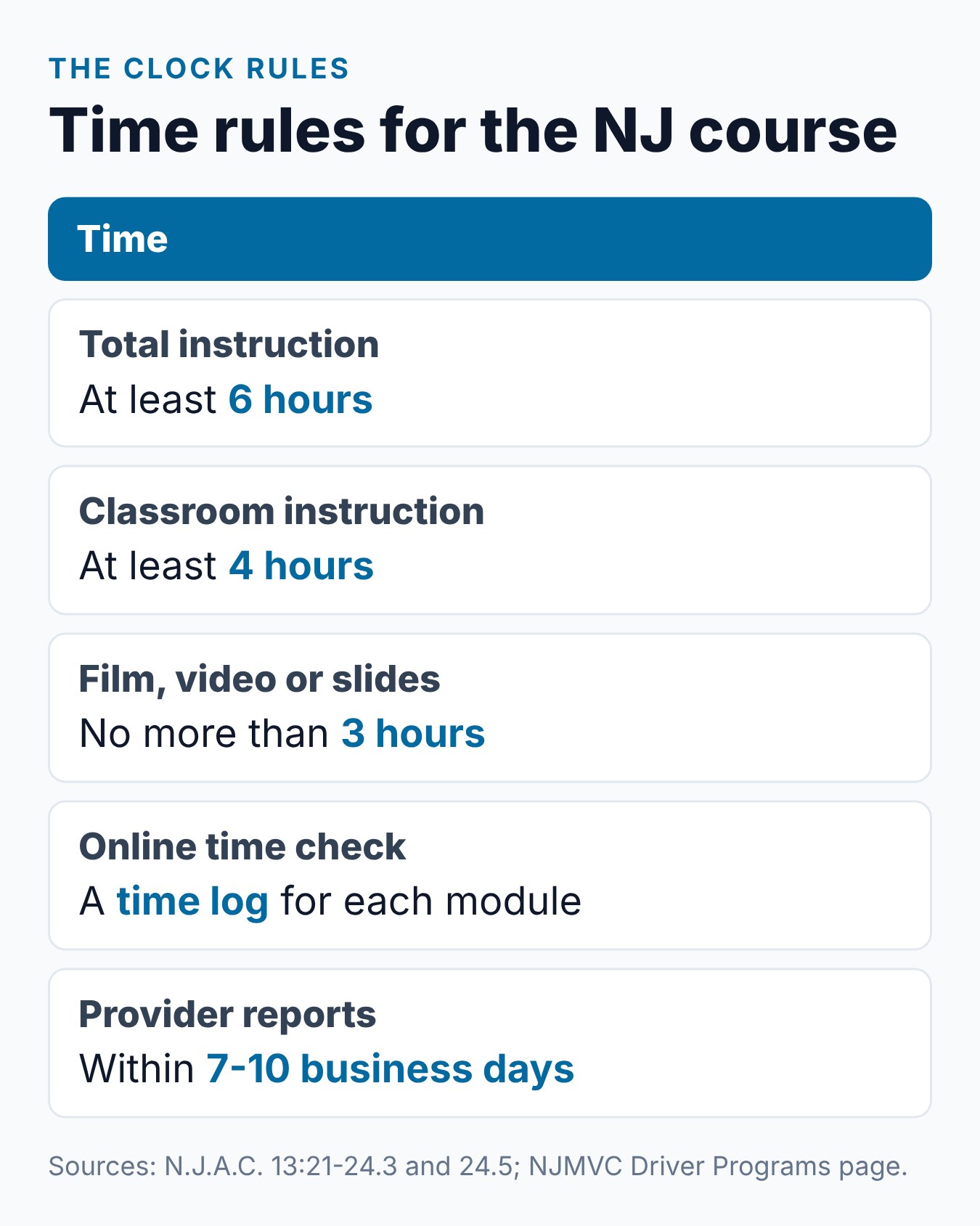
A classroom course has three time rules. All three come from section (a) of the same rule:
- At least six hours of total instruction.
- At least four hours of classroom instruction.
- No more than three hours of films, videos, slides or DVDs.
The provider sets the class schedule. Ask whether the class runs in one session or more than one, and on which dates.
If you miss a class, there may be room in a later one. The rule lets a class add up to five students who missed an earlier session, on top of the 30-student limit.
How an Online Course Is Structured
An online course follows a set order. The rule lays it out:
- Modules. The course content is split into modules with visual aids and interactive exercises.
- Module quizzes. Each module ends with a quiz. You must pass it before you move on.
- Proficiency exam. After the last module, a final exam covers all modules.
- Answer explanations. The exam explains correct and incorrect answers.
The rule does not set a number of modules. Each provider builds its own course and gets it approved.
Time Logs for Each Module
Online providers cannot just trust that you spent six hours. N.J.A.C. 13:21-24.3 requires an electronic time log for each module. The log confirms you spent the required time.
The same rule calls for identity checks at random times during the course and the exam. Answering them is part of finishing.
Exam Retakes
You need at least 80 percent on the proficiency exam. A provider may allow up to two retakes after you review the course.
A retake adds time. Our guide to the NJ defensive driving course test explains the quizzes and exam in detail.
For a full walk-through of the online format, see our NJ online defensive driving course guide.
Does It Have to Be One Sitting?
The online rule sets a minimum amount of instruction. It does not say the six hours must happen in one sitting.
Each provider decides how its course handles stops and restarts. Ask before you begin:
- Can I log out and come back later?
- Does my progress save at the end of each module?
- Is there a deadline to finish after I start?
For a classroom course, the schedule belongs to the provider. Ask for the dates and times before you pay.
Your Timeline After You Finish
Finishing the course starts a short reporting process. Here is who acts and when:
| Step | Who acts | Timing |
|---|---|---|
| Finish the course | You | After at least six hours of instruction |
| Send a certified list of graduates | Provider | Within 10 days of the end of the course |
| Notify the NJMVC with proof | Provider | Within 7 to 10 business days |
| Review your record and apply the credit | NJMVC | After it receives the provider’s record |
| Apply the premium reduction | Your insurer | Starting with the next policy period |
The 10-day rule comes from N.J.A.C. 13:21-24.8. The 7-to-10-business-day window comes from the NJMVC Driver Programs page.
That page also says, “Certificates are not acceptable from driver license holder.” Sending your own copy will not count.
Once that window has passed, you can check your record. A driver history abstract from the NJMVC lists your points, and our driving record abstract guide shows how to order one. If the credit is missing, contact the provider that taught your course.
How Long Your Course Record Is Kept
The provider keeps its own record of your course. Under N.J.A.C. 13:21-24.7, it must hold that record for five years from the date you finish.
The record includes your course dates and the date you finished. The NJMVC can ask to inspect it.
How Long the Benefits Last
The course takes six hours. Its benefits run on longer clocks.
The point credit. Under N.J.A.C. 13:21-24.2, you get 2 points off once in any five-year period. The time periods count from the dates of your offenses and the date you finish.
The insurance reduction. Under N.J.S.A. 17:33B-45.1, the reduction lasts three years from the next policy period. It ends early with a suspension or four or more points.
Points also fade on their own schedule. The NJMVC point system page takes off 3 points after one year with no violations or suspensions.
Want to know when you can take the course again? Read how often you can take the NJ course.
The Clocks, Worked Out
A few simple examples show how the clocks work together:
- Point credit. With 6 points, the course leaves 4. A year with no violations or suspensions then takes off 3 more, leaving 1.
- A second course too soon. Finish one course, then another two years later. The second one gives no point credit, because both fall inside five years.
- Insurance. The reduction starts with your next policy period after the course. It then runs three years unless a suspension or four or more points ends it.
Our guide to how long points stay on an NJ license covers the point side in more depth.
How It Compares With the DIP
The Driver Improvement Program (DIP) is a different program with a different length. The NJMVC remedial programs page calls it a three-hour program.
You cannot pick the DIP on your own. A driver may take it only after the NJMVC sends a notice offering it, and a defensive driving course cannot be substituted for it.
So the six-hour course and the three-hour DIP are not two lengths of the same class. Read DIP vs defensive driving for the full comparison.
Planning Your Six Hours
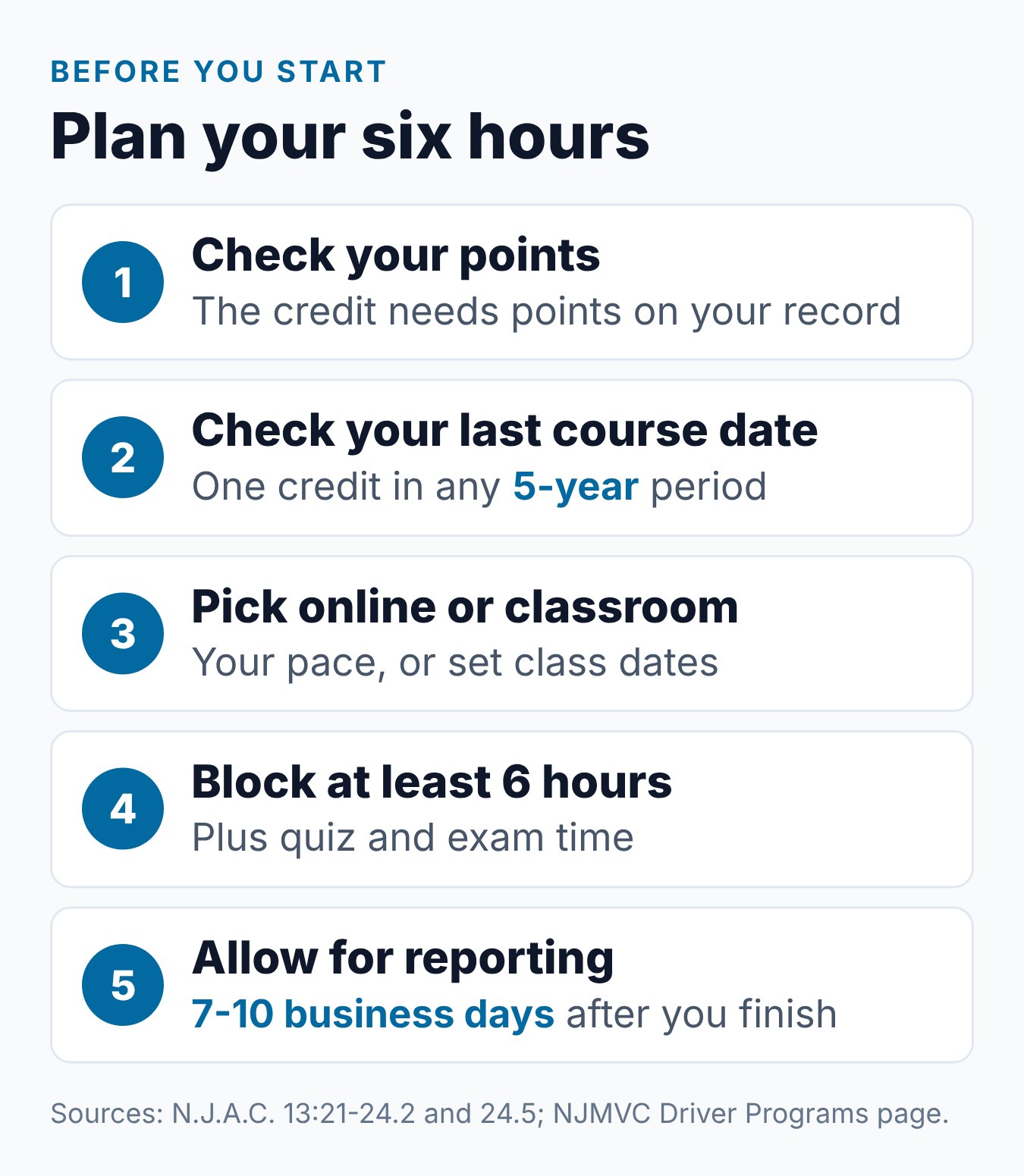
A plan keeps the course from dragging on. Work through these steps before you start:
- Check your points. The NJMVC page says the credit works only if points are on your record when you finish. A driver history abstract shows them.
- Check your last course date. If you took one in the past five years, the point credit will not apply again yet.
- Pick your format. Online lets you set the pace. A classroom sets the dates.
- Block the time. Plan for at least six hours, plus time for quizzes and any exam retake.
- Allow for reporting. Add 7 to 10 business days before the NJMVC has your completion.
If timing around a ticket matters to you, see our guide on when to take the NJ course. The course does not dismiss a ticket. It lowers points that are already on your record.
Common Time Mistakes
These mistakes come from the official rules. Each one can cost you time:
- Trusting a short course. Under six hours does not meet the rule.
- Skipping ahead. Online, each module quiz must be passed before the next module opens.
- Expecting an instant change. The provider has 7 to 10 business days to notify the NJMVC.
- Mailing your certificate. The NJMVC does not accept certificates from drivers.
- Waiting too long. Credits do not cancel a suspension the NJMVC has already proposed.
- Repeating too soon. The point credit comes once in any five-year period.
How Requirements Can Vary
New Jersey’s point system and defensive driving rules are set by state law and NJMVC rules, and they apply statewide. Fines and court costs come from the municipal court that handles your ticket, so the amount you owe depends on the court and the violation.
Insurance discounts also differ. State law requires insurers to reduce your premium after an approved course, but each insurer sets the amount.
Check the NJMVC Driver Programs page, your driver history abstract, and your insurer for current rules before you sign up for a course.
Frequently Asked Questions
How long is the NJ defensive driving course?
At least six hours of instruction, online or in a classroom. A classroom course must include at least four hours of classroom instruction.
Can I finish the NJ course in less than six hours?
No. Six hours is the minimum for an approved course. Online providers keep time logs for each module to confirm the required time.
How many modules does the online course have?
The rule does not set a number. Each provider builds its own modules, and each module ends with a quiz you must pass.
Is the classroom course shorter than the online course?
No. Both formats need at least six hours of instruction. The classroom version must also include at least four hours of classroom instruction.
Do I have to finish the online course in one day?
The rule does not require one sitting. Each provider sets how stops, restarts and deadlines work, so ask before you start.
How long until my points go down?
The provider notifies the NJMVC within 7 to 10 business days. The NJMVC then reviews your record and applies the 2-point credit.
How long does the provider keep my course record?
Five years from the date you finish, under N.J.A.C. 13:21-24.7. The record includes your course dates and completion date.
How long does the insurance reduction last?
Three years, starting with the next policy period. It ends early if your license is suspended or you reach four or more points.
Conclusion
Plan for at least six hours of instruction, plus quiz and exam time, and then 7 to 10 business days for reporting. The point credit and the insurance reduction follow their own five-year and three-year clocks. Driving Logic’s New Jersey Defensive Driving Course is coming soon, and the NJMVC Driver Programs page lists approved providers now.
Related Articles
- NJ Defensive Driving Course: The Complete Guide to Point Reduction and Insurance Discounts
- New Jersey Online Defensive Driving Course: How the 6-Hour Program Works
- NJ Defensive Driving Course Final Exam: What to Expect
- How Often Can You Take NJ Defensive Driving Course?
Sources
- NJMVC — Driver Programs (defensive driving course, DIP, PDP, approved providers)
- N.J.A.C. 13:21-24.5 — Course length and content
- N.J.A.C. 13:21-24.8 — Certification of course completion
- N.J.A.C. 13:21-24.2 — Point reduction for a defensive driving course
- N.J.S.A. 17:33B-45.1 — Insurance premium reduction after a defensive driving course
- N.J.S.A. 17:33B-45 — Approval of defensive driving courses
- NJMVC — Point System and Suspensions
- NJMVC — Driver Improvement and Probationary Driver Programs
- NJMVC — Driver History Abstract
Billy Forte is the owner of Driving Logic, a state-approved driver improvement course provider serving Florida and other U.S. states.
This article is general information, not legal advice. New Jersey point rules, surcharges, and insurance discounts are set by New Jersey law, the Motor Vehicle Commission, and your insurer, and can change. Check the NJMVC website, the court on your ticket, and your insurer for current requirements.