
Updated October 2026 · Reviewed by Billy Forte
If you are asking how long do points stay on your license in NJ, the answer is that the New Jersey Motor Vehicle Commission (NJMVC) keeps a permanent record of all points, but reductions can lower your current point total. NJMVC takes 3 points off that total for each year with no violations and no suspensions, and approved programs can take off more. Those reductions count toward the 12-point suspension line, not toward a point surcharge.
Key Facts
- Clean-year credit: 3 points off for each year with no violations or suspensions. See the one-year rule.
- Course credit: 2 points off, once in any five-year period. See program credits.
- DIP and PDP: 3 points each, but only when NJMVC offers or orders them. See program credits.
- Record window: the driver history abstract shows five years. See what your record shows.
- Surcharge: 6 or more points can bring a yearly bill, and credits do not lower that count. See surcharges.
How Long Do Points Stay on Your License in NJ?
The NJMVC Point System and Suspensions page does not give points an expiration date. It says NJMVC keeps a permanent record of all points, even after deductions. It also lists four ways to lower your current point total.
Points are added for the violations on the NJMVC Points Schedule. Once they are on your record, two lines matter.
The 12-point suspension line uses your current total, which reductions can lower. The 6-point surcharge line does not, because NJMVC says the clean-year and course credits do not reduce a surcharge point total.
So the real question is how fast your current total can come down. The answer depends on your driving and on which programs you can use. Here are the four reductions on the NJMVC page:
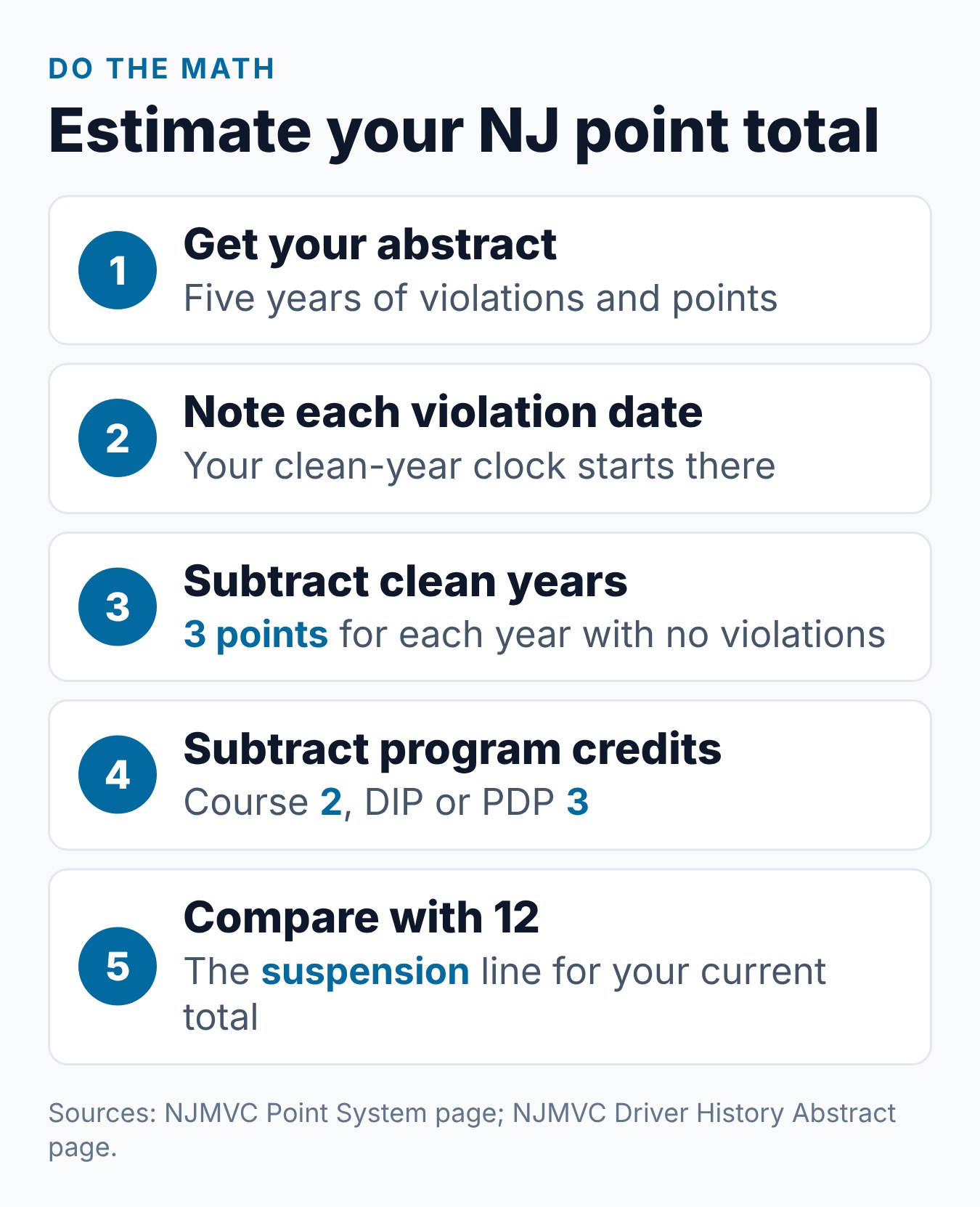
- One year with no violations or suspensions: minus 3 points.
- Defensive driving course: minus 2 points, once every five years.
- Driver Improvement Program (DIP): minus 3 points, once every two years, in response to an NJMVC proposed action.
- Probationary Driver Program (PDP): minus 3 points, one time, when NJMVC orders it.
On the NJMVC Point System page we checked on October 25, 2026, these four were the only reductions listed.
The One-Year Safe Driving Rule
The clean-year credit is the reduction every driver can earn. It does not need a class or a fee. It only needs time with a clean record.
NJMVC says the year begins on the date of the violation or the date of your most recent restoration. If you get a new violation or a suspension during that year, you do not earn the credit for it.
A Simple Example
Say you have 6 points from one ticket. You then drive for a full year with no violations and no suspensions.
NJMVC takes 3 points off your current total, which leaves 3. Another clean year takes off 3 more, which leaves 0. The points still stay on your permanent record, and the credits do not cut a surcharge.
Now say you get a new ticket halfway through the second year. That new violation means the second year is not clean. Your new points are added, and the count of clean time starts again from the new violation date.
Why the Start Date Matters
The start date is set by the violation, not by the day you paid the ticket. If your license was suspended and then restored, the restoration date can be the start date instead.
Keep the dates on your record handy. They tell you when your next clean-year credit could apply.
Program Credits and Their Time Limits
Three programs can take points off faster than clean years. Each has a different rule about how often you can use it.
Defensive Driving Course: 2 Points Every Five Years
An approved defensive driving course is voluntary. The state rule, N.J.A.C. 13:21-24.2, says points are reduced by two after you finish. Here are its limits:
- Once in any five-year period. You cannot use it again sooner.
- Never below zero. Your total cannot go under 0.
- Points must be on your record. The NJMVC Driver Programs page says the credit applies only if you have points when you finish.
- No effect on a proposed suspension. Credits do not cancel a suspension NJMVC has already proposed.
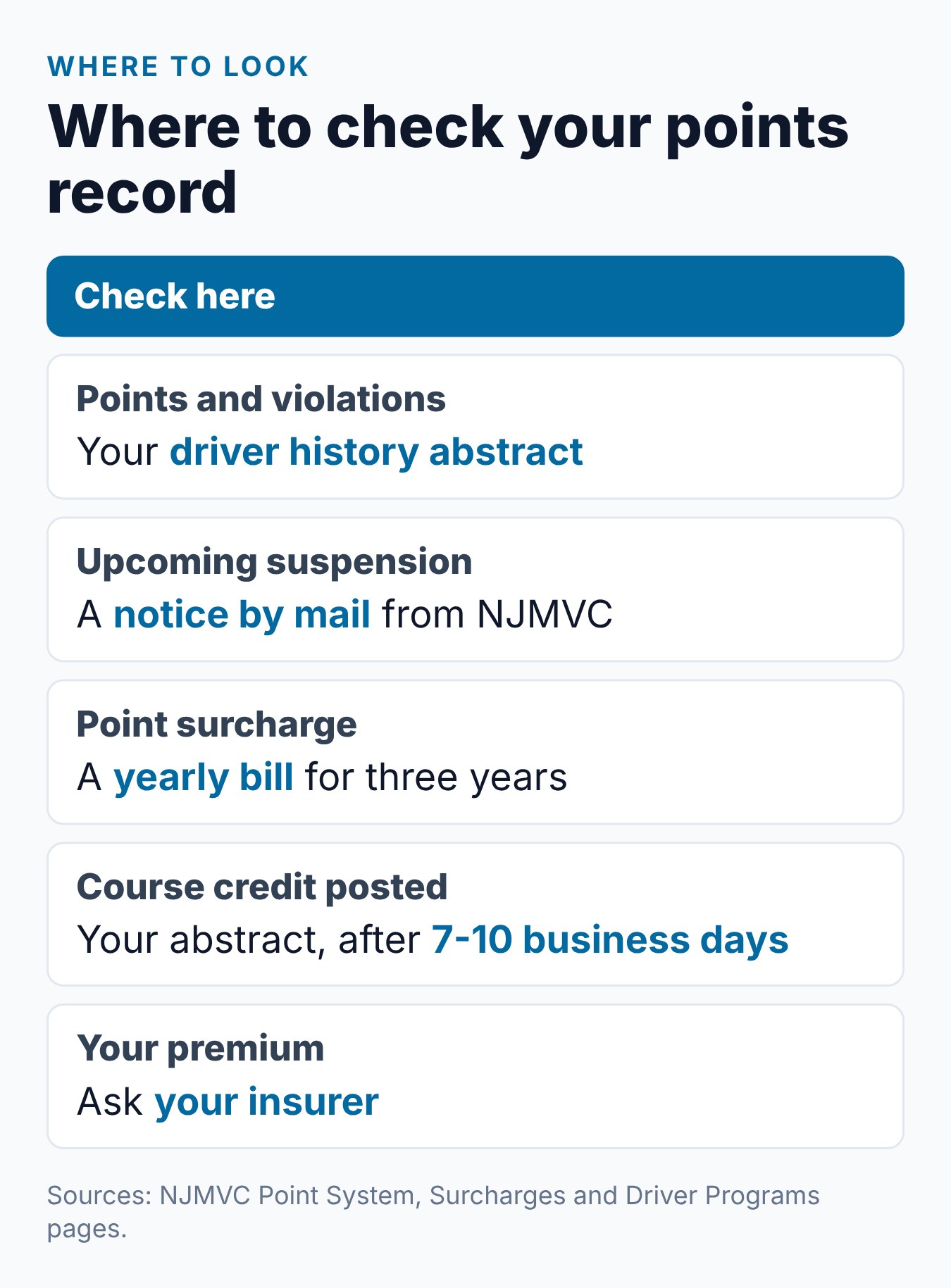
The provider, not you, tells NJMVC that you finished. NJMVC says this takes 7 to 10 business days, and it does not accept certificates from drivers.
The course does not dismiss a ticket. Our guide to the NJ defensive driving 2-point reduction covers the details.
Driver Improvement Program: 3 Points Every Two Years
The DIP is a three-hour program. You can take it only after NJMVC sends a notice offering it, when your license faces suspension.
It removes 3 points, and you can use it once every two years. A defensive driving course cannot take its place. Our Driver Improvement Program guide explains the fees and rules.
Probationary Driver Program: 3 Points, One Time
The PDP is for probationary license holders. NJMVC orders it when they gather more than two points or are convicted of certain violations.
It removes 3 points, and it can be completed only one time when ordered. Our Probationary Driver Program guide covers the 120-day deadline.
Time Rules at a Glance
Each rule below has its own clock. They run at the same time, so one record can be on several clocks at once.
| Rule | How long it runs | Where it comes from |
|---|---|---|
| Clean-year credit | 3 points off after each year with no violations or suspensions | NJMVC Point System page |
| Course point credit | Can be used once in any five-year period | N.J.A.C. 13:21-24.2 |
| DIP point credit | Can be used once every two years, when offered | NJMVC Point System page |
| PDP point credit | Can be used one time, when ordered | NJMVC Point System page |
| Driver history abstract | Shows the past five years | NJMVC abstract page |
| Point surcharge bill | Sent each year for three years | NJMVC Surcharges page |
| Course insurance reduction | Lasts three years from the next policy period | N.J.S.A. 17:33B-45.1 |
| Watch period after restoration, DIP or PDP | One year | N.J.A.C. 13:19-10.6 |
What Your Record Shows and for How Long
Your official record is the driver history abstract. NJMVC’s abstract page says it lists New Jersey moving violations, points, accidents and suspensions for the past five years.
The fee is $15. You can request it online, by mail or in person. Our guide to the NJ driving record walks through each way.
The five-year window is about what the report shows. It is not the same as a point expiring. NJMVC keeps a permanent record of all points, and reductions lower only your current total.
NJMVC also lists online services on its website. Our guide to NJ MVC online services covers what you can do without a visit.
Surcharges Use Their Own Count
Points can also lead to yearly bills. The NJMVC Surcharges page sets a surcharge for 6 or more points within three years from the last posted violation.
The amount is $150, plus $25 for each point over six. It is billed every year for three years. Our surcharge guide lists the other surcharges and how to pay.
Credits do not help with this bill. The Surcharges page says the three-point safe driving credit and the two-point reduction for a defensive driving class do not reduce a surcharge point total.
Insurance has its own rules. The NJMVC Point System page says points may raise your rates and that your insurer might not factor point deductions into your rate. Ask your insurer how it treats your record.
When Points Lead to a Suspension
NJMVC says that 12 or more points on your current record will lead to a suspension. You will get a notice of scheduled suspension by mail.
How long the suspension lasts depends on how many points you have and how fast you got them. That schedule is in N.J.A.C. 13:19-10.2. Our guide on NJ points license suspension lays out every level.
The One-Year Watch Period
Time matters after a suspension too. N.J.A.C. 13:19-10.6 covers drivers whose license was restored, or who finished a DIP or PDP.
For them, a new violation within one year can lead to a suspension. The rule sets 90 days for a violation within six months, 60 days at six to nine months and 45 days at nine to twelve months.
Where a Ticket Fits In
Points come from violations, so the clock starts with a ticket. The NJ Courts Municipal Court Self-Help page says paying the fine means you are pleading guilty.
You can look up a ticket and its court date online. Our NJ traffic ticket lookup guide shows how.
Common Mistakes to Avoid
These come from the NJMVC pages and state rules above:
- Waiting for points to expire. NJMVC keeps a permanent record of points and lists reductions, not an expiration date.
- Counting on a credit to stop a surcharge. NJMVC says the clean-year and course credits do not reduce a surcharge point total.
- Starting the clean year on the wrong day. It begins on the violation date or the most recent restoration.
- Taking a course with 0 points. The credit applies only to points on your record when you finish.
- Taking a course twice in five years. The second course earns no point credit.
- Sending NJMVC your certificate. The provider reports completion, and NJMVC does not accept certificates from drivers.
- Swapping a course for the DIP or PDP. A defensive driving course cannot replace either one.
Guides in This Series
Each guide below goes deeper on one part of the New Jersey points system:
- NJ driving record abstract: how to get your five-year record online, by mail or in person.
- NJ license suspension points: the suspension length for each point level.
- NJ Driver Improvement Program: who gets offered the DIP, the fees and the rules.
- NJ Probationary Driver Program: what new drivers must do when NJMVC orders the PDP.
- NJ MVC online services: the online services NJMVC lists for drivers.
- NJ traffic ticket lookup: how to find a ticket and court date through NJ Courts.
How Requirements Can Vary
New Jersey’s point system and defensive driving rules are set by state law and NJMVC rules, and they apply statewide. Fines and court costs come from the municipal court that handles your ticket, so the amount you owe depends on the court and the violation.
Insurance discounts also differ. State law requires insurers to reduce your premium after an approved course, but each insurer sets the amount.
Check the NJMVC Driver Programs page, your driver history abstract, and your insurer for current rules before you sign up for a course.
Frequently Asked Questions
When do points on license expire in NJ?
NJMVC does not list an expiration date, and it keeps a permanent record of all points. It takes 3 points off your current total after each year with no violations or suspensions, and approved programs can take off more.
When does the clean year start?
It starts on the date of your violation or your most recent restoration. A new violation or a suspension during that year stops the credit.
How many points does a defensive driving course remove?
Two points, once in any five-year period. It works only if you have points on your record when you finish, and your total cannot go below zero.
Does my record show points from years ago?
The driver history abstract covers the past five years. It lists moving violations, points, accidents and suspensions in that window.
Can I take the DIP to remove points on my own?
No. NJMVC says only drivers who get a notice offering the DIP can take it. Without that notice, a defensive driving course may be the option for point reduction.
How long does a point surcharge last?
A point surcharge is billed every year for three years. It applies when you have 6 or more points within three years of the last posted violation.
How long does the course insurance reduction last?
State law says three years, starting with the next policy period. It ends sooner if your license is suspended or you get four or more points.
Conclusion
Points in New Jersey stay on your permanent record, while a clean year or an approved program can lower your current total. Check your abstract, track your violation dates and watch the 6-point and 12-point lines. Driving Logic’s New Jersey Defensive Driving Course is coming soon, and the NJMVC Driver Programs page lists approved providers for now.
Related Articles
- NJ Driving Record (Abstract): How to Get Yours from the MVC
- NJ License Suspension Points: How Many Is Too Many?
- NJ Driver Improvement Program (DIP): What It Is and Who Has to Take It
- NJ Probationary Driver Program (PDP): What New Drivers Need to Know
- NJ MVC ‘My MVC’ Account: How to Manage Your NJ Driving Record Online
- NJ Traffic Ticket Lookup: How to Find Your Ticket Status and Court Date
Sources
- NJMVC — Point System and Suspensions
- NJMVC — Points Schedule
- NJMVC — Driver Programs (defensive driving course, DIP, PDP, approved providers)
- N.J.A.C. 13:21-24.2 — Point reduction for a defensive driving course
- NJMVC — Driver Improvement and Probationary Driver Programs
- NJMVC — Driver History Abstract
- NJMVC — Surcharges
- N.J.A.C. 13:19-10.2 — Suspension for points
- N.J.A.C. 13:19-10.6 — Violations after restoration, warning or a program
- N.J.S.A. 17:33B-45.1 — Insurance premium reduction after a defensive driving course
Billy Forte is the owner of Driving Logic, a state-approved driver improvement course provider serving Florida and other U.S. states.
This article is general information, not legal advice. New Jersey point rules, surcharges, and insurance discounts are set by New Jersey law, the Motor Vehicle Commission, and your insurer, and can change. Check the NJMVC website, the court on your ticket, and your insurer for current requirements.