
Updated October 2026 · Reviewed by Billy Forte
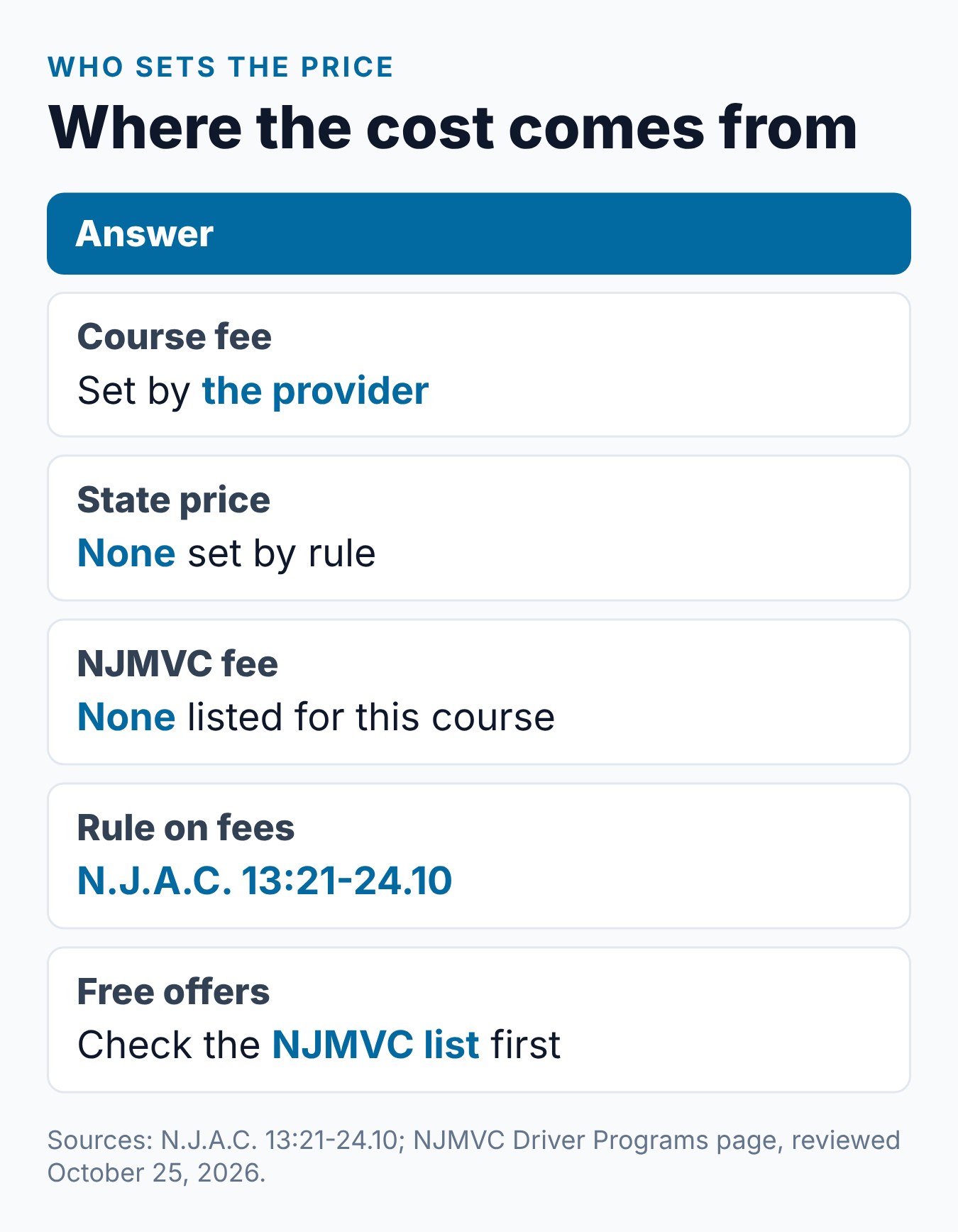
The NJ defensive driving course cost is set by each provider, not by the state, because N.J.A.C. 13:21-24.10 lets a provider charge an attendance fee. The New Jersey Motor Vehicle Commission (NJMVC) lists approved providers but no course prices. Before you use any course that claims to be free, check that it is on the NJMVC list, since only an approved course earns the 2-point credit.
Key Facts
- Who sets the price: each provider. The state sets no course price. See what sets the cost.
- Free offers: only an approved course counts, so check the NJMVC list first. See free options.
- What the fee must cover: six hours of instruction and the provider’s report to the NJMVC. See what the fee covers.
- DIP and PDP: a $75 NJMVC fee plus a class fee of no more than $75. Those are other programs. See DIP and PDP fees.
- What it can return: an insurance premium reduction for three years, in an amount your insurer sets. See what you could get back.
What Sets the NJ Defensive Driving Course Cost
The rule is short. N.J.A.C. 13:21-24.10 says entry into an approved course is voluntary. It adds that “an attendance fee may be charged.”
That is the whole state rule on price. It does not set an amount, a cap or a floor.
We checked the NJMVC Driver Programs page on October 25, 2026. Here is what it showed about money:
- No course price. The page listed no fee for the defensive driving course.
- No NJMVC fee. The page listed no state fee for this course.
- A $75 fee for other programs. The $75 administrative fee applied only to the DIP and PDP.
- No free course. The page did not use the word “free.”
So the price you pay comes from the provider you choose. Two approved providers can charge different amounts for a course that earns the same benefit.
Is There a Free Defensive Driving Course Online in New Jersey?
No state rule makes the course free. The rule lets providers charge a fee, and the NJMVC page lists no free option.
You may still see a free defensive driving course online New Jersey drivers can click on. Before you spend six hours on it, ask one question: is this exact course on the NJMVC list?
That question matters because both benefits depend on approval:
- Points. N.J.A.C. 13:21-24.2 gives the 2-point credit only for an approved course.
- Insurance. N.J.S.A. 17:33B-45.1 requires a premium reduction only after an approved course.
A course that is not approved can still teach you something. But it will not lower your points, and the insurance law does not require your insurer to count it.
Check that the course appears on the right list. The NJMVC page keeps one list for online providers and one for classroom providers. Our guide to NJMVC-approved courses shows how to check a provider.
What Every Approved Course Must Provide
Whatever a provider charges, the rules set a minimum it must deliver. N.J.A.C. 13:21-24.5 lists it.
An approved online course must give you:
- No less than six hours of instruction and curriculum information.
- A quiz after each module and a final proficiency exam.
- Explanations of correct and incorrect answers.
- Supplemental materials and technical support.
- A 24-hour live hotline staffed by a New Jersey certified instructor.
- No advertising during the six hours.
An approved classroom course must give at least six hours of instruction, with at least four hours in the classroom. Classes are capped at 30 students, plus up to five make-up students.
Every provider must also report your completion. The NJMVC page says the provider notifies the agency within 7 to 10 business days. You do not file anything yourself, because the agency does not accept certificates from drivers.
The Real Price of a Course That Is Not Approved
A course off the list can cost more than it seems. Here is what you give up:
- Your time. You may spend six hours or more on it.
- The point credit. No approved course, no 2-point credit.
- The insurance reduction. The law ties it to an approved course.
- A second fee. You may end up paying for an approved course after all.
Checking the list takes a few minutes. Skipping that check can cost you the whole benefit.
DIP and PDP Fees Are Different
New Jersey has two other driver programs with set fees. People sometimes mix them up with the defensive driving course.
The NJMVC remedial programs page lists those fees. Here is how they compare:
| Program | NJMVC fee | Class fee | How you end up there |
|---|---|---|---|
| Defensive driving course | None listed | Set by the provider | You choose to take it |
| Driver Improvement Program (DIP) | $75 administrative fee | No more than $75 | The NJMVC sends a notice offering it |
| Probationary Driver Program (PDP) | $75 administrative fee | No more than $75 | Required for some probationary license holders |
For the DIP, the total is no more than $150. If you do not pay the $75 NJMVC fee, you get no credit for the class.
A defensive driving course cannot be swapped in for the DIP. To learn more, read our guides to the Driver Improvement Program and the Probationary Driver Program.
Other Costs Points Can Bring
The course fee is not the only cost tied to points. The NJMVC surcharges page explains one more.
If you have 6 or more points within three years from your last posted violation, you owe a surcharge. It is $150, plus $25 for each point over six, billed each year for three years.
Here is the math. With 8 points, that is $150 plus $50, or $200 a year. Over three years, that comes to $600.
Points can also lead to a suspension at 12 or more. Restoring a license costs a $100 restoration fee. Our surcharge guide explains how points trigger the bill.
What You Could Get Back
The course can pay you back through your insurance. State law requires insurers to lower your premium after an approved course.
The law does not set the amount. Each insurer bases it on its own actuarial experience.
The reduction lasts three years, starting with the next policy period. It ends early with a suspension or four or more points.
The Department of Banking and Insurance confirms the rule in its auto insurance guide. It says New Jersey law requires insurers to offer discounts for drivers who complete a course approved by the NJMVC.
To weigh the fee against the savings, ask your insurer what the reduction would be on your policy. Our insurance discount guide lists what to ask.
Weighing the Fee Against the Benefit
The fee is paid once. The benefits come over time. A simple check can help you decide:
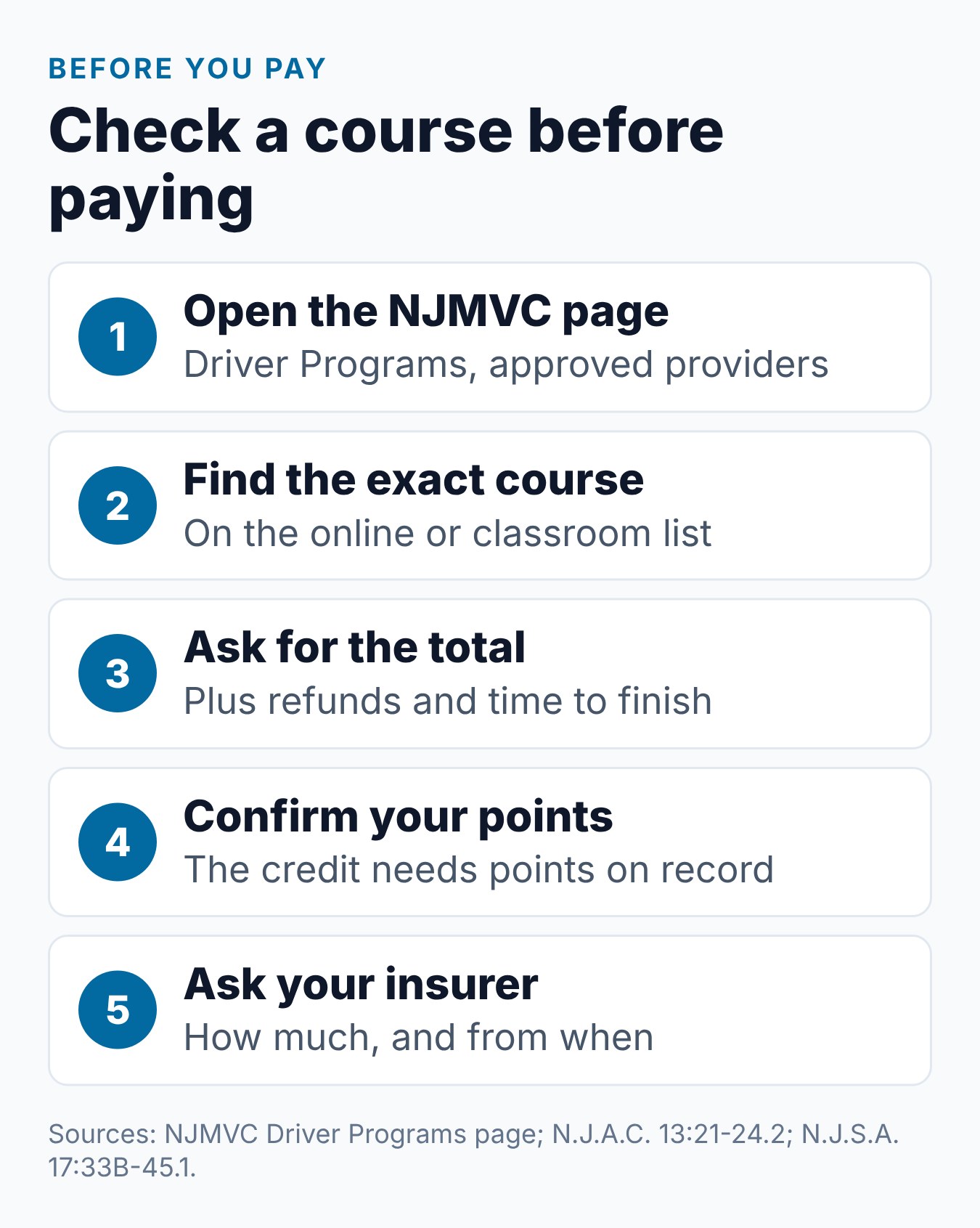
- Ask your insurer how much the premium reduction would be each year.
- Multiply by three, since the reduction lasts three years if nothing ends it early.
- Compare that total with the course fee from an approved provider.
The point credit has value too, but it is harder to price. It depends on how many points you have now.
For example, with 10 points, a 2-point credit leaves 8. That puts you further from 12, the level where the NJMVC suspends a license. But credits do not cancel a suspension the NJMVC has already proposed, so timing matters.
Online and Classroom Costs
Both formats are approved the same way, and both earn the same benefits. The fee is set by each provider in either format.
A classroom course can add costs of its own, such as travel to the class site. The address on the NJMVC classroom list is the provider’s contact address, so ask where the class meets.
An online course needs a device and an internet connection. Our online vs in person guide compares the two formats in full.
Questions to Ask Before You Pay
The state does not set prices, so ask the provider directly. Get clear answers to these:
- What is the total price? Ask whether any other charges apply.
- What if I need to stop? Ask about refunds and how long you have to finish.
- Which NJMVC list are you on? Online and classroom providers are listed apart.
- How do you report my completion? The answer should match the 7-to-10-business-day window.
Ask your insurer one question too. How much would the reduction be, and when would it start?
For more on picking a provider, see our guide to the best online defensive driving course NJ drivers can choose.
Common Cost Mistakes
These mistakes come from the official rules. Each one can waste money:
- Trusting a free label. Only a course on the NJMVC list earns the point credit.
- Paying the NJMVC for this course. The page lists no state fee for it.
- Mixing up programs. The $75 fees belong to the DIP and PDP.
- Taking a course with zero points for the credit. The credit needs points on your record when you finish.
- Repeating too soon. The point credit comes once in any five-year period.
- Expecting a ticket dismissal. The course lowers points. It does not dismiss a ticket.
How Requirements Can Vary
New Jersey’s point system and defensive driving rules are set by state law and NJMVC rules, and they apply statewide. Fines and court costs come from the municipal court that handles your ticket, so the amount you owe depends on the court and the violation.
Insurance discounts also differ. State law requires insurers to reduce your premium after an approved course, but each insurer sets the amount.
Check the NJMVC Driver Programs page, your driver history abstract, and your insurer for current rules before you sign up for a course.
Frequently Asked Questions
How much does the NJ defensive driving course cost?
Each provider sets its own price. N.J.A.C. 13:21-24.10 lets providers charge an attendance fee, and the NJMVC page lists no course price.
Is there a free NJ defensive driving course?
No state rule makes it free, and the NJMVC page lists no free option. If you find a free offer, check that the course is on the NJMVC list before you start.
Does the NJMVC charge a fee for the defensive driving course?
The NJMVC page we checked listed no state fee for this course. The $75 administrative fee applies to the DIP and PDP.
Will a course that is not approved still remove points?
No. The 2-point credit applies only to an approved course. The insurance law also ties the premium reduction to an approved course.
Can the insurance reduction cover the course fee?
It depends on your insurer. The law requires a reduction but does not set the amount. Ask your insurer for the figure before you pay.
Do I pay the NJMVC to have my points removed?
The NJMVC page we checked listed no state fee for this course. The provider reports your completion, and the NJMVC applies the credit after it reviews your record.
Is the mature driver course priced the same way?
The NJMVC page lists the mature driver course for drivers 55 and older on its own list. It shows no fee for that course either, so ask each provider for its price.
Why does the DIP cost $75 plus a class fee?
The DIP is a separate program the NJMVC offers by notice. It carries a $75 NJMVC fee plus a class fee of no more than $75.
Conclusion
The NJ defensive driving course has no state price, so compare providers on the NJMVC list and ask for the total before you pay. Be careful with free offers, because only an approved course earns the 2-point credit and the insurance reduction.
Driving Logic’s New Jersey Defensive Driving Course is coming soon. Until then, the NJMVC Driver Programs page lists approved providers.
Related Articles
- NJ Defensive Driving Course: The Complete Guide to Point Reduction and Insurance Discounts
- NJ MVC Defensive Driving Course: How to Find and Verify an Approved Provider
- Best Online Defensive Driving Course NJ: What to Look For
- NJ Defensive Driving Insurance Discount: What to Ask Your Insurer
Sources
- NJMVC — Driver Programs (defensive driving course, DIP, PDP, approved providers)
- N.J.A.C. 13:21-24.10 — Voluntary course; fees
- N.J.A.C. 13:21-24.2 — Point reduction for a defensive driving course
- N.J.A.C. 13:21-24.5 — Course length and content
- N.J.S.A. 17:33B-45.1 — Insurance premium reduction after a defensive driving course
- NJ Department of Banking and Insurance — Everything Auto Insurance (2026)
- NJMVC — Driver Improvement and Probationary Driver Programs
- NJMVC — Surcharges
- NJMVC — Point System and Suspensions
Billy Forte is the owner of Driving Logic, a state-approved driver improvement course provider serving Florida and other U.S. states.
This article is general information, not legal advice. New Jersey point rules, surcharges, and insurance discounts are set by New Jersey law, the Motor Vehicle Commission, and your insurer, and can change. Check the NJMVC website, the court on your ticket, and your insurer for current requirements.