
Updated October 2026 · Reviewed by Billy Forte
When you weigh NJ defensive driving online vs in person, the benefits match: an approved course in either format can take 2 points off your record and lower your insurance premium. What changes is the format. A classroom course runs at least six hours with at least four in the classroom and up to 30 students, while an online course runs no less than six hours with module quizzes, a final exam and a 24-hour hotline.
Key Facts
- Same benefits: 2 points off and a premium reduction, in either format. See same benefits.
- Classroom: at least four of the six hours are classroom instruction, with 30 students at most. See the classroom course.
- Online: a quiz after each module, a final exam and a 24-hour hotline. See the online course.
- Two lists: the NJMVC lists classroom and online providers on separate lists. See what the lists showed.
- Your choice: pick the format you will finish. See which format fits.
Same Benefits in Either Format
The New Jersey Motor Vehicle Commission (NJMVC) approves both formats. Its Driver Programs page lists State-approved classroom and online courses.
The point rule does not care how you took the class. N.J.A.C. 13:21-24.2 gives a 2-point credit for any approved course. The credit comes once in any five-year period, and your total cannot go below zero.
The insurance law works the same way. N.J.S.A. 17:33B-45.1 requires a premium reduction after an approved course, in an amount your insurer sets. It lasts three years and ends early with a suspension or four or more points.
Neither format dismisses a ticket. Both lower points that are already on your record.
NJ Defensive Driving Online vs In Person, Side by Side
The rules for both formats sit in N.J.A.C. 13:21-24.5. Here is how they compare:
| Feature | Online course | Classroom course |
|---|---|---|
| Minimum instruction | No less than 6 hours | At least 6 hours |
| Time in a classroom | Not required | At least 4 hours |
| Film, video or slides | Visual aids built in | No more than 3 of the hours |
| Class size | Not limited by the rule | Up to 30, plus up to 5 make-up students |
| Checks along the way | A quiz you must pass after each module | Teaching that invites student and instructor interaction |
| Final exam | Proficiency exam on all modules | Not set by the classroom rule |
| Help with questions | 24-hour hotline with a NJ certified instructor | The instructor in the room |
| NJMVC list | Approved online course providers | Approved classroom course providers |
| Point credit | 2 points, once in five years | 2 points, once in five years |
| Insurance reduction | Required; insurer sets the amount | Required; insurer sets the amount |
The last two rows are the same. Every other row is about how you learn, not what you get.
How a Classroom Course Works
A classroom course gives at least six hours of instruction. At least four of those hours must be classroom instruction.
Films, videos, slides or DVDs can fill no more than three of the six hours. The rule also calls for visual aids such as whiteboards, flip charts and magnetic boards.
Class size has a cap. A class can schedule up to 30 students, plus up to five who missed an earlier class.
The rule asks for teaching that gets students and the instructor talking. That is the main thing a classroom gives that an online course does not.
Classroom Room Rules
The room itself has to meet a standard. N.J.A.C. 13:21-24.6 says a classroom must:
- Fit at least 15 students, with at least 15 square feet for each one.
- Be clean, with good light, heat and fresh air.
- Be free of distractions you can see or hear.
- Have restrooms for both sexes.
- Have enough parking close to the classroom.
Who Can Teach a Classroom Course
N.J.A.C. 13:21-24.4 bars some people from teaching in a classroom. A provider cannot use an instructor with nine or more points from Motor Vehicle Law convictions.
The same bar applies to certain alcohol and drug convictions, or a similar offense in another place. Providers must also show the NJMVC that their instructors are qualified.
How an Online Course Works
An online course gives no less than six hours of instruction and curriculum information. It uses movies, audio, graphics and interactive exercises.
Each module ends with a quiz, and you must pass it before you move on. After the last module, a proficiency exam covers the whole course.
Help is always open. Every online course needs a live hotline, 24 hours a day, staffed by a New Jersey certified instructor. Advertising is not allowed during instruction.
Online courses also check who is taking them. Approval rules call for identity questions at random times and a time log for each module.
Our guide to the NJ online defensive driving course walks through each step.
The Same Topics in Both Formats
The format changes how you learn, not what you learn. Rule 13:21-24.5(b) sets one list of topics for every approved course:
- Defensive driving techniques, the base of the whole course.
- Alcohol and drugs as a factor in crashes.
- Risky habits such as speeding, tailgating, reckless or careless driving, not paying attention and improper lane use.
- Bad weather and how to adjust your driving.
- Following distances and communicating with other road users.
- Current New Jersey motor vehicle and traffic laws.
So a classroom student and an online student cover the same ground. The difference is whether a teacher or a screen delivers it.
How Each Format Confirms You Took It
Both formats keep proof that you finished. They just collect it in different ways.
In a classroom, the instructor sees you in the room. Under N.J.A.C. 13:21-24.7, the provider records your attendance dates and the place you attended.
Online, there is no instructor in the room. So N.J.A.C. 13:21-24.3 calls for identity questions at random times, a time log for each module and a record of your answers.
In both formats, the provider keeps your record for five years after you finish. It includes your name as shown on your license, your license number and your completion date.
What the NJMVC Lists Showed
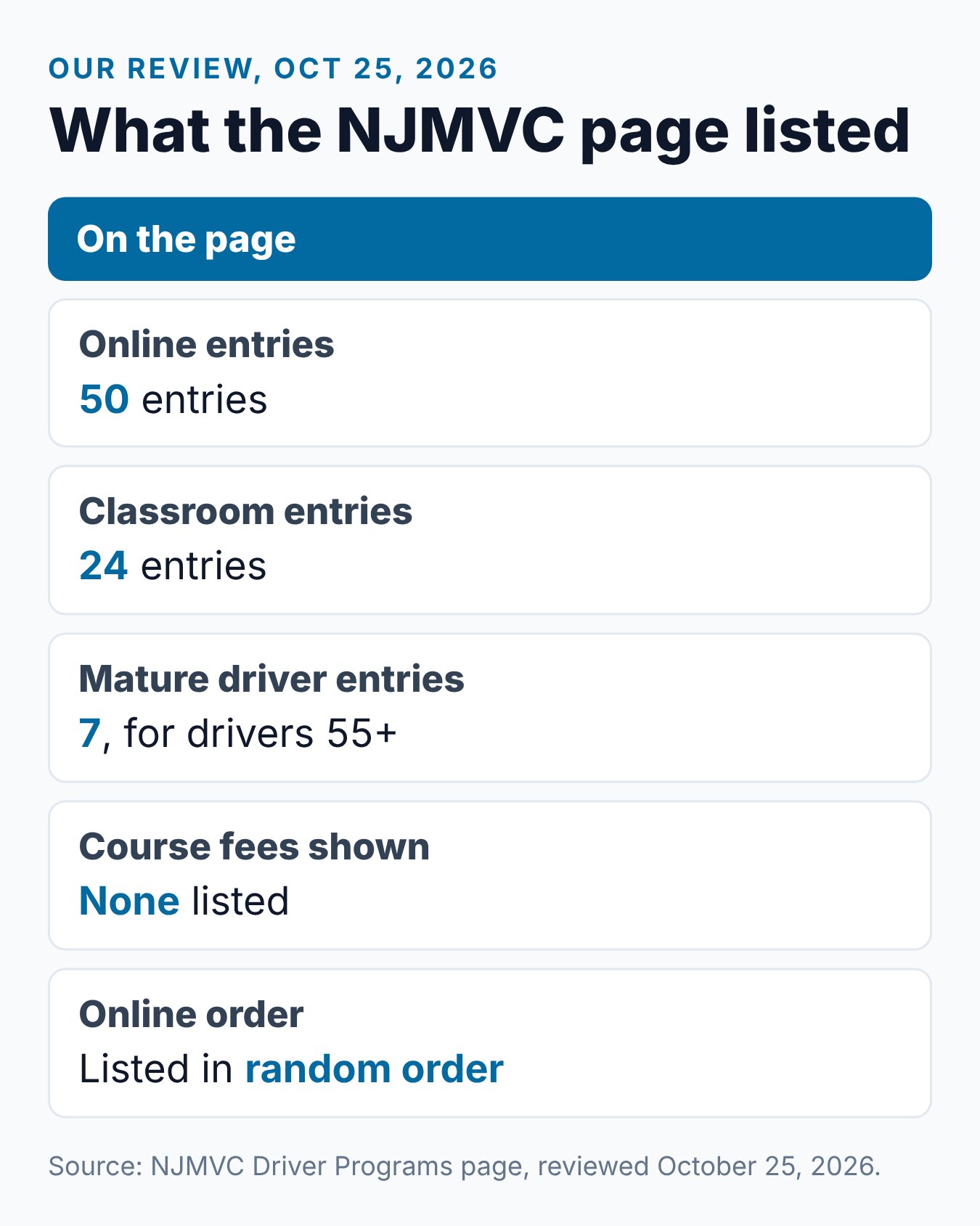
We reviewed the NJMVC Driver Programs page on October 25, 2026. Here is what the two lists looked like that day:
- Online list: 50 entries under “Approved online course providers.” Each showed a website and a contact email.
- Classroom list: 24 entries under “Approved classroom course providers.” Each showed an address, a contact person and a phone number.
- Mature driver list: 7 entries for the separate course for drivers 55 and older.
- Fees: none listed for the defensive driving course.
A few details stood out. The page says online providers appear in random order. Some classroom entries show business addresses outside New Jersey, and one entry is a motorcycle rider course.
The address on the list is the provider’s contact address. Ask the provider where and when its classes meet before you sign up.
The page also notes that some providers are approved for more than one program. It tells you to check with the provider before registering. Our guide to NJMVC-approved courses shows how to check a provider.
Questions to Ask Before You Choose
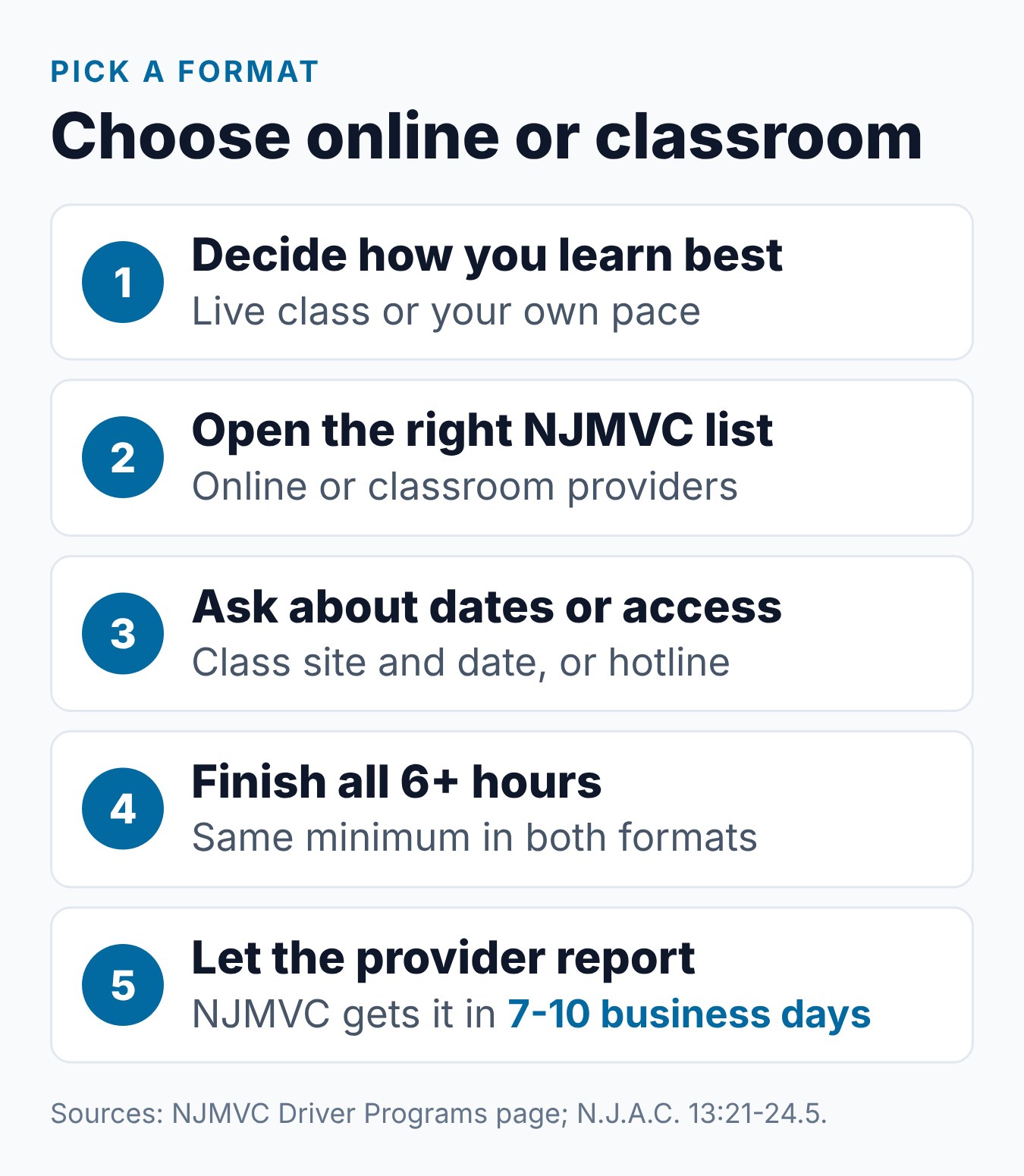
The rules tell you what every course must offer. They do not tell you about dates, places or prices. Ask the provider directly.
For a classroom course, ask:
- Where does the class meet, and on what dates?
- If I miss the class, can I join a later one as a make-up student?
- How and when will you report my completion to the NJMVC?
For an online course, ask:
- How do I reach the 24-hour hotline?
- What identity checks will I see during the course?
- How and when will you report my completion to the NJMVC?
For the reporting question, you know the answer to expect. The NJMVC page says the provider notifies the agency within 7 to 10 business days.
N.J.A.C. 13:21-24.8 requires a certified list within 10 days of the end of each course. Either way, you do not send a certificate yourself.
Which Format Fits You
Both formats lead to the same result. So the best format is the one you will actually finish.
An online course may fit if:
- You want to work at your own pace and time.
- You want to reach an instructor by phone at any hour.
- You have no listed classroom provider near you.
A classroom course may fit if:
- You learn best with a live instructor in the room.
- You want to finish on one set date.
- You would rather not spend six hours on a screen.
Price is a separate question. Each provider sets its own fee. Our cost guide explains what to check.
The Mature Driver Course
The NJMVC page lists a separate mature driver course for drivers 55 and older. It has its own list of providers.
This article compares the standard online and classroom courses. If you are 55 or older, check the mature driver list and ask the provider what the course covers.
Common Mistakes When Choosing a Format
These mistakes come from the official rules and lists:
- Checking the wrong list. Online and classroom providers are on separate lists.
- Assuming one format earns more. Both give the same 2-point credit and insurance reduction.
- Reading the list address as the class site. Ask the provider where the class meets.
- Missing a classroom date. Make-up seats are limited to five per class.
- Expecting a ticket dismissal. Neither format dismisses a ticket.
- Sending your own certificate. The provider reports to the NJMVC in both formats.
To pick between online providers, see our guide to the best online defensive driving course NJ drivers can choose.
How Requirements Can Vary
New Jersey’s point system and defensive driving rules are set by state law and NJMVC rules, and they apply statewide. Fines and court costs come from the municipal court that handles your ticket, so the amount you owe depends on the court and the violation.
Insurance discounts also differ. State law requires insurers to reduce your premium after an approved course, but each insurer sets the amount.
Check the NJMVC Driver Programs page, your driver history abstract, and your insurer for current rules before you sign up for a course.
Frequently Asked Questions
Is an online NJ defensive driving course as good as a classroom course?
For the benefits, yes. Both formats must be approved by the NJMVC and both give the same 2-point credit and insurance reduction. The difference is how you learn.
How long is each format?
Both need at least six hours of instruction. A classroom course must include at least four hours of classroom instruction.
How many students can be in a classroom course?
Up to 30 students, plus up to five make-up students who missed an earlier class. The room must give each student at least 15 square feet.
Do classroom courses have a final exam?
The classroom rule does not require one. The online rule does: a proficiency exam that covers every module. Ask a classroom provider how its course checks what you learned.
Where do I find approved classroom and online providers?
On the NJMVC Driver Programs page. Classroom and online providers are on separate lists, and the page lists no fees.
Does the format change my insurance reduction?
No. The insurance law applies to any approved course. Your insurer sets the amount, and the reduction lasts three years.
Conclusion
Online and classroom courses earn the same 2 points and the same insurance reduction, so choose the format that fits how you learn. Check that your provider is on the right NJMVC list before you pay. Driving Logic’s New Jersey Defensive Driving Course will be online only and is coming soon.
Related Articles
- NJ Defensive Driving Course: The Complete Guide to Point Reduction and Insurance Discounts
- New Jersey Online Defensive Driving Course: How the 6-Hour Program Works
- NJ MVC Defensive Driving Course: How to Find and Verify an Approved Provider
- Best Online Defensive Driving Course NJ: What to Look For
Sources
- NJMVC — Driver Programs (defensive driving course, DIP, PDP, approved providers)
- N.J.A.C. 13:21-24.5 — Course length and content
- N.J.A.C. 13:21-24.2 — Point reduction for a defensive driving course
- N.J.S.A. 17:33B-45.1 — Insurance premium reduction after a defensive driving course
- N.J.A.C. 13:21-24.8 — Certification of course completion
- N.J.A.C. 13:21-24.10 — Voluntary course; fees
Billy Forte is the owner of Driving Logic, a state-approved driver improvement course provider serving Florida and other U.S. states.
This article is general information, not legal advice. New Jersey point rules, surcharges, and insurance discounts are set by New Jersey law, the Motor Vehicle Commission, and your insurer, and can change. Check the NJMVC website, the court on your ticket, and your insurer for current requirements.