
Updated October 2026 · Reviewed by Billy Forte
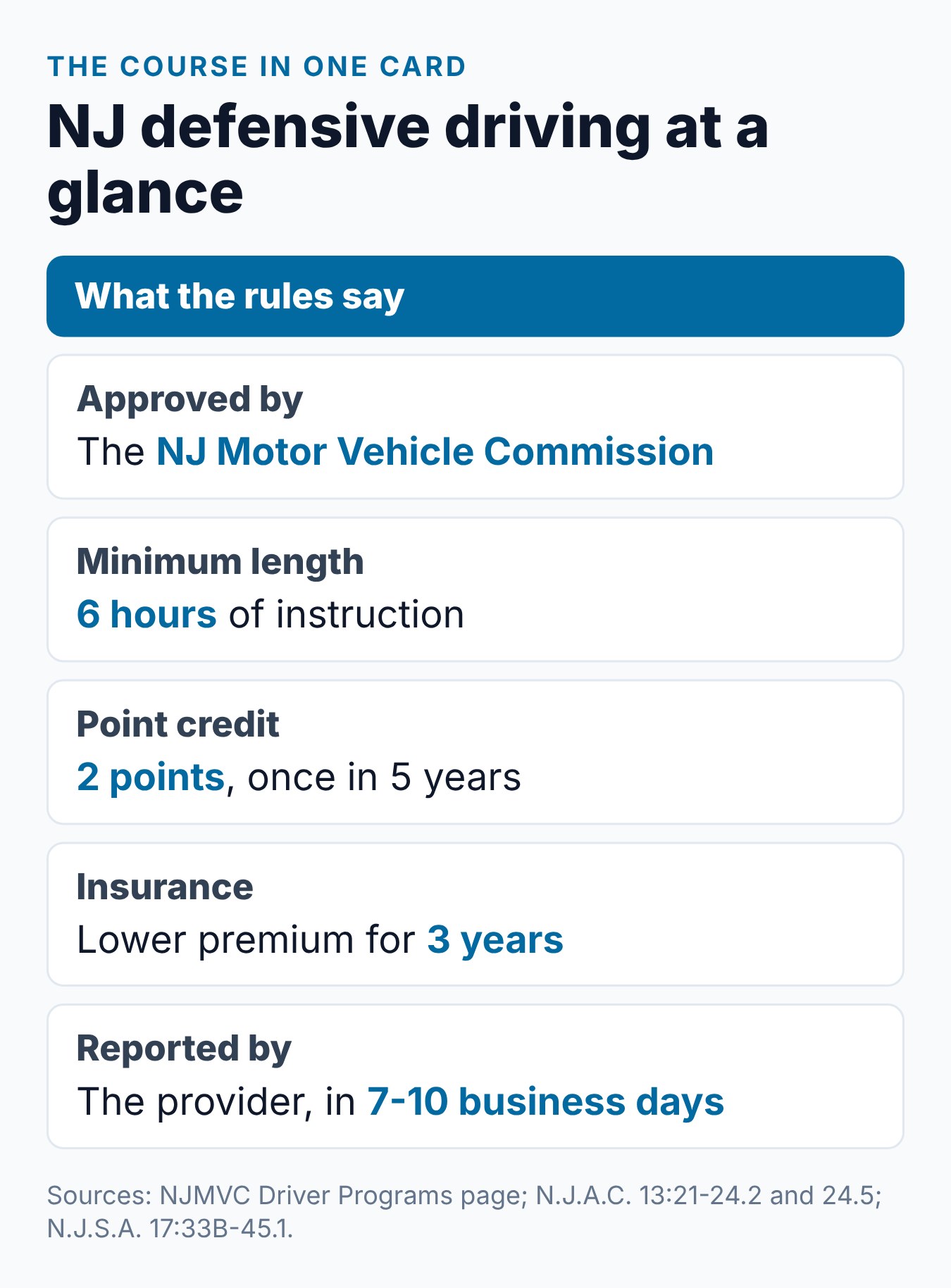
The NJ defensive driving course is a voluntary, State-approved class that can take 2 points off the points already on your New Jersey driving record and lead to a lower auto insurance premium. You can get the point credit once in any five-year period, and the class must give at least six hours of instruction. The course does not dismiss a traffic ticket.
Key Facts
- What it is: a voluntary class approved by the New Jersey Motor Vehicle Commission (NJMVC). See what the course is.
- Points: 2 points off, once in any five-year period, never below zero. See the point credit.
- Insurance: your insurer must lower your premium for three years. See the insurance benefit.
- Tickets: the course does not dismiss a ticket. See what it does not do.
- Reporting: the provider tells NJMVC within 7 to 10 business days. See how completion is reported.
What Is the NJ Defensive Driving Course?
The defensive driving course is a safety class for licensed drivers. The state rule, N.J.A.C. 13:21-24.10, says entry into an approved course “is voluntary.” No one orders you to take it.
Private providers teach the class. The NJMVC approves them and lists them on its Driver Programs page. That page has one list for classroom providers and one for online providers.
The same page lists a separate mature driver course for drivers 55 and older. This guide covers the standard defensive driving course.
Some people call the agency the DMV. In New Jersey, the agency is the Motor Vehicle Commission, or NJMVC.
The course has two benefits. It can lower your point total, and it can lower your car insurance premium. Each benefit has its own rules, so we cover them one at a time.
Benefit One: Two Points Off Your Record
Under N.J.A.C. 13:21-24.2, points recorded against you drop by two after you finish an approved course. The rule adds a few limits:
- Once in five years. You can get the credit no more than once in any five-year period.
- Not below zero. Your total cannot drop under zero.
- Dates matter. The time periods are counted from the dates of your offenses and the date you finish.
- No credit for teaching. You get no credit for a course you taught.
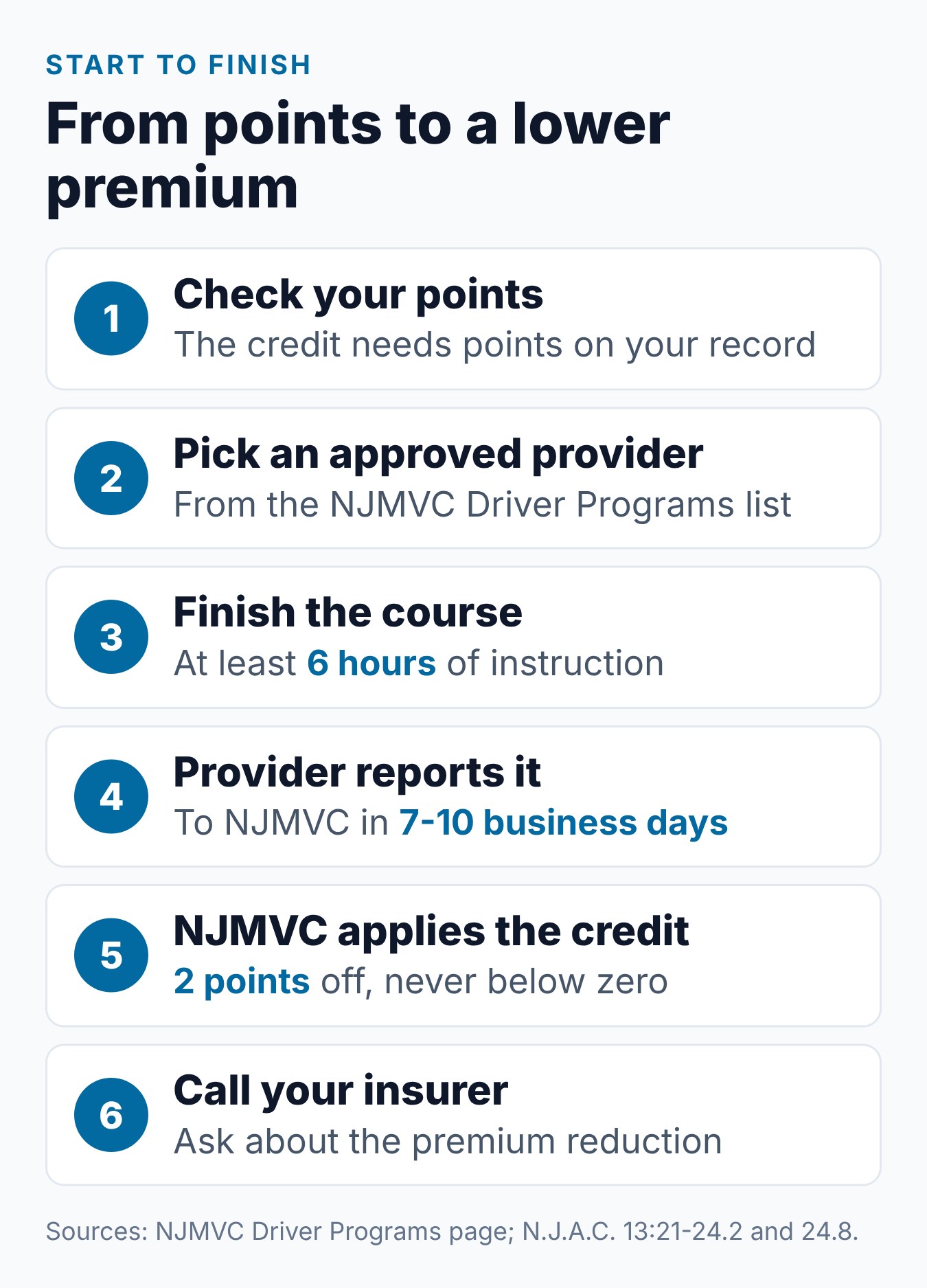
The NJMVC page adds a key point. The credit works only if there are points on your record when you finish the course.
Here is the math. With 5 points, a 2-point credit leaves 3. With 1 point, the total drops to 0, not below it.
The Credit Does Not Stop a Proposed Suspension
The NJMVC suspends a license at 12 or more points, as its point system page explains. The rule says point credits do not cancel a suspension the NJMVC has already proposed.
So timing matters. A course taken after a suspension notice arrives will not undo that notice. Our guide to the 2-point reduction goes deeper.
Benefit Two: A Lower Insurance Premium
State law, N.J.S.A. 17:33B-45.1, tells insurers to lower your premium after you finish an approved course. It applies when the named insured or principal operator takes the class.
The law does not set a percentage. Each insurer sets the amount based on its own actuarial experience.
The reduction lasts three years, starting with the next policy period. It ends sooner if your license is suspended or you build up four or more motor vehicle points.
The Department of Banking and Insurance says the same thing in plain words. Its auto insurance guide says state law requires insurers to offer discounts for drivers who complete a course approved by the NJMVC. Read our insurance discount guide for the questions to ask your insurer.
| Rule | Point credit | Insurance reduction |
|---|---|---|
| Set by | N.J.A.C. 13:21-24.2 | N.J.S.A. 17:33B-45.1 |
| Amount | 2 points | Set by your insurer |
| How often or how long | Once in any five-year period | Three years from the next policy period |
| Ends or limited by | Cannot go below zero | Suspension, or four or more points |
| Who acts | NJMVC, after the provider reports | Your insurer |
Who the Course Can Help
The two benefits follow different rules. That means the course can help drivers in different spots:
- Drivers with points. If you have points when you finish, the NJMVC can remove two of them.
- Drivers who want a lower premium. The insurance law ties the reduction to finishing an approved course. It does not mention a point minimum.
- Drivers watching the 12-point line. Fewer points leave more room before the suspension level. The credit still will not cancel a suspension already proposed.
Two examples show the math. With 8 points, a 2-point credit leaves 6, which is further from 12. With 0 points, there is nothing to remove, but you can still ask your insurer about the premium reduction.
Points also drop on their own. The NJMVC point system page says a year with no violations or suspensions takes off 3 points. Our points reduction guide shows how the two credits fit together.
Not sure how many points you have? A driver history abstract lists your New Jersey points for the past five years. Our abstract guide shows how to get one.
What the Course Does Not Do
Clear limits help you plan. The NJ course has no ticket dismissal feature. Here is what it cannot do:
- Dismiss a ticket. The course changes your point total, not the ticket itself.
- Cancel a proposed suspension. The rule says credits do not invalidate it.
- Replace an ordered program. It cannot stand in for the Driver Improvement Program (DIP) or the Probationary Driver Program (PDP).
If you just got a ticket, see our guide to ticket options. It explains paying, pleading not guilty and where the course fits.
Course Length, Format and Topics
The rules for every course are in N.J.A.C. 13:21-24.5. A classroom course gives at least six hours of instruction. At least four of those hours are classroom instruction.
An online course gives no less than six hours of instruction and curriculum information. It has a quiz at the end of each module and a final proficiency exam.
Every course must cover the same topics:
- Defensive driving techniques
- Alcohol and drugs as a crash factor
- Risky behaviors such as speeding, tailgating and not paying attention
- Driving in bad weather
- Following distances
- Communicating with other road users
- Current New Jersey traffic laws
Under N.J.S.A. 17:33B-45, the state must approve any course that meets or exceeds the National Safety Council’s defensive driving standards.
What the Course Costs
The state does not set one price. Rule 13:21-24.10 lets a provider charge an attendance fee, so each provider sets its own.
Be careful with any offer that sounds free. Only an approved course earns the point credit. Our cost guide explains what to check before you pay.
How Completion Is Reported
You do not report the course yourself. The NJMVC Driver Programs page says the provider notifies the NJMVC with proof of completion within 7 to 10 business days.
The page is direct about certificates. It says, “Certificates are not acceptable from driver license holder.”
The rules back this up. Under N.J.A.C. 13:21-24.8, the provider sends a certified list of students who finished within 10 days of the end of each course. The NJMVC then reviews your record and applies the credit.
Your insurer is a separate step. The NJMVC page says to contact your insurance agent about a rate reduction.
How It Differs From the DIP and PDP
New Jersey has two other driver programs. They work in a different way.
The Driver Improvement Program (DIP) is a three-hour program. A driver can take it only after the NJMVC sends a notice offering it. Our DIP guide covers the details.
The Probationary Driver Program (PDP) is for probationary license holders the NJMVC orders to attend. Our PDP guide explains who it covers.
The NJMVC remedial programs page says a defensive driving course cannot be swapped in for the DIP. For a side-by-side view, read DIP vs defensive driving.
Common Mistakes to Avoid
These mistakes come straight from the official rules. Each one can cost you a benefit:
- Taking a course that is not approved. Only a course on the NJMVC list counts.
- Expecting a ticket dismissal. The course lowers points. It does not drop the ticket.
- Finishing with zero points. The NJMVC page says the credit works only if points are on your record when you finish.
- Taking a second course too soon. The point credit comes once in any five-year period.
- Mailing your own certificate. The NJMVC does not accept certificates from drivers.
- Waiting for a suspension notice. Credits do not cancel a suspension already proposed.
NJ Defensive Driving Course Guides in This Series
Each guide below goes deeper on one part of the course:
- Online course: how an online class works under the state rules.
- Online vs in person: the two formats side by side.
- How long it takes: the six-hour minimum and how the course is built.
- Cost: who sets the price and how to spot risky free offers.
- Approved providers: how to find and check a provider on the NJMVC list.
- Choosing a course: what to look for in an online class.
- The course test: module quizzes and the final exam.
- GEICO and the course: what to ask that insurer.
- DIP vs defensive driving: how the two programs differ.
How Requirements Can Vary
New Jersey’s point system and defensive driving rules are set by state law and NJMVC rules, and they apply statewide. Fines and court costs come from the municipal court that handles your ticket, so the amount you owe depends on the court and the violation.
Insurance discounts also differ. State law requires insurers to reduce your premium after an approved course, but each insurer sets the amount.
Check the NJMVC Driver Programs page, your driver history abstract, and your insurer for current rules before you sign up for a course.
Frequently Asked Questions
What is the NJ defensive driving course?
It is a voluntary safety class approved by the NJMVC. Finishing it can take 2 points off your record once in any five-year period. It also leads to an insurance premium reduction.
Does the NJ defensive driving course dismiss a ticket?
No. The course does not dismiss a ticket or erase a violation. It lowers the points already on your record and can lower your insurance premium.
How many points does the course remove?
Two points. Your total cannot go below zero, and the credit comes once in any five-year period. You must have points on your record when you finish.
How long is the NJ defensive driving course?
At least six hours of instruction, online or in a classroom. A classroom course must include at least four hours of classroom instruction.
How much will my insurance go down?
State law does not set an amount. Your insurer sets it based on its own data. The reduction lasts three years and ends early with a suspension or four or more points.
Do I send my certificate to the NJMVC?
No. The provider notifies the NJMVC within 7 to 10 business days. The NJMVC does not accept certificates from drivers.
Can the course replace the Driver Improvement Program?
No. The DIP is a separate program the NJMVC offers by notice. A defensive driving course cannot be substituted for it.
Conclusion
The NJ defensive driving course gives two clear benefits: 2 points off your record and a lower insurance premium for three years. It does not dismiss tickets, so plan around the point and insurance rules. Driving Logic’s New Jersey Defensive Driving Course is coming soon, and until then you can find State-approved providers on the NJMVC Driver Programs page.
Related Articles
- New Jersey Online Defensive Driving Course: How the 6-Hour Program Works
- NJ Defensive Driving Online vs In-Person: What’s the Difference?
- How Long Is the NJ Defensive Driving Course and How Is It Structured?
- NJ Defensive Driving Course Cost: Is There a Free Option?
- NJ MVC Defensive Driving Course: How to Find and Verify an Approved Provider
- Best Online Defensive Driving Course NJ: What to Look For
- NJ Defensive Driving Course Final Exam: What to Expect
- GEICO and NJ Defensive Driving: How the Course May Affect Your Insurance
- NJ Driver Improvement Program vs Defensive Driving: What’s the Difference?
Sources
- NJMVC — Driver Programs (defensive driving course, DIP, PDP, approved providers)
- N.J.A.C. 13:21-24.2 — Point reduction for a defensive driving course
- N.J.A.C. 13:21-24.5 — Course length and content
- N.J.A.C. 13:21-24.8 — Certification of course completion
- N.J.A.C. 13:21-24.10 — Voluntary course; fees
- N.J.S.A. 17:33B-45.1 — Insurance premium reduction after a defensive driving course
- N.J.S.A. 17:33B-45 — Approval of defensive driving courses
- NJ Department of Banking and Insurance — Everything Auto Insurance (2026)
- NJMVC — Point System and Suspensions
- NJMVC — Driver Improvement and Probationary Driver Programs
Billy Forte is the owner of Driving Logic, a state-approved driver improvement course provider serving Florida and other U.S. states.
This article is general information, not legal advice. New Jersey point rules, surcharges, and insurance discounts are set by New Jersey law, the Motor Vehicle Commission, and your insurer, and can change. Check the NJMVC website, the court on your ticket, and your insurer for current requirements.