
Updated October 2026 · Reviewed by Billy Forte
The answer to what is considered criminal speeding in Arizona is in ARS 28-701.02: driving more than 20 mph over a posted limit, over 35 mph approaching a school crossing, or over 45 mph in a business or residential district with no posted limit. Crossing any of those lines is a class 3 misdemeanor. Speeding that stays under them is handled under civil speeding laws instead.
Key Facts
- The law: ARS 28-701.02, titled “Excessive speeds; classification.” See the statute in plain words.
- Posted limits: more than 20 mph over is criminal, in a district or anywhere else. See each line.
- Fixed lines: over 35 mph approaching a school crossing, and over 45 mph in an unposted district. See each line.
- Exactly 20 over: not criminal under the posted-limit lines. See worked examples.
- Ticket codes: 28-701.02A1, A2 and A3, each marked CM on the court’s list. See how your code reads.
The Statute in Plain Words
ARS 28-701.02 is short. It has three subsections, and each one does a single job.
Subsection A lists what a driver may not do. It has three numbered items:
- Item 1: “Exceed thirty-five miles per hour approaching a school crossing.”
- Item 2: exceed the posted limit in a business or residential district by more than 20 mph, or go faster than 45 mph there if no limit is posted.
- Item 3: “Exceed the posted speed limit by more than twenty miles per hour in other locations.”
Subsection B sets the class. It reads: “A person who violates subsection A of this section is guilty of a class 3 misdemeanor.”
Subsection C keeps the cases apart. A driver charged under this section may not also get a civil complaint under ARS 28-701 for the same event.
That is the whole statute. It sets no other speed line, and it has no separate rule for highways or interstates. The “other locations” item covers every road that is not a school crossing or a district.
What Is Considered Criminal Speeding in Arizona, Line by Line
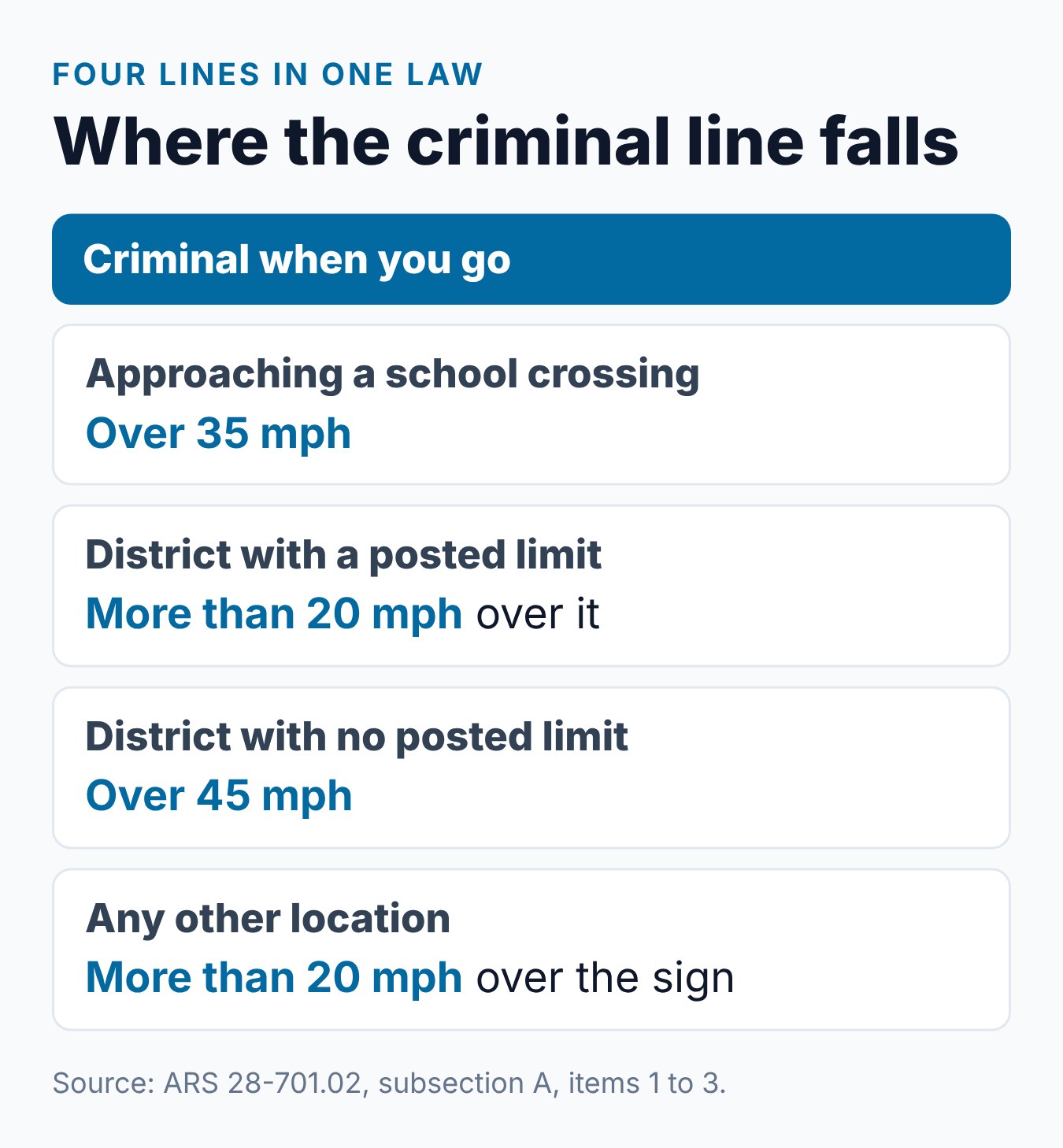
Item 2 holds two different tests. So the statute really draws four lines, one for each kind of place.
Line 1: Approaching a School Crossing
The test here is a fixed speed. Going faster than 35 mph while approaching a school crossing is criminal speeding.
This line does not count up from a sign. It stays at 35 mph wherever the school crossing is.
Line 2: A District With a Posted Limit
In a business or residential district with a posted limit, the test is relative. You cross the line when you go more than 20 mph over that limit.
On a 30 mph street, that means any speed above 50 mph. On a 40 mph street, it means any speed above 60 mph.
Line 3: A District With No Posted Limit
Some district streets have no speed sign. For those, the statute uses a fixed number: going faster than 45 mph is criminal.
No sign does not mean no rule. ARS 28-701 still applies there, as the next sections explain.
Line 4: Other Locations
Everywhere else, the test goes back to the posted limit. Going more than 20 mph over it is criminal speeding.
This item covers highways, rural roads and interstates. The statute does not set a separate number for them.
Worked Examples
The math is simple once you know the posted limit. Add 20 to the limit. Any speed above that sum is criminal speeding under items 2 and 3.
| Posted limit | 20 mph over | Criminal speeding at |
|---|---|---|
| 25 mph | 45 mph | 46 mph and up |
| 35 mph | 55 mph | 56 mph and up |
| 45 mph | 65 mph | 66 mph and up |
| 55 mph | 75 mph | 76 mph and up |
| 75 mph | 95 mph | 96 mph and up |
The table uses whole numbers. The statute’s words are “more than twenty miles per hour,” so the line starts just past 20 over.
Two examples use the fixed lines instead:
- School crossing: 36 mph or more while approaching one is over the 35 mph line. The posted limit there does not change it.
- Unposted district: 46 mph or more on a district street with no sign is over the 45 mph line.
Speeds at or below these lines are not criminal speeding. They can still break other speed laws, such as ARS 28-701.
How the Fixed Lines Compare to Default Limits
ARS 28-701 sets default limits that apply unless signs say otherwise. Speeds above them are prima facie evidence that you were going too fast:
- 15 mph approaching a school crossing.
- 25 mph in a business or residential district.
- 65 mph in other locations.
Now compare those to the fixed lines in 28-701.02. The school crossing line is 35 mph, which is 20 above the 15 mph default. The unposted district line is 45 mph, which is 20 above the 25 mph default.
So the same 20 mph gap shows up in all four lines. The statute does not explain its reasons. But the pattern is plain: each criminal line sits 20 mph past either the posted limit or the default limit for that place.
Our guide to Arizona speed limits covers default and posted limits in more depth.
Civil Speeding Below the Line
If your speed stays under the criminal lines, other laws apply. Each of these is civil, not criminal:
- ARS 28-701: the reasonable and prudent rule and the default limits.
- ARS 28-702.01: on certain faster roads, going no more than 10 mph over may be called “waste of a finite resource.” Going more than 10 over on those roads is also a civil violation.
- ARS 28-702.04: interstate limits. A violation is a civil traffic violation.
This matters for defensive driving school. ARS 28-3392 says a court shall allow the class for an eligible civil moving violation. For criminal speeding, it says the court may allow it.
We checked the court’s eligible list on October 25, 2026. It showed the civil speeding codes 28-701A, 28-701E, 28-702.01C and 28-702.04B as eligible.
For how the class works on a civil speeding ticket, read can defensive driving dismiss an Arizona speeding ticket. For a full side-by-side, see criminal speeding vs civil speeding Arizona.
How the Code on Your Ticket Reads
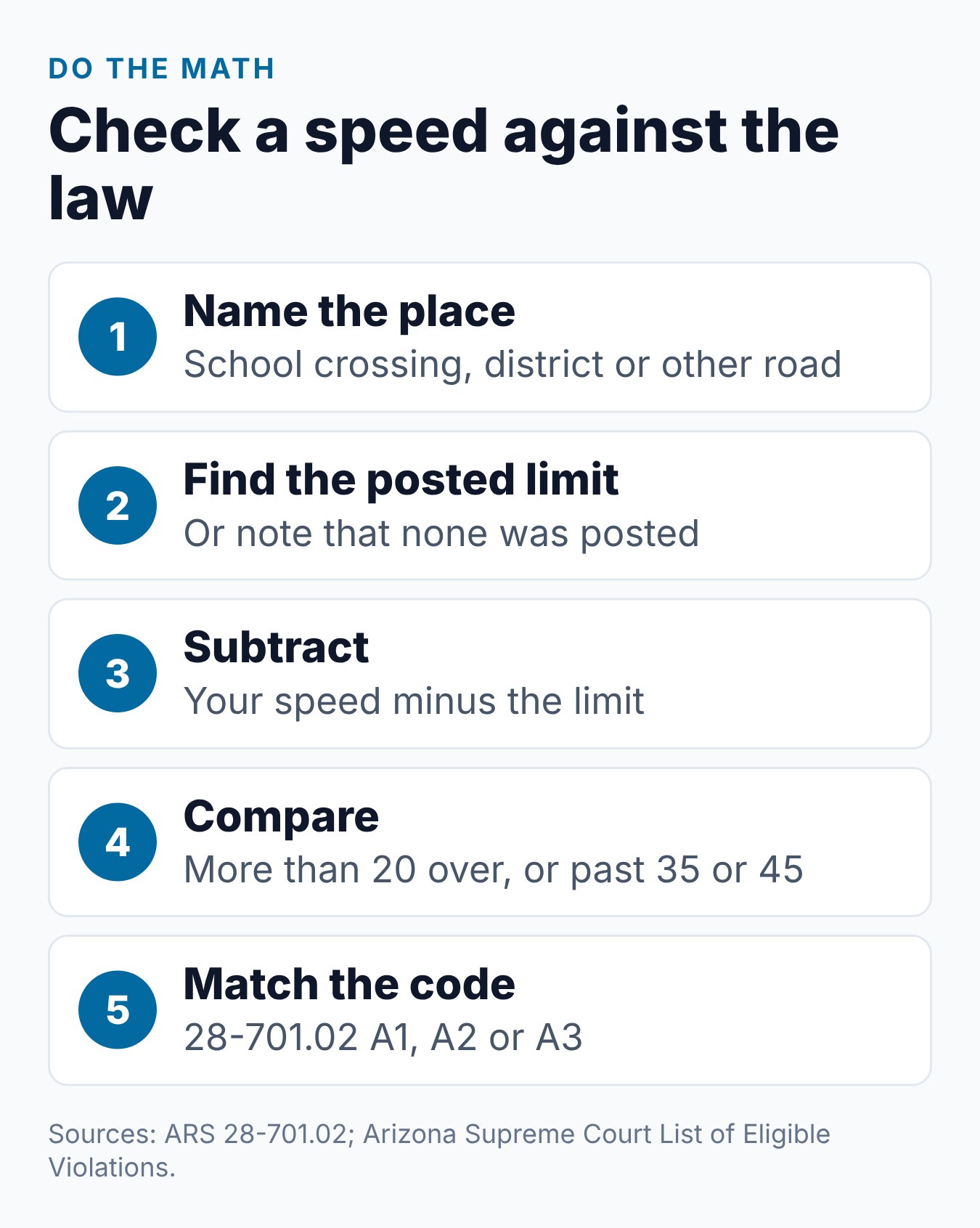
The Arizona Supreme Court’s List of Eligible Violations shows criminal speeding as three codes. Each one matches a numbered item in subsection A:
- 28-701.02A1: item 1, the school crossing line.
- 28-701.02A2: item 2, the district lines.
- 28-701.02A3: item 3, other locations.
All three carry a CM mark. The list says CM codes are eligible only with the express permission of the presiding judge.
The list also explains the numbers you may see in a speeding code. They show how far over the limit you were said to be going. The list says that speed number is not used to decide eligibility.
What These Lines Do Not Cover
ARS 28-701.02 is only about speed. Other serious driving charges are separate laws with their own rules.
Reckless driving and aggressive driving are two examples. ADOT MVD’s points page lists each of them at 8 points. Speeding, including criminal speeding, is listed at 3 points.
So a driver can face criminal speeding without any other charge. A driver can also face a different charge where speed is only one part of the facts. Your citation names the exact statute you are charged under.
When Your Speed Is Close to a Line
The citation is the place to start. It shows the statute number, so you can see whether the charge is civil or criminal.
If it lists 28-701.02, you are facing a criminal charge, even if your speed was near the line. If it lists 28-701 or 28-702.01, the charge is civil. Ask the court on your citation if you are not sure which one you have.
What Happens If You Cross the Line
A class 3 misdemeanor is a criminal charge. Arizona law caps the penalty at 30 days in jail under ARS 13-707. It caps the fine at $500 for a person under ARS 13-802, and surcharges are added.
ADOT MVD’s points page lists 3 points for speeding. Those are limits and rules, not a prediction for any one case.
If you already have a ticket, read first criminal speeding ticket Arizona for the court process. Talk to the court or an Arizona attorney about your own facts. The criminal speeding Arizona guide gives the full overview.
Common Mistakes
These errors come from misreading the statute. Each one is easy to avoid:
- Counting exactly 20 over as criminal. The posted-limit lines start at more than 20 mph over.
- Thinking the school crossing line moves. It is a fixed 35 mph, not a number added to a sign.
- Thinking no sign means no limit. Unposted district streets have a 45 mph criminal line, and ARS 28-701 still applies.
- Expecting a special highway number. Highways fall under “other locations,” which uses the posted limit.
- Reading the code speed as an eligibility test. The court’s list says that number is not used for eligibility.
- Trusting old summaries. Check any rule you read online against the current statute on azleg.gov.
How Requirements Can Vary
Arizona’s defensive driving rules are set by state law and the Arizona Supreme Court, but each court handles its own cases. The total cost includes a court diversion fee that each court sets, so the price depends on the court on your ticket.
Extension allowances also differ by court, from 14 to 60 days on the Supreme Court’s list. If a judge orders in-person attendance, you must take a classroom course.
Court fees can change in April and October each year. Check the Arizona Supreme Court Defensive Driving Program and the court on your citation for current rules before you register.
Frequently Asked Questions
What is considered criminal speeding in Arizona?
Under ARS 28-701.02, it is going more than 20 mph over a posted limit, over 35 mph approaching a school crossing, or over 45 mph in an unposted business or residential district. Any of these is a class 3 misdemeanor.
Is 20 mph over the limit criminal speeding in Arizona?
Not exactly 20. The statute says “more than twenty miles per hour” over the posted limit. So 21 mph over meets the line, and 20 mph over does not.
Is there a different criminal speed for highways?
No. Highways and interstates fall under “other locations” in item 3. The line there is more than 20 mph over the posted limit.
What if no speed limit is posted?
In a business or residential district with no posted limit, going over 45 mph is criminal speeding. ARS 28-701 also sets a 25 mph default limit for those districts.
What is the speed limit near a school crossing?
ARS 28-701 sets 15 mph as the default approaching a school crossing. The criminal line is a separate fixed number: over 35 mph.
What does A1, A2 or A3 mean on my ticket?
They match the three items in subsection A of ARS 28-701.02. A1 is the school crossing line, A2 is the district lines and A3 is other locations.
Is going over 95 mph on a 75 mph interstate criminal speeding?
Yes. Interstates fall under “other locations,” where the line is more than 20 mph over the posted limit. On a road posted at 75 mph, that means any speed above 95 mph.
Can I take defensive driving for criminal speeding?
Only with the presiding judge’s express permission. ARS 28-3392 says the court may allow it, and the court’s list marks these codes CM.
Conclusion
Arizona’s criminal speeding lines are short and exact: more than 20 mph over a posted limit, over 35 mph at a school crossing or over 45 mph in an unposted district. If your ticket cites ARS 28-701.02, call the court on your citation or an attorney before you decide what to do.
Driving Logic’s Arizona Defensive Driving Course is coming soon. For a civil speeding ticket, the court’s list at azcourts.gov/drive shows every certified school.
Related Articles
- Criminal Speeding Arizona: What It Is and What to Know
- Criminal Speeding vs Civil Speeding Arizona: Key Differences
- Arizona Speed Limits: What Drivers Need to Know
- First Criminal Speeding Ticket Arizona: What to Expect
Sources
- Arizona Revised Statutes — ARS 28-701.02 (criminal speeding)
- Arizona Revised Statutes — ARS 28-701 (reasonable and prudent speed)
- Arizona Supreme Court — List of Eligible Violations
- Arizona Revised Statutes — ARS 28-3392 (eligibility)
- Arizona Revised Statutes — ARS 28-702.01 (waste of a finite resource)
- Arizona Revised Statutes — ARS 28-702.04 (interstate speed limits)
- Arizona Revised Statutes — ARS 13-707 (misdemeanor jail terms)
- Arizona Revised Statutes — ARS 13-802 (misdemeanor fines)
- ADOT MVD — Points Assessment
Billy Forte is the owner of Driving Logic, a state-approved driver improvement course provider serving Florida and other U.S. states.
This article is general information, not legal advice. Arizona defensive driving eligibility, deadlines, and fees are set by Arizona law, the Arizona Supreme Court, and each court, and can change. Check the Arizona Supreme Court Defensive Driving Program and the court on your citation for current requirements before you register for a course.