
Updated October 2026 · Reviewed by Billy Forte
The core difference in criminal speeding vs civil speeding Arizona law is the type of case: civil speeding is a traffic violation with a money penalty, while criminal speeding under ARS 28-701.02 is a class 3 misdemeanor that can carry jail. A civil speeding penalty is capped at $250 plus surcharges, and the lowest civil tier, waste of a finite resource, is capped at $15 plus surcharges. Criminal speeding allows up to a $500 fine plus surcharges and 30 days in jail, and defensive driving needs the judge’s permission.
Key Facts
- Two types of case: Arizona moving violations are civil or criminal. See how Arizona sorts them.
- Civil cap: $250 plus surcharges under ARS 28-1598. See civil speeding.
- Lowest tier: waste of a finite resource, capped at $15 plus surcharges. See waste of a finite resource.
- Criminal cap: a $500 fine plus surcharges and up to 30 days in jail. See criminal speeding.
- Defensive driving: the court shall allow it for an eligible civil ticket, and may allow it for criminal speeding. See the class.
Criminal Speeding vs Civil Speeding Arizona at a Glance
Arizona really has three speeding tiers. This table puts them side by side, from the lightest to the most serious:
| Waste of a finite resource | Civil speeding | Criminal speeding | |
|---|---|---|---|
| Main law | ARS 28-702.01 A | ARS 28-701, 28-702.01 C, 28-702.04 | ARS 28-701.02 |
| When it applies | No more than 10 mph over, on certain faster roads | Too fast, but under the criminal lines | More than 20 over, or over 35 or 45 mph lines |
| Type of case | Civil | Civil | Class 3 misdemeanor |
| Money cap | $15 plus surcharges | $250 plus surcharges | $500 fine plus surcharges |
| Jail | None | None | Up to 30 days |
| Report to MVD | Court may not send it | Yes, 3 points for speeding | Yes, 3 points for speeding |
| Insurance rating | May not count as a moving violation | No such rule in statute | No such rule in statute |
| Defensive driving | Code not on the list we checked | Court shall allow if eligible | Only with the judge’s permission |
The sections below explain each row and where it comes from.
How Arizona Sorts Speeding Cases
The Arizona Judicial Branch Traffic Law page splits moving violations into civil and criminal. Its civil example is running a red light. Its criminal examples are DUI, reckless endangerment and driving on a suspended license.
Speeding is split the same way. Several speeding laws in Title 28 are civil. One law, ARS 28-701.02, makes speeding past certain lines a crime.
The law keeps the two apart. Subsection C of 28-701.02 says a driver charged under it may not also get a civil complaint under ARS 28-701 for the same event.
Civil Speeding
Civil speeding covers several laws. Each one sets a rule a driver can break without committing a crime:
- ARS 28-701: never drive faster than is reasonable and prudent. It also sets default limits of 15, 25 and 65 mph.
- ARS 28-702.01 C: on certain faster roads, going more than 10 mph over is a civil violation.
- ARS 28-702.04: interstate limits. A violation is a civil traffic violation.
The money cap comes from ARS 28-1598. Unless another law says otherwise, a civil penalty is capped at $250. The court adds surcharges under ARS 12-116.01 and 12-116.02.
Civil speeding still reaches your driving record. ADOT MVD’s points page lists 3 points for speeding.
Your Choices on a Civil Ticket
A civil ticket comes with a short set of choices. The Oro Valley Magistrate Court lists three:
- Pay the fine by mail, in person or online by the date on the citation.
- Deny responsibility and ask for a hearing.
- Attend defensive driving school to dismiss one eligible moving violation.
Ignoring a civil ticket has a cost too. That court says a missed response leads to a default judgment, a $70 late and default fee, and a suspended license until everything is paid.
Waste of a Finite Resource
This is Arizona’s lightest speeding tier. ARS 28-702.01 A applies where the posted limit is at least 30 mph outside an urbanized area or at least 40 mph inside one.
On those roads, going no more than 10 mph over may be designated “waste of a finite resource.” It is a civil violation with special limits in subsection B:
- Penalty: no more than $15, plus surcharges.
- License: it may not be used to suspend or revoke a license.
- Records: the court may not send the judgment to the department.
- Insurance: an insurer may not treat it as a moving violation for rating, or cancel or refuse to renew a policy over it.
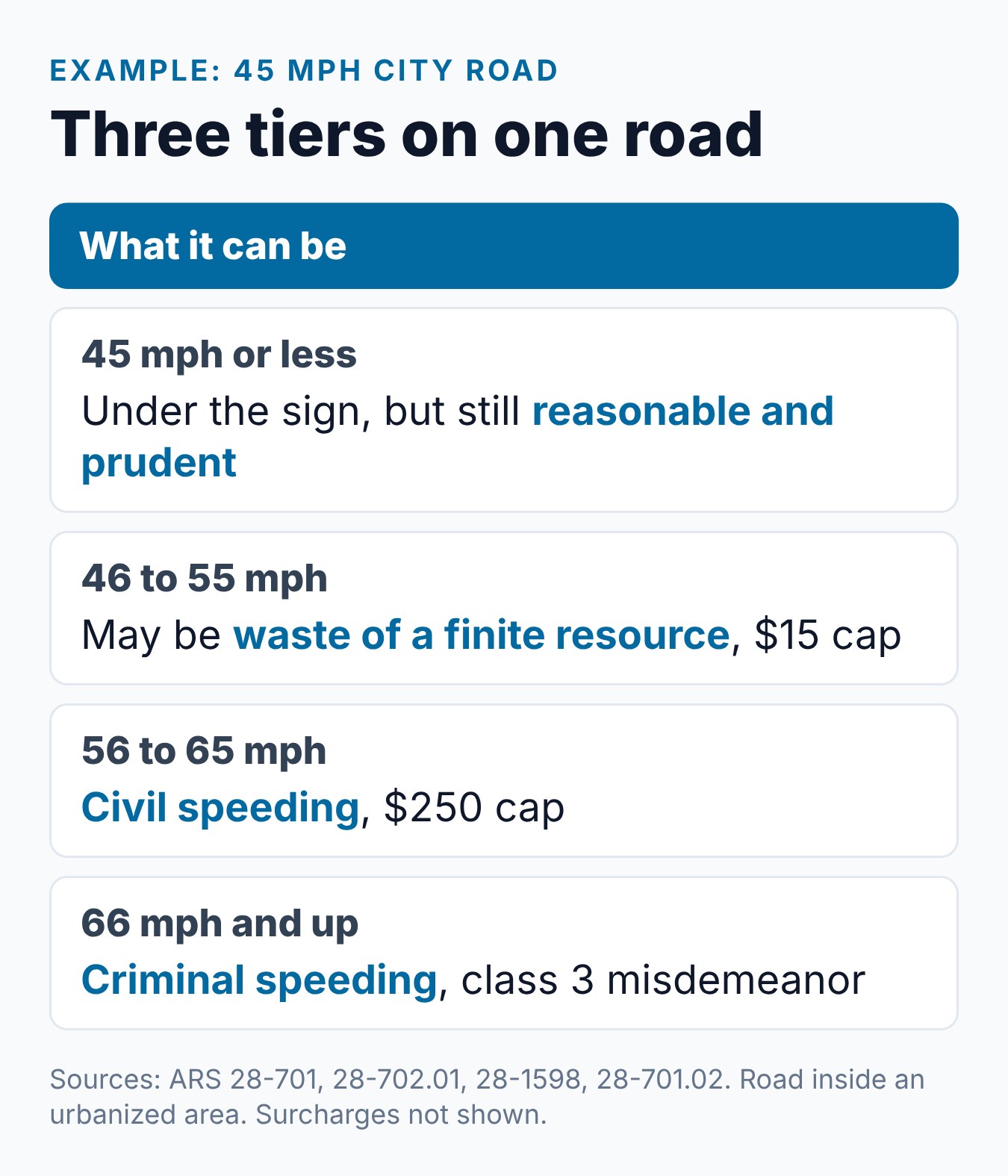
Here is an example on a rural road posted at 55 mph. Going 56 to 65 mph may be waste of a finite resource.
Going 66 to 75 mph is civil speeding under subsection C. Going 76 mph or more is criminal speeding.
Criminal Speeding
Criminal speeding has three triggers. A driver goes more than 20 mph over a posted limit, over 35 mph approaching a school crossing, or over 45 mph in an unposted business or residential district.
Each one is a class 3 misdemeanor. The penalty caps come from the criminal code:
- Jail: up to 30 days under ARS 13-707.
- Fine: up to $500 for a person under ARS 13-802, plus surcharges.
- Points: 3 points for speeding on the ADOT MVD record.
The court process is different as well. Oro Valley’s court says adults with a criminal traffic charge must appear in person on the initial appearance date. Missing it leads to an arrest warrant and a license suspension.
For each threshold in detail, see what is considered criminal speeding in Arizona. For the court steps, see first criminal speeding ticket Arizona.
Why the Difference Matters
On the same road, a few miles per hour can move a ticket from one tier to the next. The results can be very different. Here is what changes:
- Your money. The caps run from $15 to $250 to $500, before surcharges.
- Your freedom. Only criminal speeding allows a jail term.
- Your time. A criminal charge can require you to go to court in person.
- Your record. A criminal speeding conviction is a criminal conviction. Waste of a finite resource is not sent to the department.
- Your options. Defensive driving is open for an eligible civil ticket, but needs permission for criminal speeding.
Points Add Up for Both
Civil and criminal speeding both carry 3 points on the ADOT MVD record. The points page lists one number for speeding, with no separate civil or criminal amount.
With 8 or more points in any 12-month period, MVD may order Traffic Survival School or suspend your license for up to 12 months. That rule applies to points from civil and criminal tickets alike.
Traffic Survival School is not the same as defensive driving school. Our guide to defensive driving vs Traffic Survival School explains why.
The Money Side
Surcharges grow with the base amount. The four percentage surcharges add up to 78% of the fine or penalty. Our guide to Arizona speeding ticket cost works through the math.
Defensive Driving for Each Type
ARS 28-3392 treats the tiers differently. A court shall allow defensive driving school for an eligible civil moving violation. For criminal speeding, the court may allow it.
We checked the Arizona Supreme Court’s List of Eligible Violations on October 25, 2026. Here is what it showed for speeding:
- Civil codes listed: 28-701A, 28-701E, 28-702.01C and 28-702.04B.
- Criminal codes listed: 28-701.02A1, A2 and A3, each marked CM.
- Not listed: 28-702.01A, the waste of a finite resource code.
CM codes are eligible only with the express permission of the presiding judge. A code that is not on the list is not shown as eligible.
The usual rules still apply to every class. You must finish at least 7 days before your court date. You cannot have attended for a ticket issued in the past 12 months, counted from violation date to violation date.
For how the class works on a civil speeding ticket, read can defensive driving dismiss an Arizona speeding ticket.
How to Tell Which One You Have
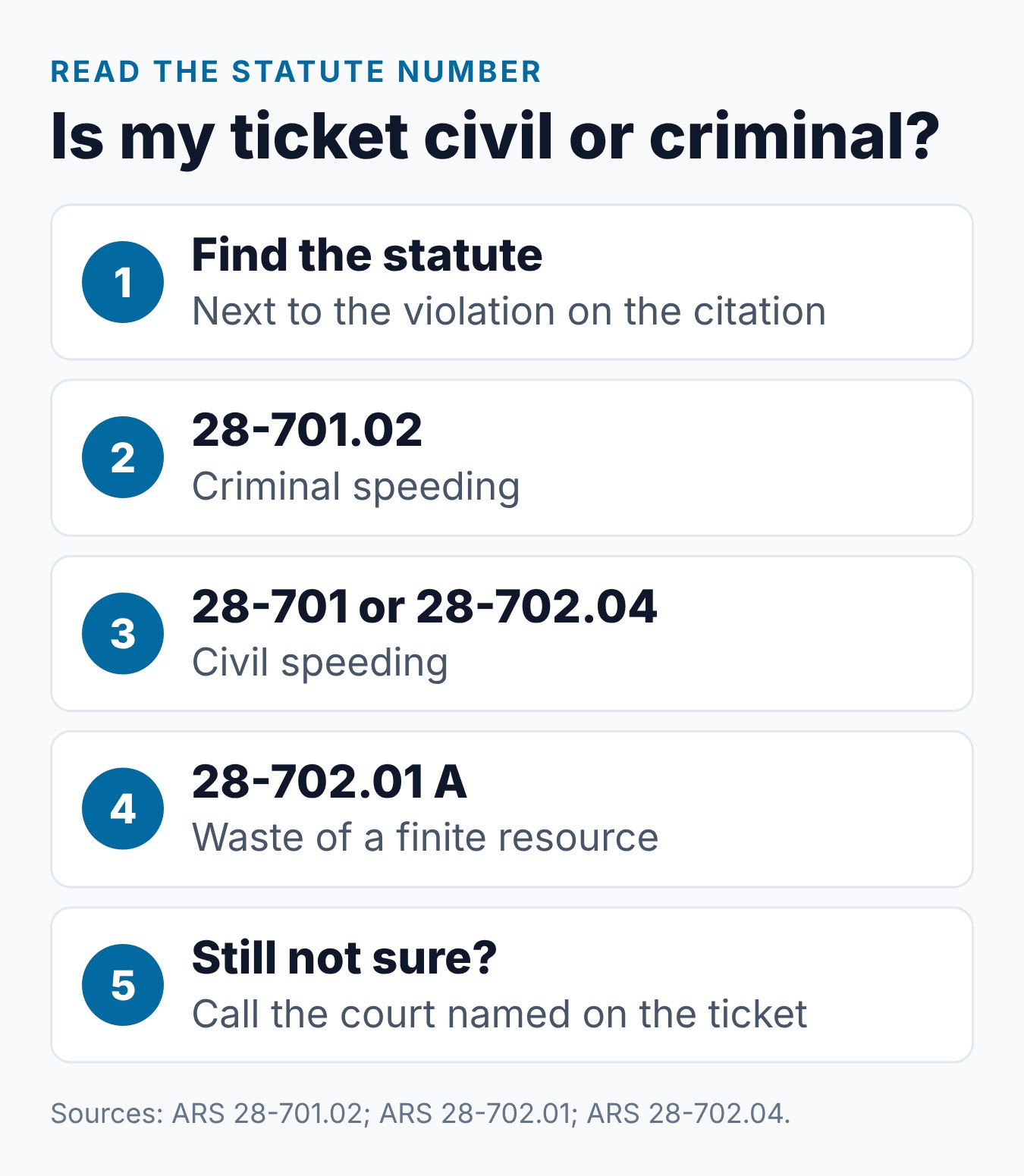
Your citation tells you. Look at the statute number next to the violation:
- 28-701.02: criminal speeding.
- 28-701 or 28-702.04: civil speeding.
- 28-702.01 with A: waste of a finite resource.
- 28-702.01 with C: civil speeding on those faster roads.
If the citation is hard to read, call the court named on it. Ask whether the charge is civil or criminal and whether you must appear in person.
Common Mistakes
These mix-ups come from treating all speeding tickets the same. Each one is avoidable:
- Paying a criminal charge online. Oro Valley’s court requires adults with criminal traffic charges to appear in person.
- Assuming civil means no record. Civil speeding still adds 3 points with ADOT MVD.
- Expecting a class for every tier. The waste of a finite resource code was not on the eligible list we checked.
- Booking a class for criminal speeding. CM codes need the presiding judge’s express permission.
- Ignoring a civil ticket. Oro Valley’s court adds a $70 late and default fee and suspends the license.
For the full overview, see the criminal speeding Arizona guide.
How Requirements Can Vary
Arizona’s defensive driving rules are set by state law and the Arizona Supreme Court, but each court handles its own cases. The total cost includes a court diversion fee that each court sets, so the price depends on the court on your ticket.
Extension allowances also differ by court, from 14 to 60 days on the Supreme Court’s list. If a judge orders in-person attendance, you must take a classroom course.
Court fees can change in April and October each year. Check the Arizona Supreme Court Defensive Driving Program and the court on your citation for current rules before you register.
Frequently Asked Questions
What is the difference between criminal and civil speeding in Arizona?
Civil speeding is a traffic violation with a money penalty capped at $250 plus surcharges. Criminal speeding is a class 3 misdemeanor under ARS 28-701.02, with a $500 fine cap plus surcharges and up to 30 days in jail.
How much is a criminal speeding ticket in Arizona?
The fine can be up to $500 for a person, under ARS 13-802. Surcharges equal to 78% of the fine are added, and courts can add their own fees. The judge sets the actual amount.
Can I get both a civil and a criminal speeding ticket for one stop?
Not for the same event under these two laws. ARS 28-701.02 C says a driver charged with criminal speeding may not also get a civil complaint under ARS 28-701 for the same circumstances.
What is waste of a finite resource?
It is a civil tier under ARS 28-702.01. On certain faster roads, going no more than 10 mph over may be designated this way. The penalty is capped at $15 plus surcharges.
Does civil speeding add points in Arizona?
Yes. ADOT MVD’s points page lists 3 points for speeding. Waste of a finite resource is different, because the court may not send that judgment to the department.
Is criminal speeding on my criminal record?
A conviction for a class 3 misdemeanor is a criminal conviction. Civil speeding is not a crime. For how your own case may be recorded, ask the court or an attorney.
Can defensive driving school dismiss either type?
For an eligible civil ticket, the court shall allow it. For criminal speeding, only the presiding judge can allow it. Either way, you must finish at least 7 days before your court date.
Conclusion
Criminal speeding vs civil speeding in Arizona comes down to the statute on your ticket, and that one number changes the cost, the court process and your options. Check your citation, and if it lists ARS 28-701.02, talk to the court or an attorney before you act.
Driving Logic’s Arizona Defensive Driving Course is coming soon. For an eligible civil ticket, the court’s list at azcourts.gov/drive shows every certified school.
Related Articles
- Criminal Speeding Arizona: What It Is and What to Know
- What Is Considered Criminal Speeding in Arizona? The Speed Thresholds
- Arizona Speeding Ticket Cost: What Affects the Total?
Sources
- Arizona Judicial Branch — Traffic Law self-service page
- Arizona Revised Statutes — ARS 28-701.02 (criminal speeding)
- Arizona Revised Statutes — ARS 28-701 (reasonable and prudent speed)
- Arizona Revised Statutes — ARS 28-702.01 (waste of a finite resource)
- Arizona Revised Statutes — ARS 28-702.04 (interstate speed limits)
- Arizona Revised Statutes — ARS 28-1598 (civil traffic penalty)
- Arizona Revised Statutes — ARS 12-116.01 (surcharges)
- Arizona Revised Statutes — ARS 12-116.02 (surcharge)
- Oro Valley Magistrate Court — Traffic Tickets
- Arizona Revised Statutes — ARS 13-707 (misdemeanor jail terms)
- Arizona Revised Statutes — ARS 13-802 (misdemeanor fines)
- ADOT MVD — Points Assessment
- Arizona Revised Statutes — ARS 28-3392 (eligibility)
- Arizona Supreme Court — List of Eligible Violations
Billy Forte is the owner of Driving Logic, a state-approved driver improvement course provider serving Florida and other U.S. states.
This article is general information, not legal advice. Arizona defensive driving eligibility, deadlines, and fees are set by Arizona law, the Arizona Supreme Court, and each court, and can change. Check the Arizona Supreme Court Defensive Driving Program and the court on your citation for current requirements before you register for a course.