
Updated October 2026 · Reviewed by Billy Forte
Defensive driving can dismiss an Arizona speeding ticket when the citation is a civil speeding code on the state’s eligible list and you meet the program’s other rules. Criminal speeding under ARS 28-701.02 is different, because it is a class 3 misdemeanor and the class is allowed only with the presiding judge’s express permission. No outcome is promised, so check your code before you choose a path.
Key Facts
- Civil speeding: codes such as 28-701A are on the eligible list. See civil vs criminal.
- Criminal speeding: 28-701.02 codes carry a CM mark and need the judge’s permission. See criminal speeding.
- Speed numbers: the mph-over number on a code is not used to decide eligibility. See reading the code.
- If you pay: speeding is 3 points on your record. See what is at stake.
- One class, one ticket: once every 12 months. See the limits.
When Can Defensive Driving Dismiss an Arizona Speeding Ticket?
The answer starts with state law. ARS 28-3392 says a court shall allow defensive driving for a civil traffic moving violation. For criminal speeding, the same law says a court may allow it.
That one word makes a big difference. “Shall” means the court must allow the class for an eligible civil ticket. “May” means the court decides.
The Arizona Supreme Court keeps the List of Eligible Violations. The basic speeding code, 28-701A, is on it with no special mark. When you finish the class for an eligible ticket, the FAQ says the citation is dismissed and no points are added.
Civil vs Criminal Speeding in Arizona
The Arizona courts’ Traffic Law page explains that moving violations are either civil or criminal. Speeding can fall on either side. Here is how the main speed laws line up with the eligible list:
| Law | What it covers | Type | On the eligible list |
|---|---|---|---|
| ARS 28-701 A | Speed faster than is reasonable and prudent | Civil | 28-701A, no CM mark |
| ARS 28-702.01 | Waste of a finite resource | Civil | 28-702.01C, no CM mark |
| ARS 28-702.04 | Interstate speed limits | Check your citation | 28-702.04B, no CM mark |
| ARS 28-701.02 | Criminal speeding | Class 3 misdemeanor | A1, A2 and A3, all marked CM |
The list does not describe each code. Use your citation and the statute to see what you were charged with.
What Makes Speeding Criminal
ARS 28-701.02 lists three kinds of criminal speeding:
- More than 20 mph over the posted limit, in a business or residential district or other locations.
- Over 35 mph when approaching a school crossing.
- Over 45 mph in a business or residential district with no posted limit.
Each is a class 3 misdemeanor. There is no separate fixed top-speed rule in the current statute.
How Arizona Sets Speed Limits
ARS 28-701 A says you must never drive faster than is reasonable and prudent for the conditions. Subsection B adds speeds that are prima facie evidence of driving too fast.
Those speeds are 15 mph approaching a school crossing, 25 mph in a business or residential district and 65 mph in other places. Lower speeds are required near intersections, curves, hill crests and pedestrians, and in bad weather.
On interstates outside urbanized areas, ARS 28-702.04 sets a 65 mph base. The ADOT director may raise it to 75 mph on an interstate.
Reading the Speed Code on Your Citation
The eligible list explains extra marks you may see. Numbers in a code show how far over the posted limit you were said to be going. Tags like “SO” for a sheriff’s office ticket or “PE” for photo enforcement are used for local tracking.
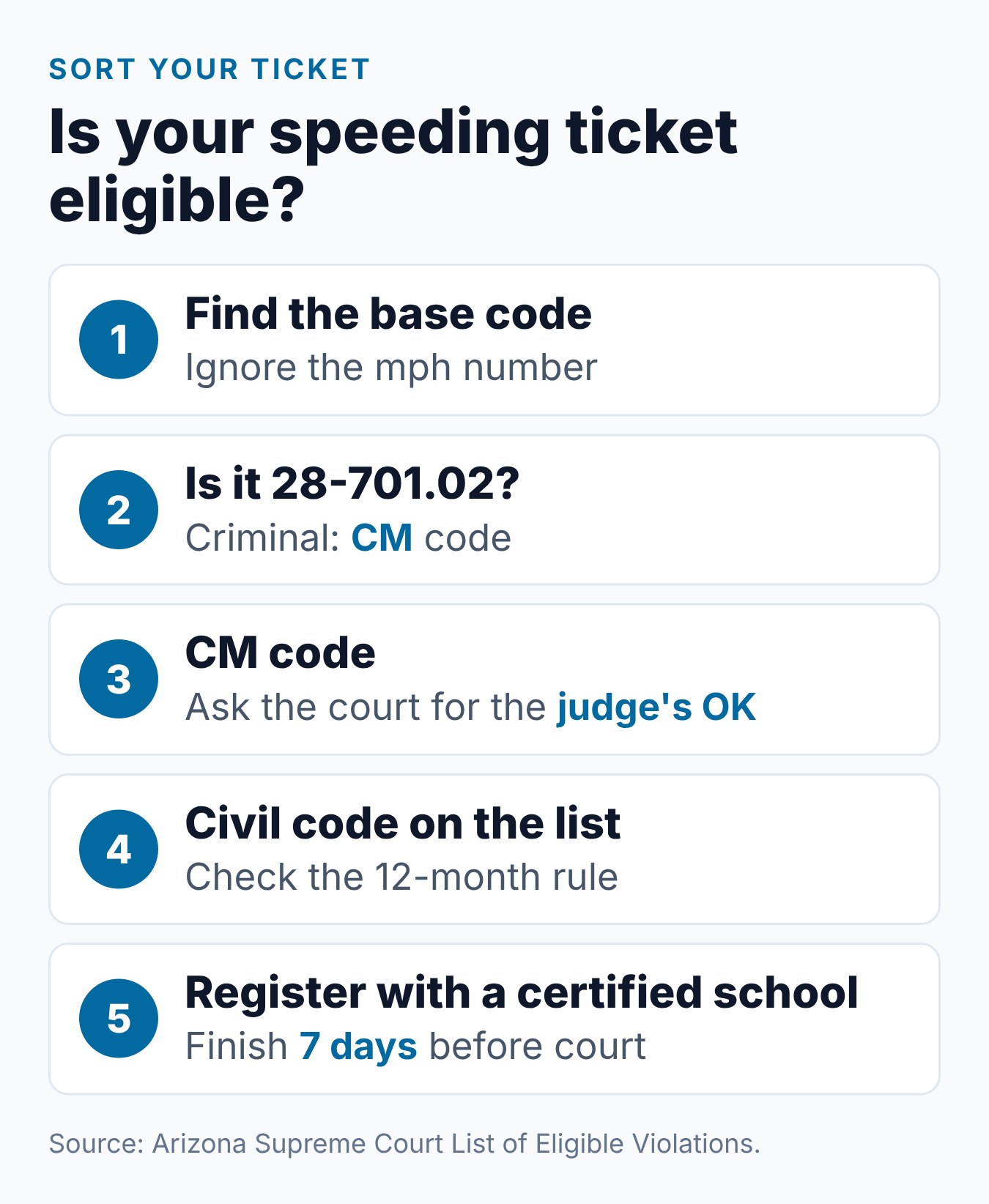
None of that extra coding is used to decide eligibility. The base code is what counts.
So a civil speeding code is treated the same whether it shows 6 mph over or 18 mph over. A code under 28-701.02 carries the CM mark no matter what number appears with it.
Waste of a Finite Resource Tickets
Arizona has a special civil speeding category. Under ARS 28-702.01, it applies where the posted limit is at least 30 mph outside an urbanized area, or at least 40 mph inside one.
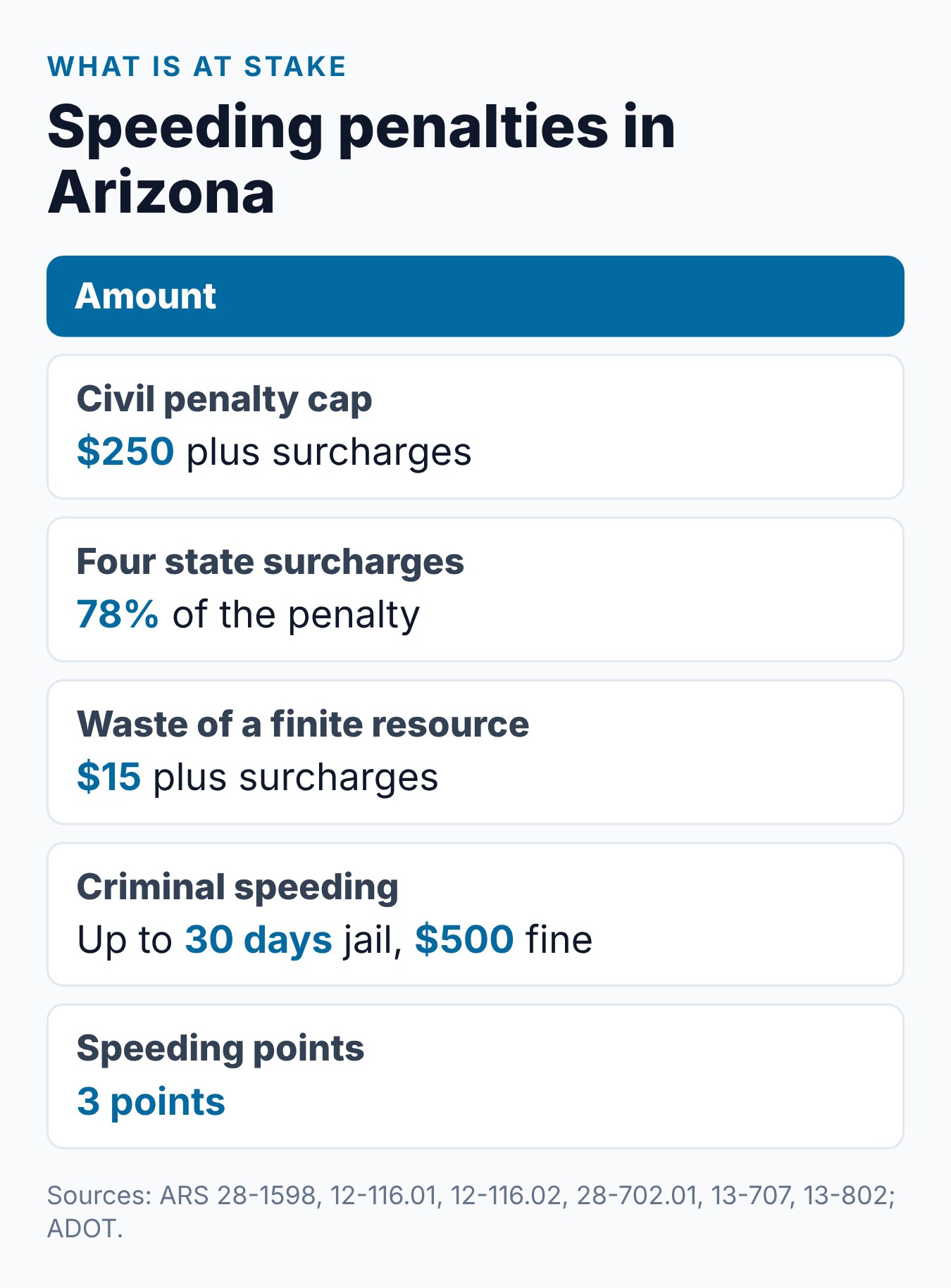
If you were no more than 10 mph over on those roads, the ticket may be marked waste of a finite resource. The law caps the penalty at $15 plus surcharges. It cannot be used to suspend or revoke your license.
It also cannot be treated as a moving violation for insurance rating. It cannot be used to cancel or refuse to renew a policy.
This code, 28-702.01C, is on the eligible list. Keep in mind that the class can be used only once in 12 months. Our guide on how often you can do traffic school in Arizona explains that rule.
Criminal Speeding and Defensive Driving
Every criminal speeding code on the list is marked CM. The list says CM codes are eligible only with the express permission of the presiding judge.
A class 3 misdemeanor carries real penalties. ARS 13-707 allows up to 30 days in jail. ARS 13-802 allows a fine of up to $500 for a person, plus surcharges.
Criminal tickets also change how you respond. At the Oro Valley Magistrate Court, adults charged with a criminal traffic offense must appear in person. Missing that date leads to an arrest warrant and a license suspension.
Do not register for a class and assume it will clear a criminal charge. Ask the court whether the judge will allow it, and think about talking to a lawyer.
What a Speeding Ticket Can Cost Without the Class
For a civil ticket, ARS 28-1598 caps the penalty at $250, except as otherwise provided. Surcharges are added on top.
Those surcharges add up. ARS 12-116.01 levies 42%, 7% and 6%, and ARS 12-116.02 levies 13%. On a $100 penalty, these four surcharges add $78.
At the top of the range, the math grows fast. A $250 penalty plus those same four surcharges comes to $445, before any other fees.
Points matter, too. The ADOT points list assigns 3 points for speeding. MVD may order Traffic Survival School or a suspension when a driver reaches 8 or more points in 12 months.
Our DDC vs TSS guide explains those point levels.
Paying a Civil Penalty
If you are found responsible, ARS 28-1601 says civil penalties are due within 30 days of the judgment. The court may extend the time or allow payments if paying at once would be an undue economic burden.
Missing a payment can make the full amount due. The court may also start collection and ask MVD to refuse to renew your vehicle registration.
Ignoring the ticket is worse. At Oro Valley’s court, failing to respond to a civil ticket leads to a default judgment, a $70 late and default fee and a license suspension until you pay. Other courts may set different fees.
How to Use Defensive Driving for an Eligible Speeding Ticket
If your code is a civil one on the list, the process is the same as for any eligible ticket:
- Check the base code on your citation against the eligible list.
- Confirm the other rules. No class for an eligible ticket in the past 12 months, and no serious injury or fatal crash.
- Find a certified school with the class search at azcourts.gov/drive.
- Register. The school runs a court database check to confirm you qualify.
- Finish no later than 7 days before your court date.
The school reports your completion to the court electronically. Some courts also want a completion certificate, so follow any court instructions.
The cost has four parts: the court diversion fee, a $24 State Fee, a $45 state surcharge and the school fee. Court fees differ by court. Our cost guide lists them by county.
Limits to Keep in Mind
The class helps with one ticket and nothing more. The FAQ and the court rules set these limits:
- One violation per class. A second charge on the same citation needs another answer.
- Once in 12 months, counted from violation date to violation date.
- No point reduction. The class does not remove points from older tickets.
- CDL holders in a commercial vehicle cannot have the ticket dismissed. See our CDL holders guide.
- Court or class, not both. If you go to court and lose, you cannot attend class afterward.
If the class is not an option, our guide to Arizona traffic ticket options covers paying and a hearing.
Drivers Under 18
Young drivers face added rules after a speeding ticket. The ADOT Traffic Survival School page says TSS is required for drivers under 18 after a first moving violation.
Criminal charges add another step. At the Oro Valley court, a driver under 18 with a criminal traffic charge must appear in person with a parent or guardian. Ask the court on the citation how it handles a young driver’s ticket.
Common Speeding Ticket Mistakes
Each of these runs against the official rules:
- Reading the mph number as a cutoff. The number is not used for eligibility. The base code decides.
- Treating a CM code like a civil one. Criminal speeding needs the presiding judge’s permission.
- Paying first, then asking about the class. At courts like Oro Valley, paying admits responsibility, and MVD assesses points.
- Skipping a criminal court date. That can lead to a warrant and a license suspension.
- Expecting the class to clear old points. It only keeps points off the dismissed ticket.
For every rule in one place, see our Arizona defensive driving eligibility checklist. For the whole process, read the Arizona online traffic school guide.
How Requirements Can Vary
Arizona’s defensive driving rules are set by state law and the Arizona Supreme Court, but each court handles its own cases. The total cost includes a court diversion fee that each court sets, so the price depends on the court on your ticket.
Extension allowances also differ by court, from 14 to 60 days on the Supreme Court’s list. If a judge orders in-person attendance, you must take a classroom course.
Court fees can change in April and October each year. Check the Arizona Supreme Court Defensive Driving Program and the court on your citation for current rules before you register.
Frequently Asked Questions
Can defensive driving dismiss an Arizona speeding ticket?
Yes, if the ticket is a civil speeding code on the eligible list and you meet the other rules. Criminal speeding needs the presiding judge’s express permission.
How fast is criminal speeding in Arizona?
More than 20 mph over the posted limit, over 35 mph approaching a school crossing, or over 45 mph in a business or residential district with no posted limit.
Does the mph-over number on my ticket affect eligibility?
No. The eligible list says the speed number shows how far over the limit you were said to be going. It is not used to decide eligibility.
How many points is a speeding ticket in Arizona?
Speeding is 3 points on the ADOT points list. A ticket dismissed through the class adds no points, according to the FAQ.
Can I take defensive driving for a waste of a finite resource ticket?
The code 28-702.01C is on the eligible list. Remember that you can use the class only once in 12 months.
What if my ticket is for criminal speeding?
Ask the court whether the judge will allow the class. Adults with a criminal traffic charge may need to appear in person, so check your citation and consider talking to a lawyer.
How much does it cost to dismiss a speeding ticket with the class?
It depends on your court. The total adds the court diversion fee, a $24 State Fee, a $45 surcharge and the school fee.
Conclusion
Defensive driving can dismiss an Arizona speeding ticket when the code is civil and on the eligible list. Check your base code, watch for a CM mark, and finish at least 7 days before court.
Driving Logic’s Arizona Defensive Driving Course is coming soon. Until then, find a certified school at azcourts.gov/drive.
Related Articles
- Arizona Online Traffic School: Ticket Dismissal Guide
- Arizona Defensive Driving Eligible Violations: What Tickets Qualify?
- Arizona Defensive Driving Eligibility: Who Can Take the Course?
- Arizona Traffic Ticket Options: Pay, Contest, or Defensive Driving
Sources
- Arizona Supreme Court — List of Eligible Violations
- Arizona Revised Statutes — ARS 28-3392 (eligibility)
- Arizona Revised Statutes — ARS 28-701.02 (criminal speeding)
- Arizona Revised Statutes — ARS 28-701 (reasonable and prudent speed)
- Arizona Revised Statutes — ARS 28-702.01 (waste of a finite resource)
- Arizona Revised Statutes — ARS 28-702.04 (interstate speed limits)
- Arizona Revised Statutes — ARS 28-1598 (civil traffic penalty)
- Arizona Revised Statutes — ARS 28-1601 (paying civil penalties)
- Arizona Revised Statutes — ARS 12-116.01 (surcharges)
- Arizona Revised Statutes — ARS 12-116.02 (surcharge)
- Arizona Revised Statutes — ARS 13-707 (misdemeanor jail terms)
- Arizona Revised Statutes — ARS 13-802 (misdemeanor fines)
- ADOT MVD — Points Assessment
- ADOT MVD — Traffic Survival School
- Arizona Judicial Branch — Traffic Law self-service page
- Oro Valley Magistrate Court — Traffic Tickets
- Arizona Supreme Court — Defensive Driving Schools (eligibility and class search)
- Arizona Supreme Court — Defensive Driving Frequently Asked Questions
- Arizona Supreme Court — Cost to Attend School (by county)
Billy Forte is the owner of Driving Logic, a state-approved driver improvement course provider serving Florida and other U.S. states.
This article is general information, not legal advice. Arizona defensive driving eligibility, deadlines, and fees are set by Arizona law, the Arizona Supreme Court, and each court, and can change. Check the Arizona Supreme Court Defensive Driving Program and the court on your citation for current requirements before you register for a course.