
Updated October 2026 · Reviewed by Billy Forte
The answer to how often can you do traffic school in Arizona is once in a 12-month period, and the court counts from the date of your last eligible violation to the date of your new one. The day you took your last class does not matter. If your new ticket falls inside that 12-month window, the class cannot dismiss it, and you will need to pay or ask for a hearing instead.
Key Facts
- The limit: one class for an eligible ticket in any 12 months. See the rule.
- The dates that count: violation date to violation date. See which dates count.
- The class date: it plays no part in the count. See why.
- Two tickets close together: only one can go through the class. See two tickets.
- Not the same as points: MVD’s 12-month points period is a separate rule. See the two windows.
How Often Can You Do Traffic School in Arizona?
The Arizona Supreme Court’s Defensive Driving Schools page sets the limit. You must not have attended a class for an eligible citation issued within the past 12 months.
The page adds a key detail. Eligibility is based on the date of your current violation, not the date you last attended. The program FAQ says the same thing in a shorter way: the 12 months run from violation date to violation date.
State law backs this up. ARS 28-3392 bars a driver from the program if they attended for a violation within the 12 months before the new one.
So for Arizona defensive driving, 12 months is the gap that matters. Each class can dismiss only one violation, so one class covers one ticket in that span.
Which Dates Count
Your citation and your class come with several dates. Only two of them matter for this rule:
| Date | Used for the 12-month rule? |
|---|---|
| Violation date on your last eligible ticket | Yes |
| Violation date on your new ticket | Yes |
| Day you registered for your last class | No |
| Day you finished your last class | No |
| Day the court dismissed your last ticket | No |
| Your new court date | No, it sets the 7-day deadline instead |
The violation date is the date of the offense. It is printed on your citation.
Your court date matters for a different rule. You must finish no later than 7 days before it. Our 7-day deadline guide covers that one.
Date Examples
These examples use simple date math. In each one, assume the driver took a class for the earlier ticket and meets every other rule.
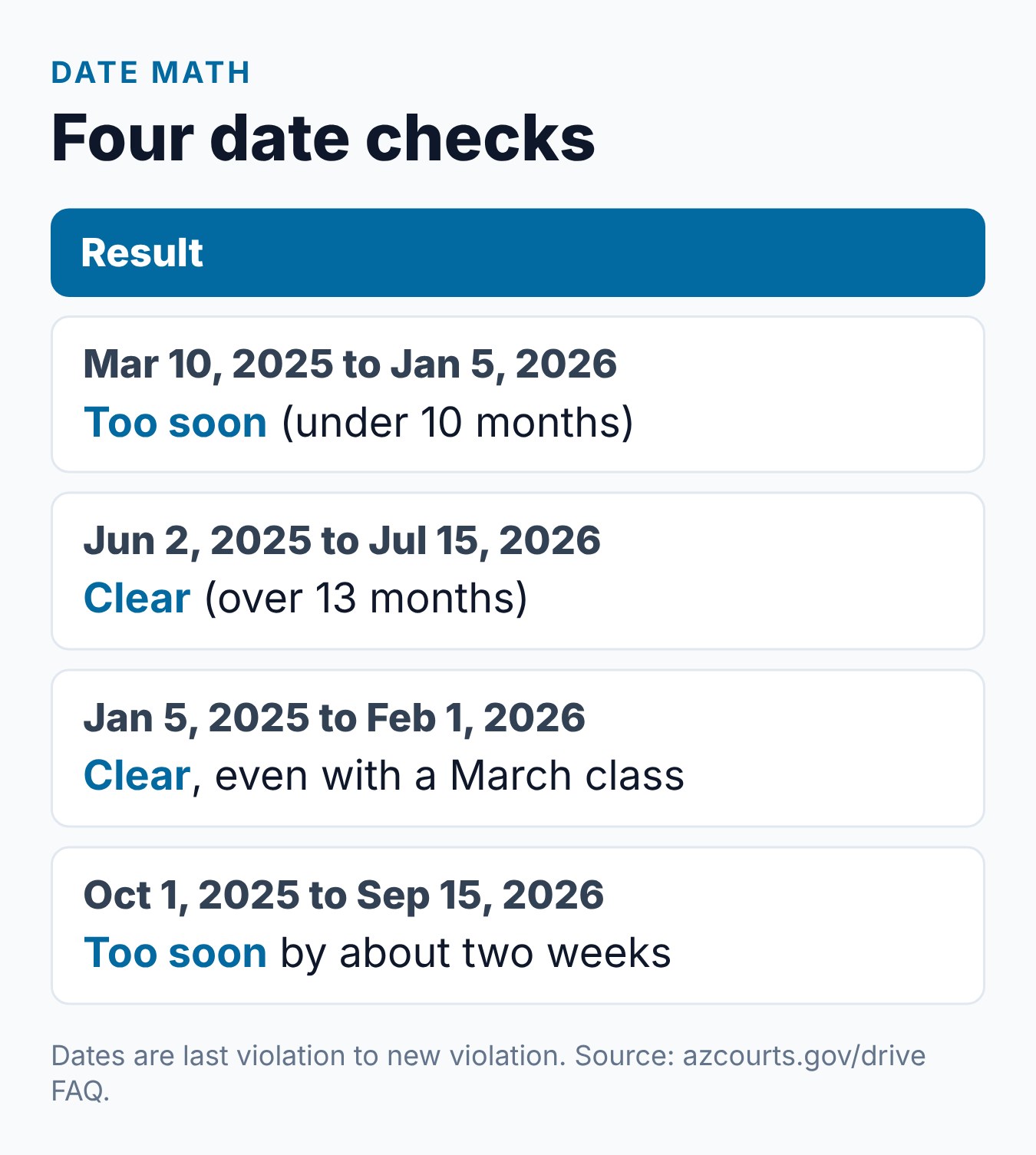
Example 1: Too Soon
Your last eligible ticket had a violation date of March 10, 2025. Your new ticket has a violation date of January 5, 2026.
That is under 10 months apart. The new ticket falls inside the 12-month window, so the class cannot dismiss it.
Example 2: Clear of the Window
Your last eligible ticket was dated June 2, 2025. Your new ticket is dated July 15, 2026.
That gap is more than 13 months. On the 12-month rule, you are clear.
Example 3: The Class Date Trap
Your last ticket was dated January 5, 2025, and you finished the class on March 1, 2025. Your new ticket is dated February 1, 2026.
Counting from the class date gives 11 months, which looks too soon. But the court counts from the violation date. January 5, 2025 to February 1, 2026 is more than 12 months, so you pass this rule.
Example 4: Waiting It Out
Your last ticket was dated October 1, 2025. A new ticket dated September 15, 2026 would be about two weeks short of 12 months.
A ticket dated November 1, 2026 would be more than 12 months later. You cannot pick your violation date, of course. The point is that your window closes based on your last violation date, not a calendar year.
How to Count the 12 Months Yourself
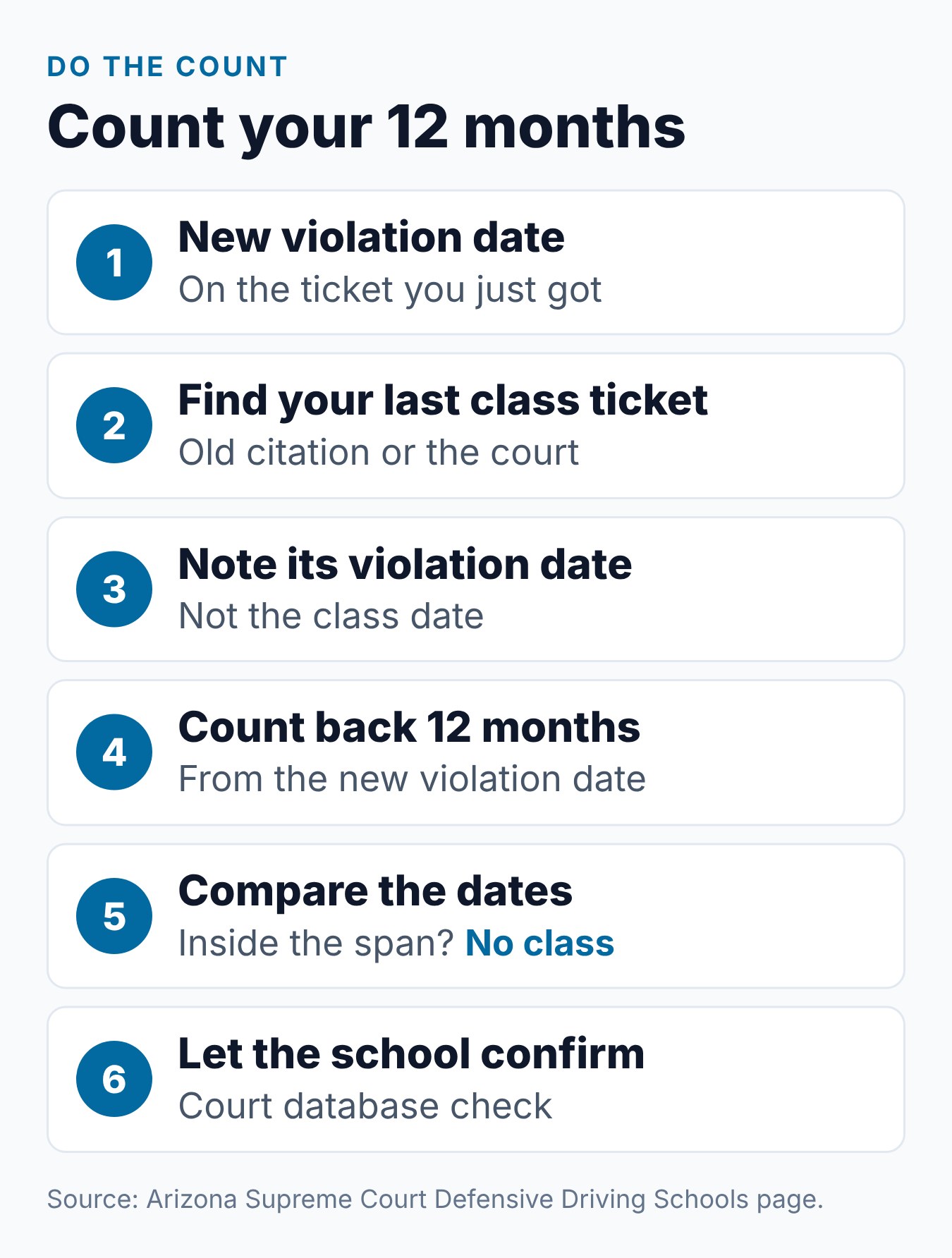
You can run this check in a few minutes. Here is the order to follow:
- Find your new violation date. It is on the ticket you just got.
- Find your last class ticket. Use the old citation, or ask the court that handled it.
- Note that ticket’s violation date. Ignore the class date and the dismissal date.
- Count back 12 months from your new violation date.
- Compare. If your last violation date falls inside that span, the class cannot dismiss the new ticket.
- Let the school confirm. The school runs a court database check when you register.
If the two dates are close to 12 months apart, do not guess. Call the court on your new citation, or let the school’s check settle it before you pay.
Why the Class Date Does Not Matter
Drivers take the class at different times after a ticket. One driver might finish a week after the violation. Another might finish two months later because of a later court date.
Counting from the violation date treats both drivers the same. The court page states the rule plainly: the date of your current violation decides it, not the date you last attended.
This is good news if you took your last class late. Your next window may open sooner than you think.
Two Tickets Close Together
Say you got one ticket on May 1, 2026, and another on May 20, 2026. Both are on the eligible list.
A class can dismiss only one violation. And once you use the class for one ticket, the other one falls inside the 12-month window. So only one of the two can go through the program.
The other ticket needs a different answer. The Oro Valley Magistrate Court lists paying the fine or asking for a hearing as the other options for a civil ticket. It also says MVD assesses points for moving violations when you pay.
The ADOT points list may help you weigh the two tickets. Speeding is 3 points. Moving violations not named elsewhere on the list are 2.
The same limit applies to two charges on one citation. Only one violation can be dismissed.
What If You Are Inside the 12 Months?
The class is off the table for that ticket, but you still must respond. For a civil ticket, your choices are to pay or ask for a hearing.
Do not ignore the ticket. At Oro Valley’s court, failing to respond leads to a default judgment, a $70 late and default fee and a license suspension until you pay. Other courts may charge different fees.
Our guide to Arizona traffic ticket options compares paying and a hearing in more detail.
Do Not Mix Up the Two 12-Month Windows
Arizona has two different rules that use 12 months. They come from different agencies and do different things:
| Defensive driving 12-month rule | MVD points 12-month period | |
|---|---|---|
| Run by | Arizona Supreme Court and the courts | ADOT MVD |
| What it limits | How often a class can dismiss a ticket | How many points you can build up |
| What it counts | Violation date to violation date | Points from violations in any 12 months |
| What happens | The class is not available | MVD may order Traffic Survival School or a suspension at 8 or more points |
The points rule comes from R17-4-404 and the ADOT points page. A dismissed ticket adds no points, per the FAQ.
Traffic Survival School is a separate program from defensive driving. Our DDC vs TSS guide explains the point levels.
Clear of the Window? Check the Other Rules
Passing the 12-month rule does not make you eligible on its own. The Defensive Driving Schools page lists other rules that must also be met:
- Your code is on the list. The citation must appear on the List of Eligible Violations.
- No serious crash. You are not eligible if you were in a serious injury or fatal accident.
- One violation only. The class dismisses a single charge.
- Time to finish. The class must be done no later than 7 days before your court date.
Codes marked CM, such as criminal speeding, need the presiding judge’s permission. Our speeding ticket guide explains how that works.
Keep a Record for Next Time
The next time you get a ticket, you will need the violation date from this one. Write it down when you finish the class, along with the court name.
Keep your completion certificate, too. Some courts still ask for one. If you lose it, the FAQ says to contact the school you attended.
Common Mistakes With the 12-Month Rule
Each of these goes against the official rule:
- Counting from the class date. The court uses violation dates only.
- Counting by calendar year. A new year does not reset the window.
- Counting from the dismissal. The day the court closed your last case is not used.
- Planning to use one class for two tickets. One class covers one violation.
- Ignoring a ticket you cannot dismiss. You still must pay or ask for a hearing.
For the full list of rules beyond timing, see our Arizona defensive driving eligibility checklist. For the big picture, read the Arizona online traffic school guide.
How Requirements Can Vary
Arizona’s defensive driving rules are set by state law and the Arizona Supreme Court, but each court handles its own cases. The total cost includes a court diversion fee that each court sets, so the price depends on the court on your ticket.
Extension allowances also differ by court, from 14 to 60 days on the Supreme Court’s list. If a judge orders in-person attendance, you must take a classroom course.
Court fees can change in April and October each year. Check the Arizona Supreme Court Defensive Driving Program and the court on your citation for current rules before you register.
Frequently Asked Questions
How often can you do traffic school in Arizona?
Once in a 12-month period for an eligible ticket. The court counts from the violation date of your last eligible ticket to the violation date of your new one.
Does the 12 months start when I finish the class?
No. The Defensive Driving Schools page says eligibility is based on the date of your current violation, not the date you last attended. The class date is not part of the count.
Does a new calendar year reset the rule?
No. The rule looks back 12 months from your new violation date. A ticket in January can still fall inside the window from a ticket the previous spring.
Can I take the class for two tickets in the same month?
No. Each class covers one violation, and the second ticket would fall inside the 12-month window. Pay or ask for a hearing on the other one.
How do I find the date of my last violation?
Look at your old citation, or call the court that handled that case. The school will also run a court database check when you register.
Is the 12-month rule the same as the MVD points rule?
No. The defensive driving rule limits how often a class can dismiss a ticket. MVD’s rule looks at points from violations in any 12 months, and 8 or more points may lead to Traffic Survival School or a suspension.
Does the rule apply to out-of-state drivers?
Yes. Any driver using the program for an Arizona ticket must meet the same rules. Our out-of-state drivers guide has more detail.
What if I lost my certificate from my last class?
Contact the school you attended. The FAQ says the school can help with a lost certificate. Your old citation also shows the violation date you need for the 12-month count.
Conclusion
The 12-month rule is simple once you know which dates count. Compare the violation date on your last class ticket with the date on your new one, and ignore the class date.
Driving Logic’s Arizona Defensive Driving Course is coming soon. Until then, find a certified school at azcourts.gov/drive.
Related Articles
- Arizona Online Traffic School: Ticket Dismissal Guide
- Arizona Defensive Driving Eligibility: Who Can Take the Course?
- Arizona Defensive Driving 7-Day Deadline: What You Need to Know
- Arizona Traffic Ticket Options: Pay, Contest, or Defensive Driving
Sources
- Arizona Supreme Court — Defensive Driving Schools (eligibility and class search)
- Arizona Supreme Court — Defensive Driving Frequently Asked Questions
- Arizona Revised Statutes — ARS 28-3392 (eligibility)
- ADOT MVD — Points Assessment
- Arizona Administrative Code — R17-4-404 (driver points and Traffic Survival School)
- ADOT MVD — Suspension and Traffic Survival School
- Oro Valley Magistrate Court — Traffic Tickets
Billy Forte is the owner of Driving Logic, a state-approved driver improvement course provider serving Florida and other U.S. states.
This article is general information, not legal advice. Arizona defensive driving eligibility, deadlines, and fees are set by Arizona law, the Arizona Supreme Court, and each court, and can change. Check the Arizona Supreme Court Defensive Driving Program and the court on your citation for current requirements before you register for a course.