
Updated October 2026 · Reviewed by Billy Forte
Arizona defensive driving eligible violations are the traffic code sections printed on the Arizona Supreme Court’s List of Eligible Violations, and your ticket qualifies only if its code is on that list and you meet the other program rules. The court FAQ says most common moving violations qualify, from speeding to running a red light. Codes marked “CM,” such as criminal speeding, need the express permission of the presiding judge.
Key Facts
- One official list: the court posts eligible codes by ARS section number. See what the list is.
- Our count: 137 code entries on October 25, 2026, with one code listed twice. See our review.
- CM codes: eligible only with the presiding judge’s express permission. See the CM mark.
- Speed numbers do not count: the mph number added to a code is not used for eligibility. See reading your code.
- City tickets: local ordinance violations appear as code 999. See code 999.
What the List of Eligible Violations Is
The Arizona Supreme Court runs the Defensive Driving Program. On its List of Eligible Violations, it prints every traffic code that can be dismissed through the class. The codes come from Title 28 of the Arizona Revised Statutes, the state’s traffic laws.
State law sets the base rule. Under ARS 28-3392, a court shall allow the class for a civil traffic moving violation from the listed parts of Title 28, or a matching local ordinance. The court may also allow it for criminal speeding.
The Defensive Driving Schools page adds the plain version. Your violation must be on the list of eligible violations. If it is not, the class is not an option for that ticket.
Arizona Defensive Driving Eligible Violations by Topic
The list is a grid of code numbers with no descriptions. To make it easier to read, we matched some of the codes to the section titles on the Arizona Legislature’s Title 28 index:
| Topic | Codes on the list (examples) | ARS section title |
|---|---|---|
| Speed | 28-701A | Reasonable and prudent speed |
| Signals and signs | 28-644A1, 28-645A1A | Obedience to traffic control devices; traffic control signal legend |
| Stop and yield | 28-855B, 28-855C | Stop signs; yield signs |
| Lanes and spacing | 28-729.1, 28-730A | Driving on roadways laned for traffic; following too closely |
| Turns | 28-751.1, 28-754A | Required position and method of turning; turning movements and required signals |
| Right of way | 28-771A, 28-772, 28-792A | Vehicle at intersection; vehicle turning left at intersection; right-of-way at crosswalk |
| School zones and buses | 28-797.F, 28-857A1 | School crossings; school bus signs, overtaking and passing |
| Work zones | 28-710A, 28-710B | State highway work zone safety |
| HOV lanes | 28-737A | High occupancy vehicle lanes |
| Phone use | 28-914A1a | Use of portable wireless communication device while driving |
This table shows examples, not the whole list. Always check your exact code on the court’s page.
Civil and Criminal Codes on the Same List
Arizona moving violations come in two kinds. The court’s Traffic Law page says moving violations are either civil or criminal.
Running a red light is a civil example. DUI and driving on a suspended license are criminal examples.
The list mixes both kinds, but it treats them differently. For a civil moving violation on the list, ARS 28-3392 says the court shall allow the class. For criminal speeding, the law says the court may allow it, which is why those codes carry the CM mark.
How to Read the Code on Your Ticket
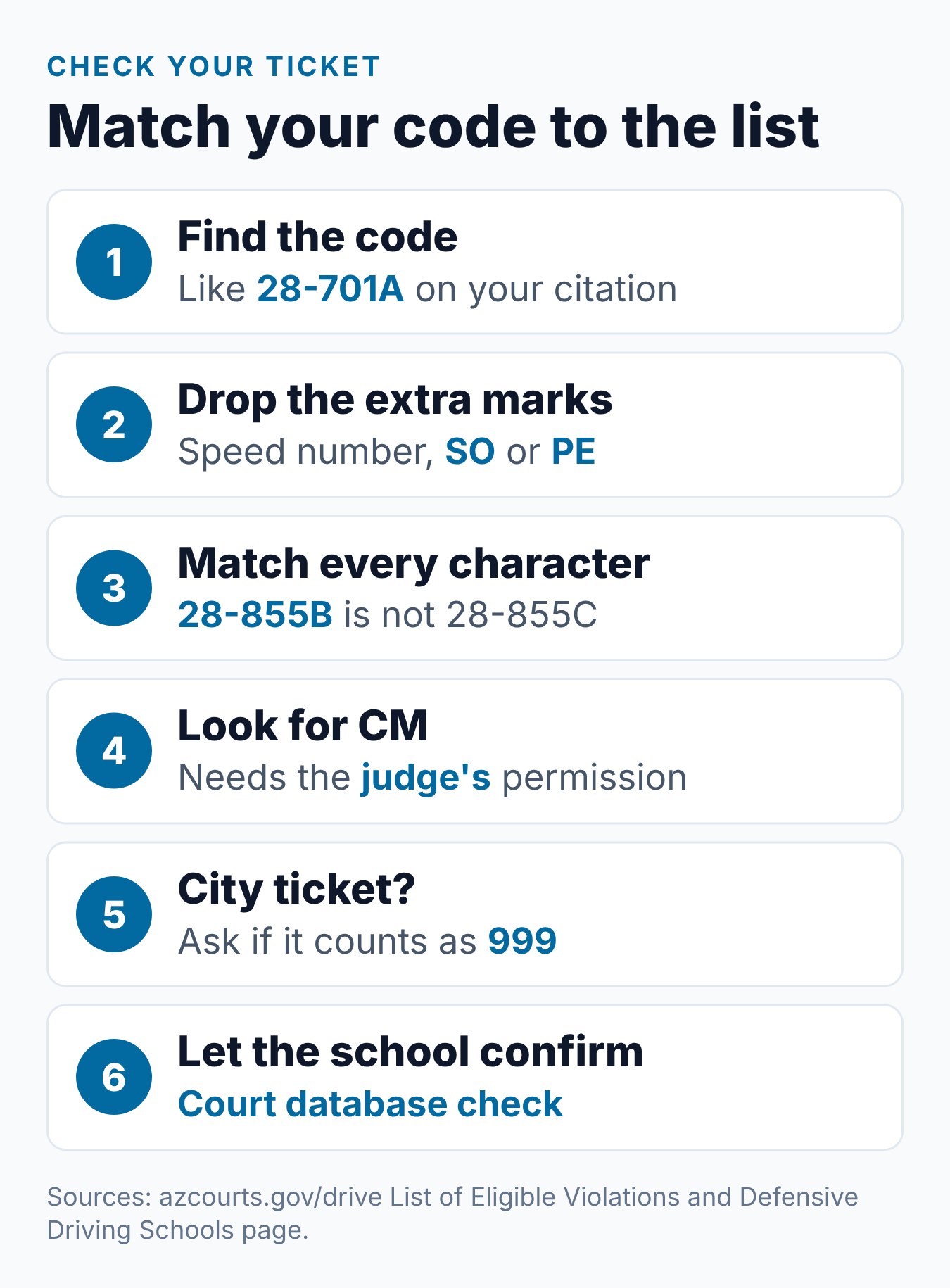
Your citation shows the law you are charged under. It looks like “28-701A” or “28-645A1A.” The “28” is the title of Arizona law, and the number after the dash is the section. Letters and numbers after that point to a part of the section.
Match the full code, not just the section. The list includes 28-855B and 28-855C, for example. Two parts of the same section can both be listed, so read every character.
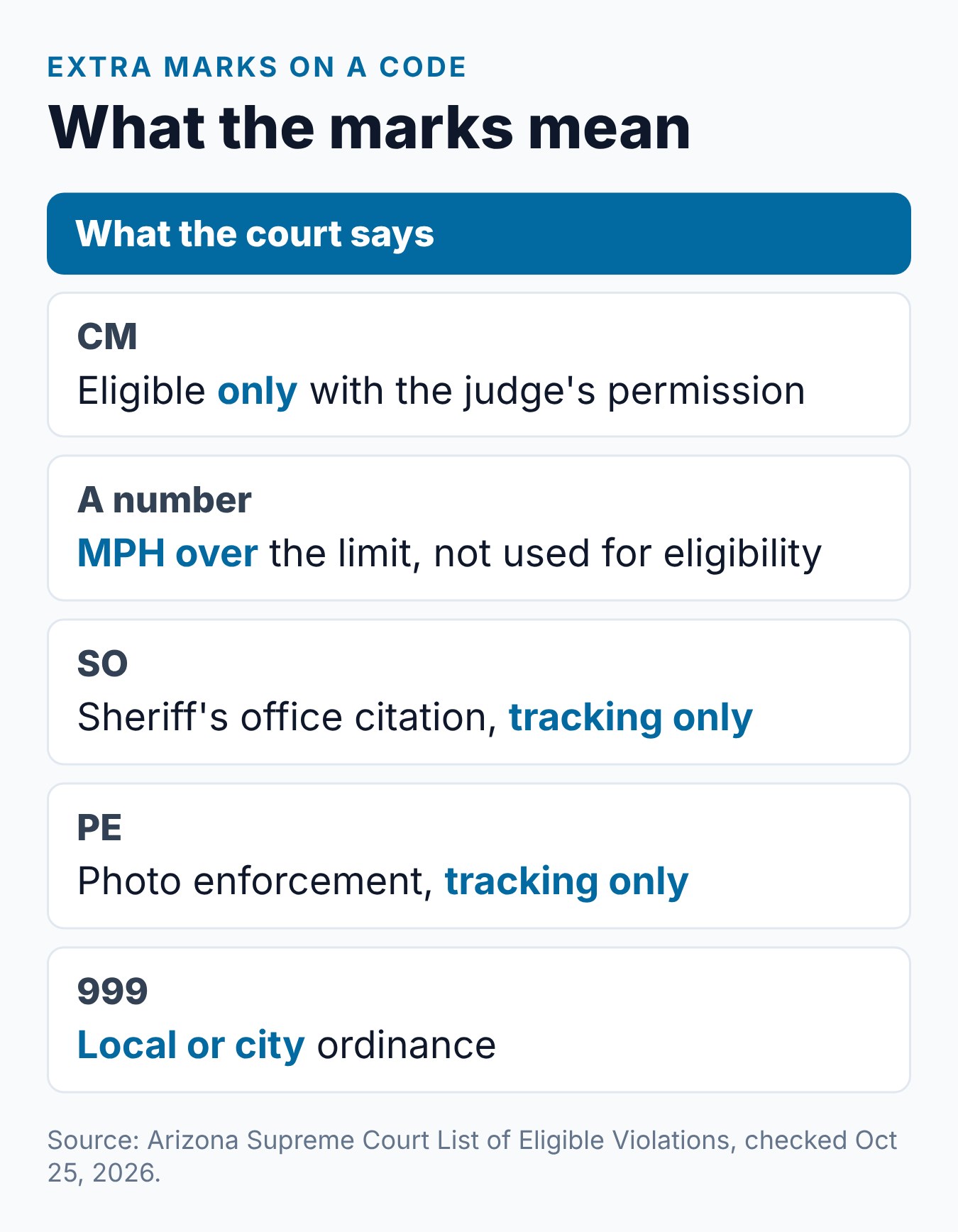
Your ticket may show extra marks after the code. The court’s list explains them:
- A number shows the speed in mph over the posted limit that you were alleged to be going.
- “SO” marks a citation issued by a sheriff’s office.
- “PE” marks a photo enforcement citation.
The court says these marks are used only for local tracking. In its own words, the extra coding “is NOT used in determining eligibility for the state diversion program.” So a speed number on a 28-701A ticket does not change whether 28-701A is on the list.
What the CM Mark Means
Some codes on the list carry the letters “CM.” The court says these codes are eligible ONLY with the express permission of the presiding judge of the court that holds your citation.
Three codes carry the mark: 28-701.02A1, 28-701.02A2 and 28-701.02A3. They are the criminal speeding codes under ARS 28-701.02.
That law covers going more than 20 mph over the posted limit. It also covers going over 35 mph approaching a school crossing, or over 45 mph in a business or residential district with no posted limit.
Criminal speeding is a class 3 misdemeanor, not a civil ticket. Being on the list does not make it automatic.
The judge decides. Our guide to whether defensive driving can dismiss an Arizona speeding ticket covers speed tickets in depth.
Code 999 for City and Town Ordinances
The last entry on the list is “999 (Local/City Ord).” It covers violations of a local or city ordinance. This matches ARS 28-3392, which lets the class apply to a local ordinance that matches a listed state violation.
If your ticket cites a city or town code instead of a Title 28 section, ask the court whether it is handled as code 999. The school’s eligibility check will also show whether it qualifies.
What We Found on the List
We read the full List of Eligible Violations on October 25, 2026. Here is what it showed:
- 137 code entries, with 28-851B (railroad crossing safety) listed twice. That leaves 136 different codes.
- Three CM codes, all from the criminal speeding law, 28-701.02.
- Two speed codes beyond 28-701A: 28-702.01C and 28-702.04B.
- One local code: 999 for city and town ordinances.
The two extra speed codes deserve a note. ARS 28-702.01 covers “waste of a finite resource,” a civil speed violation on certain roads. ARS 28-702.04 covers interstate speed limits. Both appear on the list as eligible codes.
The waste of a finite resource rule is narrow. It applies where the posted limit is at least 30 mph outside an urbanized area, or at least 40 mph inside one. If you were not more than 10 mph over there, the ticket may be written this way, with a penalty capped at $15 plus surcharges.
The list can change. Check it again before you register, and trust the school’s eligibility check over any copy you find elsewhere.
What Is Not on the List
The court is clear that a code not on the list is not eligible. When we checked, we found no code from these sections:
- ARS 28-693, reckless driving.
- ARS 28-1381, driving under the influence.
- ARS 28-661, accidents involving death or physical injuries.
These are serious charges. ADOT’s Points Assessment page lists DUI and reckless driving at 8 points each. A defensive driving class is not a path for them.
What Dismissal Means for Points
Why does the list matter so much? Because of points. ADOT lists a speeding conviction at 3 points and all other moving violations at 2 points, unless a higher value applies.
When an eligible ticket is dismissed through the class, the court FAQ says no points are added for it. The FAQ also says the class cannot be used for point reduction. It will not remove points from older tickets.
When a Listed Code Still Does Not Qualify
Being on the list is necessary, but it is not enough. The court’s other rules still apply:
- The 12-month rule. You cannot have attended for a ticket issued in the past 12 months.
- One violation only. If you got several tickets in one stop, only one can be dismissed.
- No serious injury or fatal accident. ARS 28-3392 bars the class when the violation caused death or serious physical injury.
- The 7-day deadline. You must finish at least 7 days before your court date.
- Commercial vehicles. A CDL holder driving a commercial motor vehicle is not eligible for diversion. See our guide to Arizona defensive driving CDL rules.
For the full checklist, read our Arizona defensive driving eligibility guide.
How to Confirm Your Ticket Qualifies
You do not have to decide alone. The Defensive Driving Schools page says the school runs a court database check once you register. That check confirms whether you are eligible.
Still, check the list first so you do not waste time. Then call the court on your citation if anything is unclear. For general program questions, the Defensive Driving Unit is at 1-888-334-5565.
Common Mistakes When Reading the List
These mistakes come from the court’s own notes:
- Treating the speed number as a limit. The court says that number is not used for eligibility.
- Assuming a CM code qualifies. It needs the presiding judge’s express permission.
- Matching only the section. Check the full code, including letters and numbers after the section.
- Skipping the other rules. A listed code still fails if the 12-month rule or deadline is not met.
- Relying on an old copy. Use the court’s current page.
For the full program, see our Arizona online traffic school ticket dismissal guide.
How Requirements Can Vary
Arizona’s defensive driving rules are set by state law and the Arizona Supreme Court, but each court handles its own cases. The total cost includes a court diversion fee that each court sets, so the price depends on the court on your ticket.
Extension allowances also differ by court, from 14 to 60 days on the Supreme Court’s list. If a judge orders in-person attendance, you must take a classroom course.
Court fees can change in April and October each year. Check the Arizona Supreme Court Defensive Driving Program and the court on your citation for current rules before you register.
Frequently Asked Questions
What tickets qualify for defensive driving in Arizona?
Tickets with a code on the Arizona Supreme Court’s List of Eligible Violations. The FAQ says most common moving violations qualify. You must also meet the other rules, such as the 12-month rule and the 7-day deadline.
Is speeding an eligible violation?
Civil speeding under 28-701A is on the list. Criminal speeding codes under 28-701.02 are marked CM. They are eligible only with the presiding judge’s express permission.
Does going 20 mph over make my ticket ineligible?
The speed number added to a code is not used to decide eligibility. What matters is the code itself. More than 20 mph over the posted limit is criminal speeding, which is a CM code.
Are photo enforcement tickets on the list?
The list says a “PE” mark only shows a photo enforcement citation for local tracking. It does not change eligibility. Check whether the base code is on the list.
What does code 999 mean?
Code 999 covers local or city ordinance violations. If your ticket cites a city code, ask the court or let the school’s eligibility check confirm it.
Is DUI an eligible violation?
No. We found no code from ARS 28-1381, the DUI law, on the list. Reckless driving under 28-693 was not on it either.
Who decides if my ticket qualifies?
The school runs a court database check when you register. For a CM code, the presiding judge decides. For other questions, contact the court on your citation.
Can I get more than one listed violation dismissed?
No. The court page says you can attend to have only one violation dismissed. The court handles any other ticket.
Conclusion
Arizona defensive driving eligible violations come down to one official list and a few clear marks. Find your code, ignore the speed number, watch for CM and confirm with the school’s eligibility check.
Driving Logic’s Arizona Defensive Driving Course is coming soon. Until then, find a school certified by the Arizona Supreme Court at azcourts.gov/drive.
Related Articles
- Arizona Online Traffic School: Ticket Dismissal Guide
- Arizona Defensive Driving Eligibility: Who Can Take the Course?
- Can Defensive Driving Dismiss an Arizona Speeding Ticket?
- Arizona Defensive Driving CDL Rules: Who Can Take It?
Sources
- Arizona Supreme Court — List of Eligible Violations
- Arizona Supreme Court — Defensive Driving Schools (eligibility and class search)
- Arizona Supreme Court — Defensive Driving Frequently Asked Questions
- Arizona Judicial Branch — Traffic Law self-service page
- Arizona Revised Statutes — ARS 28-3392 (eligibility)
- Arizona Revised Statutes — ARS 28-701.02 (criminal speeding)
- Arizona Revised Statutes — ARS 28-702.01 (waste of a finite resource)
- Arizona Revised Statutes — ARS 28-702.04 (interstate speed limits)
- Arizona Revised Statutes — ARS 28-701 (reasonable and prudent speed)
- ADOT MVD — Points Assessment
Billy Forte is the owner of Driving Logic, a state-approved driver improvement course provider serving Florida and other U.S. states.
This article is general information, not legal advice. Arizona defensive driving eligibility, deadlines, and fees are set by Arizona law, the Arizona Supreme Court, and each court, and can change. Check the Arizona Supreme Court Defensive Driving Program and the court on your citation for current requirements before you register for a course.