
Updated October 2026 · Reviewed by Billy Forte
A first criminal speeding ticket Arizona drivers receive opens a misdemeanor case under ARS 28-701.02, not a civil traffic case, so expect a court date you may have to attend in person. The law allows up to 30 days in jail and a $500 fine plus surcharges, ADOT MVD assesses 3 points, and a defensive driving class is possible only with the judge’s permission. Nothing here is legal advice, so talk to the court on your citation or an Arizona attorney about your own case.
Key Facts
- Type of case: a class 3 misdemeanor, even for a first offense. See what the case means.
- Court: at Oro Valley’s court, adults must appear in person at the first hearing. See the court process.
- Maximum penalties: 30 days in jail and a $500 fine, plus surcharges. See possible penalties.
- Points: 3 points on your MVD record. See points.
- Defensive driving: only with the presiding judge’s express permission. See the class.
What a First Criminal Speeding Ticket Arizona Case Means
ARS 28-701.02 says a driver who breaks it is guilty of a class 3 misdemeanor. The statute has no lighter version for a first offense. A first ticket and a later one carry the same class.
That makes it a criminal case from the start. It is handled under criminal rules, with a judge and a possible sentence.
The ticket itself may look like any traffic citation. The difference is in the statute number. If your citation lists 28-701.02, you are facing a criminal charge.
The statute covers three kinds of speeding. They are more than 20 mph over a posted limit, over 35 mph near a school crossing, and over 45 mph in an unposted district. Our guide to what is considered criminal speeding in Arizona explains each line.
The Misdemeanor Court Process
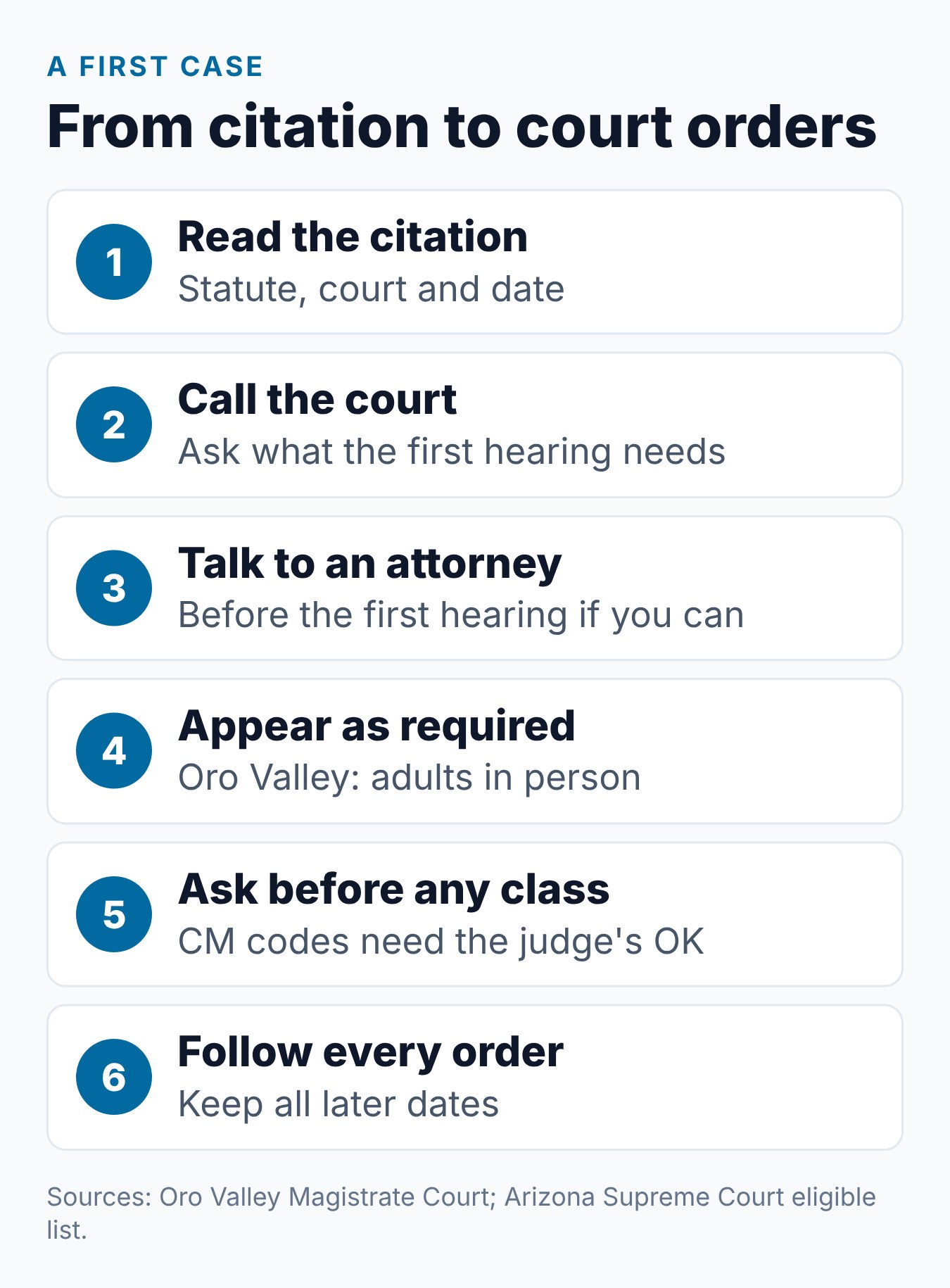
Each court runs its own calendar and sets its own procedures. The Oro Valley Magistrate Court posts its rules online, so we use it here as an example. Your court may differ, so check with the court named on your citation.
Your First Court Date
Oro Valley’s court calls the first hearing the initial appearance. It says adults charged with a criminal traffic offense must appear in person on that date and go before a judge.
Drivers under 18 have a stricter rule there. They must come in person with a parent or legal guardian, whatever the charge.
Can You Handle It by Mail or Online?
At Oro Valley’s court, not for a criminal charge. That court lets adults with a civil ticket pay by mail, in person or online. Its page sets a different rule for criminal charges: appear in person.
Do not assume your court allows payment without a hearing. Read your citation and call the court if you are unsure.
If You Miss the Date
Missing your first court date is a serious problem. Oro Valley’s court says it leads to a warrant for your arrest. It also leads to a suspended driver license.
Put the date on your calendar the day you get the ticket. If you cannot attend, contact the court before the date, not after.
After the First Hearing
What happens next depends on your court and your case. The judge and court staff explain the next steps.
We cannot tell you how your case will turn out. An attorney can explain your choices, including how to contest the charge.
Keep a copy of every paper the court gives you. Write down each new date as soon as you hear it, and keep it in one place.
How This Differs From a Civil Ticket
A civil speeding ticket gives you choices you can handle without a criminal case. At Oro Valley’s court, those choices are paying the fine, asking for a hearing or attending defensive driving school.
A criminal charge does not offer that simple menu. For the full side-by-side, read criminal speeding vs civil speeding Arizona.
Possible Penalties
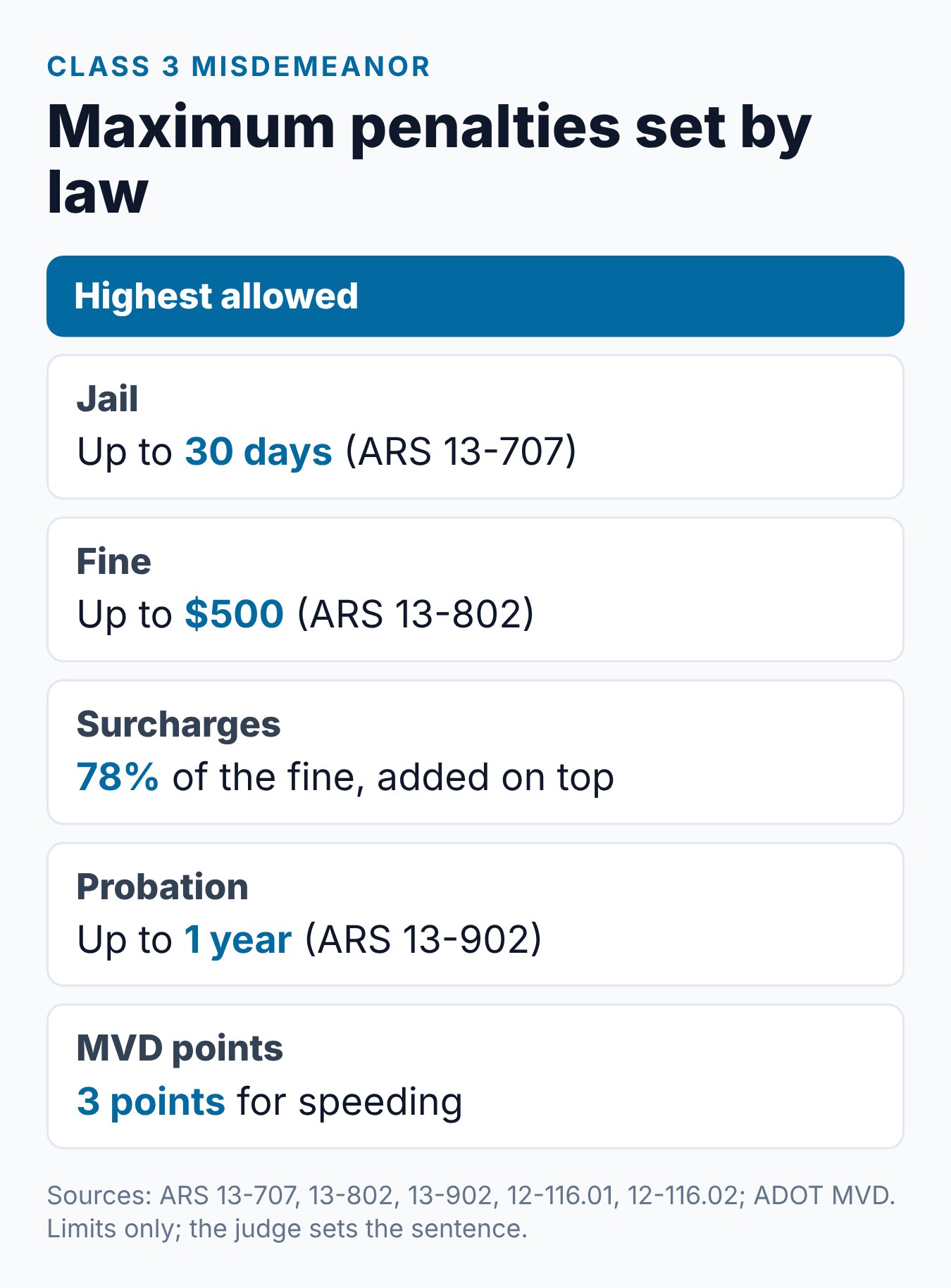
Because criminal speeding is a class 3 misdemeanor, its limits come from Arizona’s criminal code. The law sets these maximums:
- Jail: up to 30 days, under ARS 13-707.
- Fine: up to $500 for a person, under ARS 13-802.
- Surcharges: added on top of the fine, under ARS 12-116.01 and ARS 12-116.02.
- Probation: ARS 13-902 says probation for a class 3 misdemeanor may continue for up to one year, unless it ends sooner.
These numbers are ceilings. The judge sets the actual sentence, and a first case does not come with a fixed result. No article can promise you a lower penalty.
The surcharges are percentages. ARS 12-116.01 adds 42%, 7% and 6%, and ARS 12-116.02 adds 13%. Together that is 78% of the fine.
For worked cost examples, read Arizona speeding ticket cost.
Points on Your MVD Record
ADOT MVD runs the points system, not the court. Its points page lists 3 points for speeding. If several violations come from one stop, only the highest is assessed.
One speeding conviction alone stays below the 8-point level that triggers MVD action. But points from other tickets in the same 12 months count too.
Under R17-4-404, 8 to 12 points in 12 months with no Traffic Survival School in the past 24 months leads to an order to attend TSS. With TSS in those 24 months, it leads to a 3-month suspension.
Checking Your Driving Record
You can see what MVD has on file. ADOT’s Motor Vehicle Records page says eligible drivers can get and print a record online at AZMVDNow.gov.
You can also mail or bring a Motor Vehicle Record Request form. ADOT lists $3 for an uncertified three-year record and $5 for a certified five-year record.
A Note for Drivers Under 18
ADOT’s suspension and TSS page lists drivers under 18 after a first moving violation among those who must attend Traffic Survival School. A teen with a first speeding conviction should watch for mail from MVD.
TSS is not defensive driving school. MVD orders it, and it does not dismiss a ticket.
Defensive Driving School and the CM Code
ARS 28-3392 says a court may allow defensive driving school for criminal speeding. It does not say the court must.
The Arizona Supreme Court’s List of Eligible Violations marks the criminal speeding codes, 28-701.02A1, A2 and A3, as CM. A CM code is eligible only with the express permission of the presiding judge.
If the judge allows it, the regular rules on the Defensive Driving Schools page apply:
- 12 months: you have not attended for an eligible ticket issued in the past 12 months.
- Deadline: you finish at least 7 days before your court date.
- No serious crash: you were not in a serious injury or fatal accident.
- Certified school: the Arizona Supreme Court certifies the schools, not ADOT MVD.
Timing matters if the judge says yes. Say your court date is December 15. You would need to finish the class by December 8.
When you register, the school runs a court database check. You can go to court or attend class, but not both. For how the class works on a speeding ticket, see can defensive driving dismiss an Arizona speeding ticket.
Talking to an Attorney
A criminal charge is worth a conversation with a lawyer, even a first one. An Arizona attorney can read your citation, look at the facts and explain your options in your court.
We do not give legal advice, and we do not predict outcomes. What we can say is that the stakes include a criminal record, possible jail and MVD points. Those are good reasons to get advice that fits your case.
Talk to an attorney before your first court date if you can. That gives you time to ask questions before you stand before the judge.
Questions to Ask the Court
The court clerk’s office is the place for process questions. You might ask questions like these:
- Do I need to appear in person for my first hearing?
- What is my case number and my exact court date and time?
- What should I bring to the first hearing?
- How do I ask the judge about a defensive driving class?
- Which fees apply in this court, on top of any fine?
- How can I pay if the court orders a fine?
Write down the answers, the date you called and the name of the person you spoke with.
Common Mistakes
First-time drivers can make these mistakes because the ticket looks ordinary. Each one comes from the rules above:
- Paying it like a civil ticket. Oro Valley’s court requires adults with criminal traffic charges to appear in person.
- Skipping the first hearing. That court says a missed date brings an arrest warrant and a license suspension.
- Assuming a first offense is lighter. The statute sets the same class 3 misdemeanor for every offense.
- Booking a class without permission. CM codes need the presiding judge’s express permission.
- Ignoring MVD. Points are assessed by ADOT MVD, and drivers under 18 face a TSS rule.
- Waiting to get advice. Talk to an attorney before the first court date if you can.
For the full topic, see the criminal speeding Arizona guide.
How Requirements Can Vary
Arizona’s defensive driving rules are set by state law and the Arizona Supreme Court, but each court handles its own cases. The total cost includes a court diversion fee that each court sets, so the price depends on the court on your ticket.
Extension allowances also differ by court, from 14 to 60 days on the Supreme Court’s list. If a judge orders in-person attendance, you must take a classroom course.
Court fees can change in April and October each year. Check the Arizona Supreme Court Defensive Driving Program and the court on your citation for current rules before you register.
Frequently Asked Questions
Is a first criminal speeding ticket in Arizona a misdemeanor?
Yes. ARS 28-701.02 makes criminal speeding a class 3 misdemeanor. The statute has no separate, lighter class for a first offense.
Do I have to go to court for my first criminal speeding ticket?
Check your citation and your court. Oro Valley’s court, for example, says adults with a criminal traffic charge must appear in person at the initial appearance. Missing it can lead to a warrant.
Can I just pay a criminal speeding ticket online?
Do not assume so. Oro Valley’s court allows online payment for civil tickets, but it requires adults with criminal charges to appear in person. Ask the court on your citation.
Will I go to jail for a first criminal speeding ticket?
The law allows up to 30 days for a class 3 misdemeanor. The judge decides the actual sentence based on the case. No one can promise a result in advance.
How much is the fine for a first criminal speeding ticket?
ARS 13-802 caps the fine at $500 for a person. Surcharges equal to 78% of the fine are added, and courts can add their own fees.
How many points is a first criminal speeding ticket?
ADOT MVD’s points page lists 3 points for speeding. MVD may order TSS or a suspension at 8 or more points in 12 months.
Should I hire a lawyer for a first criminal speeding ticket?
That choice is yours, but it is a criminal charge. An Arizona attorney can review your citation and explain your options in your court. We cannot give legal advice or predict your result.
Can I take defensive driving school for a first criminal speeding ticket?
Only if the presiding judge gives express permission. The court’s eligible list marks criminal speeding codes CM. If allowed, you must finish at least 7 days before your court date.
Conclusion
A first criminal speeding ticket in Arizona starts a misdemeanor case, so read your citation, keep your court date and plan to appear if your court requires it. Talk to an attorney about your facts, and ask the judge before you book any class.
Driving Logic’s Arizona Defensive Driving Course is coming soon. If a judge allows a class, the court’s list at azcourts.gov/drive shows every certified school.
Related Articles
- Criminal Speeding Arizona: What It Is and What to Know
- What Is Considered Criminal Speeding in Arizona? The Speed Thresholds
- Arizona Speeding Ticket Cost: What Affects the Total?
Sources
- Arizona Revised Statutes — ARS 28-701.02 (criminal speeding)
- Oro Valley Magistrate Court — Traffic Tickets
- Arizona Revised Statutes — ARS 13-707 (misdemeanor jail terms)
- Arizona Revised Statutes — ARS 13-802 (misdemeanor fines)
- Arizona Revised Statutes — ARS 12-116.01 (surcharges)
- Arizona Revised Statutes — ARS 12-116.02 (surcharge)
- ADOT MVD — Points Assessment
- Arizona Administrative Code — R17-4-404 (driver points and Traffic Survival School)
- ADOT MVD — Suspension and Traffic Survival School
- ADOT MVD — Motor Vehicle Records
- Arizona Revised Statutes — ARS 28-3392 (eligibility)
- Arizona Supreme Court — List of Eligible Violations
- Arizona Supreme Court — Defensive Driving Schools (eligibility and class search)
- Arizona Revised Statutes — ARS 13-902 (probation periods)
Billy Forte is the owner of Driving Logic, a state-approved driver improvement course provider serving Florida and other U.S. states.
This article is general information, not legal advice. Arizona defensive driving eligibility, deadlines, and fees are set by Arizona law, the Arizona Supreme Court, and each court, and can change. Check the Arizona Supreme Court Defensive Driving Program and the court on your citation for current requirements before you register for a course.