
Updated October 2026 · Reviewed by Billy Forte
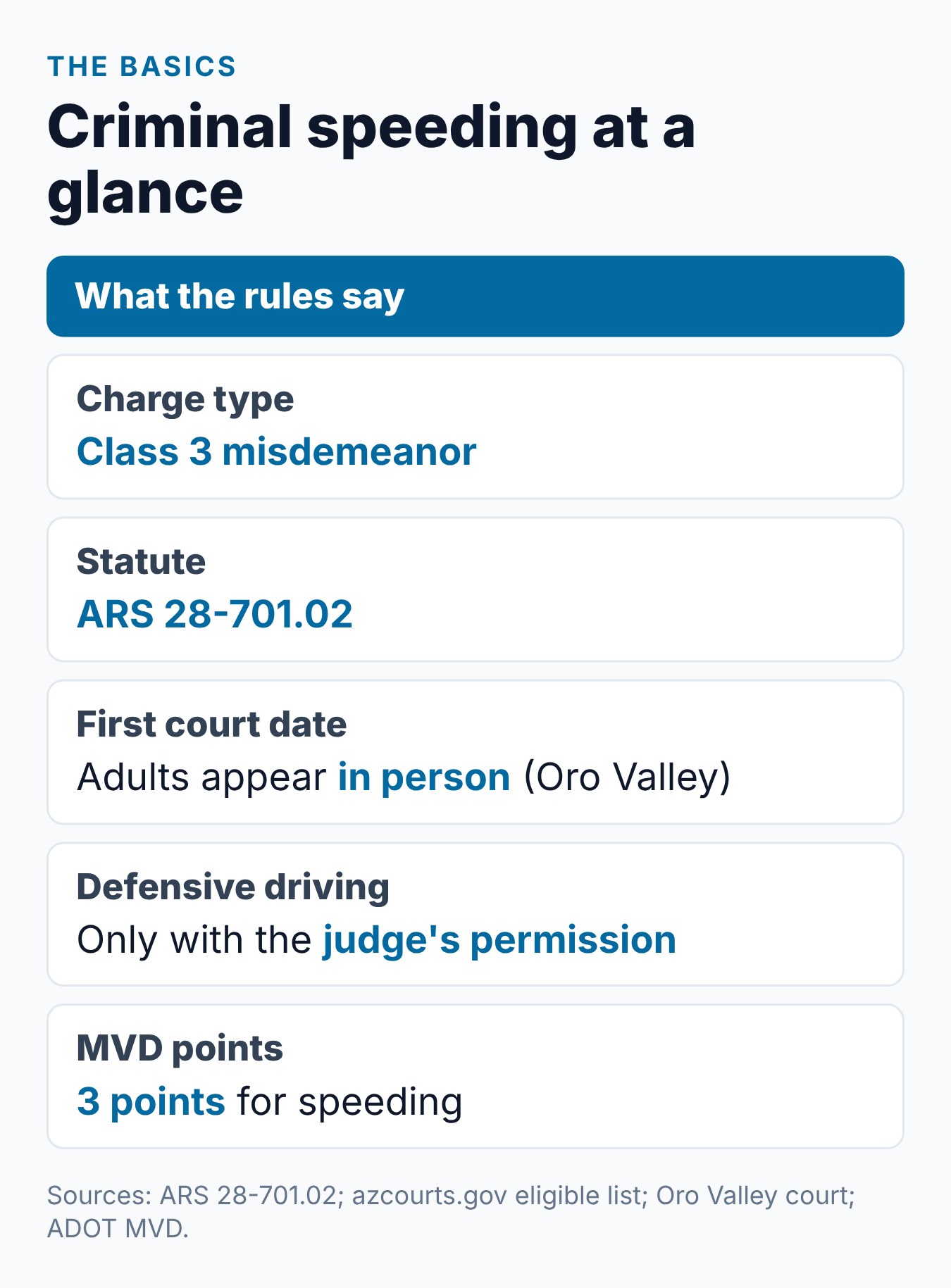
Criminal speeding Arizona law, found in ARS 28-701.02, turns some speeding into a class 3 misdemeanor instead of a civil traffic ticket. It applies when a driver goes more than 20 mph over the posted limit, over 35 mph approaching a school crossing, or over 45 mph in a business or residential district with no posted limit. Because it is a crime, the case can bring a court date, a fine, possible jail and 3 points, so talk to the court or an attorney about your own case.
Key Facts
- What it is: a class 3 misdemeanor under ARS 28-701.02. See how the law works.
- Speed triggers: more than 20 mph over, over 35 mph near a school crossing, or over 45 mph in an unposted district. See the three triggers.
- Maximum penalties: 30 days in jail and a $500 fine are the limits, before surcharges. See possible penalties.
- Points: ADOT MVD assesses 3 points for speeding. See points and your record.
- Defensive driving: allowed only with the presiding judge’s express permission. See defensive driving school.
How Criminal Speeding Arizona Law Works
Arizona sorts moving violations into two groups. The Arizona Judicial Branch Traffic Law page says each one is either civil or criminal.
Its civil example is running a red light. Its criminal examples include DUI, reckless endangerment and driving on a suspended license.
Speeding can land in either group. A regular speeding ticket is a civil matter. Speeding that crosses one of the lines in ARS 28-701.02 is a crime.
The statute is titled “Excessive speeds; classification.” Subsection B says a person who breaks it is guilty of a class 3 misdemeanor.
The two kinds of speeding are kept apart. Subsection C says a driver charged under this section may not also get a civil complaint under ARS 28-701 for the same event. So one stop leads to one type of case, not both.
What a Class 3 Misdemeanor Means
Arizona law has three classes of misdemeanor. ARS 13-707 sets the longest jail term for each one:
- Class 1: six months.
- Class 2: four months.
- Class 3: thirty days.
Class 3 is the lowest of the three. It is still a criminal charge, and a conviction is a criminal conviction.
The Three Speed Triggers
ARS 28-701.02 names three ways speeding becomes a crime. Here they are in plain words:
- Over the posted limit: going more than 20 mph above a posted limit, in a district or anywhere else.
- School crossing: going over 35 mph while approaching a school crossing.
- Unposted district: going over 45 mph in a business or residential district where no limit is posted.
Notice the words “more than.” Going exactly 20 mph over a posted limit does not meet the first trigger. Going 21 mph over does.
The statute lists no other speed trigger. If you read about a different rule on a forum or an old web page, check it against the current text on azleg.gov.
Each trigger has its own details. Our guide to what is considered criminal speeding in Arizona walks through every one with simple math.
How It Differs From a Civil Ticket
A civil ticket and a criminal charge can start with the same traffic stop. After that, they split apart:
- Type of case: civil speeding is a traffic violation. Criminal speeding is a misdemeanor.
- Money: the civil penalty cap under ARS 28-1598 is $250, plus surcharges. The criminal fine cap is $500, plus surcharges.
- Jail: a civil ticket carries no jail term. A class 3 misdemeanor can carry up to 30 days.
- Defensive driving: a court must allow it for an eligible civil ticket. For criminal speeding, the court only may allow it.
There is also a third, smaller category. A driver who goes no more than 10 mph over on certain faster roads may get a “waste of a finite resource” ticket instead. It has a much lower cap.
Our criminal speeding vs civil speeding Arizona guide compares all three side by side.
Possible Penalties
Because criminal speeding is a class 3 misdemeanor, the penalty limits come from Arizona’s criminal code. These are the highest amounts the law allows:
- Jail: a term of no more than 30 days, set by ARS 13-707.
- Fine: at most $500 for an individual, set by ARS 13-802, with surcharges added.
- Probation: as long as one year for this class of crime, under ARS 13-902.
- Points: 3 points on your driving record, under ADOT’s points rules.
These are limits, not a forecast. The judge decides the sentence in each case, based on the facts. No website can tell you what your judge will order.
Surcharges can add a lot. Arizona adds four percentage surcharges to fines for criminal offenses and civil traffic violations. Together they equal 78% of the fine.
For what a first case can look like in court, see first criminal speeding ticket Arizona.
What Happens After the Ticket
A criminal case runs on the court’s schedule. Your citation names the court and the date you must appear.
Court rules differ, so one court’s page is a useful example. The Oro Valley Magistrate Court says adults charged with a criminal traffic offense must appear in person on the initial appearance date. They go before a judge.
That court also warns what happens if you miss that date. A warrant is issued for your arrest, and your driver license is suspended. Drivers under 18 must come in person with a parent or legal guardian.
Your court may set different rules. Call the court on your citation if anything is unclear. Do not assume you can pay online and be done.
Can Defensive Driving School Help?
Maybe, but only if the judge says yes. ARS 28-3392 requires courts to allow the class for an eligible civil moving violation. For criminal speeding under 28-701.02, the statute leaves the choice to the court.
The Arizona Supreme Court’s List of Eligible Violations shows this too. Codes 28-701.02A1, A2 and A3 are marked CM. CM codes are eligible only with the express permission of the presiding judge.
If the judge allows it, the usual program rules still apply:
- 12-month rule: one dismissal per 12 months, measured from one violation date to the next.
- Deadline: finish at least 7 days before your court date.
- Serious crashes: not allowed if the violation caused death or serious physical injury.
- Commercial vehicles: a CDL holder driving a commercial motor vehicle is not eligible for dismissal.
The Arizona Supreme Court certifies the schools, not ADOT MVD. For how the class works on a regular speeding ticket, read can defensive driving dismiss an Arizona speeding ticket. The Arizona defensive driving school guide covers the whole program.
Points and Your Driving Record
ADOT MVD keeps your driving record and assigns points. Its points page lists 3 points for speeding. If one stop leads to more than one violation, only the highest is assessed.
Points add up over time. Reaching 8 points within 12 months lets MVD order Traffic Survival School or a suspension of up to 12 months.
Traffic Survival School is a different program. It is ordered by MVD and cannot dismiss a ticket. Our guide to defensive driving vs Traffic Survival School explains the gap.
Speed Limits Set the Line
Every criminal speeding trigger depends on a limit. One trigger counts up from the posted sign. The other two, 35 and 45 mph, are fixed numbers in the statute itself.
Arizona also has a general rule. You must never drive faster than is reasonable and prudent for the conditions, even below the sign.
To learn how posted and default limits work, see Arizona speed limits.
What a Ticket Can Cost
The money side has more parts than the fine. Courts add surcharges, and each court can add its own fees.
A criminal case can also cost you time off work for court. For the full math on civil and criminal tickets, read Arizona speeding ticket cost.
Your Options After a Criminal Speeding Ticket
Nothing here is legal advice. These are sensible first steps for any criminal traffic charge:
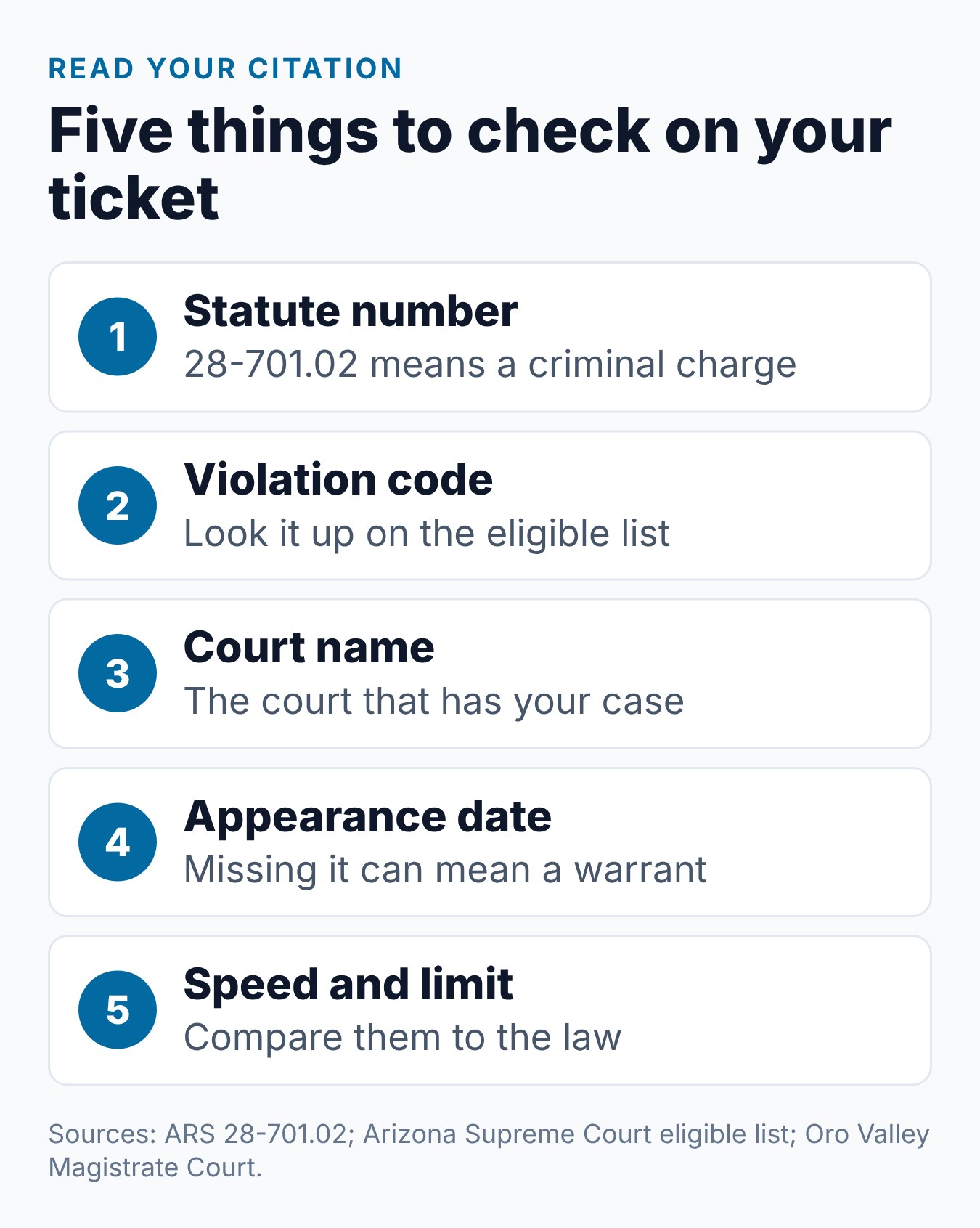
- Read the citation closely. Look for the statute number, the court name and the appearance date.
- Contact the court. Ask whether you must appear in person and what to bring.
- Talk to an Arizona attorney. A lawyer can review your facts and explain how to contest the charge.
- Ask about defensive driving. Only the presiding judge can allow it for a CM code.
- Keep every date. Missing an appearance can lead to a warrant and a suspended license.
Guides in This Series
Each guide below covers one part of the topic in depth:
- What Is Considered Criminal Speeding in Arizona. It explains each threshold in ARS 28-701.02. It also shows how to check your own speed against the law.
- First Criminal Speeding Ticket Arizona. It covers the misdemeanor process for a first case. Topics include court appearances, maximum penalties and when to call a lawyer.
- Criminal Speeding vs Civil Speeding Arizona. It compares civil, criminal and waste of a finite resource tickets in one table.
- Arizona Speeding Ticket Cost. It breaks down penalty caps, surcharges and court fees. It includes worked examples.
- Arizona Speed Limits. It explains the reasonable and prudent rule, default limits and interstate limits.
Common Mistakes
These mistakes come from the rules covered above. Each one can make a criminal case harder:
- Treating it like a civil ticket. At Oro Valley’s court, adults with a criminal traffic charge must appear in person.
- Missing the first court date. That court says a missed date leads to an arrest warrant and a license suspension.
- Signing up for a class without permission. A CM code needs the presiding judge’s express permission first.
- Reading too much into the speed in the code. The eligible list says that number is not used to decide eligibility.
- Mixing up DDC and TSS. Traffic Survival School is an MVD program and does not dismiss a ticket.
- Finishing an allowed class too late. The class must be done at least 7 days before court.
How Requirements Can Vary
Arizona’s defensive driving rules are set by state law and the Arizona Supreme Court, but each court handles its own cases. The total cost includes a court diversion fee that each court sets, so the price depends on the court on your ticket.
Extension allowances also differ by court, from 14 to 60 days on the Supreme Court’s list. If a judge orders in-person attendance, you must take a classroom course.
Court fees can change in April and October each year. Check the Arizona Supreme Court Defensive Driving Program and the court on your citation for current rules before you register.
Frequently Asked Questions
What is criminal speeding in Arizona?
It is speeding that breaks ARS 28-701.02. It covers three cases: topping a posted limit by more than 20 mph, passing 35 mph near a school crossing, or passing 45 mph on an unposted district street. Each is a class 3 misdemeanor.
Is criminal speeding a felony in Arizona?
No. ARS 28-701.02 makes it a class 3 misdemeanor. That is still a crime, so it is more serious than a civil ticket.
Can you go to jail for criminal speeding in Arizona?
The law allows it. ARS 13-707 sets a limit of 30 days in jail for a class 3 misdemeanor. The judge decides the actual sentence.
How many points is criminal speeding in Arizona?
ADOT MVD’s points page lists 3 points for speeding. If one stop leads to several violations, only the highest is assessed.
Can I take defensive driving school for criminal speeding?
Only with the presiding judge’s express permission. The eligible list marks criminal speeding codes as CM. Ask the court before you pay for a class.
Do I have to go to court for criminal speeding?
Check your citation and your court’s rules. Oro Valley’s court, for example, says adults charged with a criminal traffic offense must appear in person. Missing that date can lead to a warrant.
Should I talk to a lawyer?
It is a good idea for any criminal charge. This article cannot give legal advice. An Arizona attorney can review your facts and your options.
Conclusion
Criminal speeding in Arizona is a class 3 misdemeanor, so treat the citation as a court case and not a simple fine. Read the guides in this series, call the court on your citation and talk to an attorney about your own facts.
Driving Logic’s Arizona Defensive Driving Course is coming soon. Should a judge permit a class, find a certified school on the court’s list at azcourts.gov/drive.
Related Articles
- What Is Considered Criminal Speeding in Arizona? The Speed Thresholds
- First Criminal Speeding Ticket Arizona: What to Expect
- Criminal Speeding vs Civil Speeding Arizona: Key Differences
- Arizona Speeding Ticket Cost: What Affects the Total?
- Arizona Speed Limits: What Drivers Need to Know
Sources
- Arizona Revised Statutes — ARS 28-701.02 (criminal speeding)
- Arizona Judicial Branch — Traffic Law self-service page
- Arizona Revised Statutes — ARS 13-707 (misdemeanor jail terms)
- Arizona Revised Statutes — ARS 13-802 (misdemeanor fines)
- ADOT MVD — Points Assessment
- Oro Valley Magistrate Court — Traffic Tickets
- Arizona Revised Statutes — ARS 28-3392 (eligibility)
- Arizona Supreme Court — List of Eligible Violations
- Arizona Supreme Court — Defensive Driving Schools (eligibility and class search)
- Arizona Supreme Court — Defensive Driving Frequently Asked Questions
- Arizona Revised Statutes — ARS 28-1598 (civil traffic penalty)
- Arizona Revised Statutes — ARS 13-902 (probation periods)
Billy Forte is the owner of Driving Logic, a state-approved driver improvement course provider serving Florida and other U.S. states.
This article is general information, not legal advice. Arizona defensive driving eligibility, deadlines, and fees are set by Arizona law, the Arizona Supreme Court, and each court, and can change. Check the Arizona Supreme Court Defensive Driving Program and the court on your citation for current requirements before you register for a course.