
Updated October 2026 · Reviewed by Billy Forte
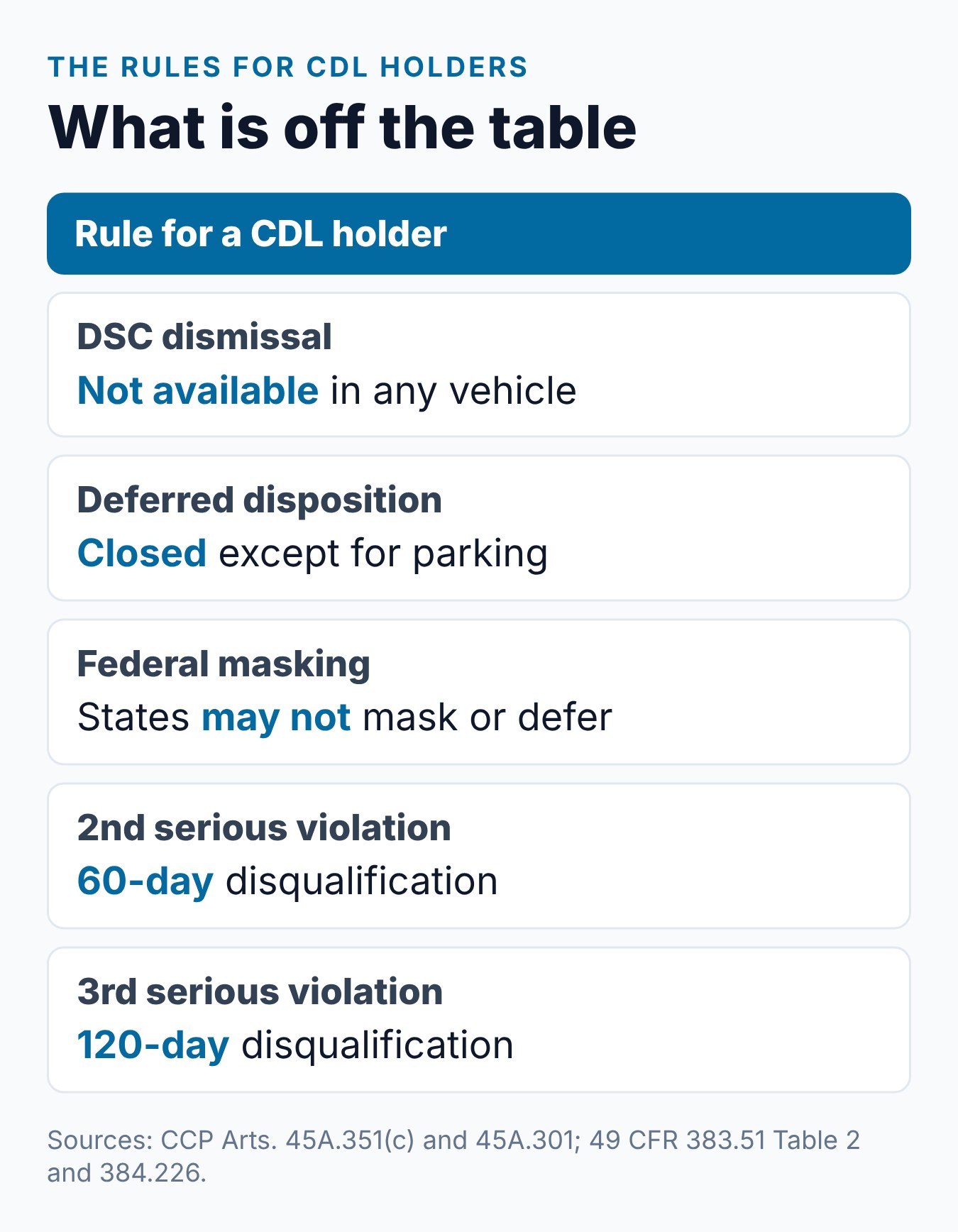
Texas CDL defensive driving is not a path to ticket dismissal: Texas law says the driving safety course process does not apply to anyone who holds a commercial driver license (CDL), or held one when the offense happened. The rule covers every vehicle, including your own car, and deferred disposition is also closed to CDL holders for traffic offenses other than parking.
Key Facts
- The rule: Art. 45A.351(c) excludes anyone who holds a CDL or held one at the offense. See the statute.
- Any vehicle: the exclusion does not depend on what you were driving. See car or truck.
- Deferred disposition: closed to CDL holders for traffic violations other than parking. See deferred disposition.
- Federal rule: states may not mask or defer a CDL holder’s traffic conviction in any type of motor vehicle. See the masking ban.
- What is left: you can still contest the ticket or talk to a lawyer. See your options.
The Texas CDL Defensive Driving Rule in the Statute
The driving safety course (DSC) rules are in Code of Criminal Procedure Chapter 45A. Art. 45A.351(c) sets the limit in plain words. The subchapter “does not apply to an offense committed by a person who” holds a CDL or held one when the offense was committed.
That sentence removes the whole process. It is not a smaller version of the right or a matter for the judge to weigh. For a CDL holder, the DSC dismissal rules simply do not apply.
Holds or Held: Two Triggers
The statute names two cases. Either one is enough to exclude you:
- You hold a CDL. Your commercial license is current.
- You held a CDL on the offense date. This applies even if your CDL status changed after the ticket.
So the question is not only what license you carry now. It is also what license you had on the day of the offense.
A Personal Car or a Truck
The exclusion turns on the driver, not the vehicle. Nothing in Art. 45A.351(c) limits it to a commercial motor vehicle.
A CDL holder who gets a speeding ticket in a family car is excluded the same way as one driving a truck. Older pages that limit the rule to commercial-vehicle tickets are wrong.
Age Does Not Change It
Drivers under 25 get a wider rule for moving violations under Art. 45A.351(b). That wider rule does not lift the CDL exclusion. The two rules sit side by side, and the exclusion wins.
What About a Commercial Learner Permit?
The federal masking ban names commercial learner permit (CLP) holders along with CDL holders. Art. 45A.351(c) names the commercial driver license.
We did not find an official Texas source on how courts treat a CLP holder under that article. If you hold a CLP, ask the court or a lawyer before you request the course.
No Room for Judge Discretion
Other drivers who miss a condition can sometimes ask the judge for the course anyway. Art. 45A.352(c) lets a court grant a late or repeat request before the case is closed.
That room exists only “under this subchapter.” Because the subchapter does not apply to CDL holders at all, that discretion does not open the course to them.
Deferred Disposition Is Closed Too
Deferred disposition is another way a Texas traffic case can end in dismissal. It is also limited for CDL holders.
Art. 45A.301 lists who cannot use deferred disposition. One group is a person who holds a CDL, or held one at the time of the offense.
For that person, it does not apply to a violation of a motor vehicle control law. A parking violation is the one exception named.
Our deferred disposition guide explains how that process works for other drivers.
The Federal Masking Ban
The Texas rule lines up with a federal one. 49 CFR 384.226 is titled “Prohibition on masking convictions.”
It says a state “must not mask, defer imposition of judgment, or allow an individual to enter into a diversion program” for these drivers. The goal is to keep a CDL or learner permit holder’s traffic conviction on their record.
That record sits in the national CDL system, called CDLIS. It applies to violations in any type of motor vehicle.
The federal rule names three exceptions: parking, vehicle weight and vehicle defect violations. Ask a lawyer how those exceptions fit your ticket.
Federal Penalties in Brief
Convictions matter more for CDL holders because of federal disqualification rules. Under 49 CFR 383.51, serious traffic violations add up.
- Two in three years: a second conviction in a separate incident within three years means a 60-day disqualification.
- Three in three years: a third or later conviction means 120 days.
Serious traffic violations include speeding 15 mph or more over the limit, reckless driving, improper or erratic lane changes, and following too closely. In a personal vehicle, these count only in one case. The conviction must lead to a suspension, revocation or cancellation of your license or driving privileges.
Our guide to the Texas CDL speeding ticket covers the federal rules in detail.
What a CDL Holder Can Still Do
Losing the DSC route does not leave you without choices. Texas law allows three pleas: guilty, not guilty and nolo contendere (no contest).
- Talk to a lawyer first. A Texas traffic lawyer can review your citation before you enter any plea.
- Contest the ticket. A plea of not guilty leads to a trial in the justice or municipal court.
- Ask the court about your options. Call before the answer date on your citation.
Paying a ticket is a plea of guilty or no contest, and it ends in a conviction. For a CDL holder, that conviction can count toward federal disqualification, so think before you pay.
Taking a Course for Other Reasons
TDLR says “anyone can take a driving safety course.” A CDL holder can still take one, for example to learn or to ask an insurer about a discount.
The Texas Department of Insurance lists a defensive driving course as a possible discount and says each company decides the amount. The course just cannot be used to dismiss a ticket under Chapter 45A.
What Happens to a Conviction
A conviction follows the same path for a CDL holder as for any driver. Nothing about the CDL slows it down or keeps it off the record. Transportation Code Chapter 543 says the court reports a traffic conviction to DPS no later than the seventh day after it.
Texas also has its own suspension rule for any driver. DPS must suspend the license of a “habitual violator.” Under Transportation Code § 521.292, that means four or more moving-violation convictions in 12 months in a row. Seven or more in 24 months also counts.
The Texas Department of Insurance also says “insurance companies will charge you more if you’ve had accidents or gotten tickets.” For a CDL holder, a conviction can carry both state and federal effects.
Respond by the Answer Date Anyway
The answer date on your citation still matters, even without the DSC. It is the date the court expects your response.
If the citation requires you to appear in court, you must follow it. Plan your call to a lawyer early, so you have time to decide on a plea before that date.
Questions to Ask a Lawyer
A short consult goes further with a list ready. Consider asking:
- Does this offense count as a serious traffic violation under federal rules?
- How would a conviction affect my CDL, given my record for the past three years?
- What happens if I plead not guilty and go to trial?
- Are there any options the court offers that fit my case?
Bring your citation, your license and any past court papers to the meeting.
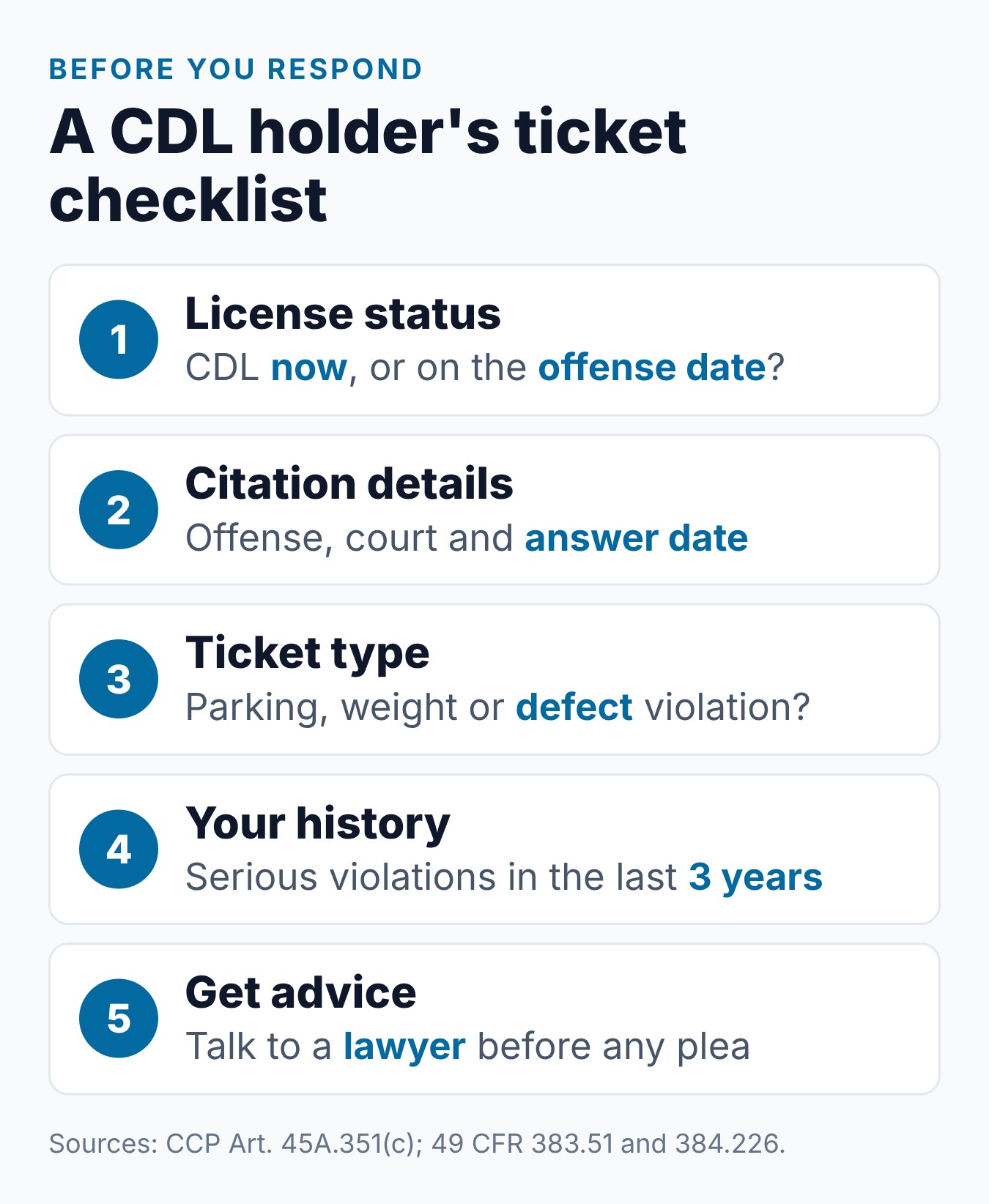
How to Check Where You Stand
Use this short list before you respond to a ticket:
- Check whether you hold a CDL now, and whether you held one on the offense date.
- Read the citation for the offense, the court and the answer date.
- Note whether the ticket is a parking, weight or defect violation.
- Count any serious traffic violation convictions in the past three years.
- Call a Texas traffic lawyer before you pay or plead.
What We Found in the Federal Rules
On the eCFR pages we checked on October 26, 2026, 49 CFR 384.226 was titled “Prohibition on masking convictions.” It covered violations “in any type of motor vehicle” and excepted parking, vehicle weight and vehicle defect violations.
Table 2 of 49 CFR 383.51 listed ten serious traffic violations. Five of them, such as texting while driving, applied only to driving a commercial motor vehicle.
Common Mistakes to Avoid
Each of these conflicts with Art. 45A.351(c), Art. 45A.301 or 49 CFR 384.226:
- Thinking the rule covers only truck tickets. It covers any vehicle.
- Thinking a lapsed CDL clears you. Holding a CDL on the offense date is enough to exclude you.
- Enrolling in a course to dismiss the ticket. The DSC dismissal rules do not apply to CDL holders.
- Counting on deferred disposition. It is closed for traffic violations other than parking.
- Paying without advice. Payment is a plea that leads to a conviction.
For how dismissal works for other drivers, see our ticket dismissal guide.
How Requirements Can Vary
The driving safety course rules come from Texas law and TDLR and apply statewide. Each justice or municipal court still sets its own fees, filing steps and contact methods, and the facts of your citation decide which options you have.
Laws, fees and court procedures can change. Check your citation, ask the court that handles your case, and use the TDLR and Texas DPS websites for current rules before you act.
Frequently Asked Questions
Can a CDL holder take defensive driving in Texas?
Anyone can take the course, TDLR says. A CDL holder just cannot use it to have a ticket dismissed under Chapter 45A.
Does the rule apply if I was in my own car?
Yes. Texas law excludes anyone who holds or held a CDL, no matter what vehicle they were driving.
Can a CDL holder get deferred disposition?
Not for a traffic violation other than parking. Art. 45A.301 closes deferred disposition to CDL holders for those offenses.
What if I let my CDL lapse after the ticket?
The law also excludes anyone who held a CDL when the offense was committed. A change after the ticket does not reopen the course.
Will one speeding ticket disqualify my CDL?
Federal disqualification for serious traffic violations starts at a second conviction within three years. One conviction still counts toward that total, so get advice first.
Can the judge make an exception for a CDL holder?
The judge’s power to grant a late or repeat request applies only under the DSC subchapter. Since that subchapter does not apply to CDL holders, it does not open the course to them.
Does the rule cover a commercial learner permit?
The federal masking ban covers CLP holders. We found no official Texas source on how Art. 45A.351(c) treats a CLP, so ask the court or a lawyer.
Should a CDL holder just pay the ticket?
Paying is a plea of guilty or no contest and leads to a conviction. Talk to a Texas traffic lawyer before you decide.
Conclusion
Texas law shuts CDL holders out of DSC dismissal in any vehicle, and deferred disposition is closed for traffic offenses other than parking. Federal rules back this up by barring states from masking a CDL holder’s conviction.
Before you pay or plead, talk to a lawyer about your choices. For drivers who do qualify, there is Driving Logic’s online Texas driving safety course.
Related Articles
- Texas Defensive Driving for Ticket Dismissal: The Complete Guide
- Texas Speeding Ticket for CDL Holders: Federal Rules and Higher Stakes
- What Texas Traffic Violations Qualify for Defensive Driving Dismissal?
- What Is Deferred Disposition in Texas? How It Compares to Defensive Driving
Sources
- Texas Code of Criminal Procedure Chapter 45A (PDF)
- 49 CFR § 384.226 — Prohibition on masking convictions
- 49 CFR § 383.51 — CDL disqualification
- TDLR — Taking a Driving Safety Course
- Texas Department of Insurance — Auto insurance guide
Billy Forte is the owner of Driving Logic, a state-approved driver improvement course provider serving Texas and other U.S. states.
This article is general information, not legal advice. Texas traffic and driving safety course rules are set by Texas law, TDLR, Texas DPS and each court, and they can change. Check with the court on your citation and the official TDLR and DPS websites for current requirements, and talk to a Texas lawyer about your specific case.