
Updated October 2026 · Reviewed by Billy Forte
A Texas defensive driving course for ticket dismissal works in a set order: you ask the court for the course on or before the answer date on your citation, finish a TDLR-approved course, and turn in your papers within 90 days. When every step is done, the court dismisses the charge. The rules come from the Code of Criminal Procedure, Chapter 45A, and they apply in justice and municipal courts across Texas.
Key Facts
- The law: Code of Criminal Procedure Arts. 45A.351 to 45A.359, in effect since Jan. 1, 2025. See how it works.
- The request: a guilty or no contest plea plus a course request, due on or before the answer date. See the six steps.
- The clock: 90 days after the plea to finish the course and file three papers. See the two deadlines.
- The fee: court costs, plus a court fee of up to $10 for each eligible charge. See what you pay.
- The result: a dismissed charge may not be part of your driving record. See what dismissal means.
How a Texas Defensive Driving Course for Ticket Dismissal Works
Texas calls this course a driving safety course, or DSC. People also call it defensive driving. It is the same course either way, and the Texas Department of Licensing and Regulation (TDLR) approves it.
The dismissal rules sit in Code of Criminal Procedure Chapter 45A, Arts. 45A.351 to 45A.359. That chapter replaced the old Chapter 45 on Jan. 1, 2025. Older pages may still cite a repealed article number.
The key word in the law is “shall.” If you meet every condition in Art. 45A.352(a), the judge must require the course and then dismiss the charge when you finish. That makes it a right, not a favor.
Which Courts and Offenses It Covers
The process covers driving offenses under the Texas rules of the road in justice and municipal courts. Drivers under 25 can use it for any moving violation. Our guide to eligible violations lists every exclusion.
Who Has the Right to Dismissal
The right comes with conditions. All of them must be true:
- You ask for it. You elect the course in time.
- You hold a Texas license or permit. Active-duty U.S. military members, their spouses and their dependent children also qualify.
- No recent course. You did not complete an approved course in the 12 months before the offense date.
- You show insurance. You give the court proof of financial responsibility.
- Not too fast. The charge is not speeding 25 mph or more over the limit, or 95 mph or more.
Some people and offenses are left out entirely. Anyone who holds a commercial driver license (CDL), or held one when the offense happened, cannot use the process in any vehicle. See our CDL guide for details.
Drivers with another state’s license are not covered by the right either. Our out-of-state driver guide explains what those drivers can ask the court about.
The Six Steps from Ticket to Dismissal
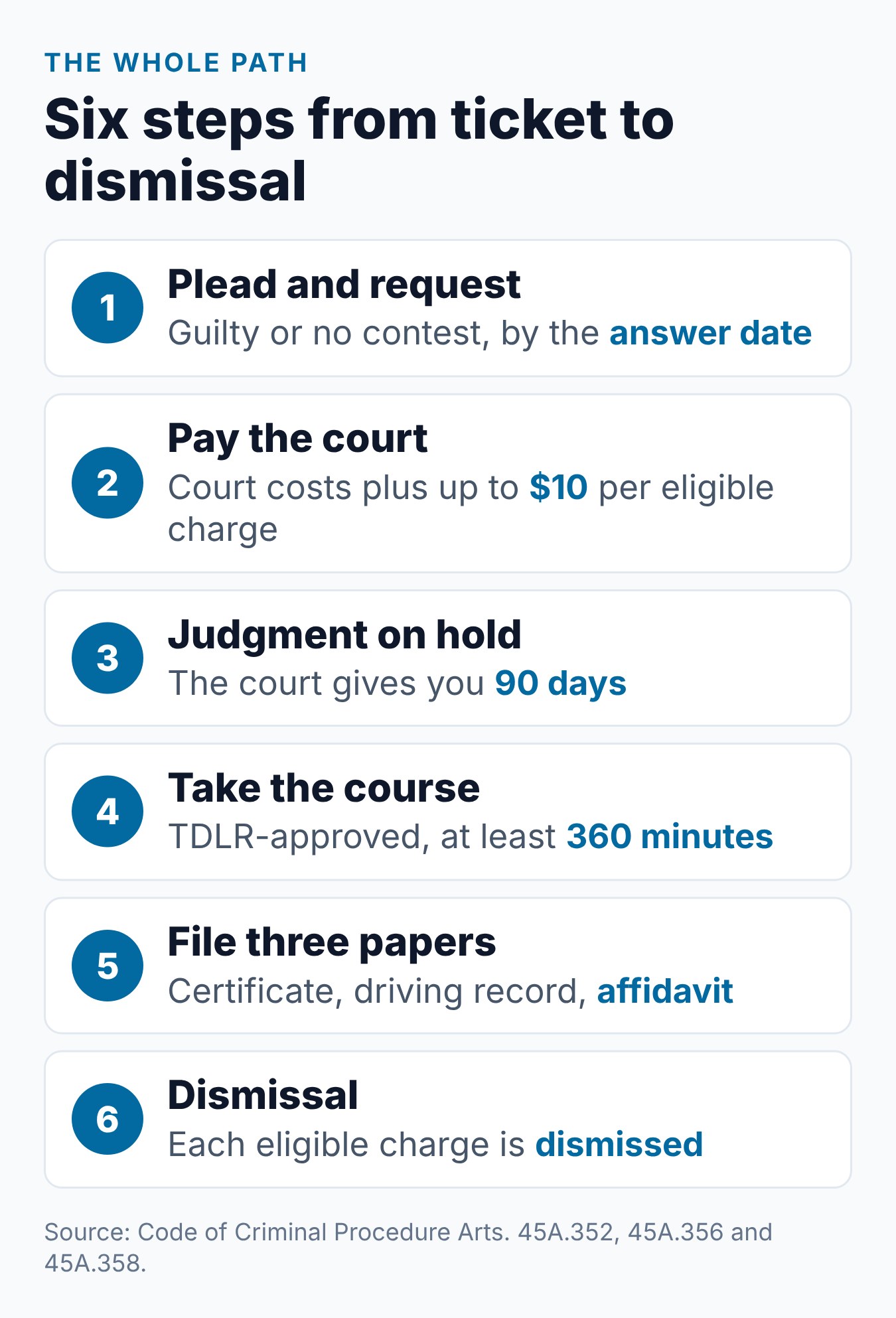
Here is the whole path in order:
- Plead and ask by the answer date. Enter a plea of guilty or no contest (nolo contendere) and request the course. Do it on or before the answer date on the citation.
- Pay what the court charges. That means court costs, plus a fee of up to $10 for each eligible charge if the court sets one.
- Get your 90 days. The court enters judgment but puts it on hold for 90 days.
- Take the course. Finish a TDLR-approved course of at least 360 minutes.
- File three papers. Within the 90 days, turn in the certificate, your driving record and a signed affidavit.
- Get the dismissal. The court removes the judgment and dismisses each eligible charge.
There are four ways to send the request in step 1. You can go in person, use a lawyer, or mail it by certified mail, return receipt requested, postmarked by the answer date. If the court allows it, you can also use the court’s e-mail address or online portal.
Our court request guide covers each method and what to have ready.
The Two Deadlines
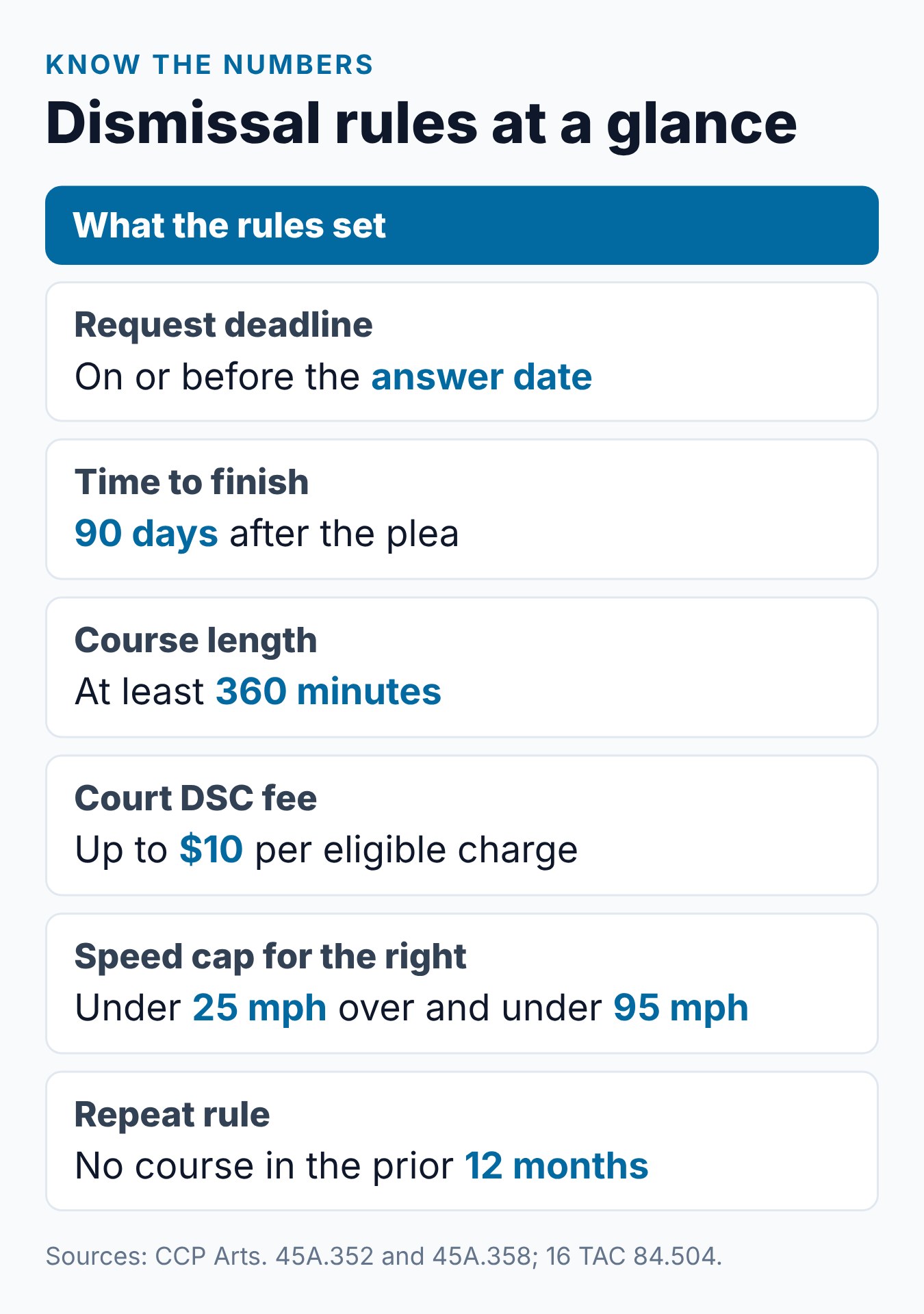
The first date is the answer date on your citation, which is the last day to make the request as a right.
The second is the 90-day window that starts with your plea. In that window you finish the course and turn in every paper. Our deadline guide explains both dates and what happens with a late request.
If the 90 days run out, the court must send you a written notice. You then appear and show cause. Our guide on a missed defensive driving deadline covers that hearing.
What You Pay
Three costs come up in a DSC case. The amounts below come from state law and DPS.
- The course: Education Code Chapter 1001 says a provider must charge each student at least $25. The old $3 fee was repealed on Sept. 1, 2025.
- The court: court costs, plus a reimbursement fee of not more than $10 for each eligible charge.
- The record: DPS charges $10 for the Type 3A driving record.
The court fee is not refunded if you request the course and then skip it. Our cost guide breaks these numbers down.
What You Turn In
Art. 45A.356 lists three papers for the court. All three are due within the 90 days.
- The certificate. This is the uniform certificate of course completion. TDLR says it should reach you within 14 days of finishing.
- Your driving record. It shows no approved course in the 12 months before the offense. Some judges get it from DPS themselves and charge a fee instead.
- An affidavit. This sworn statement says you were not taking a course when you asked, and you finished none in the prior 12 months that is missing from the record.
DPS says on its driver record FAQ that “most courts generally require a Type 3A driver record.” DPS also says to contact the court to confirm the type it needs. Type 3A is the certified list of all your crashes and violations, ordered from the DPS driver record page.
Our Type 3A guide explains how to order it. For the certificate itself, see our certificate guide.
Several Charges from One Stop
A change in 2025 helps drivers with more than one charge. SB 296 took effect on Sept. 1, 2025. It removed the old rule that one course could dismiss only one charge.
Now, if your charges come from the same criminal transaction, one course can dismiss each of them. Each charge must qualify on its own, and you must meet the other rules. The court may charge its fee of up to $10 for each eligible charge.
The change covers course requests made on or after Sept. 1, 2025, even for older offenses. TDLR posted a notice on SB 296 that says the same thing.
What Dismissal Means for Your Record
Under Art. 45A.357, a charge dismissed this way “may not be part of a person’s driving record or used for any purpose.” An insurer may not cancel your policy or raise your premium because you took the course or had the charge dismissed.
The court does report one thing to DPS: that you completed a course, and the date. Your record can show the fact of a course, but not the reason.
Paying a ticket is different. A plea of guilty or no contest without the course leads to a conviction. Transportation Code Chapter 543 says courts report convictions to DPS within seven days. Our guide on whether defensive driving keeps a ticket off your record compares the two outcomes.
When the Right Does Not Apply
Art. 45A.352(c) lets the court grant a course request before the case is finally decided. That covers a late request, or a course taken within the past 12 months.
This is up to the judge, and it does not override the Texas license condition.
Another option is deferred disposition. There, the judge may put the case on hold for up to 180 days and set conditions. Our guide to deferred disposition compares it with the DSC.
Who Does What
| Party | Its role in a DSC dismissal |
|---|---|
| Justice or municipal court | Takes the plea, grants the course and dismisses the charge |
| TDLR | Licenses providers and approves the course |
| Course provider | Teaches the course and sends the uniform certificate |
| Texas DPS | Keeps driving records and sells the Type 3A record |
TDLR says it cannot recommend a provider. You can check any provider’s license with the TDLR provider search.
What We Found on the TDLR Pages
On the TDLR student page we checked on October 26, 2026, TDLR said that “anyone can take a driving safety course.” The page said a driver should “first receive notice from the Texas court system” that they are eligible before using the course for a ticket.
The same page said the student is responsible for sending the certificate to the court. It also said the driver is still “responsible for paying any fines and fees related to the ticket.” The length rule matched 16 TAC 84.504: at least 360 minutes, with at least 300 minutes of instruction.
Common Mistakes to Avoid
Each item below breaks a rule in Chapter 45A or a TDLR rule:
- Waiting past the answer date. After that date, the course becomes the judge’s choice.
- Skipping the plea. The request goes with a plea of guilty or no contest.
- Using an unlicensed course. The law accepts only a course approved by TDLR.
- Forgetting the affidavit. The court needs it along with the certificate and record.
- Ordering the wrong record. DPS says Type 2A “cannot be used” for a defensive driving course.
- Letting the 90 days lapse. A missed deadline leads to a show-cause hearing.
Ticket Dismissal Guides in This Series
Each guide below goes deeper on one part of the process:
- How to request defensive driving from the court: the four ways to ask.
- Eligible violations: which offenses qualify.
- The defensive driving deadline: the answer date and the 90 days.
- Dismissal and your record: what reaches DPS.
- CDL holders: why commercial drivers are excluded.
- A missed deadline: notice and show cause.
- Deferred disposition: the other dismissal path.
- Out-of-state drivers: who has the right by license.
How Requirements Can Vary
The driving safety course rules come from Texas law and TDLR and apply statewide. Each justice or municipal court still sets its own fees, filing steps and contact methods, and the facts of your citation decide which options you have.
Laws, fees and court procedures can change. Check your citation, ask the court that handles your case, and use the TDLR and Texas DPS websites for current rules before you act.
Frequently Asked Questions
Can a Texas court say no if I qualify?
No. If you meet every condition in Art. 45A.352(a), the judge must require the course. Courts have a choice only when a condition is missing, such as a late request.
Do I plead guilty to get defensive driving?
The law requires a plea of guilty or no contest along with the request. This is a legal choice, so ask the court or a lawyer if you are unsure which plea fits your case.
How long do I have to finish the course?
You have 90 days after the plea to finish the course and turn in your papers. The court may allow more time only if you show good cause.
Can one course dismiss two tickets from the same stop?
Yes, for requests made on or after Sept. 1, 2025. Each charge must qualify on its own, and the court may charge its fee for each one.
Does the course remove the ticket from my record?
A dismissed charge may not be part of your driving record. DPS records only that you completed a course and the date, not why you took it.
Conclusion
Ticket dismissal in Texas follows a clear path: plead and ask by the answer date, take an approved course, and file three papers within 90 days. If you meet every condition, the judge must allow it, and the dismissed charge stays off your driving record.
Check with your court early so no deadline slips. When you are ready, you can take Driving Logic’s online Texas driving safety course.
Related Articles
- Texas Defensive Driving Court Request: Step by Step
- What Texas Traffic Violations Qualify for Defensive Driving Dismissal?
- Texas Defensive Driving Deadline: Request Before the Appearance Date
- Does Texas Defensive Driving Dismiss a Ticket or Keep It Off Your Record?
- Texas CDL Holders and the Driver Safety Course: Why Commercial Drivers Can’t Use It
- What Happens If You Miss the Texas Defensive Driving Completion Deadline?
- What Is Deferred Disposition in Texas? How It Compares to Defensive Driving
- Texas Defensive Driving for Out-of-State Drivers: What You Need to Know
Sources
- Texas Code of Criminal Procedure Chapter 45A (PDF)
- Texas SB 296 (2025), enrolled bill (PDF)
- TDLR — SB 296: one driving safety course for multiple charges
- TDLR — Taking a Driving Safety Course
- TDLR — Driving Safety Provider Search
- 16 Tex. Admin. Code § 84.504 — Driving safety course length
- Texas Education Code Chapter 1001 — Driver and Traffic Safety Education (PDF)
- Texas DPS — How to Order Your Driver Record
- Texas DPS — Driver Record FAQ
- Texas Transportation Code Chapter 543 — Arrest and Prosecution of Violators (PDF)
Billy Forte is the owner of Driving Logic, a state-approved driver improvement course provider serving Texas and other U.S. states.
This article is general information, not legal advice. Texas traffic and driving safety course rules are set by Texas law, TDLR, Texas DPS and each court, and they can change. Check with the court on your citation and the official TDLR and DPS websites for current requirements, and talk to a Texas lawyer about your specific case.