
Updated October 2026 · Reviewed by Billy Forte
The Texas defensive driving deadline is really two deadlines: you must plead and ask for the course on or before the answer date on your citation, and you then have 90 days after the plea to finish the course and turn in your papers. Missing the first date ends your right to the course, though the court may still allow it. Missing the second leads to a show-cause hearing, so it pays to plan both from day one.
Key Facts
- Deadline one: the plea and course request are due on or before the answer date. See the answer date.
- Deadline two: 90 days after the plea to finish the course and file three papers. See the 90 days.
- Late request: the court may still grant it before the case is decided, but it does not have to. See a missed answer date.
- Missing notice: if the citation lacked the required notice, the right continues. See the notice rule.
- More time: the court may extend the 90 days only for good cause. See extensions.
The Two Texas Defensive Driving Deadlines at a Glance
Both dates come from Code of Criminal Procedure Chapter 45A. They have been in place since the chapter took effect on Jan. 1, 2025.
| Deadline | When it falls | What is due | If you miss it |
|---|---|---|---|
| Answer date | The date on your citation | Plea of guilty or no contest and the course request | The right is lost; the court may still allow the course |
| 90-day window | 90 days after the plea | Course finished, plus certificate, driving record and affidavit | Written notice and a show-cause hearing |
The first deadline decides whether you get the course as a right. The second decides whether the charge is dismissed.
Deadline One: The Answer Date
Art. 45A.352 says the plea and request must come “on or before the answer date on the notice to appear.” The notice to appear is your citation.
“On or before” means the answer date itself still counts. You do not have to act a day early to meet the rule.
Answer Date or Appearance Date?
You may see two names for the same date. The statute says “answer date.” The notice the law requires on your citation speaks of your “appearance date.”
Both point to the date printed on your citation for your response to the court. If the citation shows more than one date, call the court and ask which one applies.
How Each Method Meets the Deadline
The way you send your request changes what “on time” means:
- In person or through a lawyer: the plea and request reach the court on or before the answer date.
- Certified mail: the envelope is postmarked on or before the answer date, with return receipt requested.
- Court e-mail or portal: sent by the answer date, and only if the court has authorized this route.
Certified mail is judged by its postmark, not by the day the court opens it. Our court request guide covers each method in full.
If the Citation Left Out the Notice
Art. 45A.354 requires the citation to tell you about the course. In substance, it must say you will lose the right if you do not ask on or before your appearance date.
If the court did not give that notice, your right does not end on the answer date. It continues until the notice is given or the case is finally decided.
Why the Answer Date Matters So Much
The answer date is the line between “shall” and “may.” On time, with every condition met, the judge must require the course. Late, the judge may allow it or may say no.
That one word changes your position. A timely request is a right you can rely on. A late request is a favor you have to ask for.
If You Miss the Answer Date
A late request does not give you the course as a right. Art. 45A.352(c) still lets the court grant it “before the final disposition of the case.” That means before the case is closed.
The court may agree, but it does not have to. If it grants the course as its own choice, Art. 45A.358 lets it set a fine of up to the most allowed for the offense.
The same discretion covers a driver who took a course within the past 12 months. It does not cover a driver without a Texas license or military status.
If the answer date has passed, contact the court as soon as you can. Ask what options it offers. Deferred disposition is one possibility, and our deferred disposition guide explains how it differs.
Deadline Two: The 90 Days
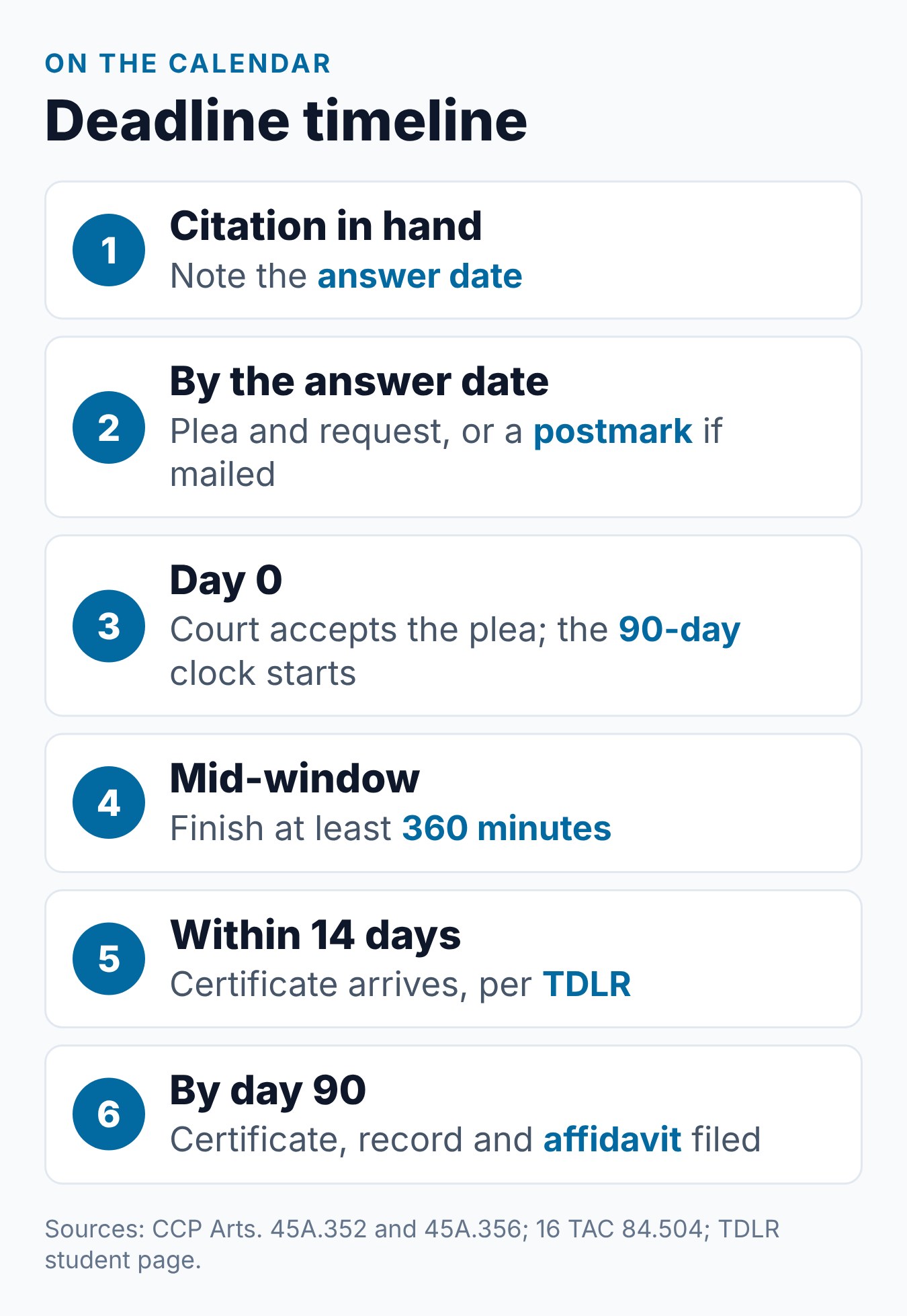
Once the court accepts your plea and request, it enters judgment and puts it on hold. Art. 45A.356 then gives you 90 days to do two things.
First, finish the course. Second, present three items to the court:
- The uniform certificate of course completion.
- Your Texas DPS driving record showing no course in the 12 months before the offense, unless the judge gets the record.
- An affidavit saying you were not taking a course when you asked and finished none in the prior 12 months that is missing from the record.
Finishing the course on day 89 is not enough. The papers must also reach the court within the window.
A Simple Date Example
Say the court accepts your plea on March 1. Counting 90 days forward, day 90 lands on May 30.
That is the outer edge, not a target. Confirm the exact date with the court, and ask how it counts the days.
Plan the 90 Days Backward
Three steps take time inside the window, so start with them:
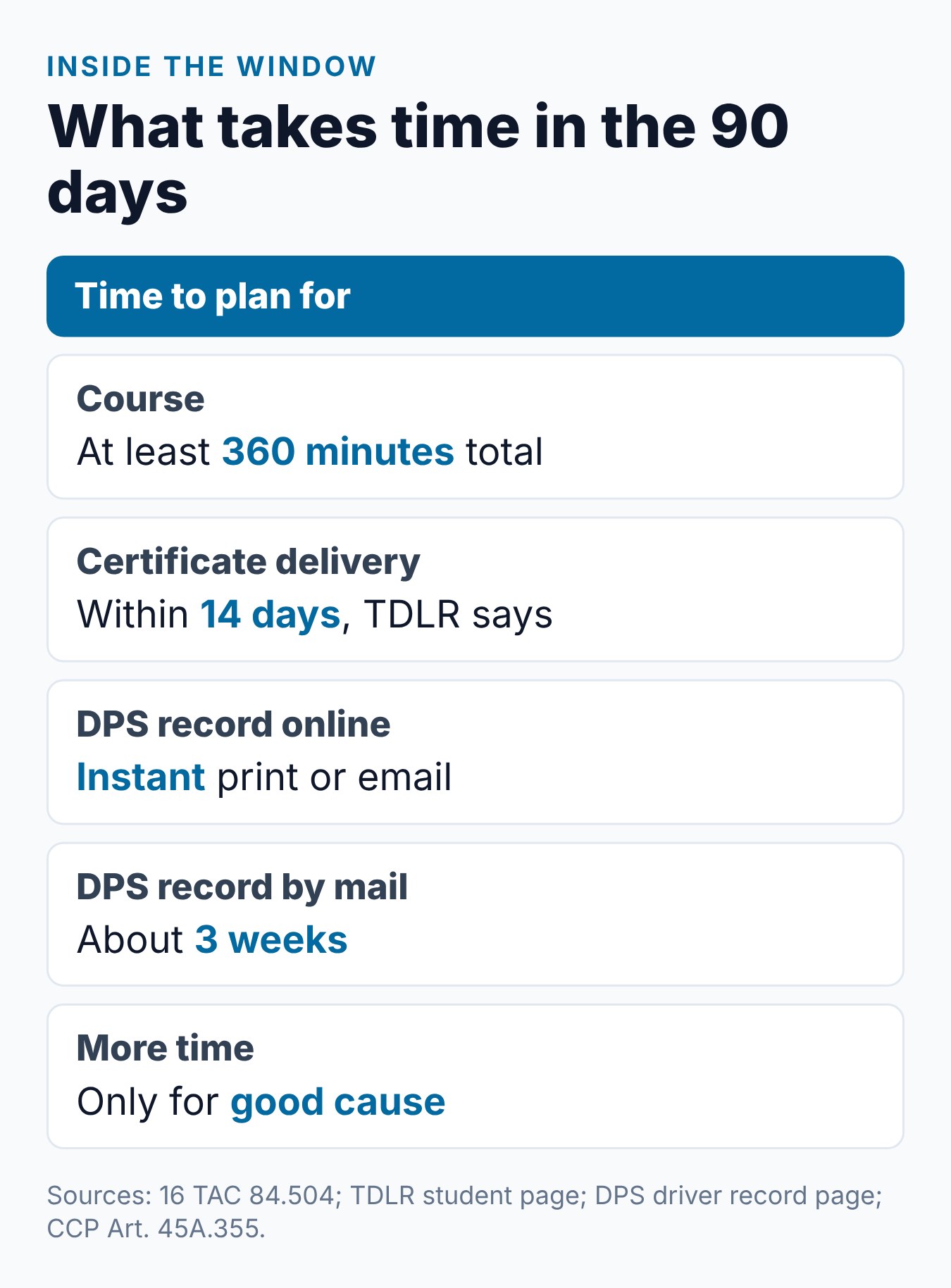
- The course. 16 TAC 84.504 sets a minimum of 360 minutes, with at least 300 minutes of instruction.
- The certificate. TDLR says you should receive it within 14 days of finishing the course.
- The record. The DPS driver record page says online orders print or email instantly, while mail orders need about three weeks.
DPS says on its driver record FAQ that “most courts generally require a Type 3A driver record.” Confirm the type with your court. If you have no audit number for the online order, DPS says to order by mail or ask the court for an extension.
Keep Proof of Every Date
Dates are the whole game here, so keep a record of each one. Save these items until the case is closed:
- The certified mail receipt or the court’s e-mail or portal confirmation.
- The court order or notice that shows when your plea was accepted.
- The date on your course certificate.
- Proof of when you filed your papers with the court.
Extensions for Good Cause
Art. 45A.355 lets the court allow more time to present the certificate if you show good cause for the delay. This is up to the court, so ask before the 90 days end.
If the window closes with papers missing, the court must mail you a notice and set a show-cause hearing. Our guide on a missed defensive driving deadline covers that process step by step.
Several Charges, One Set of Dates
If one stop led to more than one charge, the same two deadlines apply to each. Ask for the course on every charge by the answer date.
Since Sept. 1, 2025, one course can dismiss each charge from the same criminal transaction that qualifies on its own. That rule came from SB 296. It covers requests made on or after that date, even for older offenses.
A Deadline Checklist
Use this list to keep both dates in view:
- The day you get the citation. Write down the answer date and the court’s phone number.
- Before the answer date. Check that you qualify, find your insurance card, and decide on your plea. A lawyer can help with that choice.
- By the answer date. Send or deliver the plea and request.
- Right after the plea. Write down day 90 and order your driving record.
- In the first weeks. Take the course while there is room to spare.
- After the course. Watch for the certificate and follow up if it is late.
- Before day 90. File the certificate, record and affidavit, and ask the court to confirm it got them.
What We Found on the TDLR Pages
On the TDLR student page we checked on October 26, 2026, TDLR said that if a course is used for ticket dismissal, “the court will typically establish a date that the course must be completed by.” The page also said providers “may require that you complete the course within a specific amount of time.”
So two clocks can run at once: the court’s 90 days and any time limit the provider sets. TDLR’s SB 296 notice repeated that written requests must come “on or before the answer date on the notice to appear.”
Common Mistakes to Avoid
Each of these runs against a deadline rule in Chapter 45A:
- Treating the answer date as a soft date. After it passes, the course is the judge’s choice.
- Mailing without certified service. The postmark rule applies to certified mail with a return receipt.
- Starting the 90-day count late. The window runs from the plea, not from the day you begin the course.
- Waiting on a mailed record. About three weeks by mail can eat a large share of the window.
- Asking for more time after day 90. Extensions need good cause, so ask early.
For the whole process from plea to dismissal, see our ticket dismissal guide.
How Requirements Can Vary
The driving safety course rules come from Texas law and TDLR and apply statewide. Each justice or municipal court still sets its own fees, filing steps and contact methods, and the facts of your citation decide which options you have.
Laws, fees and court procedures can change. Check your citation, ask the court that handles your case, and use the TDLR and Texas DPS websites for current rules before you act.
Frequently Asked Questions
Is the answer date the same as my court date?
The law uses “answer date,” and the required notice uses “appearance date.” Both refer to the date on your citation for responding to the court. If you are unsure which date applies, call the court.
Can I take the course before the court says yes?
TDLR says a driver should first get notice from the court that they are eligible. Asking first protects your right and starts the 90-day clock in the right order.
Does certified mail sent on the answer date count?
Yes. The rule is a postmark on or before the answer date, with return receipt requested. Keep your receipt.
What if I already missed the answer date?
The right is lost, but the court may still grant the course before the case is closed. Contact the court quickly and ask what it allows.
When does the 90-day window start?
It runs from the plea. After the court accepts the plea and request, you have 90 days to finish the course and file your papers.
Does the provider’s time limit change the court deadline?
No. The 90 days come from state law. TDLR says a provider may also set its own time limit, so check both.
Can I get more than 90 days?
Only if you show good cause. The court may then allow extra time to present the certificate.
Does the 90 days include time to get my certificate?
Yes. TDLR says the certificate should arrive within 14 days of finishing, and it must reach the court inside the 90 days.
Conclusion
Two dates control a Texas defensive driving case: the answer date for your plea and request, and the 90 days that follow for the course and papers. Meet the first and the course is your right if you qualify, and meet the second and the charge is dismissed.
Put both dates on your calendar the day you get the citation. When you are ready, start Driving Logic’s online Texas driving safety course.
Related Articles
- Texas Defensive Driving for Ticket Dismissal: The Complete Guide
- What Happens If You Miss the Texas Defensive Driving Completion Deadline?
- Texas Defensive Driving Court Request: Step by Step
- 6 Hour Defensive Driving Course Texas: How Long It Takes
Sources
- Texas Code of Criminal Procedure Chapter 45A (PDF)
- TDLR — Taking a Driving Safety Course
- TDLR — SB 296: one driving safety course for multiple charges
- Texas DPS — How to Order Your Driver Record
- Texas DPS — Driver Record FAQ
- 16 Tex. Admin. Code § 84.504 — Driving safety course length
Billy Forte is the owner of Driving Logic, a state-approved driver improvement course provider serving Texas and other U.S. states.
This article is general information, not legal advice. Texas traffic and driving safety course rules are set by Texas law, TDLR, Texas DPS and each court, and they can change. Check with the court on your citation and the official TDLR and DPS websites for current requirements, and talk to a Texas lawyer about your specific case.