
Updated October 2026 · Reviewed by Billy Forte
A Texas approved 6 hour driving course online must follow a special TDLR rule, 16 TAC 84.505, on top of the basic course rules. That rule requires built-in timers, identity questions you answer within 90 seconds, and exams with set retest limits. It also says what the provider’s website must show and what records it must keep about your progress.
Key Facts
- Length: at least 360 minutes, with at least 300 minutes of timed instruction. See how the minutes are counted.
- Timers: built into the course to confirm the 300 minutes were attended. See built-in timers.
- Identity checks: each question must be answered within 90 seconds, and missing more than 30 percent removes you. See identity questions.
- Exams: failing the same exam three times fails the course under one retest option. See exams and retests.
- Website: the provider’s name and TDLR license number must show on the site. See what the site must show.
How a Texas Approved 6 Hour Driving Course Online Works
TDLR calls an online course an “alternative delivery method,” or ADM. Under 16 TAC 84.505, the ADM must teach the provider’s approved curriculum. That curriculum follows TDLR’s Course of Organized Instruction, which calls it the “6-Hour Driving Safety Course.”
Only a licensed driving safety provider can run an online course. The provider is responsible for how the course works. TDLR’s student page says some providers teach online and others require you to attend in person.
The online version is the same course in a different format. It can be used for ticket dismissal or an insurance discount, just like a classroom course. Our Texas driver safety course guide covers those uses.
Online vs Classroom Rules
Both formats share the core rules in 16 TAC 84.504. Each has at least 300 minutes of instruction and a 360-minute total. Section 84.504 also says audio or video makes up 60 to 165 of the 300 instruction minutes.
The checks are what differ. Here is how the two rules handle the same jobs:
| Job | Classroom course | Online course |
|---|---|---|
| Proving time | Attendance is documented | Built-in timers track the 300 minutes |
| Proving identity | Reasonable effort at enrollment | Identity questions during the course |
| Breaks | At least 30 minutes for lunch in a one-day class | 60 minutes of breaks or added content |
| Class size | No more than 50 students in person | The 50-student cap is for in-person classes |
Both formats must also explain any alternative testing for students with reading, hearing or learning disabilities. A provider may choose not to offer it, but it must tell you before you enroll.
How the 300 Minutes Are Counted
A classroom has a clock on the wall. An online course needs another way to measure time, so the rule gives a formula. The course must hold enough content to take a student 300 minutes.
The rule counts content this way:
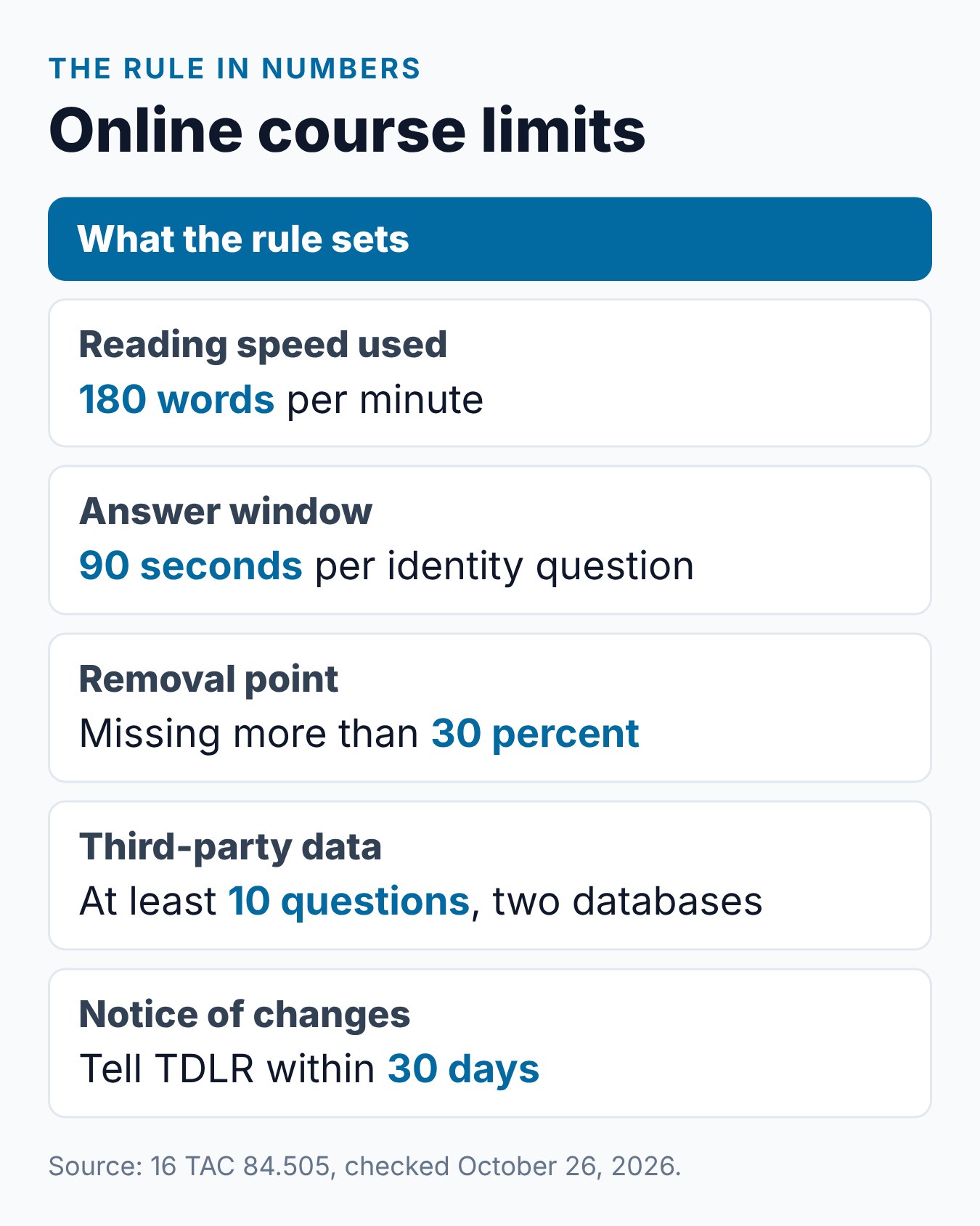
- Text: the number of words divided by 180 words per minute.
- Video and audio: the actual play time.
- Charts and graphs: one minute each.
- Exam questions: up to 90 seconds each.
Then come 60 more minutes. Students take 60 minutes of breaks, or the provider adds 60 minutes of content, for a total of 360. A provider may ask TDLR to approve a different way to count time.
The rule also limits what appears on screen. Ads and unrelated material may not show during instruction time. The text must be edited for grammar and spelling.
Built-In Timers
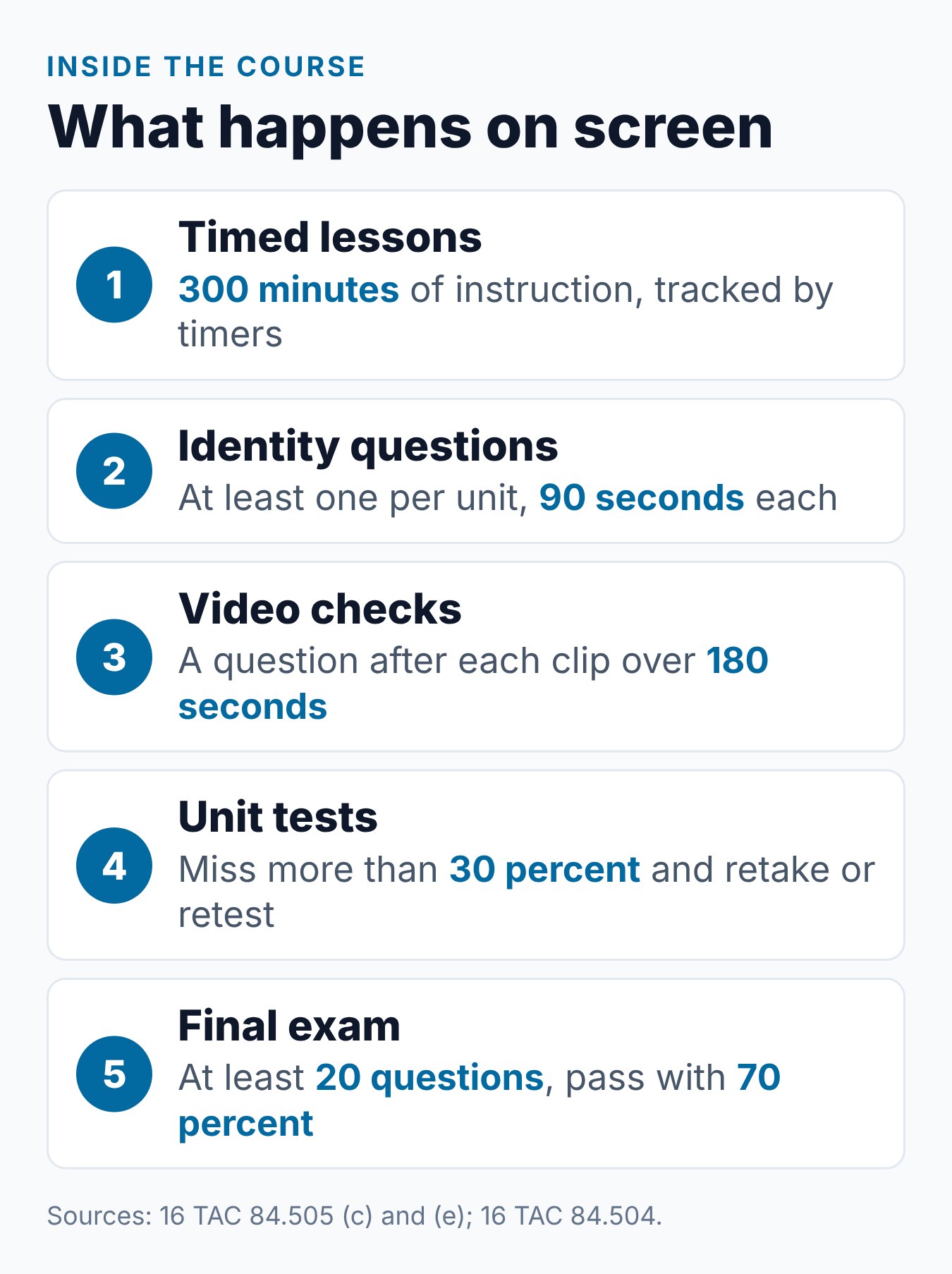
The rule says the course “must include built-in timers to ensure that 300 minutes of instruction have been attended.” A timer keeps a student from clicking through a unit faster than the content allows.
16 TAC 84.504 adds that enrollment and other admin tasks do not count toward the 300 minutes. So signing up and paying are not part of your instruction time. Our guide on how long the course takes covers the full time picture.
Personal Validation Questions
Personal validation questions check that the person enrolled is the person taking the course. The provider picks one of several methods allowed by the rule.
With the provider’s own questions, these limits apply:
- You must answer each question within 90 seconds.
- At least one question appears in each major unit, not counting the final exam.
- Missing more than 30 percent of the questions removes you from the course.
- A provider may correct a miss made by accident, but its record must show both answers and the reason.
A provider may instead use third-party data. Then the course asks at least 10 questions at random times, drawn equally from at least two databases. The same 90-second and 30 percent limits apply.
Some students may not show up in two databases, such as someone with an out-of-state license. The rule lets that student get a certificate with a notarized copy of a driver license or photo ID. The student also gives a statement certifying that they finished the course.
The rule also allows two-factor or multifactor login. A provider may use another method if it is at least as secure.
Video Questions
Video gets its own check. After each clip longer than 180 seconds, the course must ask at least one question about it. Each clip needs a bank of at least four questions.
If you miss a video question, one of two things happens. You watch the clip again and get a different question, or you fail the course. The course may not show you the correct answer.
Exams and Retests
Mastery questions test what you learned. The rule requires at least two questions for each topic in Chapter Four, Topics Two through Twelve, of TDLR’s course outline. Each topic needs a bank of at least 10 questions.
Under 16 TAC 84.504, the final exam has at least 20 questions. You need a score of 70 percent or more to pass and get a certificate.
A provider must pick one of two retest options. It may use only one:
| Option A: repeat the unit | Option B: retest | |
|---|---|---|
| Trigger | Missing more than 30 percent of the questions | Missing more than 30 percent of the questions |
| What you do | Retake the whole unit | Take the same exam again with different questions |
| Timers | All timers reset | You do not have to repeat the unit |
| Limit | No limit on repeats | Failing the same unit exam or final three times fails the course |
Ask the provider which option it uses before you start. The answer tells you what happens after a bad test.
What the Website Must Show
The rule sets plain rules for course websites. The provider’s name and its TDLR license number must appear on the site. They must also appear on the sign-up and payment pages, before and during payment.
If another website sends you to the course, you must land on a page that shows the same name and number. Each online course must run from a single web domain.
The provider must also set hours for tech help. Students must be able to reach that help during those hours. To check a provider’s license, see our guide on TDLR approval.
Records the Provider Keeps
An online course keeps a detailed record of each student. Each activity gets a date and time stamp. The record includes:
- Your name and driver license number.
- Each identity question and your answer.
- Each video question and your answer.
- Each exam question and your answer.
- Time spent in each unit and total instruction time.
TDLR can inspect these records. Any changed answer must show both answers and a reason.
After You Finish
When you pass, the provider issues the uniform certificate of course completion. TDLR says it should arrive within 14 days, by mail or electronically. TDLR also says it is your job to send it to the court or your insurer.
For a ticket, the court gives you 90 days after your plea under Code of Criminal Procedure Chapter 45A. In that time, you file the certificate, a driving record and an affidavit. See our certificate guide and the full online step-by-step.
What the Law Says About Price
Online or not, the price has a floor. Education Code § 1001.352 says a provider “shall charge each student at least $25.” TDLR’s fee notice says providers must charge that fee before they enroll a student.
That rule took effect Sept. 1, 2025, under House Bill 3012. The same bill removed the old $3 fee. Our cost guide covers the court and record fees too.
What We Found in the Online Course Rule
On the 16 TAC 84.505 text we checked on October 26, 2026, a few gaps stood out. The rule did not set a daily hour limit. It did not set a deadline to finish the course.
Section 84.504 filled one gap. It said a student gets no credit unless the full course is done within the timeline set by the court. TDLR’s student page added that providers may set their own deadlines for finishing.
The online rule also let providers change an approved course without asking first. They must tell TDLR within 30 days after the change.
Common Mistakes to Avoid
Each of these comes from the TDLR rules:
- Stepping away during an identity question. Each one has a 90-second limit.
- Guessing on identity questions. Missing more than 30 percent removes you.
- Skipping video. A clip over 180 seconds comes with a question about it.
- Not asking about retests. Under Option B, three failures of the same exam fail the course.
- Signing up on a site with no license number. The rule requires the provider’s name and TDLR license number on the site.
- Waiting too long to start. The course must be done within the court’s timeline.
How Requirements Can Vary
The driving safety course rules come from Texas law and TDLR and apply statewide. Each justice or municipal court still sets its own fees, filing steps and contact methods, and the facts of your citation decide which options you have.
Laws, fees and court procedures can change. Check your citation, ask the court that handles your case, and use the TDLR and Texas DPS websites for current rules before you act.
Frequently Asked Questions
Is an online course approved for ticket dismissal in Texas?
Yes, if a TDLR-licensed provider offers it. TDLR says any licensed provider may offer the 6-hour course for ticket dismissal or insurance discounts, online or in person.
Can I finish the online course in less than six hours?
No. Built-in timers make sure 300 minutes of instruction are spent. The full course is at least 360 minutes, including 60 minutes of breaks or added content.
What happens if I miss an identity question?
One miss does not end the course. You are removed only if you miss more than 30 percent of the identity questions. A provider may correct a miss made by accident, with a record of why.
How many times can I take the final exam?
It depends on the retest option the provider uses. Under Option B, failing the final exam three times fails the course. Under Option A, you repeat the unit, with no limit on repeats.
What score do I need to pass?
You need 70 percent or more on the final exam. The exam has at least 20 questions.
Do I get my certificate right away?
TDLR says you should get it within 14 days of finishing. It comes by mail or electronically, and you send it to the court.
Can I get help with the exam if I have a learning disability?
Ask the provider before you enroll. TDLR rules require providers to describe any alternative testing for reading, hearing or learning disabilities. A provider may decline to offer it, but it must tell you first.
Conclusion
A Texas online driving safety course is the same 6-hour course, with extra checks to prove the time and the identity of the student. Timers, 90-second identity questions and exam limits all come from 16 TAC 84.505. Check the provider’s TDLR license number on its site before you pay. Driving Logic’s online Texas driving safety course is one place to start.
Related Articles
- Texas Driver Safety Course (DSC): The Complete Guide
- 6 Hour Defensive Driving Course Texas: How Long It Takes
- Texas Defensive Driving Course Online: How to Take It
- Texas Driver Safety Course Certificate: What It Is and How to Submit It
Sources
- 16 Tex. Admin. Code § 84.505 — Alternative delivery (online) courses
- 16 Tex. Admin. Code § 84.504 — Driving safety course length
- TDLR — 6-Hour Driving Safety Course of Organized Instruction (PDF)
- TDLR — Taking a Driving Safety Course
- TDLR — Driving safety providers must charge students a fee
- Texas Education Code Chapter 1001 — Driver and Traffic Safety Education (PDF)
- Texas Code of Criminal Procedure Chapter 45A (PDF)
Billy Forte is the owner of Driving Logic, a state-approved driver improvement course provider serving Texas and other U.S. states.
This article is general information, not legal advice. Texas traffic and driving safety course rules are set by Texas law, TDLR, Texas DPS and each court, and they can change. Check with the court on your citation and the official TDLR and DPS websites for current requirements, and talk to a Texas lawyer about your specific case.