
Updated October 2026 · Reviewed by Billy Forte
A Texas CDL speeding ticket carries more weight than a regular driver’s ticket, because federal rules treat speeding 15 mph or more over the limit as a serious traffic violation that counts toward a CDL disqualification. Two serious traffic violations within 3 years mean a 60-day disqualification, and three mean 120 days. Texas law also bars CDL holders from the driving safety course and from deferred disposition, in any vehicle.
Key Facts
- Excessive speeding: 15 mph or more over the posted or regulated limit is a serious traffic violation. See serious traffic violations.
- Disqualification: two serious violations in 3 years mean 60 days, and three mean 120 days. See the periods.
- Personal vehicle: a violation in your own car counts only if the conviction leads to a license suspension, revocation or cancellation. See your own car.
- No course or deferral: Texas bars anyone who holds or held a CDL from both. See the Texas rule.
- No masking: federal rules bar states from hiding a CDL holder’s conviction in any type of vehicle. See the masking ban.
Why a Texas CDL Speeding Ticket Is Different
For a driver without a CDL, a speeding ticket is about a fine, a record entry and maybe insurance. A CDL holder has one more layer. Federal rules in 49 CFR 383.51 set disqualification periods based on convictions.
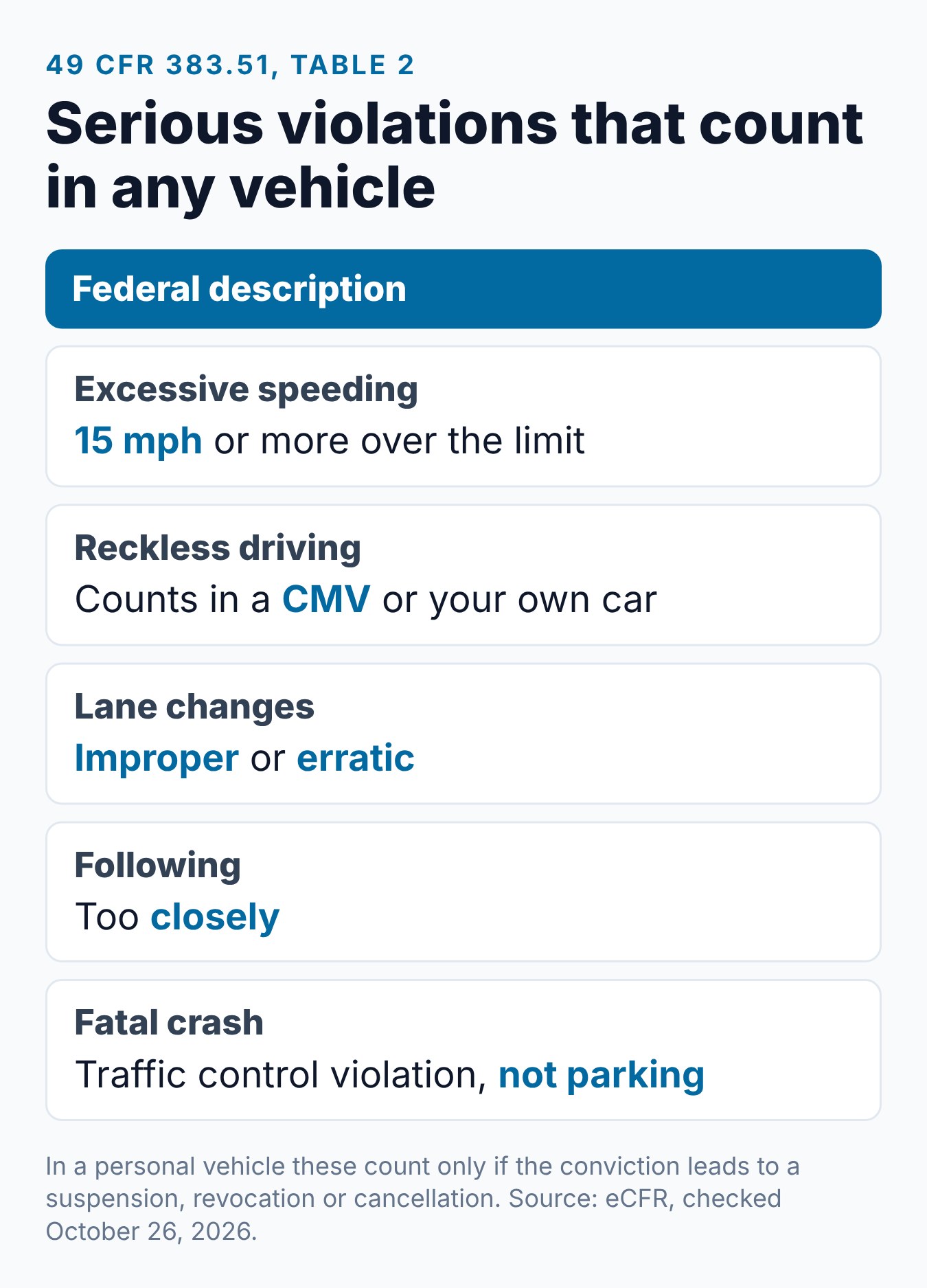
Texas has its own definition, too. Transportation Code Section 522.003 defines a “serious traffic violation” to include “excessive speeding, involving a single charge of driving 15 miles per hour or more above the posted speed limit.” It also lists reckless driving, improper or erratic lane changes and following too closely.
That is why the speed on your citation matters so much. A ticket for 15 mph or more over can count toward a disqualification.
What Counts as a Serious Traffic Violation
The federal list in Table 2 of 49 CFR 383.51 has ten items:
- Excessive speeding, meaning 15 mph or more above the regulated or posted limit.
- Reckless driving.
- Improper or erratic lane changes.
- Following the vehicle ahead too closely.
- A traffic control violation tied to a fatal crash, other than a parking violation.
- Driving a commercial motor vehicle (CMV) without a CLP or CDL.
- Driving a CMV without the CLP or CDL in your possession.
- Driving a CMV without the proper class or endorsements.
- Texting while driving a CMV.
- Using a hand-held mobile phone while driving a CMV.
The first five can count in any vehicle, under the conditions below. Items 6 through 10 apply only in a CMV.
Disqualification Periods
The periods depend on how many serious traffic violation convictions you have within 3 years. This table shows the federal rule for items 1 through 5.
| Convictions within 3 years | While driving a CMV | While driving a personal vehicle |
|---|---|---|
| Second serious violation | 60 days | 60 days, if the conviction leads to a suspension, revocation or cancellation |
| Third or more | 120 days | 120 days, if the conviction leads to a suspension, revocation or cancellation |
A Simple 3-Year Example
Here is how the count works in plain numbers. Say you were convicted of driving 15 mph over in a CMV. Two years later, you are convicted of following too closely in a CMV.
Both convictions fall within 3 years. That is a second serious traffic violation, and the federal period is 60 days. A third within the same 3-year period would mean 120 days.
Now change the timing. If the second conviction came more than 3 years after the first, the two would not share a 3-year period. Keep a list of each conviction date so you can see which ones fall inside any 3-year period.
Tickets in Your Personal Vehicle
A CDL holder’s ticket in a personal car can still count. The non-CMV column in Table 2 applies only if the conviction “results in the revocation, cancellation, or suspension” of the CLP or CDL holder’s license or non-CMV driving privileges.
So the question is what the conviction does to your license. Texas can suspend a license for several reasons. One is the habitual violator rule in Transportation Code Chapter 521: 4 or more moving-violation convictions in 12 months, or 7 or more in 24 months.
The details can be hard to apply. A lawyer can tell you how a ticket in your own car may affect your CDL.
Texas Bars the Course and Deferral
Texas drivers who qualify can ask for a driving safety course to dismiss an eligible ticket. CDL holders cannot. Code of Criminal Procedure Chapter 45A says the course rules do not apply to a person who holds a CDL or held one when the offense happened.
Deferred disposition is closed too. Chapter 45A says it does not apply to a traffic offense, other than parking, by a person who holds or held a CDL at the time.
Neither rule depends on the vehicle. They apply in a CMV and in your own car. For the state rule in depth, see Texas CDL defensive driving.
The Federal Masking Ban
Federal law closes the same door from another side. 49 CFR 384.226 says a state may not mask, defer, or divert a CLP or CDL holder’s traffic conviction. That applies to violations in any type of motor vehicle.
Because the rule covers any type of motor vehicle, it reaches a ticket in your own car too. The Texas exclusions line up with this federal rule.
What Options Remain
With the course and deferral off the table, two main paths remain. You can pay, which is a plea of guilty or no contest and ends in a conviction. Or you can plead not guilty and contest the charge at trial.
A conviction goes to Texas DPS no later than the seventh day after it is entered, under Transportation Code Chapter 543. That is the record that can count toward a disqualification.
Because the stakes are higher, talk to a lawyer before you pay any moving violation. For the trial process, see contesting a Texas speeding ticket in court.
Steps After a Ticket
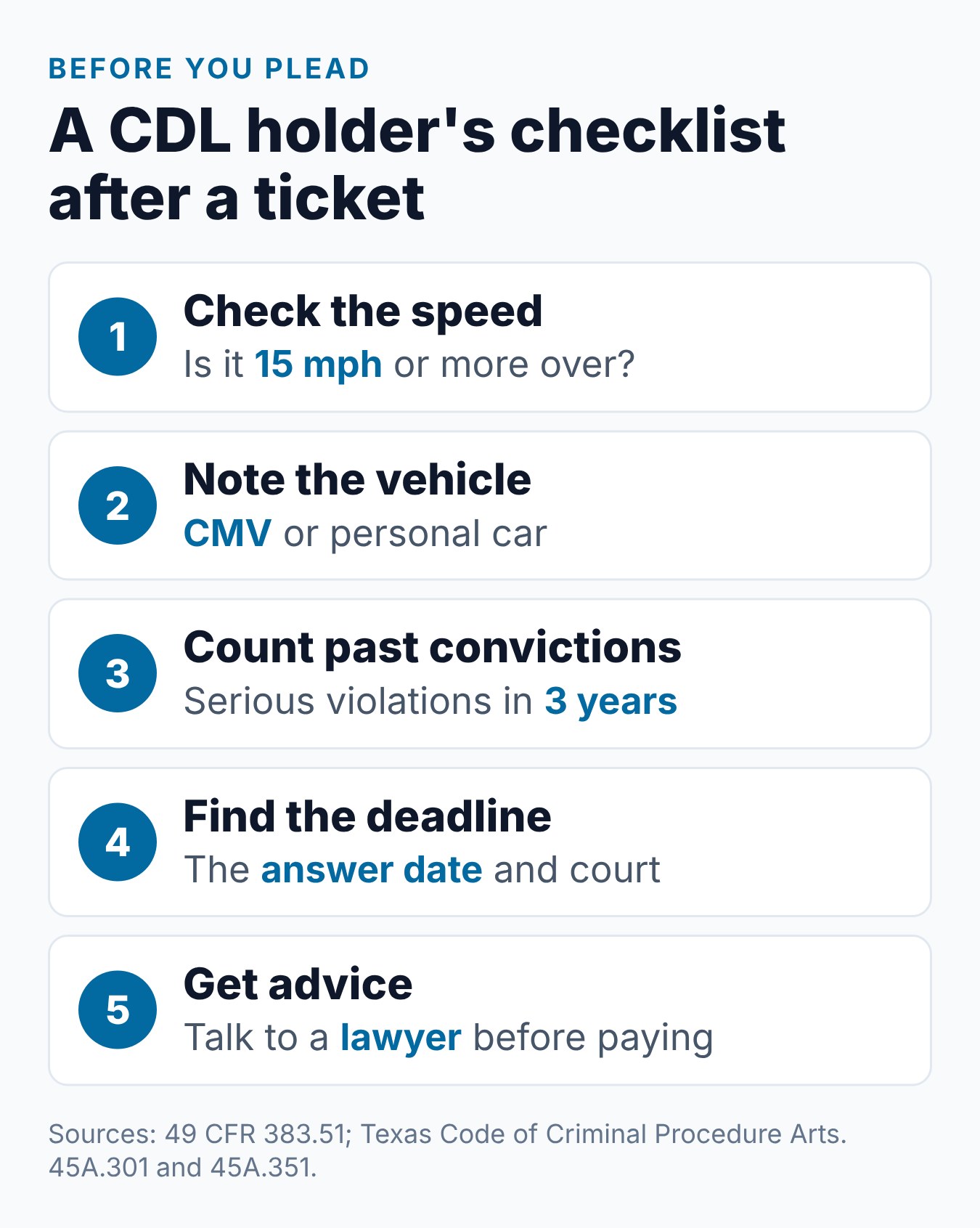
These steps follow from the rules above:
- Read the speed and the posted limit on the citation.
- Note whether you were in a CMV or a personal vehicle.
- Count any serious traffic violation convictions in the past 3 years.
- Find the answer date and the court.
- Talk to a lawyer before you enter a plea or pay.
Telling Your Employer
A conviction also brings a reporting duty. Under 49 CFR 383.31, a CDL holder who drives a CMV must tell the current employer about a traffic conviction. The rule covers a violation “in any type of motor vehicle,” other than parking.
The notice is due within 30 days after the conviction. It must be in writing. Among other items, it lists:
- Your name and license number.
- The date of the conviction and the offense.
- Whether the violation was in a CMV.
- Where the offense happened, and your signature.
This duty applies on top of the disqualification rules. Keep a copy of what you send.
The Fine Itself
A CDL does not change the Texas fine rules. The general fine for a rules-of-the-road offense is $1 to $200 when no other penalty applies. The court sets the amount and adds court costs.
The bigger cost for a CDL holder can be the effect on the license. That is why the fine alone is a poor guide to what a ticket means for you.
Questions for Your Lawyer
Bring your citation and a list of past convictions to the meeting. These questions can help:
- Does this charge count as a serious traffic violation?
- How many serious violation convictions do I have inside 3 years?
- Could this conviction lead to a suspension of my license?
- What are my choices before the answer date?
Speeding Under 15 Over
A ticket for less than 15 mph over does not meet the federal excessive speeding definition. It is still a moving violation. If you pay, it still ends in a conviction on your Texas record.
The course and deferral bars still apply, since they depend on holding a CDL, not on the speed. Any moving-violation conviction also counts toward the habitual violator rule.
What We Found on eCFR
On the eCFR page for 49 CFR 383.51 we checked on October 26, 2026, Table 2 listed ten serious traffic violations. It set 60 days for a second and 120 days for a third within 3 years.
The non-CMV column applied to the first five items only. It required that the conviction lead to a revocation, cancellation or suspension of the driver’s license or non-CMV privileges.
Common Mistakes to Avoid
These come straight from the rules above:
- Thinking a personal-car ticket never counts. It can count if the conviction leads to a suspension, revocation or cancellation.
- Planning on defensive driving. Texas bars CDL holders from the course in any vehicle.
- Asking for deferral. It is closed to CDL holders for traffic offenses other than parking.
- Paying without advice. Paying ends in a conviction that can count toward a disqualification.
- Losing track of the 3-year window. Count every serious violation conviction inside it.
How Requirements Can Vary
The driving safety course rules come from Texas law and TDLR and apply statewide. Each justice or municipal court still sets its own fees, filing steps and contact methods, and the facts of your citation decide which options you have.
Laws, fees and court procedures can change. Check your citation, ask the court that handles your case, and use the TDLR and Texas DPS websites for current rules before you act.
Frequently Asked Questions
How does a speeding ticket affect a Texas CDL?
Speeding 15 mph or more over is a serious traffic violation under federal rules. Two such convictions in 3 years mean a 60-day CDL disqualification, and three mean 120 days.
Can a commercial driver take defensive driving to dismiss a speeding ticket in Texas?
No. Texas law says the course rules do not apply to anyone who holds a CDL or held one at the time of the offense. That is true in any vehicle.
Does a ticket in my own car count against my CDL?
It can. Under federal rules, a serious traffic violation in a personal vehicle counts if the conviction leads to a suspension, revocation or cancellation of your license or driving privileges.
Is 10 mph over a serious traffic violation?
Not under the excessive speeding definition, which starts at 15 mph over. It is still a conviction if you pay, and the course is still not open to CDL holders.
Can I get deferred disposition with a CDL?
No. Texas law says deferred disposition does not apply to a traffic offense, other than parking, by a person who holds or held a CDL. Federal rules also bar masking a CDL holder’s conviction.
Should I talk to a lawyer before paying?
Paying ends in a conviction, and convictions are what count toward a disqualification. With that at stake, it makes sense to talk to a lawyer before you pay any moving violation.
Do I have to tell my employer about a speeding conviction?
Yes, if you drive a CMV. Federal rules say a CDL holder must notify the current employer in writing within 30 days of a traffic conviction in any type of vehicle, other than parking.
Is the fine higher because I have a CDL?
Texas uses the same fine rules for every driver. The general range is $1 to $200 when no other penalty applies, plus court costs. The larger risk for a CDL holder is the federal disqualification count.
Conclusion
For a CDL holder, a speeding ticket can count toward a federal disqualification of 60 or 120 days. Texas law closes the driving safety course and deferred disposition to anyone who holds or held a CDL, in any vehicle.
Talk to a lawyer before you pay. For drivers in your household who do not hold a CDL and qualify, Driving Logic’s online Texas driving safety course is one option.
Related Articles
- Texas Speeding Ticket: Costs, Record Impact, and What to Know
- Texas CDL Holders and the Driver Safety Course: Why Commercial Drivers Can’t Use It
- Texas Speeding Ticket Options: Pay, Contest, or Take Defensive Driving
- Texas Speeding Ticket Court: Can You Contest It?
Sources
- 49 CFR § 383.51 — CDL disqualification
- 49 CFR § 384.226 — Prohibition on masking convictions
- Texas Code of Criminal Procedure Chapter 45A (PDF)
- Texas Transportation Code Chapter 521 — Driver’s Licenses (PDF)
- Texas Transportation Code Chapter 543 — Arrest and Prosecution of Violators (PDF)
Billy Forte is the owner of Driving Logic, a state-approved driver improvement course provider serving Texas and other U.S. states.
This article is general information, not legal advice. Texas traffic and driving safety course rules are set by Texas law, TDLR, Texas DPS and each court, and they can change. Check with the court on your citation and the official TDLR and DPS websites for current requirements, and talk to a Texas lawyer about your specific case.