
Updated October 2026 · Reviewed by Billy Forte
Yes, you can fight a speeding ticket in Texas speeding ticket court by pleading not guilty, and the justice or municipal court will then set your case for trial before a judge or a jury. No one can promise how a trial will end. If you would rather end the case with a dismissal, the driving safety course is a different path that starts with a plea of guilty or no contest instead.
Key Facts
- Not guilty plea: contesting starts with a plea of not guilty, and the case goes to trial. See step 1.
- Judge or jury: you can waive a jury in writing, or the court calls one. See step 2.
- Lawyer: you have the right to appear through a lawyer. See step 3.
- Appeal: an appeal bond is due within 10 days after judgment. See appeals.
- Course is different: it needs a guilty or no contest plea by the answer date. See contesting vs the course.
Which Texas Speeding Ticket Court Hears Your Case
Speeding tickets go to a justice court or a municipal court. Your citation names the one handling your case. Code of Criminal Procedure Chapter 45A sets the rules both courts follow.
The court type tells you who prosecutes. Chapter 45A says a county or district attorney conducts each prosecution in a justice court. A municipal attorney conducts each one in a municipal court.
The citation also shows your answer date. Transportation Code Chapter 543 says that when you signed it, you made a written promise to appear. Breaking that promise on purpose is a separate misdemeanor, so respond on time even if you plan to fight the charge.
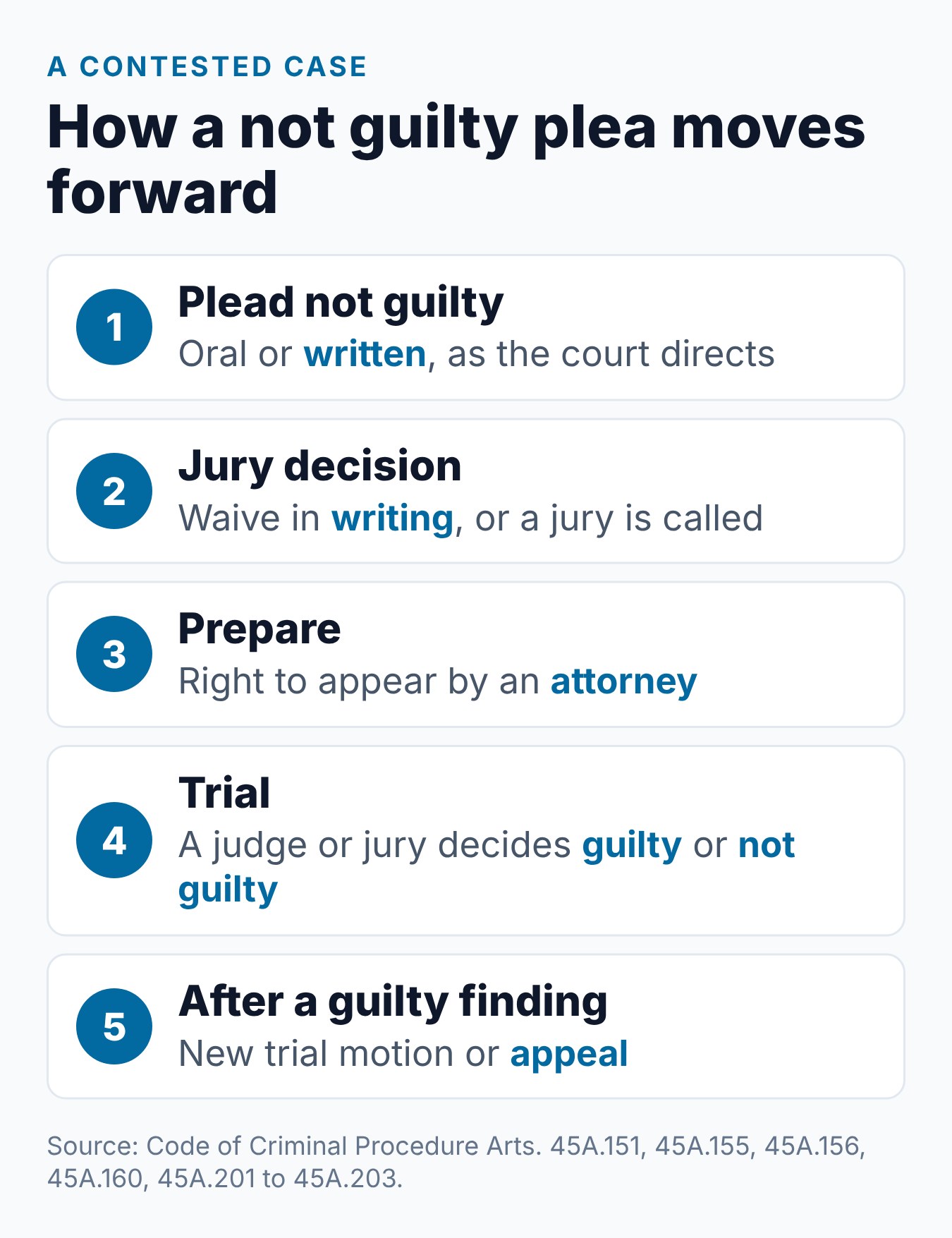
Step 1: Enter a Not Guilty Plea
Chapter 45A lists three pleas: guilty, not guilty and nolo contendere. To contest the ticket, you plead not guilty. A plea may be oral or in writing, as the court directs.
Ask the court how it takes a not guilty plea. Courts differ in the steps they use, so the clerk is the best source for yours.
If a defendant refuses to plead, the law tells the judge to enter a plea of not guilty. The case then moves toward trial, the same as if you had entered the plea yourself.
Step 2: Choose a Judge or a Jury
You have a choice about who decides the facts. Chapter 45A says a defendant “may waive a trial by jury in writing.” If you do, the judge hears and decides the case without a jury.
If you do not waive a jury, the judge issues a writ to call one. The trial then goes forward with jurors.
Showing up matters here. If you do not appear for a jury trial, Chapter 45A lets the court order you to pay a jury impanelment reimbursement fee.
Step 3: Prepare for Trial
Chapter 45A says the defendant “has a right to appear by an attorney as in all other cases.” A traffic lawyer can review your citation and explain which defenses, if any, may fit your facts.
This guide does not list defense tactics or predict results. Each case turns on its own facts and the evidence presented. Bring your citation and any court letters to your first meeting with a lawyer.
Before trial, confirm these details with the court:
- The date, time and place of the trial.
- Whether the trial is before a judge or a jury.
- How the court wants you to check in.
- Whether you need to file anything before the trial date.
Step 4: The Verdict
A trial ends with a finding of guilty or not guilty. Each one leads somewhere different.
If you are found not guilty, there is no conviction. If you are found guilty, the court imposes a sentence. For most rules-of-the-road offenses, the fine is $1 to $200 under Transportation Code Chapter 542, and court costs are added.
A conviction is reported to Texas DPS no later than the seventh day after it is entered. The Texas Department of Insurance says companies charge more for tickets, and each one decides how much.
Step 5: New Trial or Appeal
A guilty verdict is not always the last word. Chapter 45A sets two short deadlines:
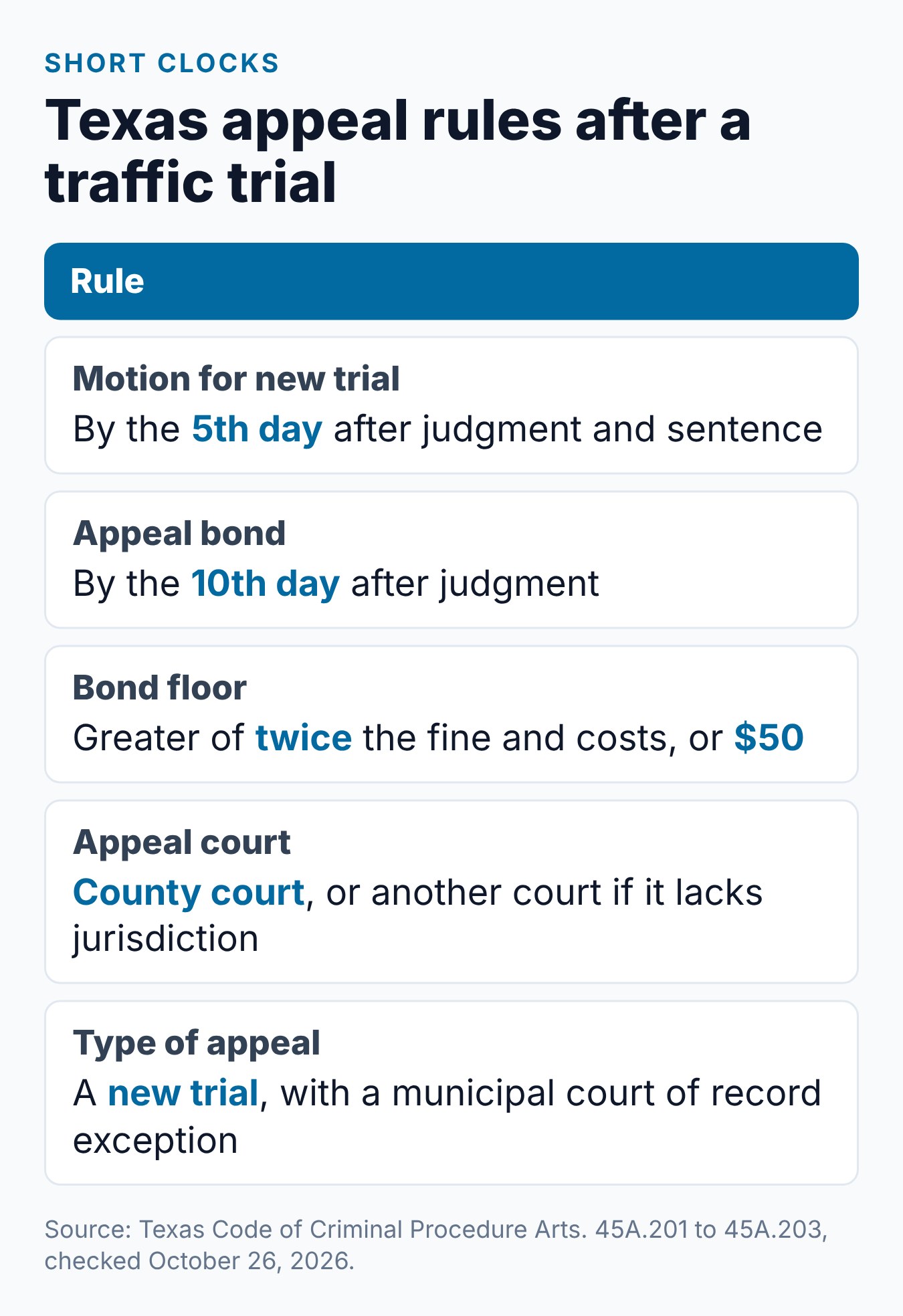
- Motion for new trial: due no later than the fifth day after judgment and sentence are imposed.
- Appeal bond: due no later than the 10th day after the judgment is entered.
The appeal bond has a floor. It may not be less than the greater of twice the fine and costs, or $50.
An appeal goes to the county court, or another court if the county court lacks jurisdiction. The appeal is a new trial, called a trial de novo. The exception is an appeal from a municipal court of record that is based on error in the record.
These deadlines are short. Count the days from the date of the judgment, and mark both on a calendar. If you think you may appeal, talk to a lawyer before or right after the trial, so there is time to act.
If You Are Found Guilty and Cannot Pay
A guilty verdict brings a fine and costs. When a defendant pleads in open court, Chapter 45A tells the judge to ask, at or right after sentencing, whether the defendant can pay right away.
If not, the judge can allow later payment or payments over time. Community service and a full or partial waiver are also options in the law, when the judge finds they fit. For more on these choices, see what affects a Texas speeding fine.
If You Miss a Setting
A missed court date can make a contested case harder. Chapter 45A puts limits on arrest warrants for missing the first court setting, tied to notice rules in the statute.
It also gives a way back. If you come to the court on your own and make a good faith effort to resolve the case, the judge must recall a warrant issued for that failure to appear. Call the court as soon as you know you will miss a date.
Questions for the Court Clerk
The clerk can tell you how your court runs its process. Before trial, ask:
- How do I enter a not guilty plea in this court?
- How do I ask for a jury, or waive one in writing?
- When will my trial be set, and how will I be told?
- How do I file a motion for new trial or an appeal bond?
Keep a note of each answer, along with the date and the name of the person you spoke with.
Contesting Versus the Driving Safety Course
Contesting and the course start in opposite places. The course requires a plea of guilty or no contest, made on or before the answer date. If you meet every condition, the judge must allow the course and dismiss the charge once you finish it and file your papers.
| Question | Contesting at trial | Driving safety course |
|---|---|---|
| Plea | Not guilty | Guilty or no contest |
| Deadline to choose | Respond by the answer date | Ask on or before the answer date |
| Who decides the result | Judge or jury, after the evidence | A right if every condition is met |
| End result | Not guilty, or a conviction | Charge dismissed after 90-day paperwork |
| CDL holders | Can contest | No course right |
You cannot do both on the same charge at the same time. If you plead not guilty and later want the course, the right may be gone.
Chapter 45A lets the court still allow it before the case is finally decided, but the court does not have to. For how to ask for the course, see how to request defensive driving from a Texas court.
When to Talk to a Traffic Lawyer
A lawyer can help with any contested ticket. Some cases call for one more than others:
- You hold a CDL. A conviction can count toward a federal disqualification. See the CDL speeding ticket guide.
- You have recent convictions. DPS must suspend a habitual violator with 4 or more moving-violation convictions in 12 months, or 7 or more in 24 months.
- The charge has extra facts. A work-zone note, a very high speed or several charges can change your options.
- You plan to appeal. The appeal deadlines run in days, not weeks.
What We Found in Chapter 45A
On the Legislature’s compiled Chapter 45A text we checked on October 26, 2026, the pleas were in Art. 45A.151 and jury waiver in Art. 45A.155. The right to appear by attorney was in Art. 45A.160.
The appeal rules sat in Arts. 45A.201 to 45A.203. They set the 5-day new trial deadline, the 10-day appeal bond deadline and the bond floor of twice the fine and costs or $50.
Common Mistakes to Avoid
Each of these comes from a rule above:
- Ignoring the answer date. A not guilty plea is still a response the court needs on time.
- Pleading not guilty while hoping for the course. The course right needs a guilty or no contest plea by the answer date.
- Missing a jury trial. The court can order a jury impanelment reimbursement fee.
- Waiting to appeal. The appeal bond is due within 10 days after judgment.
- Expecting a set outcome. A trial has no promised result.
How Requirements Can Vary
The driving safety course rules come from Texas law and TDLR and apply statewide. Each justice or municipal court still sets its own fees, filing steps and contact methods, and the facts of your citation decide which options you have.
Laws, fees and court procedures can change. Check your citation, ask the court that handles your case, and use the TDLR and Texas DPS websites for current rules before you act.
Frequently Asked Questions
Can you contest a speeding ticket in Texas?
Yes. You plead not guilty, and the justice or municipal court sets the case for trial before a judge or a jury. The result depends on the trial.
How do I contest a speeding ticket in Texas?
Enter a plea of not guilty by the answer date, in the way your court directs. Then decide whether to waive a jury, prepare with or without a lawyer, and attend the trial.
Do I need a lawyer to contest a Texas ticket?
The law gives you the right to appear through a lawyer, but it does not require one. A traffic lawyer can explain which defenses may fit your facts.
What happens if I lose at trial?
The court imposes a sentence, which includes a fine and court costs, and the conviction is reported to Texas DPS. You can file a motion for new trial within 5 days or an appeal bond within 10 days.
Can I take defensive driving after pleading not guilty?
Not as a right if the answer date has passed. The court may still allow the course before the case is finally decided, but it does not have to.
Where does an appeal go?
To the county court, or another court if the county court lacks jurisdiction. The appeal is a new trial, except for some appeals from a municipal court of record.
Can I get a jury trial for a speeding ticket?
Yes. Unless you waive a jury in writing, Chapter 45A says the judge issues a writ to call one. If you waive it, the judge decides the case alone.
Conclusion
You can contest a Texas speeding ticket by pleading not guilty, and the court will set a trial before a judge or a jury. The result depends on the trial, and the appeal deadlines are short.
If you would rather seek a dismissal and you qualify, the course path starts with a different plea by the answer date. For that path, Driving Logic’s online Texas driving safety course is one option.
Related Articles
- Texas Speeding Ticket: Costs, Record Impact, and What to Know
- Texas Speeding Ticket Options: Pay, Contest, or Take Defensive Driving
- Texas Defensive Driving Court Request: Step by Step
- Texas Speeding Ticket for CDL Holders: Federal Rules and Higher Stakes
Sources
- Texas Code of Criminal Procedure Chapter 45A (PDF)
- Texas Transportation Code Chapter 543 — Arrest and Prosecution of Violators (PDF)
- Texas Transportation Code Chapter 542 — Rules of the Road, General Provisions (PDF)
- TDLR — Taking a Driving Safety Course
Billy Forte is the owner of Driving Logic, a state-approved driver improvement course provider serving Texas and other U.S. states.
This article is general information, not legal advice. Texas traffic and driving safety course rules are set by Texas law, TDLR, Texas DPS and each court, and they can change. Check with the court on your citation and the official TDLR and DPS websites for current requirements, and talk to a Texas lawyer about your specific case.