
Updated October 2026 · Reviewed by Billy Forte
A Texas defensive driving court request is a plea of guilty or no contest plus a request for the course, made on or before the answer date on your citation. You can make it in person, through a lawyer, by certified mail, or through the court’s e-mail or online portal if the court allows it. The steps below follow Code of Criminal Procedure Art. 45A.352, so you can ask the right way the first time.
Key Facts
- Two parts: a plea of guilty or no contest, and a request for the course. See what the request includes.
- Four methods: in person, a lawyer, certified mail, or a court e-mail or portal. See ways to send it.
- Bring insurance: the law requires proof of financial responsibility. See step 4.
- Court fee: up to $10 for each eligible charge, on top of court costs. See step 5.
- Late requests: after the answer date, the course is up to the judge. See if the date has passed.
What a Texas Defensive Driving Court Request Includes
The request has two pieces that travel together. The first is your plea. The law calls for a plea of guilty or nolo contendere, which is the legal term for no contest.
The second piece is the request itself. You tell the court you want to take a driving safety course (DSC) to have the charge dismissed. A plea with no request, or a request with no plea, does not meet Art. 45A.352(a)(4).
Which plea to enter is your decision. If you are unsure, ask the court clerk how the process works or talk to a lawyer.
A request made on time also does another job. Art. 45A.352(d) says a request made at or before the time and place to appear counts as an appearance in the case.
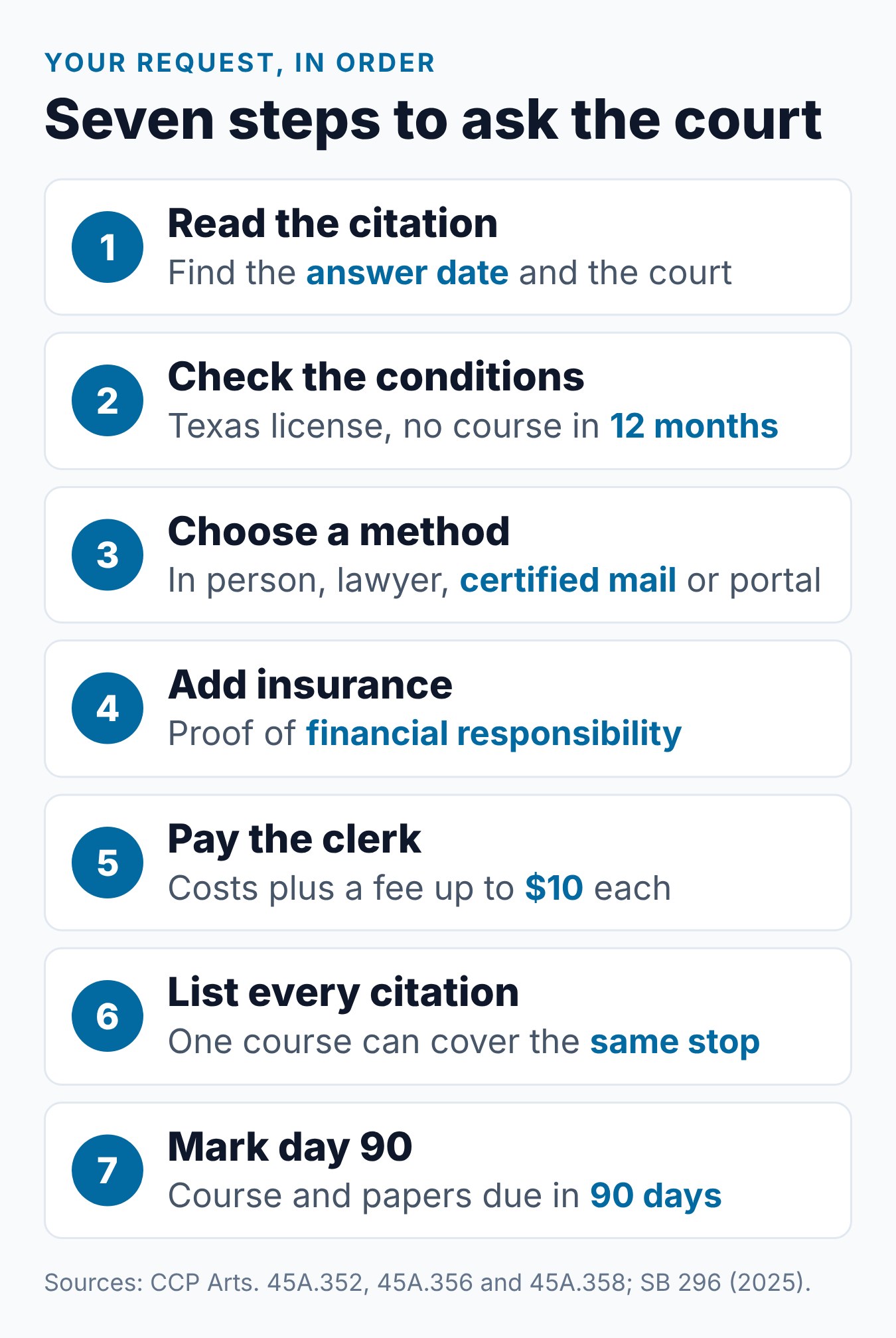
Step 1: Find the Answer Date and the Court
Start with your citation, also called the notice to appear. Look for two things: the date you must answer and the court that has your case.
The law calls this date the “answer date on the notice to appear.” The notice itself must tell you, in substance, that you may lose the right to the course if you do not ask “on or before your appearance date.” Both phrases point to the same deadline on your citation.
The court will be a justice court or a municipal court. Write down its name, address and phone number. You will need them for every step.
Step 2: Check That You Qualify
Before you ask, make sure the right applies to you. The law requires a Texas license or permit, or active-duty military status for you or a family member. You must not have completed a course in the 12 months before the offense date.
Some drivers and charges are left out, such as CDL holders and speeding 25 mph or more over the limit. Our list of eligible violations covers every exclusion.
Step 3: Pick a Way to Send the Request
Art. 45A.352(a)(4) lists the ways to make the plea and request. Each one has its own timing rule.
| Method | How the timing works | Good to know |
|---|---|---|
| In person | Appear at the court on or before the answer date | Ask the clerk for the court’s request form if it has one |
| Through a lawyer | The lawyer makes the plea and request for you | A lawyer can also explain your plea choices |
| Certified mail | Postmarked on or before the answer date | Use return receipt requested and keep the receipt |
| Court e-mail or portal | Sent by the answer date | Only if the court has authorized this option |
In Person
You can go to the court and make your plea and request yourself. Bring your citation, your driver license and your insurance card.
Through a Lawyer
The law lets an attorney make the request for you. This can help if you live far from the court or have questions about the plea.
By Certified Mail
A written request by mail must go “by certified mail, return receipt requested.” It must be postmarked on or before the answer date. Regular mail does not meet this rule, so use the certified option at the post office.
What to Put in a Written Request
Some courts have their own form, so check the court’s website or ask the clerk first. If there is no form, a short signed letter can carry the request. Include these details:
- Your full name, mailing address and phone number.
- The citation number and the offense date.
- Your plea of guilty or no contest for each charge.
- A clear sentence asking to take a driving safety course for dismissal.
- A copy of your proof of insurance.
- Your signature and the date.
Keep a copy of the whole packet before you send it.
By Court E-mail or Online Portal
Some courts let you send the request through a court-designated e-mail address or online portal. The law allows this only “if authorized by the court.” Check the court’s website or call the clerk before you rely on it.
Step 4: Show Proof of Insurance
The law requires proof of financial responsibility under Transportation Code Chapter 601. In plain terms, that means proof of liability insurance.
Send or bring a copy of your insurance card with the request. If you mail the request, include a copy in the envelope.
Step 5: Pay Court Costs and the DSC Fee
Expect to pay court costs, and the amount varies by court. Art. 45A.358 also lets the court charge a reimbursement fee of not more than $10 for the course request. That fee is on top of court costs.
If you request the course and then do not take it, the fee is not refunded. Ask the clerk for the exact total and the ways the court takes payment.
Two other charges can come up:
- A record fee. Under Art. 45A.359, a judge may get your driving record from DPS and charge you the certified record fee plus a state portal fee.
- A late or repeat request. If the court grants the course as its choice, it may set a fine up to the most allowed for the offense.
The course price is separate. Our cost guide lists every official amount.
Step 6: Ask About Every Charge from the Stop
If you got more than one citation in the same stop, name each one in your request. Since Sept. 1, 2025, one course can dismiss every charge from the same criminal transaction that qualifies on its own.
This change came from SB 296. The court may charge its fee of up to $10 for each eligible charge. A charge that is excluded, such as passing a school bus, still has to be handled another way.
Step 7: Note What Comes Next
Once the court accepts your plea and request, it defers judgment. You then have 90 days to finish a TDLR-approved course and turn in three papers:
- The uniform certificate of course completion.
- Your Texas DPS driving record, unless the judge gets it.
- A signed affidavit about your past courses.
DPS says on its driver record FAQ that “most courts generally require a Type 3A driver record,” and that you should confirm the type with the court. You can order it from the DPS driver record page.
Mark the 90th day on your calendar. Our deadline guide explains both dates in detail.
If the Answer Date Is Close or Has Passed
If the date is near, contact the court right away. Certified mail counts by its postmark, so mailing on the answer date still meets the rule.
If the date has passed, the right to the course is lost. Art. 45A.352(c) still lets the court grant a request before the case is finally decided. The court may agree, but it does not have to.
There is one more exception. If your citation did not include the required notice about the course, the right continues until the notice is given or the case is decided.
Keep a Paper Trail
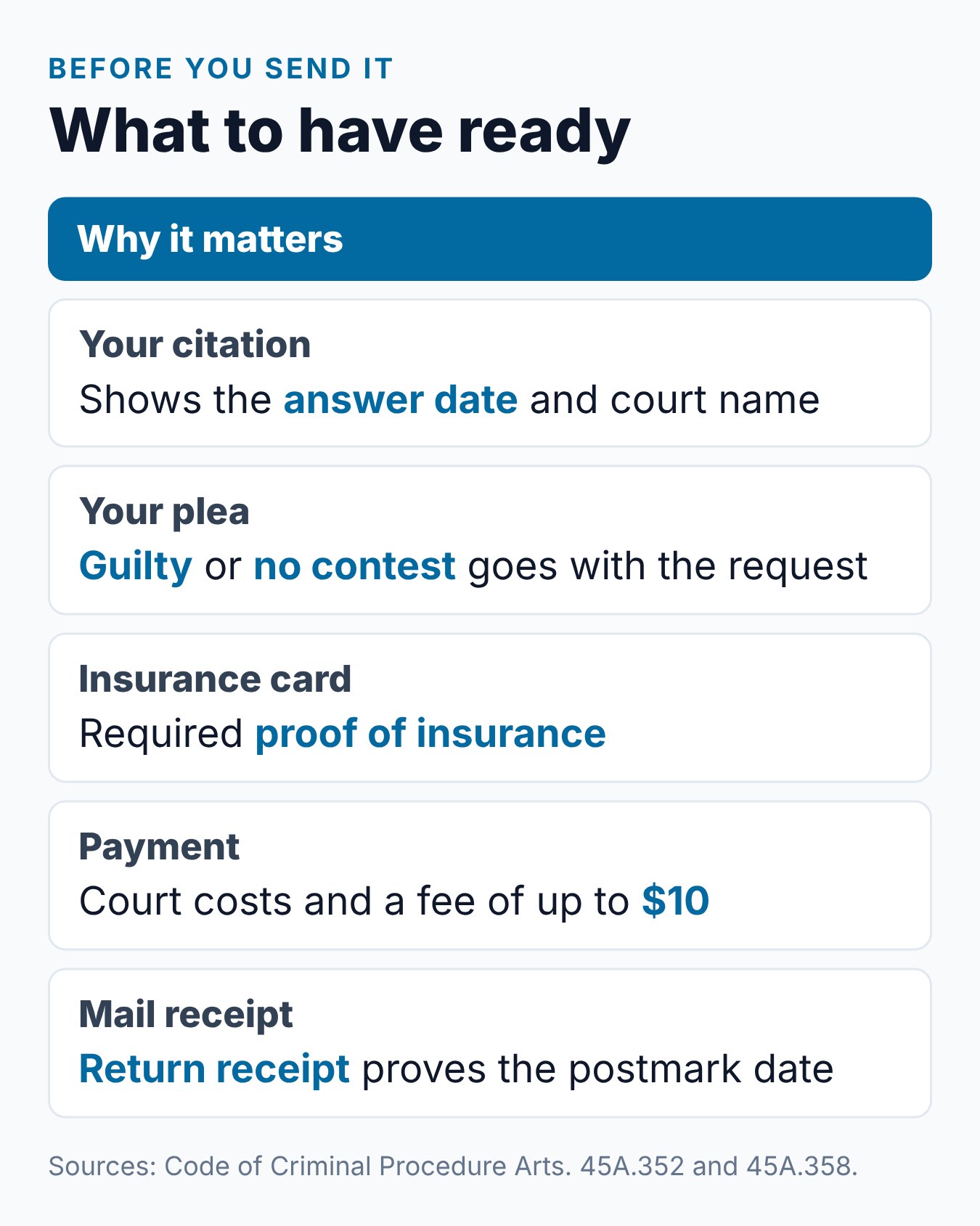
The law ties your rights to dates, so proof of those dates matters. Save each of these until the case is closed:
- The certified mail receipt and the return receipt card.
- A copy of any e-mail or portal confirmation.
- The court’s written reply or order, with the 90-day date.
- Receipts for court costs and the DSC fee.
If a question comes up later, these papers show what you sent and when.
What We Found on the Official Pages
On the TDLR notice about SB 296 we checked on October 26, 2026, TDLR said written requests “must be made on or before the answer date on the notice to appear.” The same notice described the new rule for more than one charge.
The TDLR student page said a driver should first get notice from the court that they are eligible. It also said TDLR cannot recommend a specific provider.
Common Mistakes to Avoid
Each of these breaks a rule in Art. 45A.352 or 45A.358:
- Sending regular mail. The law calls for certified mail with a return receipt.
- Using e-mail the court never approved. The e-mail or portal option works only if the court authorizes it.
- Leaving out the plea. The request must come with a plea of guilty or no contest.
- Forgetting insurance. Proof of financial responsibility is one of the conditions.
- Naming only one charge. List every citation from the stop so each can be dismissed.
- Taking the course first and asking later. A late request leaves the decision to the judge.
For the full process from request to dismissal, see our ticket dismissal guide.
How Requirements Can Vary
The driving safety course rules come from Texas law and TDLR and apply statewide. Each justice or municipal court still sets its own fees, filing steps and contact methods, and the facts of your citation decide which options you have.
Laws, fees and court procedures can change. Check your citation, ask the court that handles your case, and use the TDLR and Texas DPS websites for current rules before you act.
Frequently Asked Questions
Can I ask for defensive driving by mail in Texas?
Yes. Send a written plea and request by certified mail, return receipt requested, postmarked on or before the answer date. Keep the receipt as proof of the date.
Can I request defensive driving online?
Only if the court allows it. The law permits a court-designated e-mail address or online portal when the court has authorized one.
Do I have to go to court in person?
No. The law also allows a request through a lawyer, by certified mail, or through an approved court e-mail or portal.
How much does the court charge for the request?
The court may charge a fee of up to $10 for each eligible charge, plus court costs. Ask the clerk for your exact total.
Should I take the course before I ask the court?
Ask first. The right depends on a timely request, and TDLR says to first get notice from the court that you are eligible.
Does a mailed request count as showing up in court?
Yes. Art. 45A.352(d) says a course request made at or before the time and place to appear counts as an appearance.
What if I asked but the court never answered?
Call the clerk and confirm the court received your request. Keep your certified mail receipt or e-mail record in case you need to show when you sent it.
Conclusion
A good court request has four parts: the right plea, a request for the course, proof of insurance, and an on-time delivery method. Send it by the answer date, list every charge from the stop, and plan for the 90 days that follow. Once the court says yes, you can start Driving Logic’s online Texas driving safety course.
Related Articles
- Texas Defensive Driving for Ticket Dismissal: The Complete Guide
- Texas Defensive Driving Deadline: Request Before the Appearance Date
- What Texas Traffic Violations Qualify for Defensive Driving Dismissal?
- How Much Is Defensive Driving in Texas? Cost Breakdown
Sources
- Texas Code of Criminal Procedure Chapter 45A (PDF)
- Texas SB 296 (2025), enrolled bill (PDF)
- TDLR — SB 296: one driving safety course for multiple charges
- TDLR — Taking a Driving Safety Course
- Texas DPS — Driver Record FAQ
- Texas DPS — How to Order Your Driver Record
Billy Forte is the owner of Driving Logic, a state-approved driver improvement course provider serving Texas and other U.S. states.
This article is general information, not legal advice. Texas traffic and driving safety course rules are set by Texas law, TDLR, Texas DPS and each court, and they can change. Check with the court on your citation and the official TDLR and DPS websites for current requirements, and talk to a Texas lawyer about your specific case.