
Updated October 2026 · Reviewed by Billy Forte
The best defensive driving course Texas drivers can choose is one from a TDLR-licensed provider that fits their court deadline and is clear about price, format, retests and certificate delivery. TDLR does not rank providers, and every approved course must meet the same minimum rules. So the real choice is about fit, and this checklist helps you compare.
Key Facts
- Must have: a TDLR license, at least 360 minutes and a price of at least $25. See the non-negotiables.
- No rankings: TDLR says it “cannot recommend a specific provider.” See what best can mean.
- No shortcuts: no approved course is shorter or skips the final exam. See easiest and fastest.
- What differs: format, price above $25, retest option, tech help and certificate delivery. See fixed vs flexible.
- Ask first: a few questions before you pay save trouble later. See the questions.
Picking the Best Defensive Driving Course Texas Offers
TDLR’s Taking a Driving Safety Course page says plainly, “TDLR cannot recommend a specific provider.” Its provider search says, “Inclusion in this list is not an endorsement, recommendation, or advertising.”
So no official list ranks courses. Every approved course must meet the same length, exam and price rules. The best course for you is the one that meets those rules and fits your needs.
Your needs depend on why you are taking it. For a ticket, the court’s 90-day window matters. For an insurance discount, your insurer’s rules matter.
The Non-Negotiables
Start with what the law requires. A course that misses any of these will not work for a ticket:
- TDLR approval. Article 45A.352 in Code of Criminal Procedure Chapter 45A requires a course “approved by the Texas Department of Licensing and Regulation.”
- Full length. 16 TAC 84.504 requires at least 360 minutes, with at least 300 minutes of instruction.
- Lawful price. Education Code § 1001.352 says a provider “shall charge each student at least $25.”
- Online checks. 16 TAC 84.505 requires built-in timers and identity questions.
- A uniform certificate. The course ends with the uniform certificate of course completion, numbered by TDLR.
To check a license, use TDLR’s Driving Safety Provider search. Our TDLR approval guide shows each step.
What the Rules Fix and What Can Differ
Some features are the same everywhere. Others are up to the provider. This table shows which is which:
| Feature | What the rules fix | What can differ |
|---|---|---|
| Length | At least 360 minutes, 300 of instruction | A course may run longer |
| Price | At least $25, charged before enrollment | The amount above $25 |
| Format | Any licensed provider may teach the course | Online, in person or both |
| Retests | One of two TDLR options | Which option the provider uses |
| Certificate delivery | Mail or a TDLR-approved electronic method | Which method the provider uses |
| Tech help | Set hours that students can reach | The hours the provider sets |
| Time to finish | Within the court’s timeline | Any deadline the provider adds |
Compare the right-hand column when you shop. The left-hand column is the same at every approved course.
Easiest and Fastest Courses
People search for the easiest defensive driving course in Texas or the fastest one. The rules leave little room for either.
On speed, every approved course runs at least 360 minutes. Online, built-in timers make sure the 300 minutes of instruction are spent. No approved course is shorter.
On ease, the exam rules are the same for everyone. The final exam has at least 20 questions, and you need 70 percent or more to pass. The rules say questions must be hard enough that the answer cannot be easily found without taking the instruction.
What can differ is how the material is presented. Some providers use more video, others more text, within the rule that audio or video makes up 60 to 165 of the 300 instruction minutes.
A style you enjoy may feel easier, but the rules do not change. See our comedy defensive driving guide for one example.
A Checklist for Comparing Courses
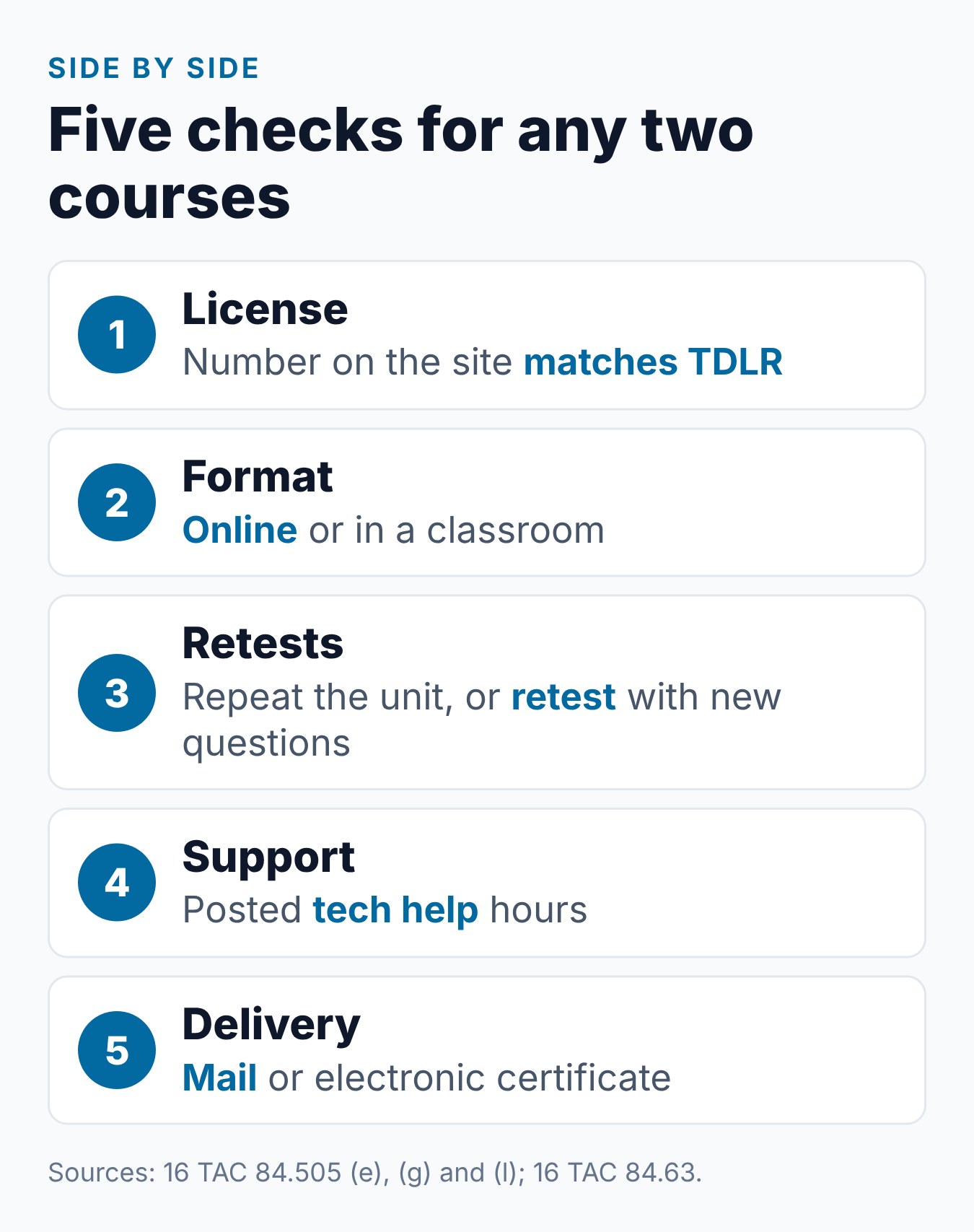
Use this list to compare two or more courses side by side:
- License. The provider’s name and TDLR license number appear on the website and match TDLR’s search.
- Format. The course comes in the format you want. TDLR says some providers teach online and others in person.
- Price. The price is at least $25, and you know of any extra fees.
- Retest option. You know whether a failed unit means repeating it or retesting.
- Certificate delivery. You know if it comes by mail or electronically.
- Tech help. You know the hours when help is available.
- Deadline. The provider’s time limit fits inside your court’s 90 days.
- Access needs. If you need alternative testing, the provider offers it.
Write down what each course says. A side-by-side list makes the choice easier.
Questions to Ask Before You Pay
These questions come straight from what the rules leave to the provider:
- Which retest option do you use, repeating the unit or retesting?
- How do you send the certificate, by mail or electronically?
- What is your fee for a lost certificate?
- Where is your no-cost duplicate policy in the enrollment contract?
- What are your tech help hours?
- Do you offer alternative testing for reading, hearing or learning disabilities?
- How long do I have to finish once I start?
Under 16 TAC 84.504, a provider that does not offer alternative testing must tell you before you enroll. Under 16 TAC 84.63, the enrollment contract must include the no-cost duplicate policy.
Choosing for a Ticket
A ticket adds a clock to your choice. You plead guilty or no contest and ask the court for the course on or before the answer date. TDLR’s student page says to first get notice from the court that you are eligible.
Then you have 90 days after the plea to finish and file three papers: the certificate, your driving record and an affidavit. So pick a course whose own time limit fits inside that window. Ask how fast the certificate goes out once you finish.
Choosing for an Insurance Discount
For a discount, your insurer’s rules come first. The TDI auto insurance guide says “Each company decides what discounts to offer and the amount of the discount.”
Ask your insurer whether it accepts an online course and how it wants the certificate. Then pick a licensed course that meets those terms.
What the Course Website Must Show
The website itself can help you compare. Under 16 TAC 84.505, an online provider must show its name and TDLR license number on the site and on its sign-up and payment pages.
If an ad sends you to the course from another site, you must land on a page with the same name and number. Each online course must run from one web domain. A site that hides this information fails a basic rule.
Format: Online or In Person
TDLR says you need to contact the provider to find out which format it offers. Each format has its own checks.
Online courses use timers and identity questions you answer within 90 seconds. Missing more than 30 percent of those questions removes you from the course. Our online course guide explains these checks.
In-person classes have their own rules. They are capped at 50 students, and a one-day class needs at least a 30-minute lunch. If you want a classroom, ask where and when the class meets.
Price: Reading the Number
The price has a floor, not a ceiling. Since Sept. 1, 2025, the law requires at least $25, with no separate $3 fee. TDLR’s fee notice says providers must charge that fee before they enroll you.
A price below $25 is a warning sign, since the law sets $25 as the minimum. A higher price is allowed. Compare what you get for the price, such as delivery method and support hours.
Remember the other costs for a ticket. The court may charge up to $10 per eligible charge, plus court costs, and a Type 3A record costs $10. See our cost guide.
Certificate Speed
The certificate is what the court needs, so delivery matters. TDLR says you should get it within 14 days of finishing. Under 16 TAC 84.63, it comes by first-class mail, an equal commercial service or a TDLR-approved electronic method.
For a ticket, plan around the 90 days after your plea. A course that sends the certificate electronically may save mailing time.
Ask the provider which method it uses. If the certificate never arrives or has errors the provider caused, TDLR says you can ask for a free copy within 30 days.
That rule covers every licensed provider, so it is a baseline rather than a selling point. Our certificate guide covers filing.
What We Found on the TDLR Pages
On the TDLR pages we checked on October 26, 2026, the student page said TDLR cannot recommend a specific provider. It suggested checking a provider’s license status with TDLR’s search.
The provider search page described itself as a tool for “verifying the license status” of providers. It said inclusion was not an endorsement. No TDLR page we checked ranked or rated courses.
Common Mistakes to Avoid
Each of these comes from a TDLR rule or Texas law:
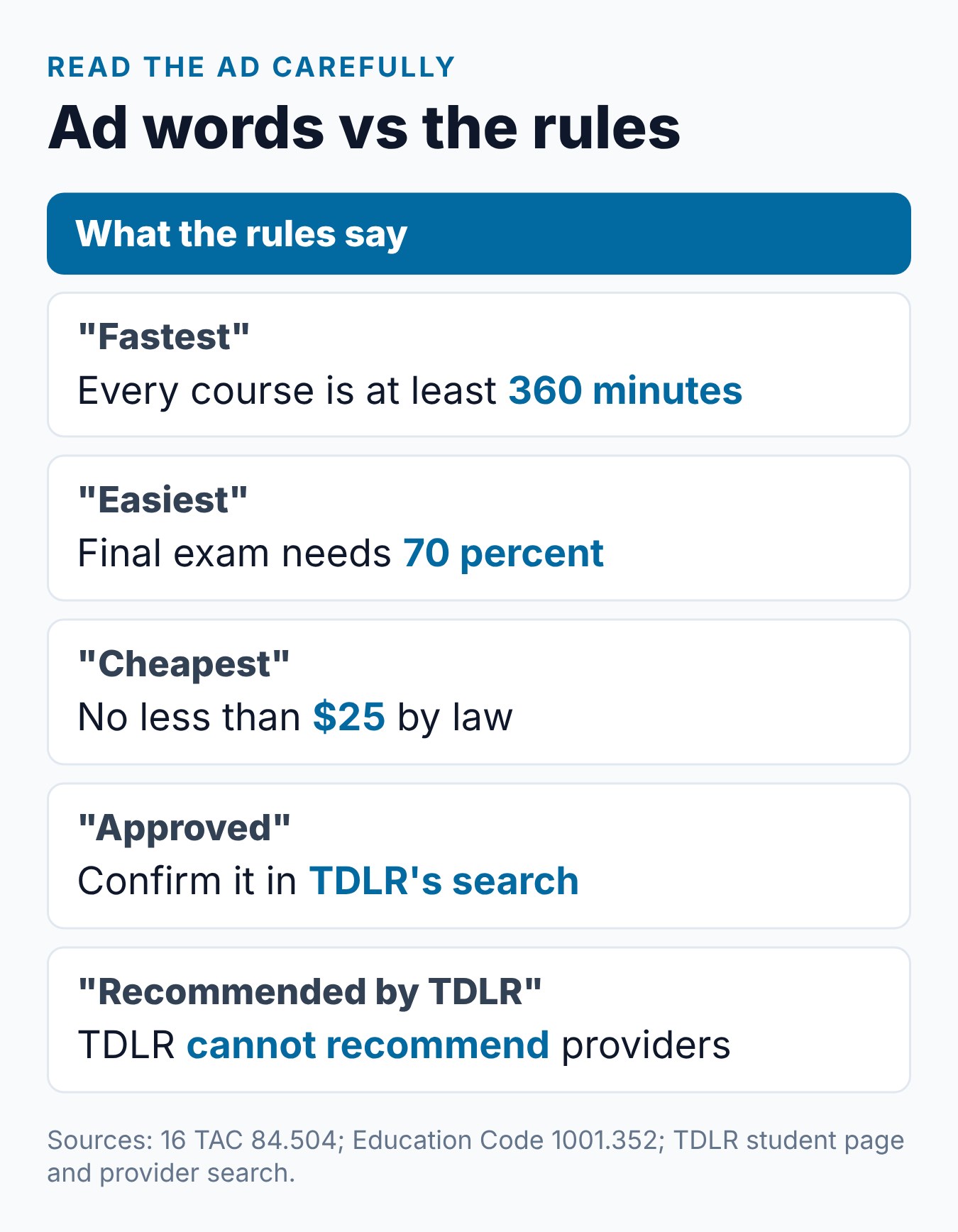
- Choosing by a “fastest” claim. Every approved course runs at least 360 minutes.
- Choosing the lowest price below $25. The law sets $25 as the minimum.
- Trusting a “TDLR recommended” claim. TDLR says it cannot recommend a provider.
- Skipping the retest question. Under one option, three failures of the same exam fail the course.
- Ignoring the provider’s deadline. The course must be done within your court’s timeline.
How Requirements Can Vary
The driving safety course rules come from Texas law and TDLR and apply statewide. Each justice or municipal court still sets its own fees, filing steps and contact methods, and the facts of your citation decide which options you have.
Laws, fees and court procedures can change. Check your citation, ask the court that handles your case, and use the TDLR and Texas DPS websites for current rules before you act.
Frequently Asked Questions
What is the best defensive driving course in Texas?
TDLR does not rank courses, and every approved course meets the same rules. The best one for you is TDLR-licensed, fits your deadline and is clear about its price, retests and certificate delivery.
What is the easiest defensive driving course in Texas?
Every approved course has the same core rules. The final exam has at least 20 questions and needs 70 percent to pass. A style you like may feel easier, but the requirements do not change.
Is there a shorter course than six hours?
No. TDLR rules require at least 360 minutes, with at least 300 minutes of instruction. Online timers make sure the time is spent.
Is a cheaper course a good deal?
Check the price against the law first. A provider must charge at least $25. Above that, compare what you get, such as delivery method and support.
How do I know a course will be accepted by the court?
Make sure a TDLR-licensed provider offers it. Then make sure you meet the court’s conditions, such as asking on or before the answer date.
Should I pick online or in person?
Either can be approved. TDLR says some providers teach online and others in person, so choose the format that fits your schedule and ask the provider what it offers.
Can I take the course on my phone?
TDLR’s rules do not set device requirements for students. Ask the provider which devices its course supports before you pay.
Conclusion
The best defensive driving course in Texas is one that a TDLR-licensed provider offers and that fits your deadline and needs. Every approved course has the same length, exam and price rules, so compare format, retests, support and certificate delivery.
Check the license before you pay. One option to consider is Driving Logic’s online Texas driving safety course.
Related Articles
- Texas Driver Safety Course (DSC): The Complete Guide
- TDLR-Approved Driver Safety Course: What It Means and How to Verify
- Texas Approved 6 Hour Driving Course Online: How It Works
- Comedy Defensive Driving in Texas: What to Know Before You Choose One
Sources
- TDLR — Taking a Driving Safety Course
- TDLR — Driving Safety Provider Search
- 16 Tex. Admin. Code § 84.504 — Driving safety course length
- 16 Tex. Admin. Code § 84.505 — Alternative delivery (online) courses
- 16 Tex. Admin. Code § 84.63 — Uniform certificate of course completion
- Texas Education Code Chapter 1001 — Driver and Traffic Safety Education (PDF)
- TDLR — Driving safety providers must charge students a fee
- Texas Code of Criminal Procedure Chapter 45A (PDF)
- Texas Department of Insurance — Auto insurance guide
Billy Forte is the owner of Driving Logic, a state-approved driver improvement course provider serving Texas and other U.S. states.
This article is general information, not legal advice. Texas traffic and driving safety course rules are set by Texas law, TDLR, Texas DPS and each court, and they can change. Check with the court on your citation and the official TDLR and DPS websites for current requirements, and talk to a Texas lawyer about your specific case.