
Updated October 2026 · Reviewed by Billy Forte
The first fact to know about a virginia speeding ticket pay or court choice is simple: prepaying is a guilty plea, and the conviction and its points go to the Virginia DMV. Only charges on the prepayable list can be paid without going to court, and reckless driving is not on it. This guide lays out the facts on each path, so you can talk with the court or a lawyer about your own case.
Key Facts
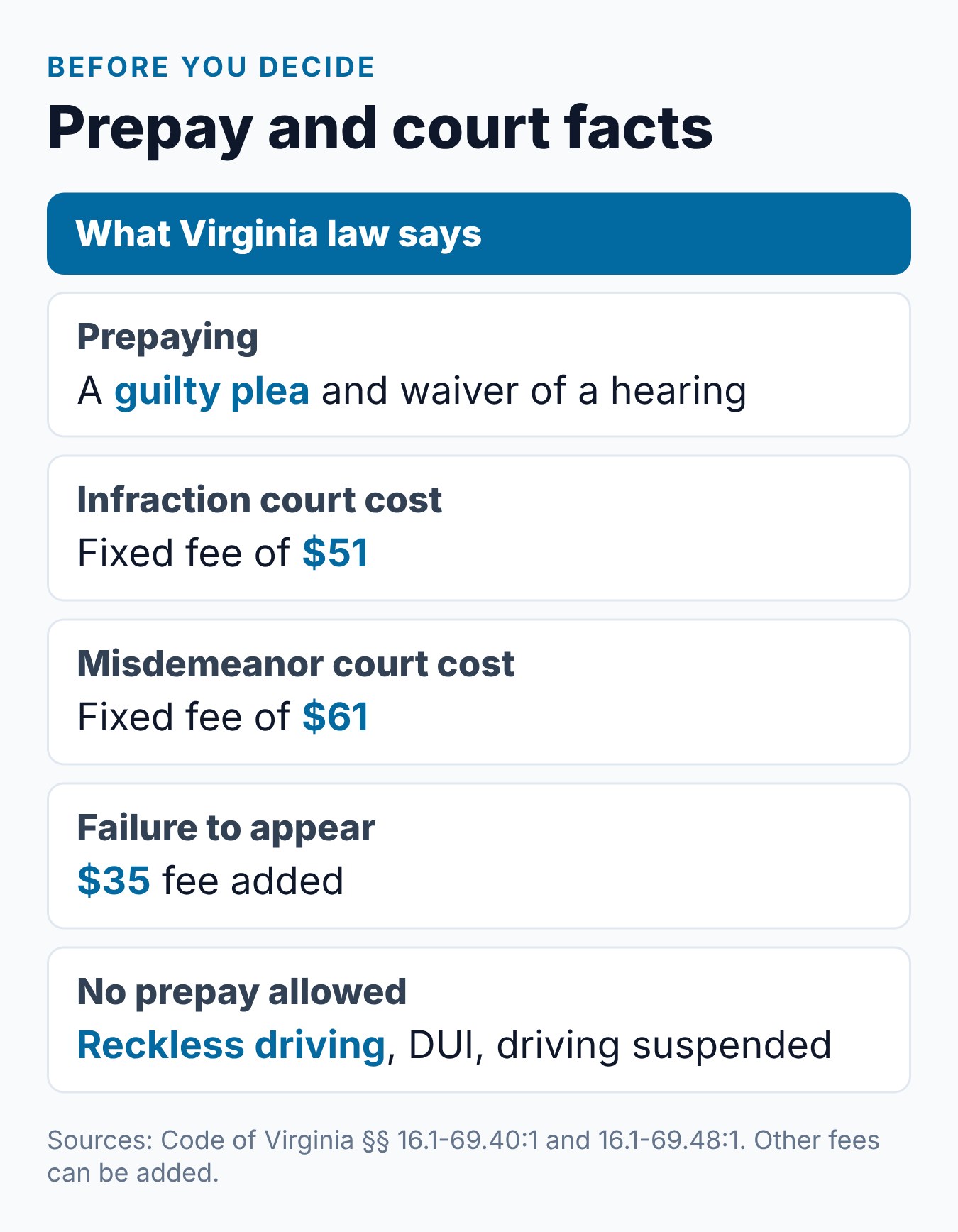
- Prepaying is a plea: paying the ticket counts as a guilty plea and a waiver of a hearing. See what prepaying means.
- Not every charge qualifies: reckless driving, DUI and driving while suspended cannot be prepaid. See charges that need court.
- Missing court costs more: the Code adds a $35 fee when a defendant fails to appear. See going to court.
- Points follow a conviction: a speeding conviction adds 3, 4 or 6 DMV demerit points. See points after a conviction.
- The court decides on clinic points: if a judge orders a clinic, the judge decides if you get safe driving points. See where a clinic fits.
What Prepaying Means in Virginia
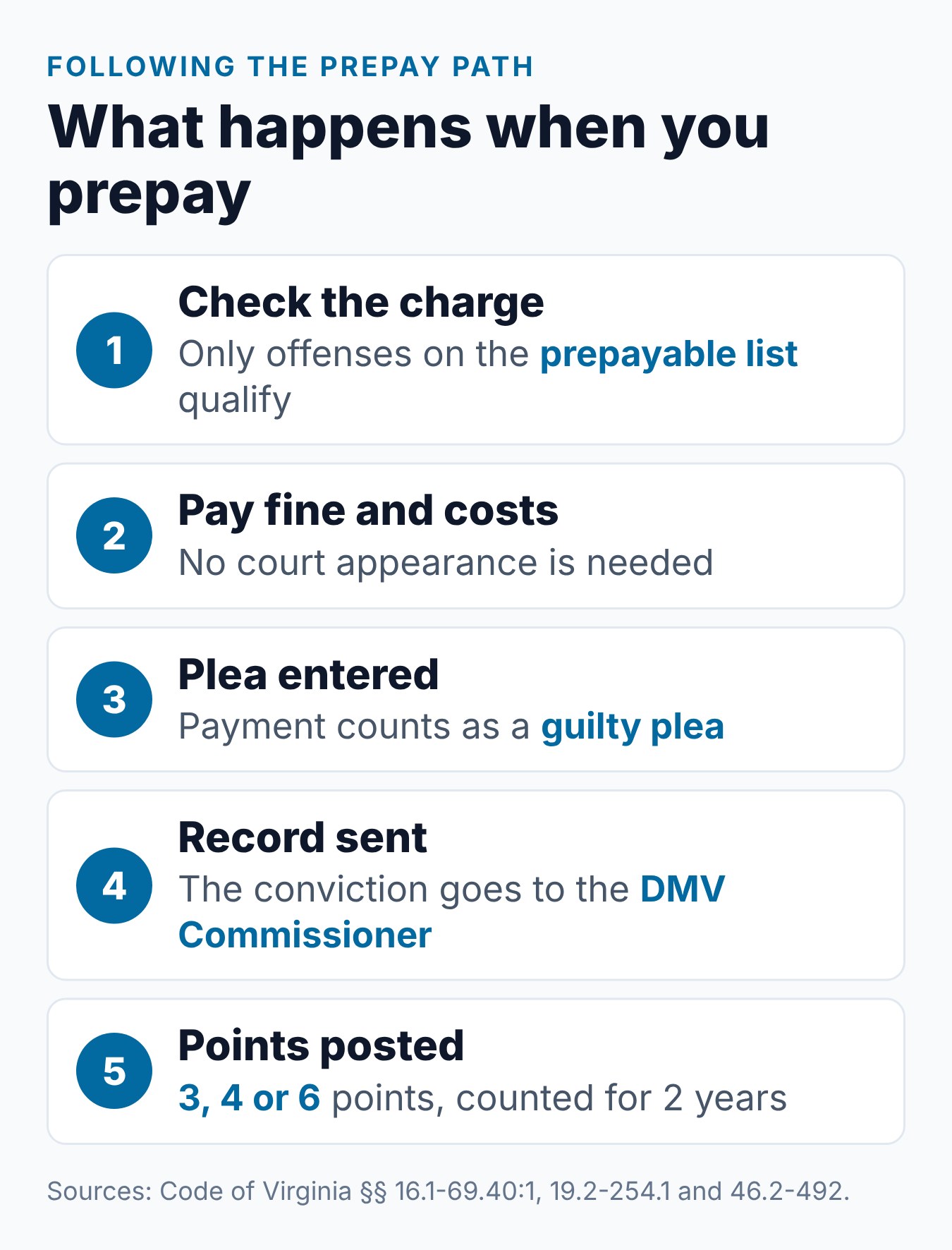
Prepaying means you pay the fine and court costs without going to court. Code of Virginia § 16.1-69.40:1 allows this for offenses on a prepayable list. The same section warns that your signature on a guilty plea has “the same force and effect as a judgment of court.”
A second law says the same thing in other words. Under § 19.2-254.1, paying is “deemed a waiver of court hearing and entry of guilty plea.” So a prepaid ticket is not a quiet payment. It is a conviction.
After you prepay, the record of conviction goes to the DMV Commissioner. DMV then posts the conviction and any demerit points to your driving record.
Who Sets the Prepayable List
The Supreme Court of Virginia sets the list of offenses that can be prepaid. Section 16.1-69.40:1 says the schedule “shall be uniform in its application throughout the Commonwealth.” That means the list of prepayable offenses is the same in every Virginia court.
The court clerk can tell you if your charge can be prepaid. If it cannot, you must appear in court.
What a Prepaid Speeding Fine Is Based On
For a prepaid speeding ticket, § 46.2-878.3 sets the fine at $6 for each mph over the limit. The rate is $7 in school crossing zones and highway work zones, and $8 in posted residence districts. A fixed $51 court cost is added, and other fees can be added too.
Our speeding ticket fines guide walks through the math by speed. This page stays on the choice between paying and court.
Charges That Cannot Be Prepaid
Some charges always need a court date. Section 16.1-69.40:1 lists them. Prepayment is not allowed for:
- Indictable offenses
- Driving under the influence (DUI)
- Reckless driving
- Leaving the scene of a crash
- Driving while your license is suspended or revoked
- Driving without a license
This list matters for speeding. Under § 46.2-862, driving 20 mph or more over the limit, or over 85 mph, is reckless driving. If your summons charges reckless driving, the prepay path is closed.
Our article on when speeding becomes reckless driving explains that line in full.
What Going to Court Involves
If you go to court, you appear in the court named on your summons, on the date it shows. The judge hears the case and decides the outcome.
Court costs are fixed by law. Code § 16.1-69.48:1 sets a fixed fee of $51 for a traffic infraction and $61 for a misdemeanor. Those costs also apply on a written guilty plea or a trial held without you.
The Fee for Missing Court
The same section adds another charge. It says “a fee of $35 shall be taxed as costs whenever a defendant fails to appear.” So skipping a court date adds a cost on top of the fixed fee.
The case can still go forward, since the Code refers to trials held in a defendant’s absence. Follow your summons, and call the court clerk if you cannot attend.
Virginia Speeding Ticket Pay or Court: Facts to Check First
These are facts to gather, not advice on what to choose. Each one changes what a conviction would mean for you.
| Fact to check | Why it matters | Where the rule comes from |
|---|---|---|
| Your speed over the limit | 20 or more over, or over 85 mph, is reckless driving | Code § 46.2-862 |
| The charge on your summons | Reckless driving cannot be prepaid | Code § 16.1-69.40:1 |
| Your current DMV points | A new conviction adds 3, 4 or 6 points | Code § 46.2-492 |
| Whether you hold a CDL | 15 or more over is a serious violation for CDL holders | 49 CFR 383.51 |
| Your age | Drivers under 20 face a required clinic after a point conviction | Code §§ 46.2-334.01, 46.2-334.02 |
Your Speed and the Charge
Read your summons closely. Note the speed and the charge. A plain speeding charge is a traffic infraction, while reckless driving is a Class 1 misdemeanor.
Your Current Points
DMV offers a “Points Balance” link on its online record request page. Knowing your balance helps you see how close a new conviction would bring you to a DMV action. A driving record costs $9, or $8 online.
A Commercial License
If you hold a commercial driver’s license, federal rules add another layer. Under 49 CFR 383.51, speeding 15 mph or more over the limit is a “serious traffic violation.” Our CDL speeding ticket guide covers those rules.
Points After a Conviction
Both paths can end in a conviction. When they do, DMV adds demerit points under § 46.2-492:
- 1 to 9 mph over: 3 points.
- 10 to 19 mph over: 4 points.
- 20 mph or more over: 6 points.
Points count for 2 years from the date of the offense. The conviction itself stays on your DMV record longer. DMV’s four-point list shows speeding convictions kept for 5 years, and reckless driving stays 11 years.
DMV also says on its point assessment page that it “Notifies your insurance company upon request.” Insurance points are set by each company and are not DMV points.
When Points Lead to DMV Action
For drivers 18 and over, DMV acts at set point totals. DMV may send an advisory letter at 8 points in 12 months, or 12 in 24. A clinic is required at 12 points in 12 months, or 18 in 24.
At 18 points in 12 months, or 24 in 24, DMV suspends the license for 90 days and requires a clinic. Code § 46.2-506, as amended in 2025, also allows 9 months in the Intelligent Speed Assistance Program plus the clinic instead.
Drivers Under 20
Young drivers face rules based on convictions, not point totals. A conviction that comes from a prepaid ticket counts the same as one from court:
- Ages 18 and 19: any demerit-point conviction means a required clinic.
- Under 18, first conviction: a required clinic within 90 days, or a suspension until it is done.
- Under 18, second conviction: a 90-day suspension.
- Under 18, third conviction: revocation for 1 year or until age 18, whichever is longer.
Where a Clinic Fits
A court can order a driver to attend a Driver Improvement Clinic. Under § 46.2-505, the court decides if the driver gets safe driving points. You must give the clinic the court’s paper so DMV can award points.
The same section adds two duties. You must tell the court whether you finished, and not finishing may be punished as contempt of court.
A Voluntary Clinic
You can also take the clinic by choice. The Virginia Driver Improvement Clinic is an 8-hour course from a DMV-licensed provider, and it costs no more than $100. An eligible completion earns 5 safe driving points, once every 24 months.
The clinic does not take the conviction off your record. You get either the point benefit or an insurance discount, not both. We found no official source on how a judge treats a clinic taken before court, so ask the court.
Getting Help With Your Own Case
The choice to prepay or contest is a legal decision. This page does not tell you which to pick. Different people can answer different questions:
- The court clerk: whether your charge can be prepaid, and your court date.
- Virginia DMV: your point balance and driving record.
- A Virginia attorney: legal strategy for your own case.
What We Found on the Official Pages
On the official pages we checked on October 27, 2026, § 16.1-69.40:1 showed a history line ending in 2026, Special Session I. Its current text still excludes reckless driving from prepayment.
Section 16.1-69.48:1 showed a history ending in 2025, chapter 121. It listed the $51 infraction fee, the $61 misdemeanor fee and the $35 fee for failing to appear. Section 46.2-878.3 showed no change since 2020.
Common Mistakes
Each item below comes from a Virginia law or DMV page:
- Thinking payment is not a plea. Prepaying is a guilty plea, and the conviction goes to DMV.
- Trying to prepay reckless driving. The Code bars prepayment for reckless driving.
- Skipping the court date. The Code adds a $35 fee when a defendant fails to appear.
- Mixing up insurance points and DMV points. Each insurer sets its own points.
- Assuming a court-ordered clinic gives points. The court decides on points.
- Expecting a clinic to clear the conviction. The conviction stays on the DMV record.
How Requirements Can Vary
Virginia’s point rules, safe driving points and DMV clinic orders come from the Code of Virginia and DMV rules, and they apply statewide. What you must do still depends on whether you take the clinic by choice, because of a DMV notice, or under a court order. A court order sets its own deadline and proof steps.
Laws, fees and court practice can change. Check your DMV notice, your court order and the Virginia DMV website for current rules before you enroll or file anything.
Frequently Asked Questions
Is paying a Virginia speeding ticket an admission of guilt?
Yes. Under Code § 19.2-254.1, paying is treated as a waiver of a court hearing and a guilty plea. The conviction then goes to DMV.
Can every Virginia speeding ticket be prepaid?
No. Only offenses on the Supreme Court’s prepayable list can be prepaid. Reckless driving, which includes 20 or more over or over 85 mph, cannot be prepaid.
What happens if I miss my court date?
The Code adds a $35 fee whenever a defendant fails to appear. The Code also refers to trials held in a defendant’s absence, so contact the court clerk.
Do I get points if I prepay?
Yes. A prepaid speeding ticket is a conviction, and DMV adds 3, 4 or 6 points based on the speed. The points count for 2 years from the offense date.
Should I fight a Virginia speeding ticket?
That is a legal choice for you to make with a Virginia attorney. This page lists facts to check, such as your speed, your points and whether you hold a CDL.
Does a court-ordered clinic give safe driving points?
Only if the court says so. Under Code § 46.2-505, the court decides, and you give the clinic the court’s paper.
Is the prepaid amount the same in every Virginia court?
The rules behind it are statewide. The Supreme Court sets the prepayable list, and the Code says it is uniform throughout the Commonwealth. The prepaid speeding rate of $6 per mph over also comes from state law, Code § 46.2-878.3.
Conclusion
Paying a Virginia speeding ticket is a guilty plea, and the points follow the conviction to DMV. Reckless driving cannot be prepaid, and missing court adds a $35 fee.
If you want to earn 5 safe driving points by choice, you can take the Virginia Driver Improvement Course online. If a court ordered your clinic, ask the court first whether it accepts an online course.
Related Articles
- Virginia Speeding Ticket: Costs, Points, and What Happens Next
- Virginia Speeding Ticket Fines: What Affects the Cost?
- Virginia Reckless Driving Speed: 20 Over or Over 85 MPH
- Virginia Speeding Ticket for CDL Holders: Higher Stakes and Federal Rules
Sources
- Code of Virginia § 16.1-69.40:1 — Traffic infractions, prepayment
- Code of Virginia § 19.2-254.1 — Procedure in traffic infraction cases
- Code of Virginia § 16.1-69.48:1 — Fixed fee in district court
- Code of Virginia § 46.2-878.3 — Prepayment of speeding fines
- Code of Virginia § 46.2-862 — Exceeding speed limit (reckless)
- Code of Virginia § 46.2-492 — Uniform Demerit Point System
- Code of Virginia § 46.2-505 — Court may direct a clinic
- Virginia DMV — Moving Violations and Point Assessments
- Virginia DMV — Four Point Violations
- Virginia DMV — Six Point Violations
- 49 CFR § 383.51 — CDL disqualifications
- Virginia DMV — Online Record Request
Billy Forte is the owner of Driving Logic, a state-approved driver improvement course provider serving Virginia and other U.S. states.
This article is general information, not legal advice. Virginia DMV rules, court orders, fines and penalties depend on your notice, summons, court and case facts, and they can change. Use official Virginia DMV and court sources, and consult a qualified Virginia attorney for advice about your own case.