
Updated October 2026 · Reviewed by Billy Forte
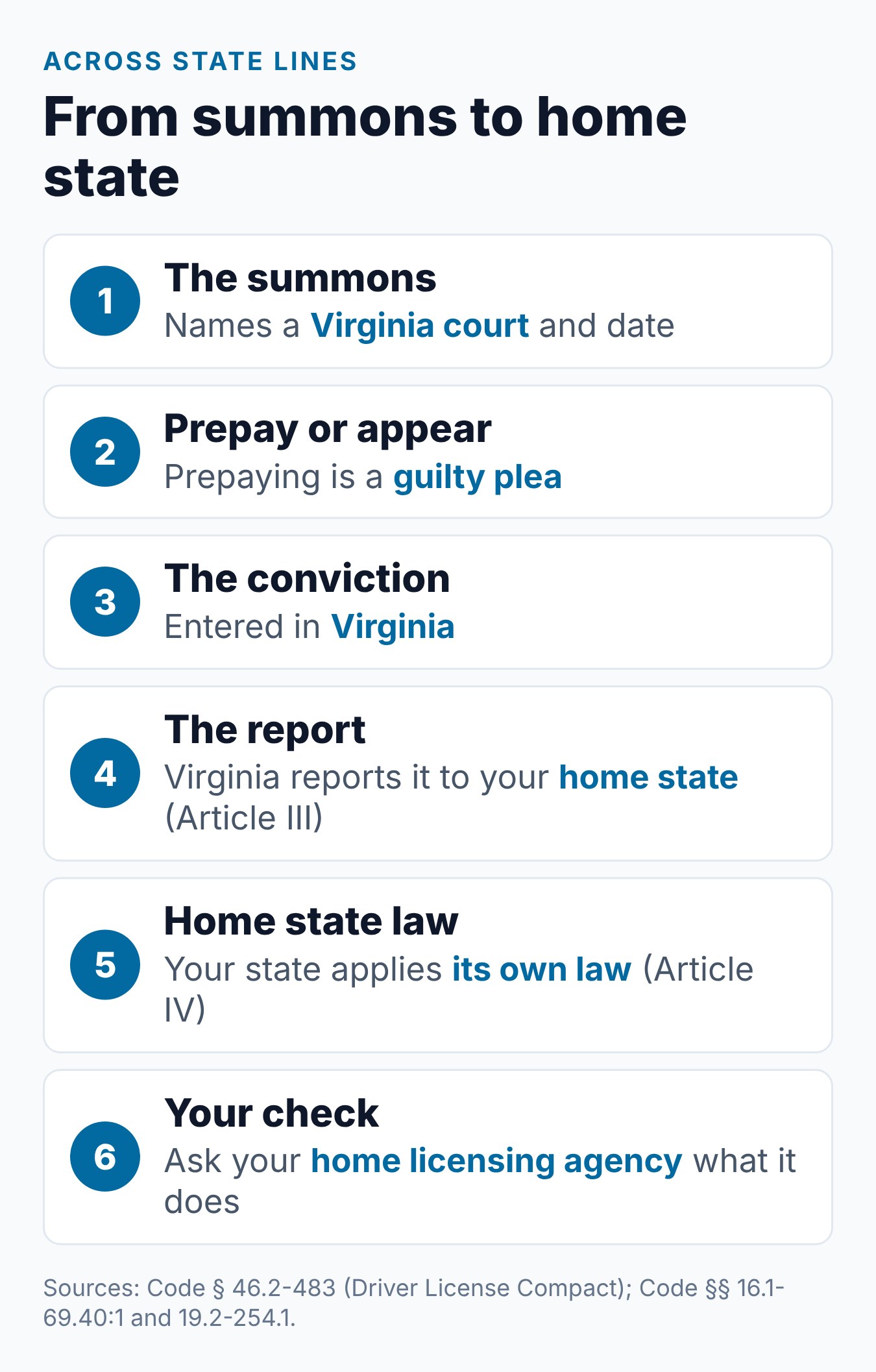
If you searched Virginia speeding tickets out of state, the short answer is this: the Virginia court handles the case, and Virginia reports any conviction to your home state. Under the Driver License Compact, your home state then decides what the conviction means for your license under its own law. If the charge can be prepaid, you may pay without going to court, but prepaying counts as a guilty plea.
Key Facts
- Reporting: Virginia reports each conviction of a driver from another compact state to that state. See how reporting works.
- Your home state: it applies its own law to the conviction. See who decides what.
- The case: it stays in the Virginia court named on your summons. See the Virginia case.
- Prepaying: allowed for prepayable charges, and it counts as a guilty plea. See prepaying from home.
- Reckless driving: 20 or more over, or over 85 mph, cannot be prepaid. See the reckless line.
Virginia Speeding Tickets Out of State: Who Decides What
A ticket in Virginia involves two governments. Virginia handles the charge. Your home state handles your license.
The link between them is the Driver License Compact. Virginia adopted it in Code § 46.2-483. The table sorts out which side controls what.
| Question | Who decides | Where the rule is |
|---|---|---|
| Where the case is heard | The Virginia court on your summons | Your summons |
| The prepaid fine rate | Virginia law | Code § 46.2-878.3 |
| Whether you can prepay | Virginia’s prepay list | Code § 16.1-69.40:1 |
| What the conviction means for your license | Your home state, under its own law | Compact, Article IV |
| Whether Virginia safe driving points count at home | Your home state | Your home state’s DMV |
The rest of this guide explains each row. For the general picture of fines and points, see the Virginia speeding ticket guide.
How Virginia Reports the Conviction
Article III of the compact sets the duty to report. The state where the conviction happens “shall report each conviction of a person from another party state” to the home state.
So a conviction does not stay in Virginia. Your home state’s licensing agency receives the report.
A charge alone is not a conviction. The report follows a conviction, which can come from a court finding or from prepaying.
What Your Home State Does With It
Article IV sets the effect at home. For a short list of serious offenses, the home state “shall give the same effect to the conduct reported.” That list covers:
- Manslaughter or negligent homicide with a vehicle.
- Driving under the influence.
- A felony in which a vehicle was used.
- Failure to stop and render aid after a crash.
Speeding is not on that list. For other offenses, the home state applies its own law. The compact text does not mention points at all.
That means Virginia law does not say how your home state will treat the ticket. Check your home state’s licensing agency for its rules.
The Case Stays in Virginia
Leaving Virginia does not move the case. It stays in the Virginia court named on your summons, with the date shown there.
The summons is your main source. It names the court, the charge and the date. If anything on it is unclear, contact that court.
We do not tell readers whether to pay or contest. For the facts on each path, see pay or go to court. For advice on your own case, ask the court or a Virginia attorney.
Prepaying From Another State
Some charges can be settled without a court visit. Code § 16.1-69.40:1 says a person charged with a prepayable offense “may prepay his fines and costs without court appearance.”
Prepaying has the same legal effect as a court judgment. The law says your signature to a guilty plea “will have the same force and effect as a judgment of court.” The record of conviction is then sent to Virginia DMV.
Code § 19.2-254.1 adds that payment is “deemed a waiver of court hearing and entry of guilty plea.” So a prepaid ticket is still a conviction. Under the compact, Virginia then reports it to your home state.
What the Ticket Costs
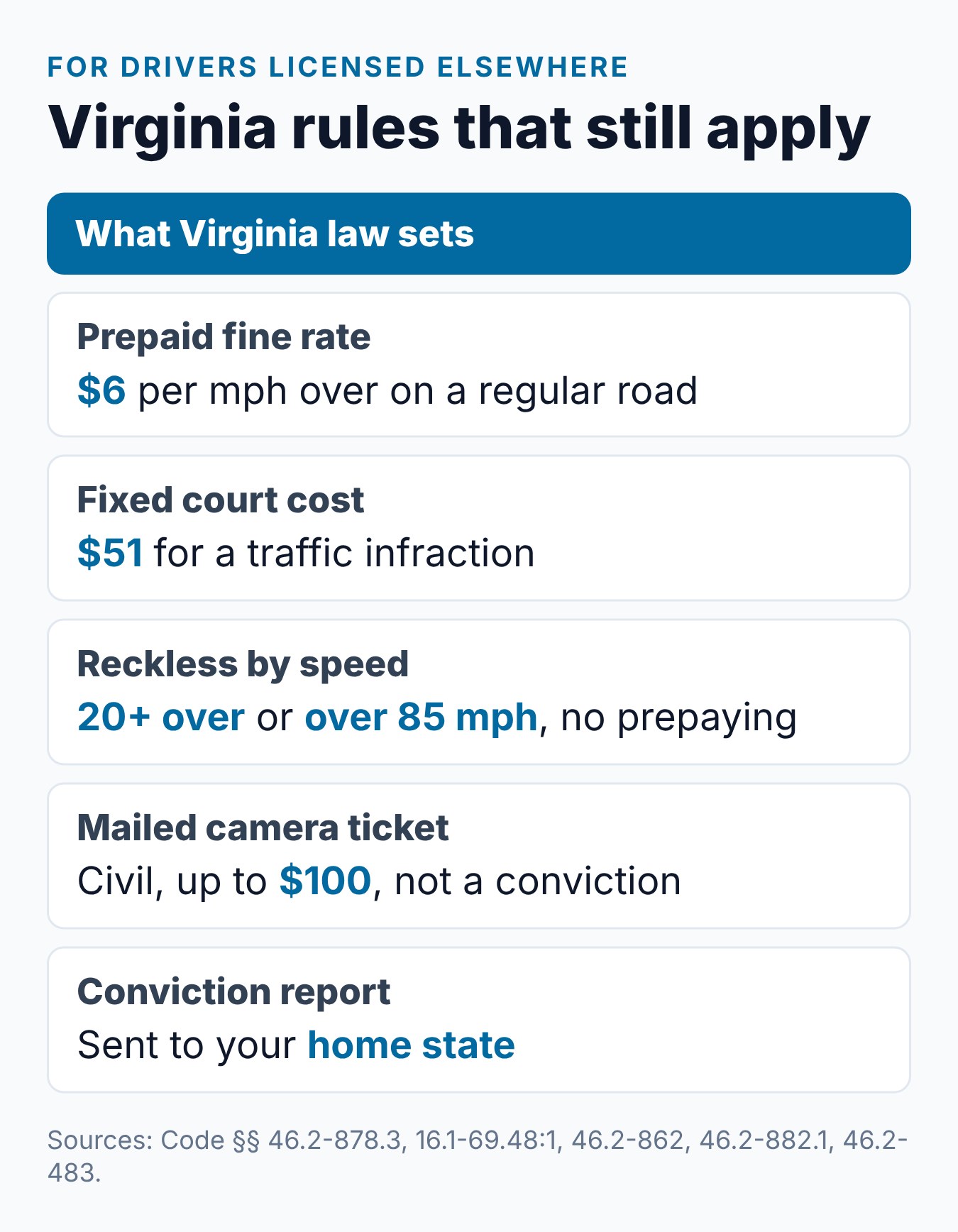
The amount does not change because you live elsewhere. Code § 46.2-878.3 sets the prepaid rates:
- $6 per mph over on a regular road.
- $7 per mph over in a school crossing zone or highway work zone.
- $8 per mph over in a posted residence district.
- An extra $100 for over 80 but under 86 mph on a 65 mph road.
Code § 16.1-69.48:1 adds a fixed $51 court cost for a traffic infraction. Other fees can be added. If you go to court, the judge can set a different amount.
When the Charge Is Reckless Driving
Some Virginia speeding tickets are not plain speeding. Under Code § 46.2-862, driving 20 mph or more over the limit is reckless driving. So is driving over 85 mph on any road.
Reckless driving is a Class 1 misdemeanor. It can bring up to 12 months in jail and a fine up to $2,500. A court may also suspend the license for up to 6 months, or order the Intelligent Speed Assistance Program instead.
It cannot be prepaid. The case goes through the Virginia court even if you live far away. Ask the court or a Virginia attorney what that means for your case.
CDL Holders From Any State
Federal rules follow a commercial driver everywhere. Under 49 CFR 383.51, speeding 15 mph or more over is a serious traffic violation. So is driving recklessly.
Two serious violations within 3 years mean a 60-day disqualification. Three mean 120 days. A ticket in a personal car counts only if it leads to a suspension, revocation or cancellation.
States also may not hide these convictions. 49 CFR 384.226 bars a state from masking or deferring a CDL holder’s traffic conviction. See CDL speeding tickets.
Mailed Camera Tickets Are Different
A speed camera ticket can reach a vehicle owner by mail. Under Code § 46.2-882.1, it is a civil penalty that “shall not exceed $100.”
A mailed camera summons is not a conviction as an operator. It is not part of the driving record and is not used for insurance.
The owner can respond by affidavit, by testimony, or with a stolen-vehicle report. See speed camera tickets.
Can a Visitor Take Virginia’s Clinic?
Virginia’s course is the Driver Improvement Clinic (DIC). It is an 8-hour course, and a clinic may charge no more than $100.
Code § 46.2-498 opens voluntary attendance to a “resident or nonresident person holding a valid license to drive a motor vehicle in Virginia.” It does not say how another state treats the clinic.
Nothing in the compact makes your home state count Virginia safe driving points. Before you enroll for that reason, ask your home state’s licensing agency how it treats the clinic. If a Virginia court orders a clinic, the court decides on points.
The Reverse Case: Virginia Drivers
Some readers hold a Virginia license and got a ticket while away. Others hold a Virginia license but live elsewhere for school or service. Virginia’s own rules cover both.
Tickets in other states: DMV says demerit points “will also be assigned to your record for traffic convictions incurred in other states.” Its Moving Violations and Point Assessments page explains this.
Clinic deadlines while away: DMV may extend a 90-day clinic deadline for out-of-state college students. It may also extend it for military members or dependents stationed outside Virginia. This applies only where no approved clinic is offered.
Moving in: under Code § 46.2-488, Virginia requires you to surrender an out-of-state license before it issues one.
Questions to Answer Before You Act
Your summons and your home state hold the answers. Work through these:
- Is the charge prepayable? Reckless driving is not.
- Which court and date? Both are on your summons.
- Was it a mailed camera ticket? That is a civil penalty, not a conviction.
- Do you hold a CDL? Federal serious-violation rules may apply.
- What does your home state do? Ask its licensing agency, since it applies its own law.
What We Checked on the Official Pages
On the Code pages we checked on October 27, 2026, § 46.2-483 still held the full compact text. Article III set the duty to report, and Article IV set the home state’s role.
The compact did not mention demerit points. The prepayment law had a 2026 update, and it still left reckless driving off the prepay list.
Common Mistakes to Avoid
Each item comes from the Code or a DMV page:
- Thinking the ticket stays in Virginia. Virginia reports convictions to your home state.
- Treating prepaying as a fee. It is a guilty plea with the force of a court judgment.
- Expecting to prepay reckless driving. It is not on the prepay list.
- Using 80 as the line. It is 20 or more over, or over 85.
- Assuming home rules match Virginia’s. Your home state applies its own law.
- Mixing up camera and officer tickets. Only a mailed camera summons is kept off the driving record.
How Requirements Can Vary
Virginia’s point rules, safe driving points and DMV clinic orders come from the Code of Virginia and DMV rules, and they apply statewide. What you must do still depends on whether you take the clinic by choice, because of a DMV notice, or under a court order. A court order sets its own deadline and proof steps.
Laws, fees and court practice can change. Check your DMV notice, your court order and the Virginia DMV website for current rules before you enroll or file anything.
Frequently Asked Questions
Will a Virginia speeding ticket go on my out-of-state record?
Virginia reports the conviction to your home state under the Driver License Compact. Your home state then applies its own law. Ask your home state’s licensing agency how it records the conviction.
Do I have to go back to Virginia for court?
If the charge is prepayable, Virginia law lets you prepay without a court appearance. Prepaying counts as a guilty plea. Reckless driving cannot be prepaid, so ask the court on your summons what applies.
Does Virginia give points to out-of-state drivers?
The compact does not mention points. What your home state does with the conviction depends on its own law. Virginia does assign points to Virginia drivers for convictions in other states.
How much is a Virginia speeding ticket for a visitor?
The same as for anyone. A prepaid fine is $6 per mph over, plus a fixed $51 court cost. Higher rates apply in some zones, and other fees can be added.
Can I take the Virginia clinic if I live in another state?
Code § 46.2-498 opens voluntary attendance to a “resident or nonresident person holding a valid license to drive a motor vehicle in Virginia.” Your home state does not have to count Virginia safe driving points. Ask your home state’s agency first.
What if I hold a CDL from another state?
Federal rules treat speeding 15 or more over and reckless driving as serious traffic violations. Two within 3 years mean a 60-day disqualification. States may not mask a CDL holder’s conviction.
Is a mailed camera ticket reported to my state?
A mailed speed camera summons is not a conviction as an operator. It is not part of the driving record and is not used for insurance.
Conclusion
A Virginia speeding ticket stays with the Virginia court on your summons, and any conviction is reported to your home state. Your home state applies its own law, so check with its licensing agency before you decide anything.
If you hold a valid Virginia license and want to lower your point total, you can take the Virginia Driver Improvement Course online. If a court ordered your clinic, ask the court first whether it accepts an online course.
Related Articles
- Virginia Speeding Ticket: Costs, Points, and What Happens Next
- Virginia Speeding Ticket: What to Know Before You Pay or Go to Court
- How Long Does a Speeding Ticket Stay on Your Record in Virginia?
- Virginia Speed Camera Tickets: Do They Go on Your Driving Record?
Sources
- Code of Virginia § 46.2-483 — Driver License Compact
- Code of Virginia § 46.2-488 — Surrender of out-of-state license
- 49 CFR § 383.51 — CDL disqualifications
- 49 CFR § 384.226 — Prohibition on masking convictions
- Code of Virginia § 16.1-69.40:1 — Traffic infractions, prepayment
- Code of Virginia § 19.2-254.1 — Procedure in traffic infraction cases
- Code of Virginia § 46.2-862 — Exceeding speed limit (reckless)
- Code of Virginia § 46.2-878.3 — Prepayment of speeding fines
- Code of Virginia § 16.1-69.48:1 — Fixed fee in district court
- Code of Virginia § 46.2-498 — Driver improvement clinics; voluntary attendance
- Code of Virginia § 46.2-882.1 — Photo speed monitoring; civil penalty
- Virginia DMV — Moving Violations and Point Assessments
- Virginia DMV — Driver Improvement
Billy Forte is the owner of Driving Logic, a state-approved driver improvement course provider serving Virginia and other U.S. states.
This article is general information, not legal advice. Virginia DMV rules, court orders, fines and penalties depend on your notice, summons, court and case facts, and they can change. Use official Virginia DMV and court sources, and consult a qualified Virginia attorney for advice about your own case.