
Updated October 2026 · Reviewed by Billy Forte
Virginia speeding ticket fines are set by speed: a prepaid fine is $6 for each mph over the limit, plus a fixed $51 court cost. The rate rises to $7 per mph in a school crossing zone or highway work zone, and to $8 per mph in a posted residence district. Not every charge can be prepaid, and a judge can set a different amount in court.
Key Facts
- Base rate: $6 for each mph over the posted limit, if prepaid. See how fines are figured.
- Higher rates: $7 in school crossing and work zones, $8 in posted residence districts. See rates by place.
- Extra $100: over 80 but under 86 mph on a 65 mph road. See the extra $100.
- Court cost: a fixed $51 for a traffic infraction, and other fees can be added. See court costs.
- Reckless line: 20 or more over, or over 85 mph, cannot be prepaid. See when the math changes.
How Virginia Speeding Ticket Fines Are Figured
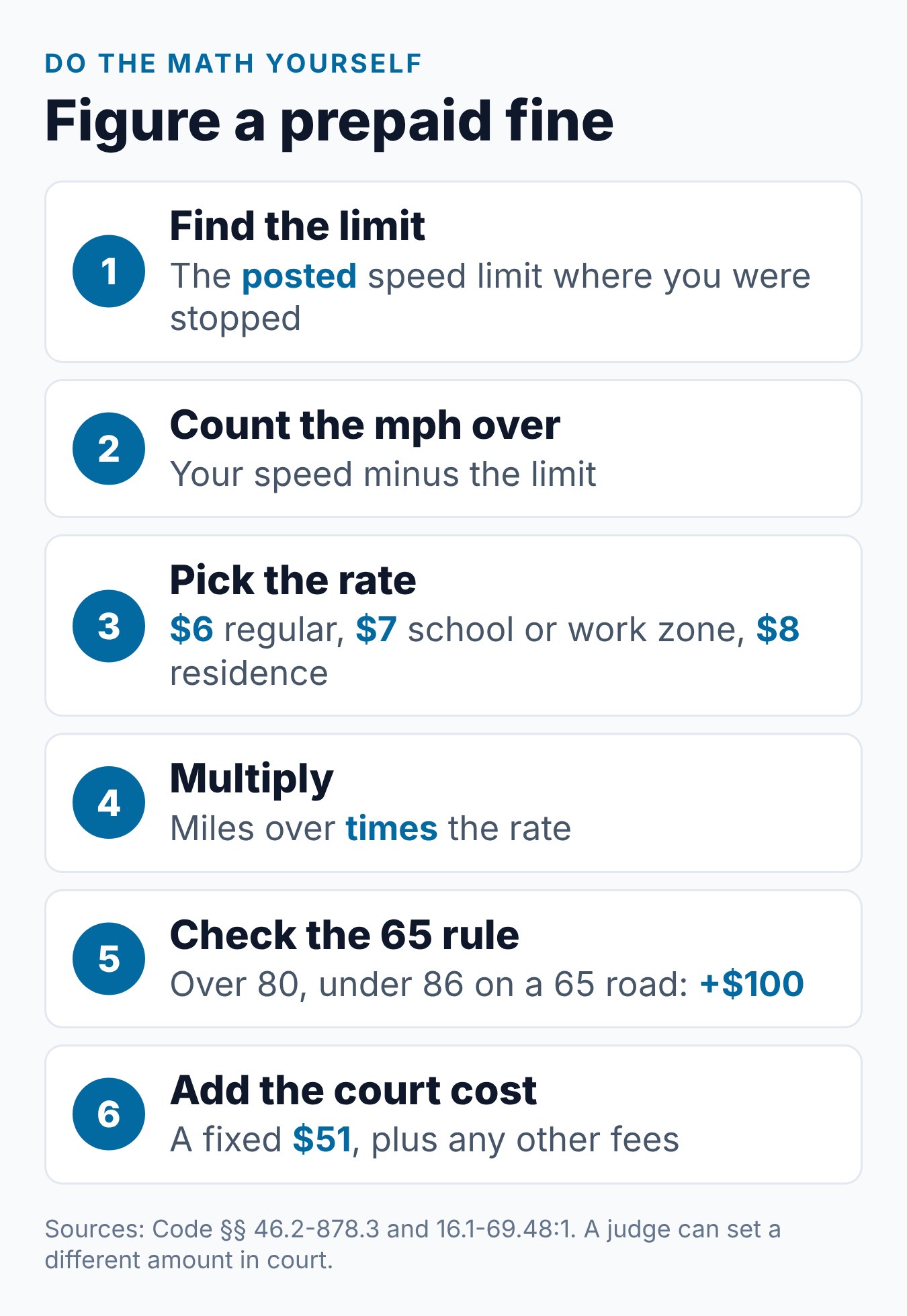
The prepaid fine is simple math. You take the miles per hour over the posted limit and multiply by a set rate. That rate comes from Code § 46.2-878.3.
The base rate is “$6 per mile-per-hour in excess of posted speed limits.” So a driver going 10 over has a prepaid fine part of $60. A driver going 5 over has a fine part of $30.
The prepayment schedule is the same across the state. Code § 16.1-69.40:1 says the Supreme Court sets it, and it “shall be uniform in its application throughout the Commonwealth.”
For the overview of fines, points and options, see our Virginia speeding ticket guide.
The Rate Depends on Where You Were
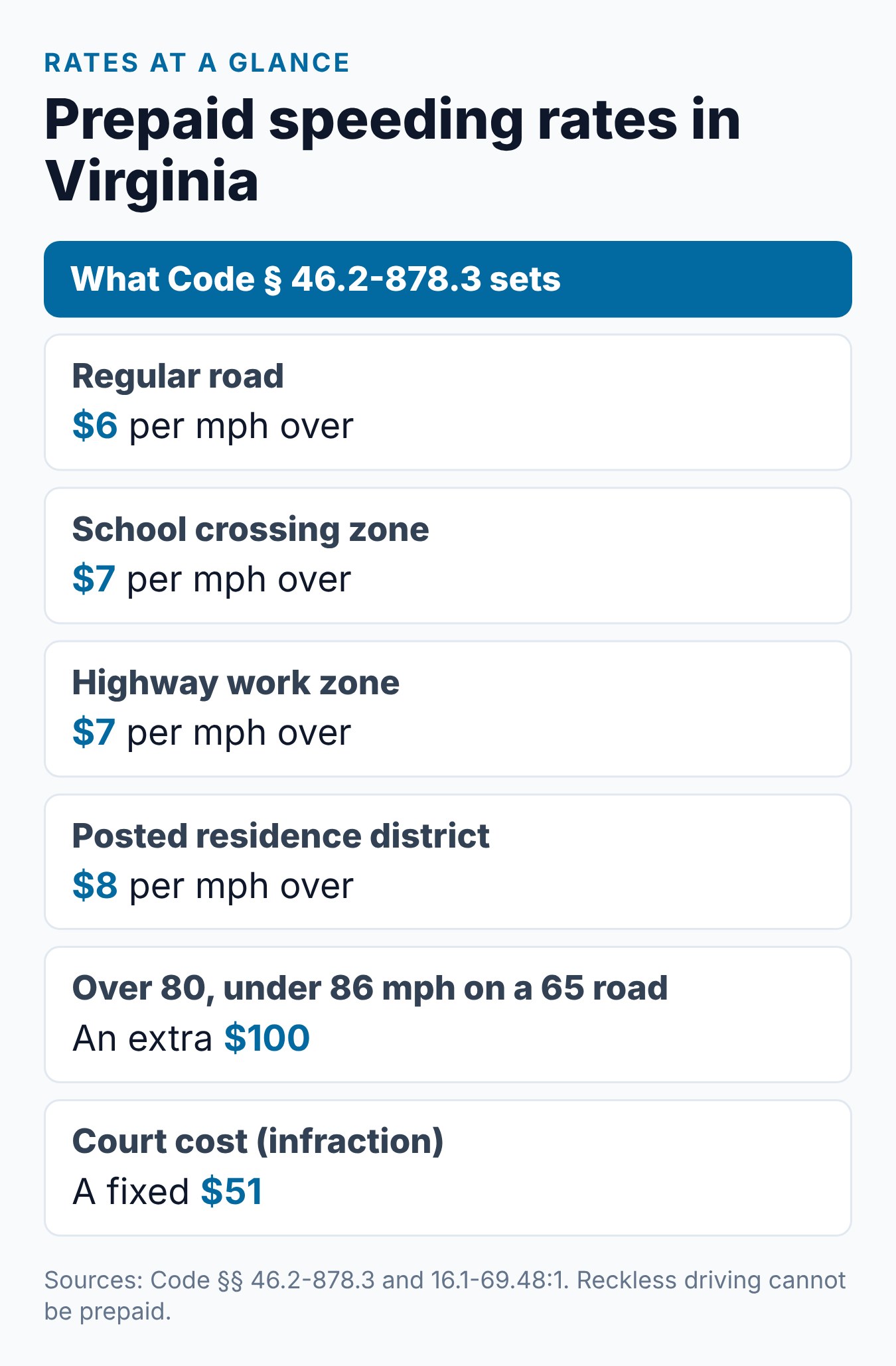
The same speed can cost more in some places. The prepaid rates are:
- Regular road: $6 per mph over.
- School crossing zone: $7 per mph over.
- Highway work zone: $7 per mph over.
- Posted residence district: $8 per mph over.
Each zone also has its own law. Under Code § 46.2-878.1, a work zone fine can be up to $500 when workers are present and signs are posted. Under Code § 46.2-873, a school crossing zone fine can be up to $250.
Those caps are not the same thing as the per-mph rate. Our guide to school zone and work zone tickets explains when each zone rule applies.
Fine Math at Common Speeds
This table shows the prepaid fine part only. It does not include the $51 court cost or any other fee. It also stops at 19 over, because 20 or more over meets the reckless line.
| Miles over the limit | Regular road ($6) | School crossing or work zone ($7) | Residence district ($8) |
|---|---|---|---|
| 5 over | $30 | $35 | $40 |
| 10 over | $60 | $70 | $80 |
| 15 over | $90 | $105 | $120 |
| 19 over | $114 | $133 | $152 |
Each cell is the rate times the miles over. If you go to court, the judge can set a different amount.
How Much Is a 15 Over Speeding Ticket in Virginia?
At 15 over on a regular road, the prepaid fine part is 15 times $6, or $90. The fixed $51 court cost is added. Other fees can be added by other laws.
In a school crossing zone or work zone, the fine part is 15 times $7, or $105. In a posted residence district, it is 15 times $8, or $120.
A 15-over conviction also carries 4 demerit points. DMV’s four-point violations list shows “Speeding 15-19 mph” kept on the record 5 years.
Fifteen over is not reckless driving by speed on its own. Speeds over 85 mph meet the reckless line even when they are less than 20 over. For example, 86 mph on a road posted at 70 is 16 over, but it is over 85.
The Extra $100 on 65 MPH Roads
One rule adds a flat amount. Code § 46.2-878.3 adds “an additional fine of $100” for going over 80 but under 86 mph on a highway with a 65 mph limit.
Here is how that works on a 65 mph road:
- 80 mph or less: no extra $100.
- Over 80 but under 86 mph: the per-mph fine plus $100.
- 85 mph: this is also 20 over a 65 limit, which meets the reckless line.
For example, 82 mph on a 65 road is 17 over. The fine part is 17 times $6, or $102, plus the extra $100.
Court Costs on Top of the Fine
The fine is not the only charge. Code § 16.1-69.48:1 says that for a traffic infraction, “there shall be assessed as court costs a fixed fee of $51.”
Costs also apply when you prepay with a written guilty plea. The same law says other fees may be added by other laws. So no official source gives one total for every ticket.
We do not give total-cost estimates. Your summons or the court clerk can tell you what applies to your case.
Prepaying Is a Plea
The prepaid amount comes with a legal effect. Under Code § 16.1-69.40:1, your signature “will have the same force and effect as a judgment of court.” The record of conviction is sent to DMV.
Code § 19.2-254.1 says paying is “deemed a waiver of court hearing and entry of guilty plea.” So paying the fine also means points and a DMV record entry.
Not every charge can be prepaid. Reckless driving, DUI and driving while suspended are not on the prepay list.
For the facts on each choice, see pay or go to court. For your own case, ask the court or a Virginia attorney.
Points That Come With the Fine
A fine is paid once, but points stay on your record for a while. Code § 46.2-492 and DMV’s lists set the speeding values:
- 1 to 9 over: 3 points.
- 10 to 14 over, and 15 to 19 over: 4 points.
- 20 or more over: 6 points.
Points count for 2 years from the offense date. The speeding conviction stays on your DMV record 5 years.
When the Reckless Line Changes the Math
At 20 mph or more over, or over 85 mph, the per-mph rate stops being the whole story. Code § 46.2-862 makes that reckless driving.
Reckless driving is a Class 1 misdemeanor. Under Code § 18.2-11, the fine can be up to $2,500, with up to 12 months in jail, or both. It cannot be prepaid.
DMV also lists a plain speeding conviction for 20 or more over. Our guide to 20 over in Virginia explains both outcomes.
Costs Beyond the Court
Two other costs can follow a ticket. Neither one is part of the court fine.
Insurance: the Bureau of Insurance says increases for violations “may be applied for 36 months.” No law sets the amount. See insurance after a ticket.
A clinic, if you choose one: a Driver Improvement Clinic (DIC) may charge no more than $100. An eligible clinic can earn 5 safe driving points, once every 24 months. It does not change the fine.
A required clinic: some drivers must take one. A driver aged 18 or 19 with any demerit-point conviction must take a clinic. A driver 18 or older who reaches 12 points in 12 months, or 18 in 24, must take one too.
Camera Tickets Use a Different Amount
A mailed speed camera ticket does not use the per-mph rate. Code § 46.2-882.1 sets a civil penalty that “shall not exceed $100.” The camera only applies when a vehicle goes at least 10 mph over the posted limit.
A mailed camera summons is not a conviction. It is not part of your driving record and is not used for insurance.
A ticket an officer hands you at the time is different, and it is a conviction. See our speed camera ticket guide.
Questions to Check Before You Pay
Your summons holds the facts that set the amount. Check these points first:
- Is the charge prepayable? Reckless driving is not.
- Where were you stopped? A school crossing zone, work zone or residence district uses a higher rate.
- What was the posted limit? On a 65 mph road, over 80 but under 86 mph adds $100.
- How many miles over? That number sets both the fine and the points.
- Do you hold a CDL? Speeding 15 or more over is a serious traffic violation for CDL holders. See CDL speeding tickets.
If any answer is unclear, ask the court clerk named on your summons.
What We Checked on the Official Pages
On the Code pages we checked on October 27, 2026, § 46.2-878.3 still listed the $6, $7 and $8 rates. Its history line ended in 2020.
The court cost law, § 16.1-69.48:1, showed “a fixed fee of $51” for traffic infractions. Its history line ended with a 2025 change. The prepayment law still left reckless driving off the prepay list.
Common Mistakes to Avoid
Each item comes from the Code:
- Forgetting the court cost. The $51 fixed fee is added to the fine.
- Using $6 in a zone. School crossing and work zones use $7, and residence districts use $8.
- Missing the $100 rule. Over 80 but under 86 on a 65 mph road adds $100.
- Treating a court amount as fixed. A judge can set a different amount.
- Trying to prepay reckless driving. It is not on the prepay list.
- Thinking payment ends the matter. It is a guilty plea, and the conviction goes to DMV.
How Requirements Can Vary
Virginia’s point rules, safe driving points and DMV clinic orders come from the Code of Virginia and DMV rules, and they apply statewide. What you must do still depends on whether you take the clinic by choice, because of a DMV notice, or under a court order. A court order sets its own deadline and proof steps.
Laws, fees and court practice can change. Check your DMV notice, your court order and the Virginia DMV website for current rules before you enroll or file anything.
Frequently Asked Questions
How are Virginia speeding fines calculated?
A prepaid fine is the miles per hour over the limit times a set rate. The rate is $6 on a regular road, $7 in school crossing and work zones, and $8 in posted residence districts. A $51 court cost is added.
How much is a 15 over speeding ticket in Virginia?
On a regular road, the prepaid fine part is $90, plus the $51 court cost. Other fees can be added. It also carries 4 demerit points.
How much is a 10 over ticket?
On a regular road, the prepaid fine part is $60, plus the $51 court cost. In a school crossing or work zone it is $70, and in a residence district $80.
Can I prepay any speeding ticket?
No. Reckless driving, including 20 or more over or over 85 mph, cannot be prepaid. Check your summons to see if your charge is prepayable.
Is the court cost always $51?
The fixed fee for a traffic infraction is $51 under Code § 16.1-69.48:1. Other fees can be added by other laws, so ask the court clerk what applies.
Does a speed camera ticket use the same rates?
No. A mailed speed camera ticket is a civil penalty of up to $100. It is not a conviction and is not part of your driving record.
Does a driver improvement clinic lower my fine?
No official rule says it does. An eligible clinic can earn 5 safe driving points, once every 24 months. That affects your point total, not the fine.
Conclusion
Virginia speeding ticket fines follow the per-mph rate in Code § 46.2-878.3, plus a $51 court cost and any other fees. The place you were caught, the speed and the reckless line all change the amount.
If you also want to lower your point total, you can take the Virginia Driver Improvement Course online. If a court ordered your clinic, ask the court first whether it accepts an online course.
Related Articles
- Virginia Speeding Ticket: Costs, Points, and What Happens Next
- 20 MPH Over the Speed Limit in Virginia: Fines, Points, and Reckless Driving Risk
- Virginia Work Zone and School Zone Speeding Tickets: Higher Fines
- Virginia Speeding Ticket: What to Know Before You Pay or Go to Court
Sources
- Code of Virginia § 46.2-878.3 — Prepayment of speeding fines
- Code of Virginia § 46.2-882.1 — Photo speed monitoring; civil penalty
- Code of Virginia § 16.1-69.48:1 — Fixed fee in district court
- Code of Virginia § 16.1-69.40:1 — Traffic infractions, prepayment
- Code of Virginia § 19.2-254.1 — Procedure in traffic infraction cases
- Code of Virginia § 46.2-492 — Uniform Demerit Point System
- Virginia DMV — Four Point Violations
- Code of Virginia § 46.2-862 — Exceeding speed limit (reckless)
- Code of Virginia § 18.2-11 — Punishment for misdemeanors
- Code of Virginia § 46.2-873 — School crossing speed limits
- Code of Virginia § 46.2-878.1 — Work zone speed limits
Billy Forte is the owner of Driving Logic, a state-approved driver improvement course provider serving Virginia and other U.S. states.
This article is general information, not legal advice. Virginia DMV rules, court orders, fines and penalties depend on your notice, summons, court and case facts, and they can change. Use official Virginia DMV and court sources, and consult a qualified Virginia attorney for advice about your own case.