
Updated October 2026 · Reviewed by Billy Forte
A Texas driving record background check can only pull what state law lets DPS release to that requester. People who qualify under the Motor Vehicle Records Disclosure Act can get your license status or a three-year history of moving-violation convictions and crashes with a citation. Your full Type 3 or Type 3A record goes only to you.
Key Facts
- Two levels for others: status details ($4) or a three-year conviction and crash history ($6). See what it can include.
- Full record is yours: DPS gives Type 3 and 3A only to the record owner. See what it can include.
- Who qualifies: requesters with a permitted use under Transportation Code Chapter 730. See eligibility.
- Dismissed tickets: a charge dismissed through the DSC may not be part of the record. See what it will not show.
- Insurers: TDI says they consider your driving record and charge more after tickets. See insurers.
What a Texas Driving Record Background Check Can Include
DPS keeps your driving record, and state law sets how much of it others can get. The rules are in Transportation Code Chapter 521.
There are two levels for outside requesters:
- Status, § 521.045 ($4): your date of birth, current license status and latest address. It does not include driving history.
- Three-year history, § 521.046 ($6): the status details plus moving-violation convictions and crashes with a citation, by date and location, from the three years before the request.
The full list is different. Under § 521.047, the record DPS gives you about yourself can list each reported violation and crash. The DPS ordering page says Type 3 and Type 3A are provided only to the record owner.
| Who asks | What DPS can give them |
|---|---|
| You, the record owner | Any of the six record types, including Type 3 and 3A |
| An eligible requester under Chapter 730 | Status, or the three-year conviction and crash history |
| A company | DPS says to email its License and Record Service |
| A judge in a DSC case | Your record through the state portal, under Art. 45A.359 |
License Status Carries Weight
Even the $4 status record says something. It shows your current license status, so a suspended license shows up at that level.
Suspensions still happen in Texas without points. Under § 521.292, DPS must suspend the license of a habitual violator, meaning 4 or more moving-violation convictions in 12 months, or 7 or more in 24. Our Texas points system guide explains that rule.
Who Is Eligible Under Chapter 730
Texas limits who can get personal details from motor vehicle records. The law is the Motor Vehicle Records Disclosure Act, Transportation Code Chapter 730.
Section 730.004 is the starting point. It says an agency may not disclose personal information from a motor vehicle record unless a listed exception applies. Personal information includes your name, address, date of birth and driver identification number.
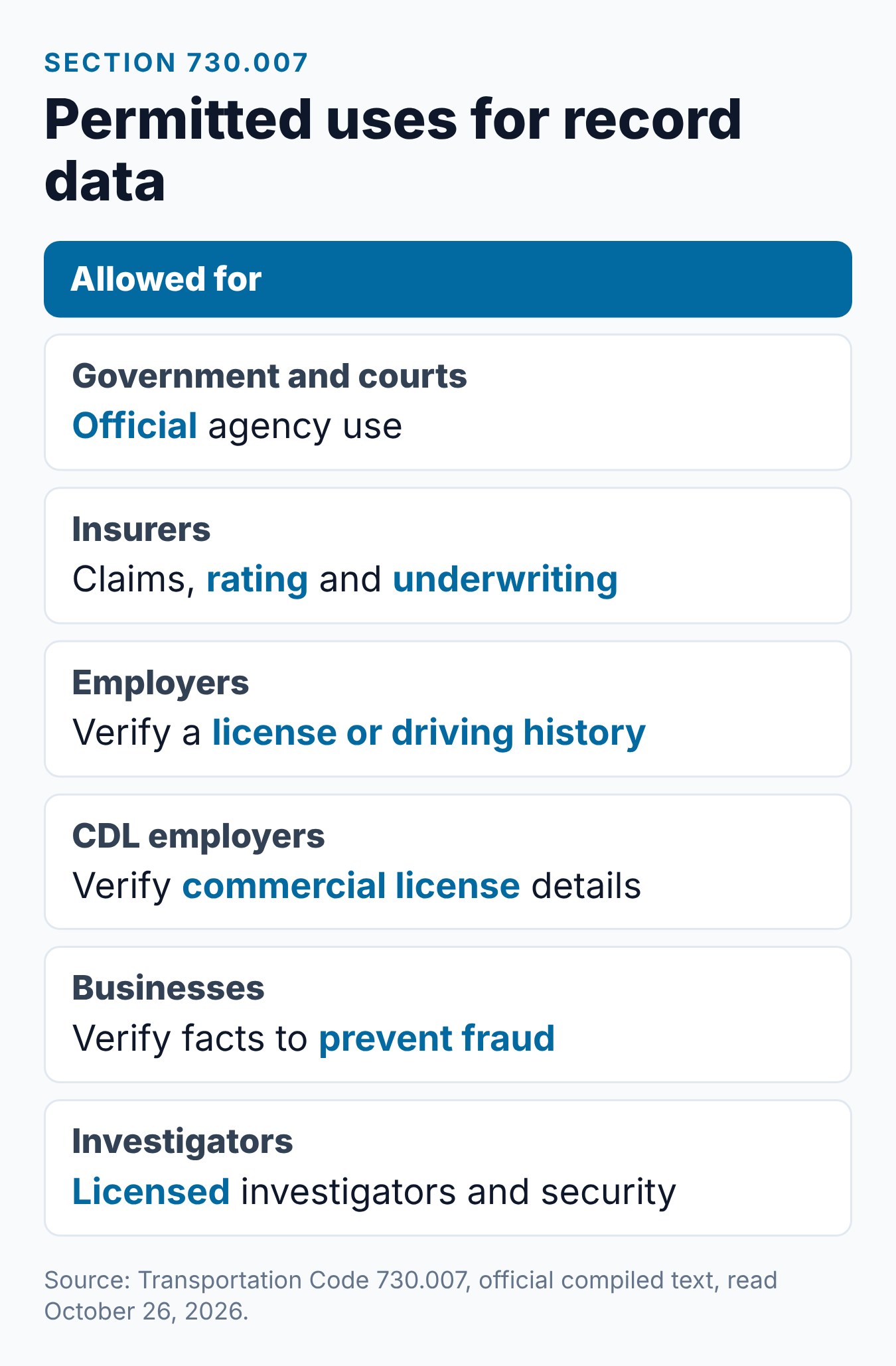
Section 730.007 lists permitted uses. A requester must give a name, address and proof, and must say the use is strictly limited to a listed purpose. The list includes:
- Government: use by a government agency, including a court or law enforcement agency.
- Legitimate businesses: verifying information you gave them, or getting correct information, to prevent fraud, pursue legal remedies or recover debts.
- Legal cases: use in a civil, criminal, administrative or arbitration proceeding.
- Insurers: claims, antifraud work, rating or underwriting.
- CDL employers: an employer, its agent or insurer verifying information about a commercial driver license holder.
- Employers and organizations: verifying a driver license or driving history for employees, contractors or volunteers.
- Others: licensed private investigators and security services, and consumer reporting agencies under the Fair Credit Reporting Act.
Limits on Passing It Along
Getting the data does not mean sharing it freely. Section 730.013 says an authorized recipient may redisclose the information only for a use permitted under § 730.007. Recipients must also keep records of who received it and why.
Chapter 730 also sets criminal penalties for misuse and for false statements on a request. If you think someone misused your record, a Texas lawyer can explain your options.
Employers and Your Record
State law allows an employer to verify a driver license or driving history for employees, contractors or volunteers. It also allows an employer to verify information about a CDL holder.
What an employer does with the record, and which jobs it checks, is up to the employer and other laws. This guide does not cover hiring practices. If a job offer depends on your record, ask the employer what it will review.
For Texas DPS data, the legal limit is the same. An eligible requester gets status or the three-year history, not your full Type 3 list.
CDL Holders
Commercial drivers face stricter record rules. Under Code of Criminal Procedure Art. 45A.351(c), the driving safety course dismissal rules do not apply to anyone who holds a CDL or held one when the offense happened.
So a CDL holder cannot use the course to keep a ticket off the record. Our Texas CDL defensive driving guide explains this in full.
Insurers and Your Record
Insurers are on the Chapter 730 list for claims, antifraud work, rating and underwriting. The Texas Department of Insurance auto guide explains how they use what they find.
TDI lists “Your driving record and claims history” among the things companies consider when setting a premium. It also says, “Insurance companies will charge you more if you’ve had accidents or gotten tickets.” TDI does not give a number of years insurers look back.
Claims history is a separate file. TDI says companies use the Comprehensive Loss Underwriting Exchange (CLUE) to learn your claims history, and you can get a free copy of your report each year.
What Insurers Cannot Do
Texas law limits one use of your record. Under Art. 45A.357, an insurer may not cancel a policy or raise a premium because you completed a driving safety course or had a charge dismissed under those rules.
TDI also covers suspensions. It says an insurer may cancel a policy at any time if your driver license is suspended or revoked.
What a Background Check Will Not Show
Some things do not reach outside requesters at all:
- A charge dismissed through the DSC. Art. 45A.357 says it “may not be part of a person’s driving record or used for any purpose.”
- A deferred case still in progress. Under Transportation Code § 543.204, a judge who defers a case may not send a conviction record to DPS. If guilt is later found, the court reports it within 7 days.
- Convictions older than the three-year window. The § 521.046 history covers the three years before the request.
- Your full list. Type 3 and 3A go only to you.
A finished DSC can still leave a trace on your own record. DPS may show that you took a course, but not the reason. See what defensive driving can and cannot do.
Check Your Own Record First
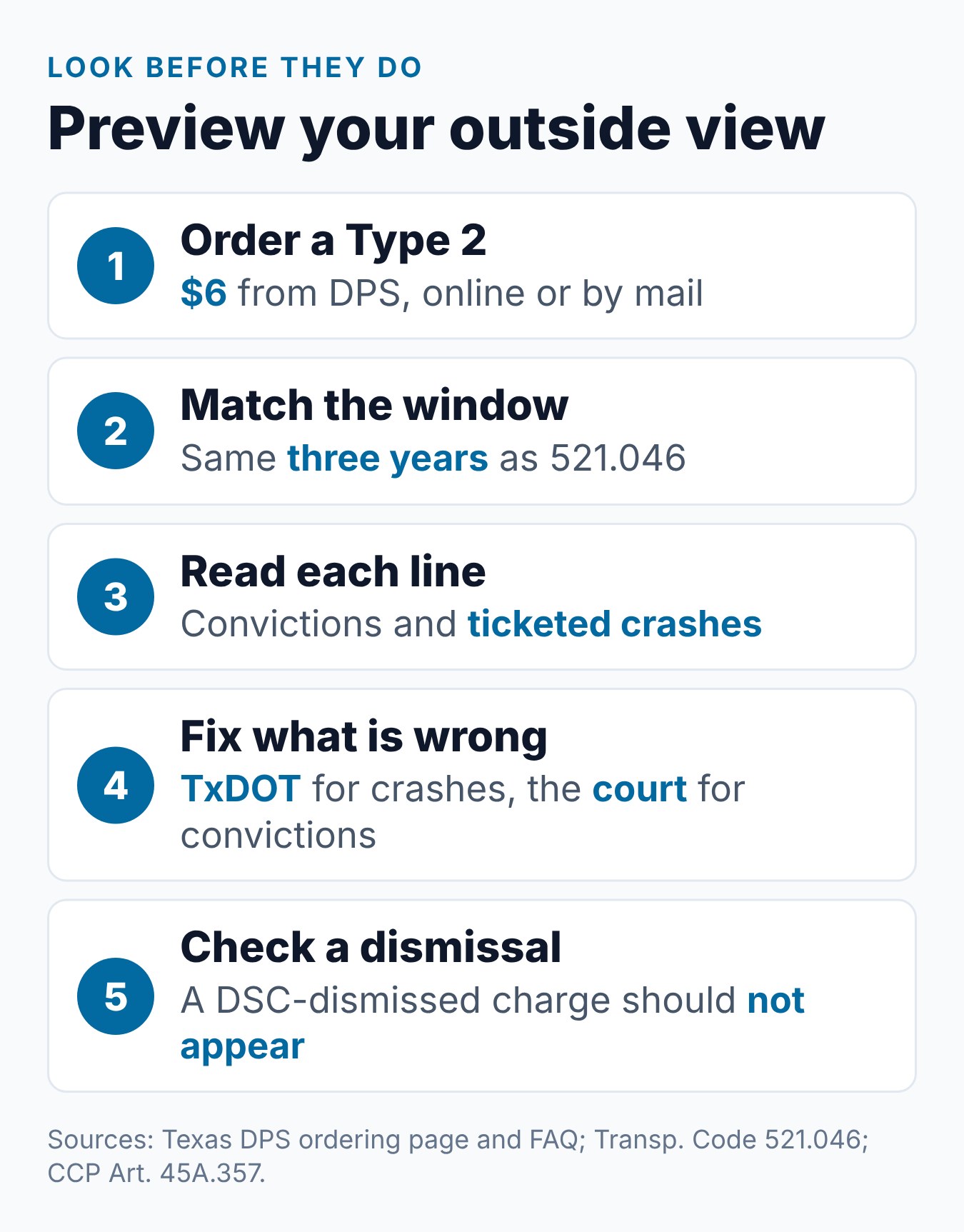
You can see roughly what an outside requester sees before they look. The Type 2 record costs $6 and shows moving violations, and crashes with a ticket, for the past three years. That matches the window in § 521.046.
Ordering takes a few minutes online. You need your license or ID number, its audit number, your birth date, the last four digits of your SSN and a credit card. Our guide to getting your Texas driving record online shows each step.
Fix Errors Before They Spread
The DPS driver record FAQ explains where to go. A wrong crash goes to the Texas Department of Transportation’s crash records office. A wrong drug or DWI conviction goes to the court that filed it, and DPS asks you to allow 21 business days after it gets the court’s correction.
Companies That Order Records
DPS has a separate channel for businesses. Its ordering page says companies that want to order driver records should email the DPS License and Record Service.
A company still needs a permitted use under Chapter 730. The portal for individuals is built around the record owner’s own card details. It is not a tool for checking other people.
What We Found on the Official Pages
On the DPS driver record pages we checked on October 26, 2026, the ordering page said Type 3 and 3A are provided only to the record owner. It sent companies to the License and Record Service by email.
In the official compiled text of Chapter 730 we read the same day, § 730.007 listed employer verification of a driver license or driving history for employees, contractors and volunteers as a permitted use. It listed insurer rating and underwriting as another.
Common Mistakes to Avoid
These come from Texas law and DPS guidance:
- Assuming anyone can pull your full record. Type 3 and 3A go only to you.
- Expecting a dismissed DSC charge to appear. Texas law keeps it off the record.
- Ignoring the three-year window. Outside requesters get a three-year history, not the full list.
- Letting an error sit. Fix crash and conviction errors through TxDOT or the court.
- Thinking the course helps with a CDL. Current and former CDL holders cannot use DSC dismissal.
How Requirements Can Vary
The driving safety course rules come from Texas law and TDLR and apply statewide. Each justice or municipal court still sets its own fees, filing steps and contact methods, and the facts of your citation decide which options you have.
Laws, fees and court procedures can change. Check your citation, ask the court that handles your case, and use the TDLR and Texas DPS websites for current rules before you act.
Frequently Asked Questions
Will my traffic tickets show up on a background check?
Moving-violation convictions from the past three years can, if the requester is eligible under Chapter 730. A charge dismissed through the driving safety course may not be part of your record.
Can my employer see my Texas driving record?
State law lets an employer verify a driver license or driving history for employees, contractors or volunteers. For DPS data, that means status or the three-year history, not your full Type 3 list.
How far back does a Texas driving record check go?
The history DPS can give an eligible requester covers the three years before the request. Your own Type 3 and 3A records list all crashes and violations.
Can my insurance company see a dismissed ticket?
No. Texas law says a dismissed DSC charge may not be part of the driving record or used for any purpose. An insurer also may not raise your premium or cancel because of it.
Can someone order my Type 3A record?
No. DPS provides Type 3 and 3A only to the record owner. Others who qualify can get status or the three-year history.
How can I see what others will see?
Order your own Type 2 record from DPS for $6. It shows moving violations, and crashes with a ticket, from the past three years.
Does a deferred case show up?
Not while it is deferred. A judge who defers a case may not send a conviction record to DPS. If guilt is later found, the court must report it within 7 days.
Do points show up on a Texas record check?
No. Texas ended its points and surcharge program on Sept. 1, 2019. A check shows license status and, for the three-year history, convictions and crashes with a citation.
Conclusion
A Texas driving record background check is limited by law to status details or a three-year history, and only for requesters with a permitted use. Your full Type 3 or 3A record stays with you, and a charge dismissed through the DSC stays off the record. If you have an eligible ticket now, Driving Logic’s online Texas driving safety course is one way to start that process.
Related Articles
- Your Texas Driving Record: How to Get It and What It Shows
- Texas DPS Driving Record: What TxDPS Tracks and Why It Matters
- How to Get Your Texas Driving Record Online
- How Long Does a Speeding Ticket Stay on Your Texas Driving Record?
Sources
- Texas Transportation Code Chapter 521 — Driver’s Licenses (PDF)
- Texas DPS — How to Order Your Driver Record
- Texas DPS — Driver Record FAQ
- Texas Code of Criminal Procedure Chapter 45A (PDF)
- Texas Transportation Code Chapter 543 — Arrest and Prosecution of Violators (PDF)
- Texas Department of Insurance — Auto insurance guide
Billy Forte is the owner of Driving Logic, a state-approved driver improvement course provider serving Texas and other U.S. states.
This article is general information, not legal advice. Texas traffic and driving safety course rules are set by Texas law, TDLR, Texas DPS and each court, and they can change. Check with the court on your citation and the official TDLR and DPS websites for current requirements, and talk to a Texas lawyer about your specific case.