
Updated October 2026 · Reviewed by Billy Forte
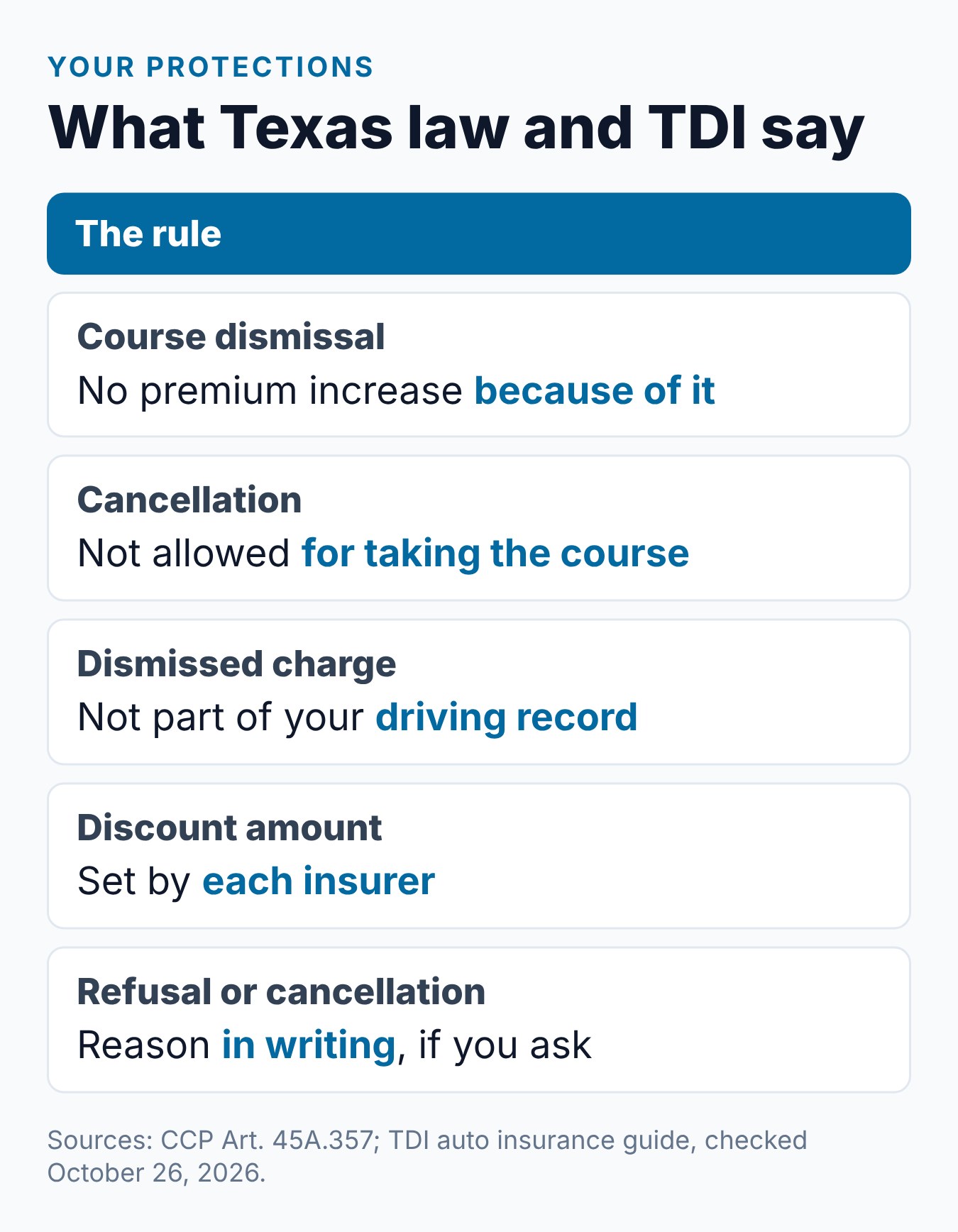
A Texas defensive driving insurance discount is possible but not set by the state: the Texas Department of Insurance (TDI) lists the course as a discount, and each company decides whether to offer it and how much. Texas law also protects drivers who use the course for a ticket. An insurer may not cancel a policy or raise a premium because you took the course or had a charge dismissed through it.
Key Facts
- Possible discount: TDI lists “Completed a defensive driving or a driver education course” as a discount. See what TDI says.
- No set amount: “Each company decides what discounts to offer and the amount of the discount.” See how much you could save.
- Rate protection: an insurer may not raise a premium or cancel because of a course dismissal. See the no-rate-hike rule.
- Record protection: a dismissed charge may not be part of your driving record or used for any purpose. See tickets and rates.
- Your job: TDLR says you send the certificate to your insurer. See getting the discount.
What the Texas Defensive Driving Insurance Discount Is
The discount is a lower premium some insurers give for finishing a defensive driving course. It is the same course used for ticket dismissal. TDLR’s Taking a Driving Safety Course page says a licensed provider’s 6-hour course “can be used for ticket dismissal or insurance discounts.”
The state does not require the discount. No Texas rule we reviewed sets an amount or a percentage. Whether you get one depends on your insurer.
You do not need a ticket to take the course. TDLR says “anyone can take a driving safety course.” Some drivers take it only to ask about a discount.
What TDI Says About Discounts
The TDI auto insurance guide says “Discounts help lower your premium.” It then lists the kinds of discounts companies may give:
- Airbags, antilock brakes and antitheft devices in your car.
- “Completed a defensive driving or a driver education course.”
- More than one car on a policy.
- Other policies with the same insurance company.
- No claims and a good driving record.
TDI adds one key line: “Each company decides what discounts to offer and the amount of the discount.” So the course is one item on a list, not a promise.
How Much You Could Save
There is no state number to quote. TDI leaves the amount to each company. Any figure you see online is not a Texas rule.
The only way to know is to ask your own insurer. Get the answer before you sign up if the discount is your main reason for taking the course.
TDI also explains how rates are set in general. “Texas law requires insurance companies to charge rates that are fair, reasonable, and adequate for the risks they cover.” Companies weigh things like your driving record, where you keep your car, the type of car and how you use it.
Questions to Ask Your Insurer
A short call can save you time. Ask these questions before you enroll:
- Do you offer a discount for a Texas defensive driving course?
- How much is it, and how is it applied?
- Do you accept an online course from a TDLR-licensed provider?
- How should I send the certificate, and to whom?
- How long does the discount last, and can I renew it?
- Does it apply to every driver on my policy?
Write down the answers and the name of the person you spoke with. Each company sets its own terms.
Getting the Discount, Step by Step
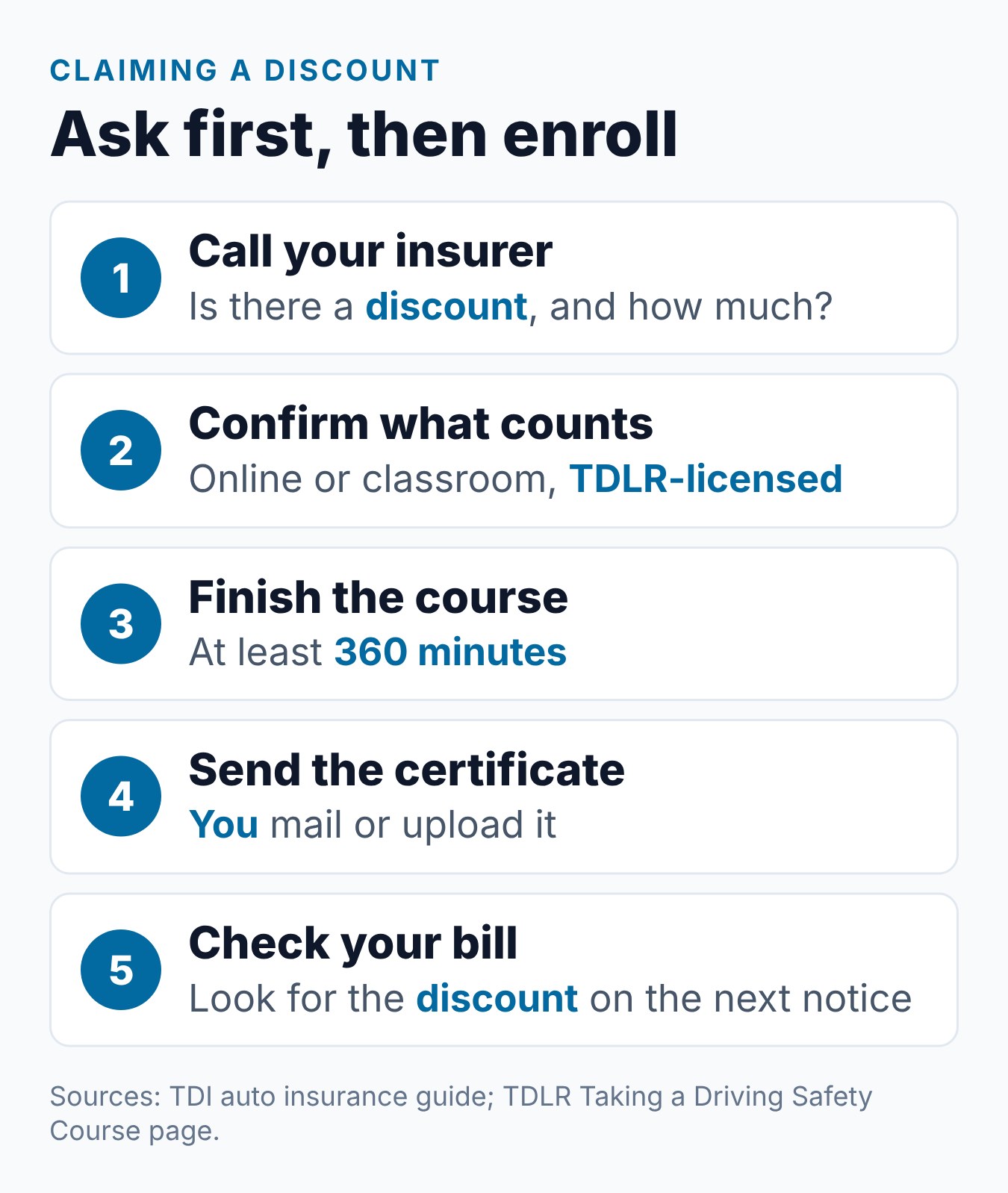
The steps for a discount are simpler than the steps for a ticket. There is no court deadline.
- Ask your insurer whether it offers a discount and what it accepts.
- Pick a TDLR-licensed provider. TDLR says it cannot recommend one, but you can check a license in its provider search.
- Finish the course. It runs at least 360 minutes, with at least 300 minutes of instruction.
- Get the uniform certificate of course completion. TDLR says it should arrive within 14 days.
- Send the certificate to your insurer. TDLR says that is your job.
- Check your next bill or policy notice to confirm the discount.
Texas law requires the provider to charge at least $25 for the course. For filing details, see our certificate guide.
The No-Rate-Hike Rule
This rule applies when you use the course for a ticket. Article 45A.357 of the Code of Criminal Procedure, in Chapter 45A, protects drivers in two ways.
First, a charge dismissed under the driving safety course rules “may not be part of a person’s driving record or used for any purpose.” Second, an insurer may not cancel a policy or raise a premium because the insured completed the course or had a charge dismissed under those rules.
Put simply, finishing the course for a dismissal cannot be the reason your rate goes up. It also cannot be the reason your policy is cancelled.
What the Rule Does Not Cover
The protection is tied to the course and the dismissal. It does not stop an insurer from setting rates for other reasons. TDI says companies look at your driving record, your car and how you use it.
It also does not apply to a ticket you paid. Paying a ticket means a guilty or no contest plea, which leads to a conviction. TDI says, “Insurance companies will charge you more if you’ve had accidents or gotten tickets.”
Tickets, Records and Rates
Courts report traffic convictions to Texas DPS. Transportation Code § 543.203 says a court must do this “not later than the seventh day” after the conviction.
A dismissal through the course is different. The court reports only that you finished a course, and the date. Transportation Code Chapter 521, § 521.047, says your record can show “the fact of, but not the reason for, completion of a driver safety course.”
Some people can get part of your record if state law allows it. Under § 521.046, eligible requesters can get moving-violation convictions from the past three years. For more on tickets and rates, see our guide to a Texas speeding ticket and insurance.
No Points or Surcharges
Texas no longer uses a point system. DPS says the Driver Responsibility Program was repealed effective Sept. 1, 2019. That program charged surcharges based on points or convictions.
Insurers still set their own rates, and TDI says tickets can raise them. The state program is simply gone.
TDI’s guide also covers TAIPA coverage. It says TAIPA “also charges more if you’ve had tickets or accidents,” and that rates might go down after a year with none.
If Your Insurer Turns You Down
TDI explains your right to a reason. If you ask, a company must tell you in writing why it turned you down, canceled your policy or did not renew it.
If you think a cancellation or rate increase was caused by a course dismissal, ask for that written reason. Then compare it with the protection in Article 45A.357. TDI’s guide also says that if you get a nonrenewal or cancellation notice, you should start shopping for new insurance right away.
Using One Course for a Ticket and a Discount
One course can serve both goals. TDLR says it is your responsibility to send the certificate “to the court and or insurance company.” That wording allows for both.
For the ticket, the court needs the certificate, your driving record and an affidavit within 90 days of your plea. For the discount, your insurer sets its own steps. Keep a copy of the certificate so you can send it to each one.
The two uses have different rules. The court decides the dismissal under Chapter 45A. Your insurer decides the discount on its own terms.
Taking the Course Only for a Discount
A course taken just for insurance has no court deadline. Only your provider’s own time limit applies.
One open question is the 12-month rule for tickets. You have a right to ticket dismissal only if you did not complete an approved course in the 12 months before the new offense date.
The law does not say whether a course taken only for insurance counts, so ask the court if you get a ticket later. Our guide on how often you can take the course explains the rule.
Keep Your Proof
Your certificate is your proof of the course. Keep the original or a saved copy after you send it.
If it never arrives or has errors the provider caused, Texas rules let you ask for a free copy within 30 days of the certificate’s issue date (16 TAC 84.63). If you lose it later, the provider may charge a fee for another one. Store it where you can find it later, in case your insurer or a court asks for it.
What We Found on the TDI Page
On the TDI auto insurance guide we checked on October 26, 2026, the discount list had five entries. Defensive driving shared one entry with driver education.
The page did not give any discount amount. It said “Each company decides what discounts to offer and the amount of the discount.” It mentioned defensive driving only in that list.
Common Mistakes to Avoid
Each of these comes from TDI, TDLR or Texas law:
- Expecting a set percentage. TDI says each company decides the amount.
- Not asking first. Each company decides whether to offer the discount at all.
- Waiting for the provider to send it. TDLR says sending the certificate is your job.
- Paying a ticket and expecting the same protection. The no-rate-hike rule covers a course dismissal, not a paid ticket.
- Skipping the written reason. If you ask, an insurer must explain a cancellation in writing.
How Requirements Can Vary
The driving safety course rules come from Texas law and TDLR and apply statewide. Each justice or municipal court still sets its own fees, filing steps and contact methods, and the facts of your citation decide which options you have.
Laws, fees and court procedures can change. Check your citation, ask the court that handles your case, and use the TDLR and Texas DPS websites for current rules before you act.
Frequently Asked Questions
How much is the Texas defensive driving insurance discount?
Texas does not set an amount. TDI says each company decides what discounts to offer and how much, so ask your insurer.
Do I need a ticket to get the discount?
No. TDLR says anyone can take a driving safety course. You can take it only to ask your insurer about a discount.
Can my insurer raise my rate because I took the course for a ticket?
No. Article 45A.357 says an insurer may not raise a premium or cancel a policy because you completed the course or had a charge dismissed through it.
Will my insurer see the dismissed ticket?
A charge dismissed through the course may not be part of your driving record or used for any purpose. Your record can show that you finished a course, but not the reason.
Is an online course accepted for the discount?
TDLR says a licensed provider’s 6-hour course can be used for insurance discounts, online or in person. Ask your insurer what it accepts before you enroll.
How do I send my certificate to my insurer?
Ask your insurer how it wants it. TDLR says sending the certificate to the court or insurance company is your responsibility.
Does a driver education course count too?
TDI’s list names “a defensive driving or a driver education course” in the same entry. Each insurer decides which courses it accepts, so ask yours.
Conclusion
A Texas defensive driving insurance discount depends on your insurer, since TDI says each company decides whether to offer one and how much. Texas law adds a separate protection: a course dismissal cannot be the reason for a rate hike or a cancellation.
Ask your insurer before you enroll, then send the certificate yourself. If you decide to take the course, see Driving Logic’s online Texas driving safety course.
Related Articles
- Texas Driver Safety Course (DSC): The Complete Guide
- Texas Driver Safety Course Certificate: What It Is and How to Submit It
- How Often Can You Take the Texas Driver Safety Course for Ticket Dismissal?
- Texas Speeding Ticket Insurance: What to Know
Sources
- Texas Department of Insurance — Auto insurance guide
- Texas Code of Criminal Procedure Chapter 45A (PDF)
- TDLR — Taking a Driving Safety Course
- Texas Transportation Code Chapter 521 — Driver’s Licenses (PDF)
- Texas Transportation Code Chapter 543 — Arrest and Prosecution of Violators (PDF)
- Texas DPS — Driver Responsibility Program repealed
Billy Forte is the owner of Driving Logic, a state-approved driver improvement course provider serving Texas and other U.S. states.
This article is general information, not legal advice. Texas traffic and driving safety course rules are set by Texas law, TDLR, Texas DPS and each court, and they can change. Check with the court on your citation and the official TDLR and DPS websites for current requirements, and talk to a Texas lawyer about your specific case.