
Updated October 2026 · Reviewed by Billy Forte
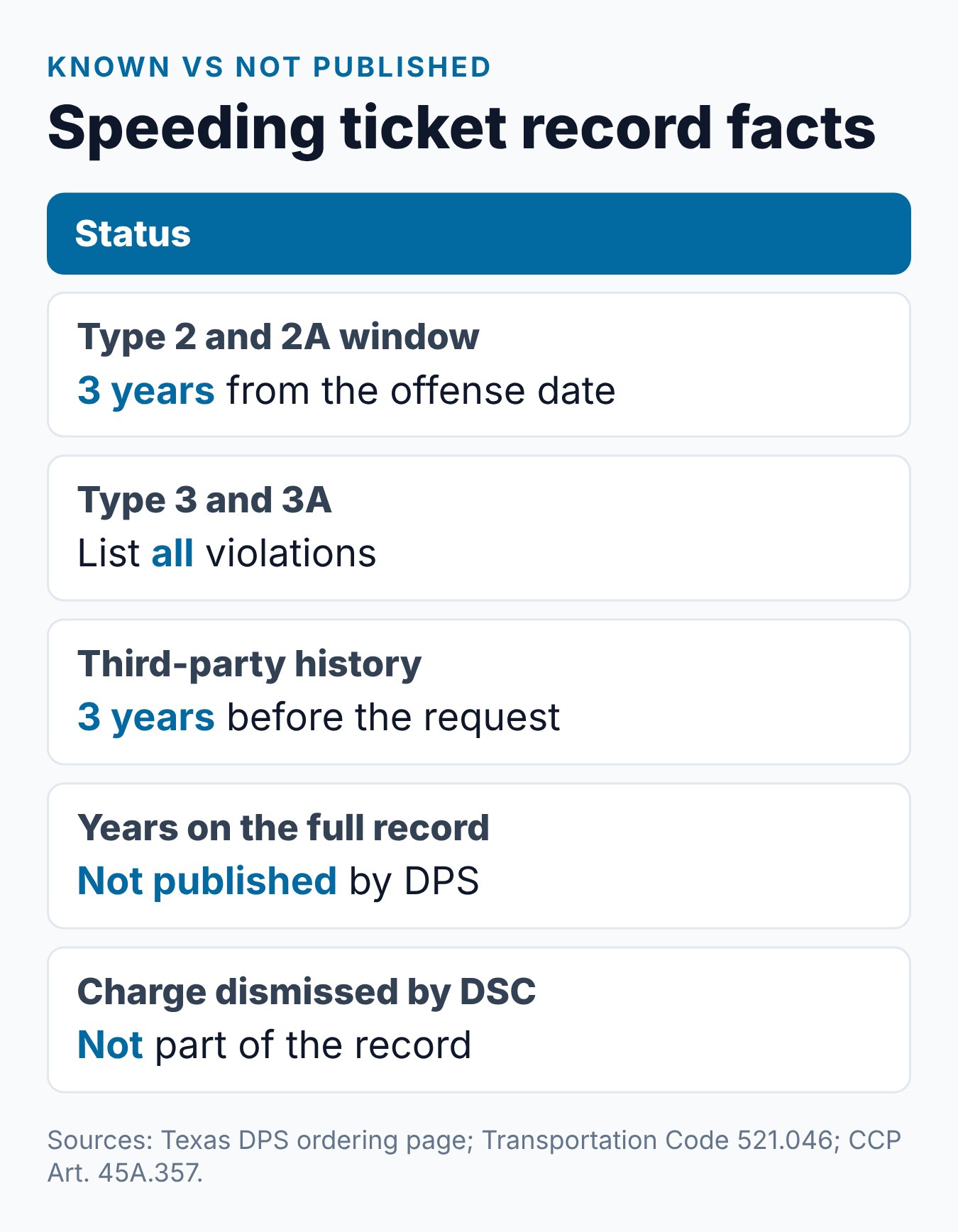
The honest answer to how long does speeding ticket stay on record Texas drivers ask is that Texas DPS does not publish a set number of years for the full driving record. What DPS does publish is the window for each record type: Type 2 shows moving violations for three years, and Type 3 and 3A list all crashes and violations. A speeding charge dismissed through the driving safety course cannot be part of your record at all.
Key Facts
- Reporting: a court must report a speeding conviction to DPS within 7 days. See when it reaches your record.
- Three-year view: the Type 2 record shows moving violations from the past three years. See record windows.
- Full view: Type 3 and 3A list all crashes and violations, with no published end date. See what DPS does not say.
- Dismissal: a charge dismissed through the DSC may not be part of the record. See keeping it off.
- Insurance: TDI says insurers charge more after tickets. See insurance.
What Happens After a Speeding Ticket
A speeding ticket starts a case in a justice or municipal court. Speeding is a rules-of-the-road offense, and Transportation Code § 542.301 makes those offenses misdemeanors.
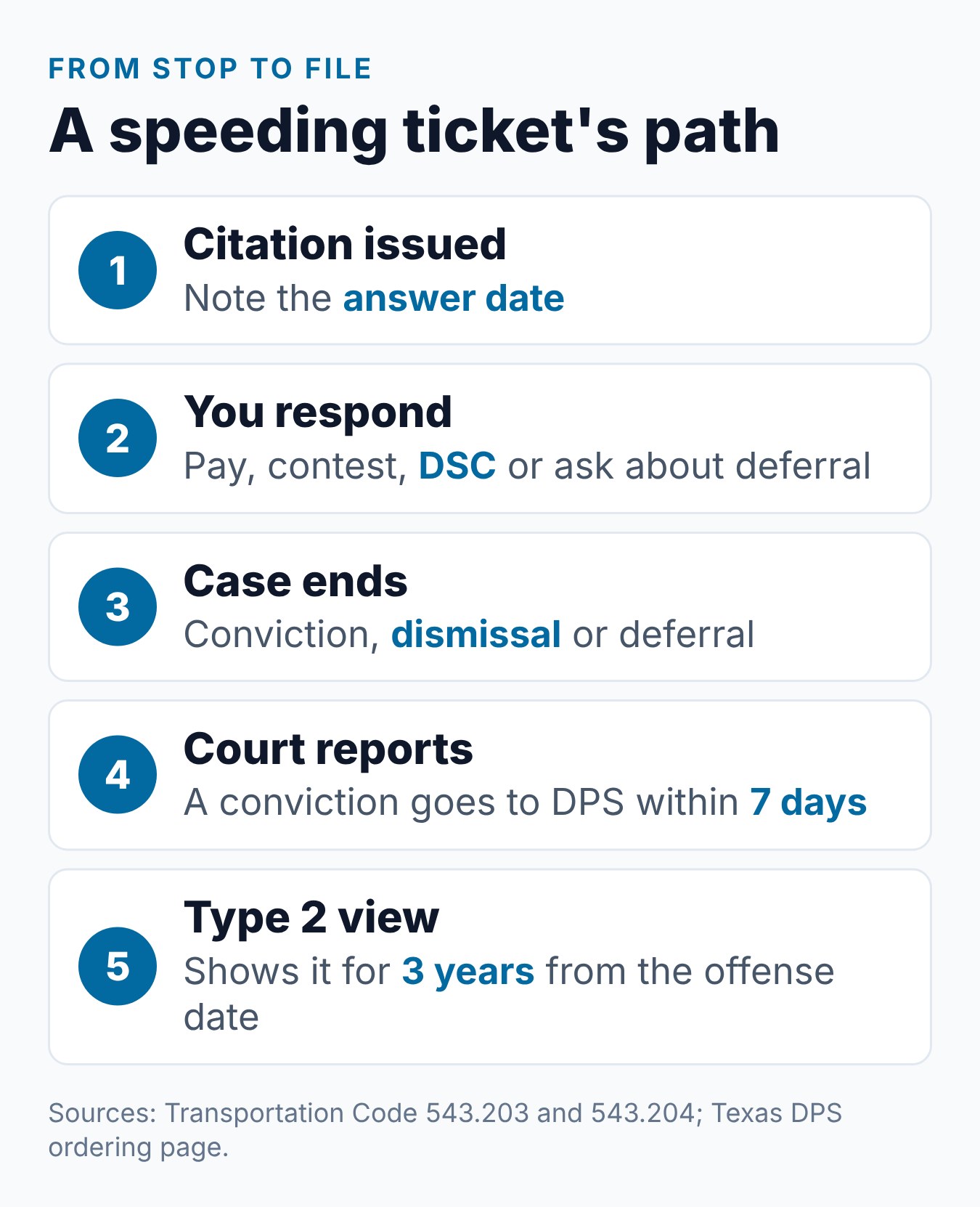
Your citation lists an answer date. Before or on that date, you choose how to respond. The main paths are:
- Pay the ticket. Paying means a plea of guilty or no contest, which leads to a conviction.
- Ask for the driving safety course. If you qualify, the charge can be dismissed.
- Ask about deferred disposition. The judge decides whether to allow it.
- Contest the ticket. You plead not guilty and the court sets a trial.
Which path you take decides what reaches your record. Our speeding ticket options guide compares them in detail.
When a Speeding Ticket Reaches Your Record
A ticket alone is not a conviction. The record changes when the case ends in one.
Under Transportation Code § 543.203, a court must report a traffic conviction to DPS no later than the seventh day after it. Under § 543.204, a judge who defers a case may not send a conviction record. If guilt is later found, the court must report it within 7 days.
DPS then records the court abstract. Section 521.042 of Transportation Code Chapter 521 says DPS records each conviction abstract it receives.
How Long Does Speeding Ticket Stay on Record Texas: What DPS Says
DPS answers the question through its record types. The DPS ordering page lists what each one covers:
- Type 2 ($6) and Type 2A ($10, certified): moving violations, and crashes with a ticket, from the past three years. DPS counts the three years from the date of the offense.
- Type 3 ($7) and Type 3A ($10, certified): all crashes and all moving and nonmoving violations.
- Type AR ($20): a certified abstract of the complete record, including all suspensions.
So a speeding conviction drops out of the Type 2 view three years after the offense date. On the Type 3 and 3A records, DPS gives no cutoff. Type 3 and 3A go only to the record owner.
What Other People Can See
Third parties see a shorter window. Under § 521.046, eligible requesters can get moving-violation convictions and crashes with a citation from the three years before their request. Our background check guide explains who is eligible.
What DPS Does Not Say
DPS does not state a number of years that a speeding conviction stays on the full record. Any number you see elsewhere did not come from the DPS ordering page or its FAQ.
The law gives a purpose instead of a date. Section 521.043 lets DPS drop records it finds unnecessary.
It must keep conviction records as long as they may be used for license actions or to spot frequent violators. Read how long violations stay on a Texas driving record for every record window.
Keeping a Speeding Ticket Off Your Record
Some outcomes never put a conviction on your record. Here is what each one sends to DPS:
| Outcome | What the court sends DPS |
|---|---|
| Ticket paid (guilty or no contest plea) | The conviction, within 7 days |
| Driving safety course finished on time | The course completion and its date |
| Deferred disposition, conditions met | No conviction record |
| Deferred disposition, guilt later found | The conviction, within 7 days |
The Driving Safety Course
The driving safety course (DSC), also called defensive driving, is set out in Code of Criminal Procedure Arts. 45A.351 to 45A.359. On or before the answer date, you plead guilty or no contest and ask for the course. You then have 90 days to turn in the certificate, your driving record and an affidavit.
When you finish, the court dismisses the charge. Art. 45A.357 says the dismissed charge “may not be part of a person’s driving record or used for any purpose.” DPS can show that you took a course and when, but not why. Our guide on what defensive driving can and cannot do covers the limits.
Deferred Disposition
Deferred disposition is a separate process that the judge controls. The judge may delay the case for up to 180 days and set conditions.
If you meet them, the case is dismissed with no final conviction. See what deferred disposition is for the full rules.
Contesting the Ticket
You can also plead not guilty. The court then sets a trial, and no result is certain.
A conviction after trial is reported like any other. Our guide on contesting a Texas speeding ticket explains the steps.
Speeding Tickets That Cannot Use the DSC
Not every speeding ticket qualifies for the course as a right. Under Arts. 45A.351 to 45A.353, these are left out:
- Speeding 25 mph or more over the posted limit.
- Speeding 95 mph or more.
- A work-zone offense when workers were present.
- A “serious traffic violation.”
- Any offense by someone who holds a CDL or held one at the time, in any vehicle.
You also need a Texas license or permit, or active-duty military status for you or your family, plus proof of insurance. Ask your court which options it offers if your ticket falls outside these rules.
Work Zones and School Zones
Work zones have their own rule. Under Transportation Code § 542.404, the minimum and maximum fines double for an offense in a construction or maintenance work zone when workers are present. For speeding, the zone must have a sign showing the speed limit, and the citation must say workers were present.
That offense is also left out of the DSC right and of deferred disposition. For school zones, read your citation and ask the court what applies. Our guide to school zone and work zone speeding covers both.
Drivers Licensed in Another State
The DSC right is tied to a Texas license or permit, or to active-duty military families. Texas is in the Driver’s License Compact, which means it must report an out-of-state driver’s conviction to the home state. See our guide for out-of-state drivers.
The 12-Month Rule
The DSC is only a right if you did not complete one in the 12 months before the new ticket date. Your Type 3A record is how the court checks.
Here is the math. Say your new speeding ticket is dated September 3.
If your last course was finished in the 12 months before that date, such as the previous December, you have no right to the course. The court may still allow it before the case is closed under Art. 45A.352(c), but it does not have to.
Speeding Tickets and Insurance
Your insurer makes its own choices. The Texas Department of Insurance auto guide says, “Insurance companies will charge you more if you’ve had accidents or gotten tickets.” It does not give a number of years.
Texas law adds a protection for the DSC. Under Art. 45A.357, an insurer may not cancel a policy or raise a premium because you completed a DSC or had a charge dismissed through it.
Repeat Speeding and Suspension
Speeding convictions add up. Under § 521.292, DPS must suspend a “habitual violator” with 4 or more moving-violation convictions in 12 months, or 7 or more in 24 months. Texas has no point system, but this count still applies.
What We Found on the DPS Pages
On the DPS driver record pages we checked on October 26, 2026, the ordering page described Type 2 as covering the past three years. It described Type 3 as all crashes and all moving and nonmoving violations.
Neither the ordering page nor the driver record FAQ gave a number of years for the full record. The FAQ said most courts generally require Type 3A for a defensive driving course and told readers to confirm with the court.
Common Mistakes to Avoid
Each of these comes from Texas law or DPS guidance:
- Trusting a fixed number of years. DPS does not publish one for the full record.
- Paying without reading the options. Paying is a guilty or no contest plea and leads to a reported conviction.
- Missing the answer date. The DSC request is due on or before it. After that, the court may allow it but does not have to.
- Assuming any speed qualifies. Speeding 25 mph or more over, or 95 mph or more, is left out.
- Forgetting the 12-month rule. A course in the 12 months before the new ticket date ends the right.
How Requirements Can Vary
The driving safety course rules come from Texas law and TDLR and apply statewide. Each justice or municipal court still sets its own fees, filing steps and contact methods, and the facts of your citation decide which options you have.
Laws, fees and court procedures can change. Check your citation, ask the court that handles your case, and use the TDLR and Texas DPS websites for current rules before you act.
Frequently Asked Questions
How long does a speeding ticket stay on my Texas record?
DPS does not publish a number of years for the full record. The Type 2 record shows moving violations for three years from the offense date, and Type 3 and 3A list all violations.
Does a speeding ticket go on my record if I pay it?
Yes. Paying is a plea of guilty or no contest, which is a conviction. The court must report it to DPS within 7 days.
Will a dismissed speeding ticket show on my record?
No. Texas law says a charge dismissed through the driving safety course may not be part of the driving record. DPS can show that you took a course, but not why.
Can an employer see a speeding ticket from four years ago?
Eligible third parties can get a three-year history of moving-violation convictions under state law. The full Type 3 and 3A lists go only to you. See our background check guide for details.
Do speeding tickets add points in Texas?
No. Texas ended its Driver Responsibility Program, which used points and surcharges, on Sept. 1, 2019. Convictions still count toward the habitual violator rule.
How long does a speeding ticket raise my insurance?
TDI does not set a number of years. It says insurers charge more after tickets and that each company sets its own rates. Ask your insurer.
Can I use defensive driving for any speeding ticket?
No. Speeding 25 mph or more over the limit, or 95 mph or more, does not qualify as a right. CDL holders cannot use it, and other conditions apply.
Conclusion
DPS does not publish how long a speeding conviction stays on the full Texas record, but the Type 2 record shows it for three years from the offense date. One way to keep a speeding charge off your record is to qualify for the driving safety course and finish it on time. If you are eligible, Driving Logic’s online Texas driving safety course is one place to start before your answer date.
Related Articles
- Your Texas Driving Record: How to Get It and What It Shows
- How Long Do Traffic Violations Stay on Your Texas Driving Record?
- Texas Defensive Driving and Your Driving Record: What It Can and Cannot Do
- Texas DPS Driving Record: What TxDPS Tracks and Why It Matters
Sources
- Texas DPS — How to Order Your Driver Record
- Texas DPS — Driver Record FAQ
- Texas Transportation Code Chapter 521 — Driver’s Licenses (PDF)
- Texas Transportation Code Chapter 543 — Arrest and Prosecution of Violators (PDF)
- Texas Code of Criminal Procedure Chapter 45A (PDF)
- Texas Department of Insurance — Auto insurance guide
- TDLR — Taking a Driving Safety Course
Billy Forte is the owner of Driving Logic, a state-approved driver improvement course provider serving Texas and other U.S. states.
This article is general information, not legal advice. Texas traffic and driving safety course rules are set by Texas law, TDLR, Texas DPS and each court, and they can change. Check with the court on your citation and the official TDLR and DPS websites for current requirements, and talk to a Texas lawyer about your specific case.