Blog Articles

Florida DETS course certificate: what it is and how to use it

Florida DETS Course Certificate: What It Is and How to Use It

Updated October 2026 · Reviewed by Billy Forte The Florida DETS course certificate shows that you passed the 6-hour Driver Education Traffic Safety course and its final exam. Your provider reports the completion to FLHSMV electronically, and you keep a copy for your records. You need that completion on file before you apply for a Florida learner’s license. Key Facts What the Florida DETS Course Certificate Is When you finish an approved DETS course, you earn a completion certificate. It shows that you completed the required course time and passed the final exam. The certificate matters because Florida requires DETS

Florida DETS Course Certificate: What It Is and How to Use It Read More »
Florida DETS course at 14: age rules for the course and the learner license

Can You Start the Florida DETS Course at 14? Age Requirements Explained

Updated October 2026 · Reviewed by Billy Forte Taking the Florida DETS course at 14 is often possible, because Florida law does not set a minimum age to start the course. Each provider sets its own start age, and one national online school we checked allows students from 14 and a half. The learner’s license itself still requires age 15, so finishing DETS early simply means the course is done when your teen is old enough to apply. Key Facts What Florida Law Says About Age The DETS requirement applies to Florida applicants under 18 who have never held a

Can You Start the Florida DETS Course at 14? Age Requirements Explained Read More »

Florida 6-hour drug and alcohol course vs DETS and TLSAE

Florida 6-Hour Drug and Alcohol Course: Is It the Same as DETS?

Updated October 2026 · Reviewed by Billy Forte The Florida 6-hour drug and alcohol course is usually another name for DETS, the 6-hour Driver Education Traffic Safety course that teens under 18 need before a first license. The 4-hour “drug and alcohol course” is TLSAE, which adults 18 and older still take. The name causes mix-ups, so check the course’s hours, age group, and FLHSMV approval before you buy. Key Facts Why People Call DETS the 6-Hour Drug and Alcohol Course For years, Florida’s first-time driver course was the 4-hour Traffic Law and Substance Abuse Education (TLSAE) course. Most families

Florida 6-Hour Drug and Alcohol Course: Is It the Same as DETS? Read More »

FLHSMV-approved DETS course: how to verify a Florida provider

FLHSMV-Approved DETS Course: What It Means and How to Verify Your Provider

Updated October 2026 · Reviewed by Billy Forte An FLHSMV-approved DETS course is one that the Florida Department of Highway Safety and Motor Vehicles has authorized to meet the teen driver education requirement. Only an approved course counts toward a first Florida license for applicants under 18. You can check approval on FLHSMV’s DETS page, but some schools sell an approved provider’s course under their own brand name, so you may need to ask one extra question. Key Facts Why an FLHSMV-Approved DETS Course Matters Since August 1, 2025, Florida applicants under 18 who have never held a license must

FLHSMV-Approved DETS Course: What It Means and How to Verify Your Provider Read More »

Title card reading When Do Texas Teen Driving Restrictions End, with an 18th birthday and renewal chips

When Do Texas Teen Driving Restrictions End?

Updated October 2026 · Reviewed by Billy Forte Parents who ask when do Texas teen driving restrictions end get a short answer from the law: on the 18th birthday. The limits in Transportation Code 545.424 cover drivers under 18, and TDLR says the provisional license expires on the 18th birthday. To keep driving, the new adult renews and gets a regular license without the teen limits. Key Facts When Do Texas Teen Driving Restrictions End? They end at 18. The limits in Transportation Code 545.424 apply to a “person under 18 years of age.” Once the driver is 18, that

When Do Texas Teen Driving Restrictions End? Read More »

Title card reading Texas Teen Driving Curfew, midnight to 5 a.m., with three exception chips

Texas Teen Midnight Driving Rule: What It Is and the Exceptions

Updated October 2026 · Reviewed by Billy Forte The Texas teen driving curfew says a driver under 18 may not drive after midnight and before 5 a.m., unless the trip is for work, a school-related activity or a medical emergency. It is part of Transportation Code 545.424, and DPS lists it for provisional license holders. This guide covers the hours, each exception, the learner carve-out and when the rule ends. Key Facts What the Texas Teen Driving Curfew Says The rule is in Transportation Code 545.424. It says a person under 18 may not drive after midnight and before 5

Texas Teen Midnight Driving Rule: What It Is and the Exceptions Read More »

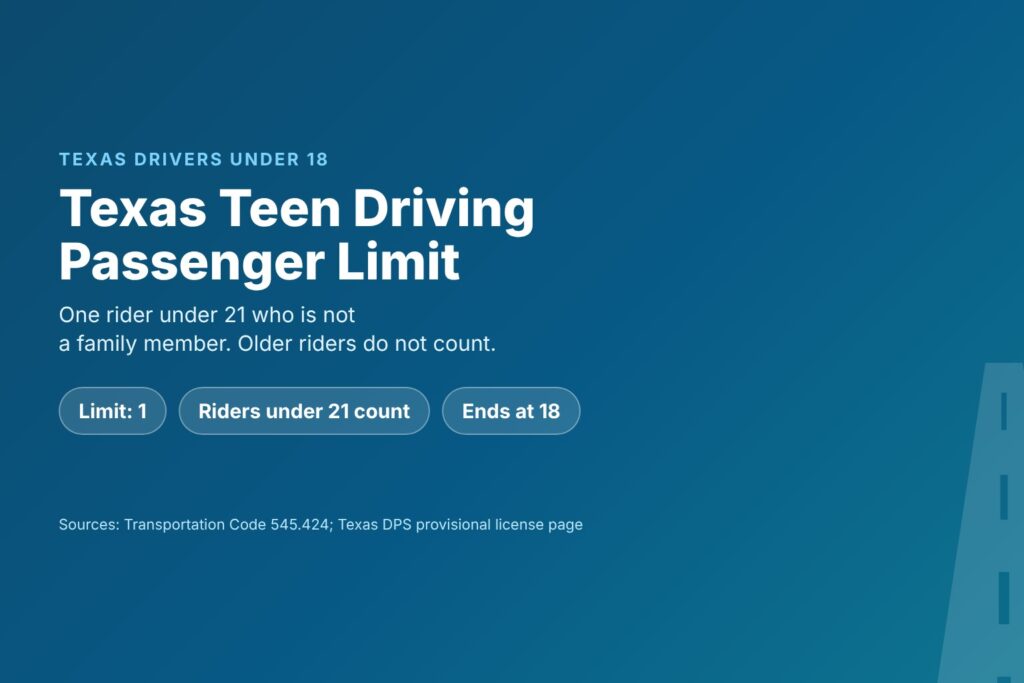
Title card reading Texas Teen Driving Passenger Limit, one passenger under 21 who is not family

Texas Teen Driving Passenger Restrictions: How Many Passengers Can a Teen Have?

Updated October 2026 · Reviewed by Billy Forte The Texas teen driving passenger limit says a driver under 18 may carry no more than one passenger under 21 who is not a family member. The rule is in Transportation Code 545.424, and DPS lists it for provisional license holders. This guide shows who counts, who does not, and how the rule works with an adult in the car. Key Facts How the Texas Teen Driving Passenger Limit Works The rule comes from Transportation Code 545.424. A person under 18 may not drive with more than one passenger in the vehicle

Texas Teen Driving Passenger Restrictions: How Many Passengers Can a Teen Have? Read More »

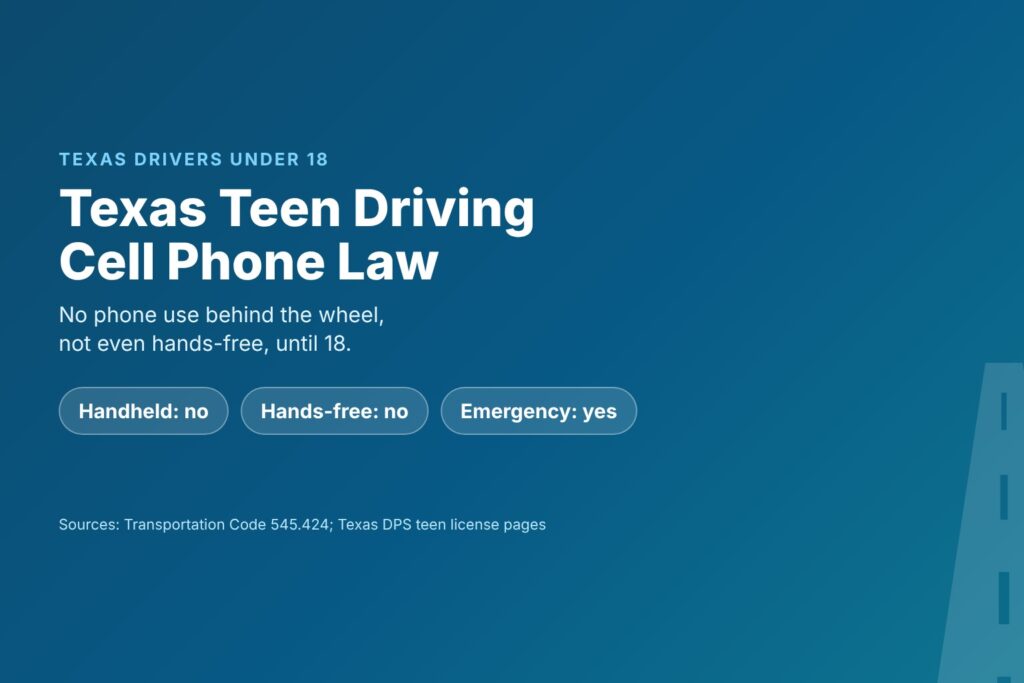
Title card reading Texas Teen Driving Cell Phone Law, no handheld or hands-free use under 18

Texas Teen Driving Cell Phone Law: What Parents Should Know

Updated October 2026 · Reviewed by Billy Forte The Texas teen driving cell phone law says a driver under 18 may not use a wireless communication device while driving, and that includes hands-free devices, except in an emergency. It covers teens with a learner license and teens with a provisional license. This guide explains what counts as use, the fines, how the rule is enforced and how it compares with the texting rule for every driver. Key Facts What the Texas Teen Driving Cell Phone Law Says The rule is in Transportation Code 545.424. A person under 18 may not

Texas Teen Driving Cell Phone Law: What Parents Should Know Read More »

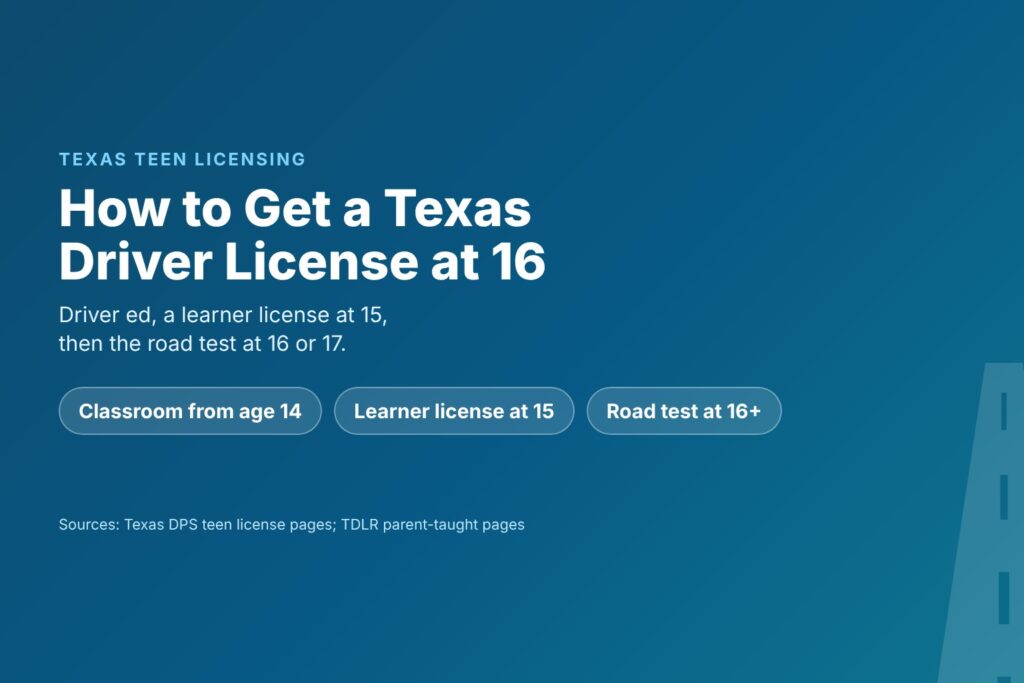
Title card reading How to Get a Texas Driver License at 16, with course, learner license and road test chips

How to Get a Texas Driver’s License at 16: The Complete Teen Guide

Updated October 2026 · Reviewed by Billy Forte The teen driver license Texas process has three big parts: a driver education course, a learner license at 15, and a provisional license at 16 or 17. TDLR licenses the driver education courses, and the Texas Department of Public Safety (DPS) issues both licenses. This guide walks through each step in order and links to a deeper guide for every rule. Key Facts How the Texas Teen License Path Works Two state agencies share the job. The Texas Department of Licensing and Regulation (TDLR) licenses driver education providers. DPS runs the tests

How to Get a Texas Driver’s License at 16: The Complete Teen Guide Read More »

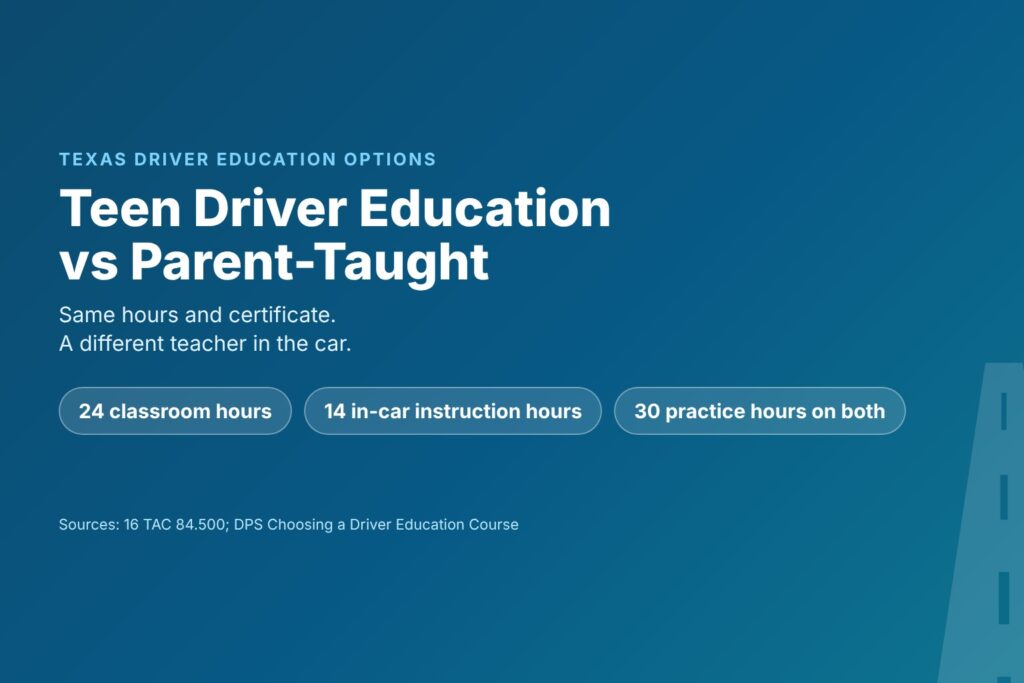
Title card reading Teen Driver Education vs Parent-Taught, same hours and certificate with a different teacher in the car

Texas Teen Driver Education (TDE): What It Is and How It Compares to PTDE

Updated October 2026 · Reviewed by Billy Forte The teen drivers ed Texas driving schools teach, called teen driver education (TDE), puts a TDLR-licensed school in charge of the 24 classroom hours and the 14 hours of in-car instruction. Every teen still needs 30 hours of supervised practice, with at least 10 at night, with a licensed adult 21 or older. Parent-taught driver education (PTDE) covers the same hours with a parent as the instructor, and both routes end with the DE-964 and the same DPS steps. Key Facts What Teen Drivers Ed Texas Schools Teach The hour rules for

Texas Teen Driver Education (TDE): What It Is and How It Compares to PTDE Read More »